
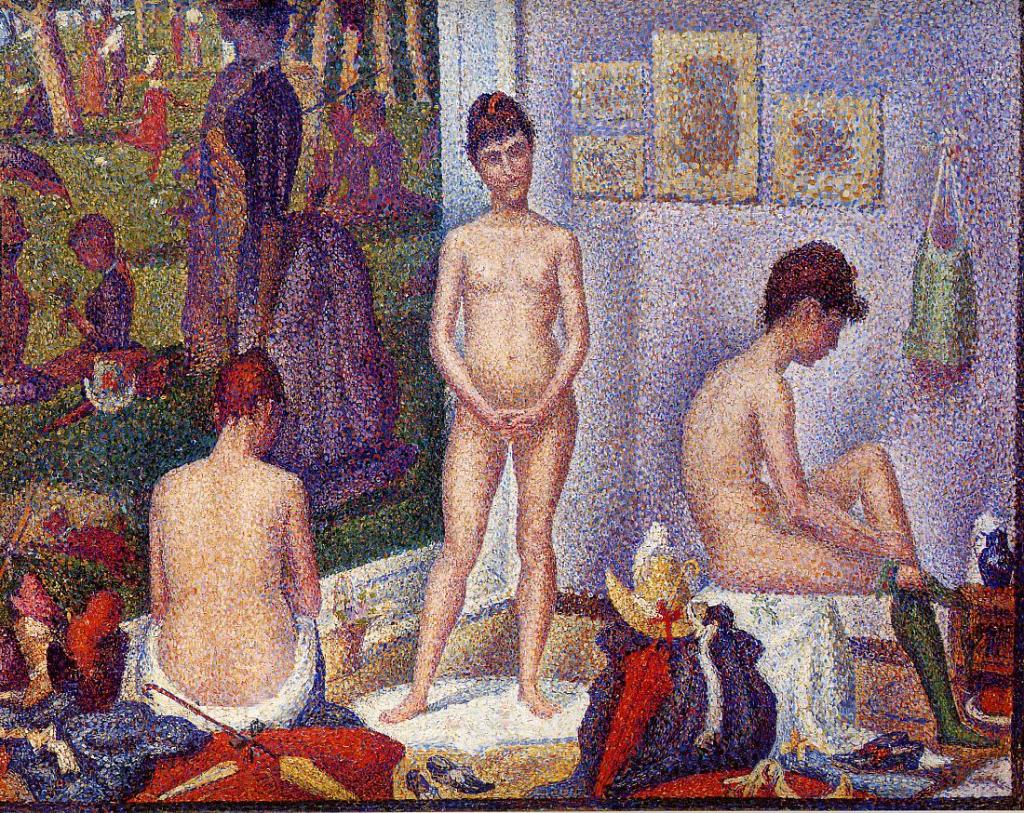
As Impressionism with its loose style and painterly brushstrokes was becoming more accepted, Georges Seurat devised its antithesis based on contemporary scientific theory, and advocated as scientific painting. Instead of blending pigments to produce different paint colours, Seurat’s novel method aimed to use optical mixing of colours. By applying many small dots of often contrasting colours, the eye or brain would perceive those as more vibrant and lifelike, so replacing visible brushstrokes with intentionally indistinguishable dots of colour.

The tiny dots of paint in Seurat’s first and greatest masterpiece, generally known as La Grande Jatte, are high in chroma for optical mixing. Prior to painting the finished work below, he made many smaller studies, including the unpopulated landscape above.

He painted the finished work in three phases. In the first, the dots he applied were mixed from available and fairly conventional pigments, including duller earths. In the second phase, he used a limited number of brighter and higher chroma pigments. In the third and final phase he added the coloured borders distinctive of his paintings.

The dots he used are far larger than those used in screening for colour printing, which start at 60 lines per inch for low quality and rise to over 200 lines per inch. Even the smallest of Seurat’s dots exceeds 1 mm in diameter, and many are large enough to give an overtly grainy appearance to passages in the painting, as seen in the detail above.
The following year, 1887, Seurat started work on studies for his next major work, Poseuses. Various preparatory drawings exist in different collections, but the three main figure studies made by Seurat for this painting are in the Musée d’Orsay, and confirm the three figures in the finished work were painted from the same model, were produced separately and then composited into the whole painting, and during that process two of the three were partially dressed, one with a white fabric wrap, the other with green stockings.


In 1888, he painted two different versions of his finished work: a full-sized version currently in The Barnes Foundation, Philadelphia, and a smaller version that used to be on display in the National Gallery, London, but has returned to Berlin.

The two can be told apart because the smaller version above appears more obviously granular, while the larger below appears far smoother in the texture of its colour. Although the differences between the two versions appear small, for consistency I show below a detail from the full-sized version alone.


Far from applying paint in separate dots of contrasting colours and leaving the eye or brain of the viewer to perform optical mixing, Seurat appears to have abandoned his original theory.

He continued with this portrait of a Young Woman Powdering Herself painted in 1889-90.

The Circus from 1891 is Seurat’s final and unfinished large masterpiece, and was presumably intended to have dots in additional colours added to it.
At the time of his death, Seurat had attracted the following of several others who had started painting using related techniques referred to as Neo-Impressionism or Pointillism. Among them were Camille Pissarro, Paul Signac, Henri-Edmond Cross and Charles Angrand, but they didn’t adopt the same technique.
 The Eclectic Light Company