
Calypso had detained Odysseus for seven years before he escaped from her island of Ogygia on a raft. He was then wrecked in a storm inflicted by Poseidon, and swam ashore on the island of the Phaeacians, variously named Phaeacia or Scheria. Once he had hauled himself, exhausted and naked, out of a river estuary he made his way into a wood, where he fell asleep in a pile of leaves.
The following morning Nausicaä “of the beautiful robes”, daughter of Alcinous the King of the Phaeacians and his queen Arete, travelled in a mule wagon with her handmaids to wash robes in a river. Her mother had given her a chest of food, wine in a goat-skin flask, and soft olive oil in a flask of gold for them to use after they had bathed themselves.
When they arrived at the washing place on the river, they unhitched the mules and let them graze, then washed the garments in the river, spreading them on the shore to dry. They next bathed themselves, anointed their bodies with oil, and had lunch. Afterwards they played ball with one another. Just as they were about to harness the mules back up to the wagon, Nausicaä threw the ball at one of her handmaids, who failed to catch it, allowing it to fall into deep water.
At that point Odysseus woke up, heard the sound of women’s voices, covered himself with a leafy branch, and emerged from the wood. The handmaids scattered, but Nausicaä stayed where she was. Odysseus, still salt-crusted from his shipwreck, begged for the princess’s help. She agreed to take him back to the palace, and told her handmaids to return and assist him. Odysseus went and washed the salt off his body, then anointed himself with oil, and dressed in clothes provided by the princess. The women gave him food and drink, which he consumed voraciously.
Once he had eaten his fill, the party took the mule wagon back to the city, where King Alcinous and the Phaeacians heard Odysseus plead his case to return home to Ithaca.
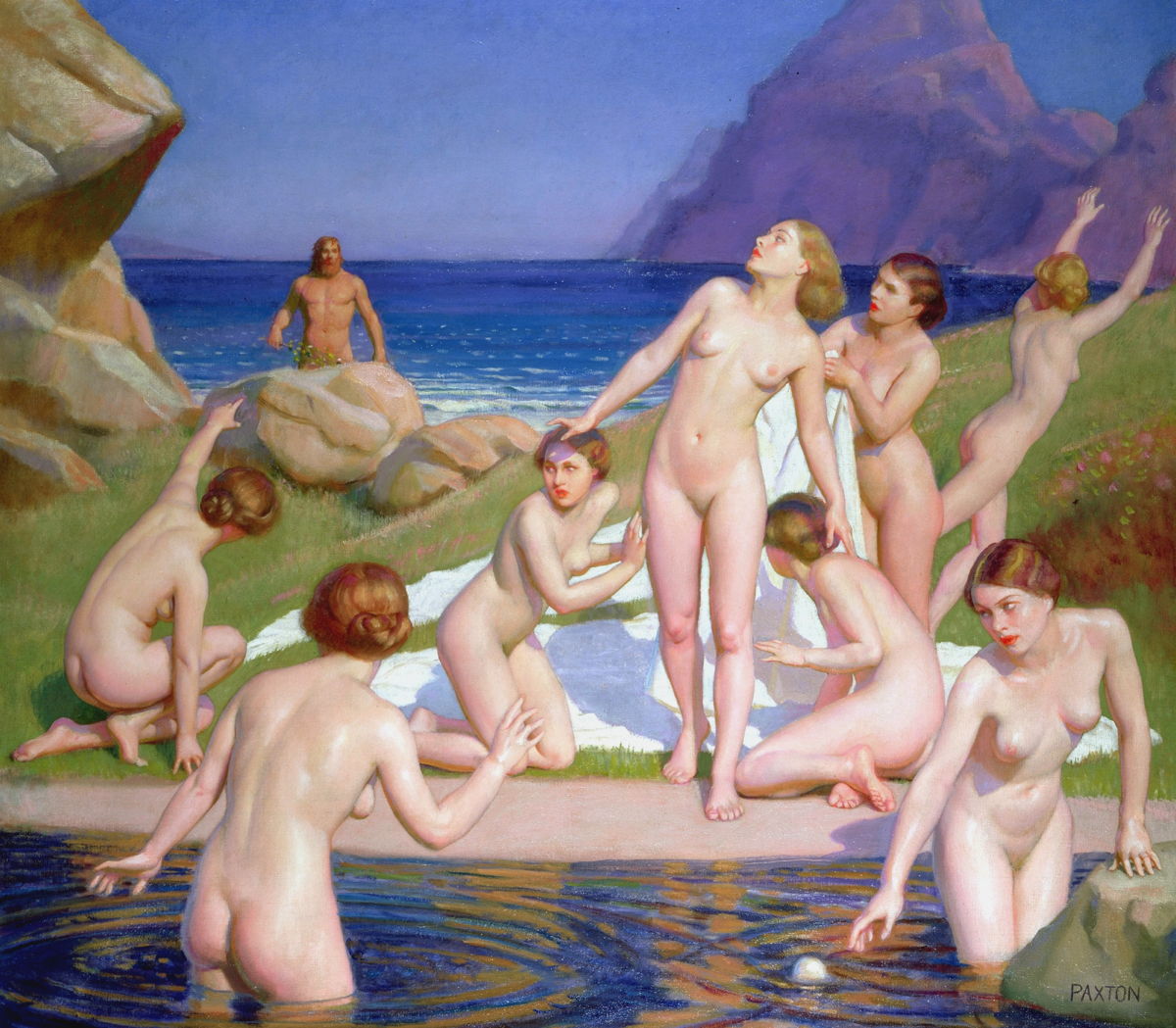
William McGregor Paxton’s Nausicaä from before 1937 picks the moment of Odysseus’ first appearance, just before the handmaids scatter in fright. Although the text doesn’t state they were nude at this stage, when playing ball after lunch, Paxton startles us with eight females and one male nude packed into a single canvas, a feat of which even William Etty might have been proud.

Friedrich Preller the Elder’s Odysseus and Nausicaä (c 1864) is an expansive landscape not available at higher resolution. The naked Odysseus is just in the process of coming out from behind a bush, towards the right. Nausicaä stands in a spotlight in the centre of the canvas. Her handmaids are seen still dealing with the washing (left), in alarm (behind her), or preparing the mule wagon (background), and there’s a coastal city in the far distance.
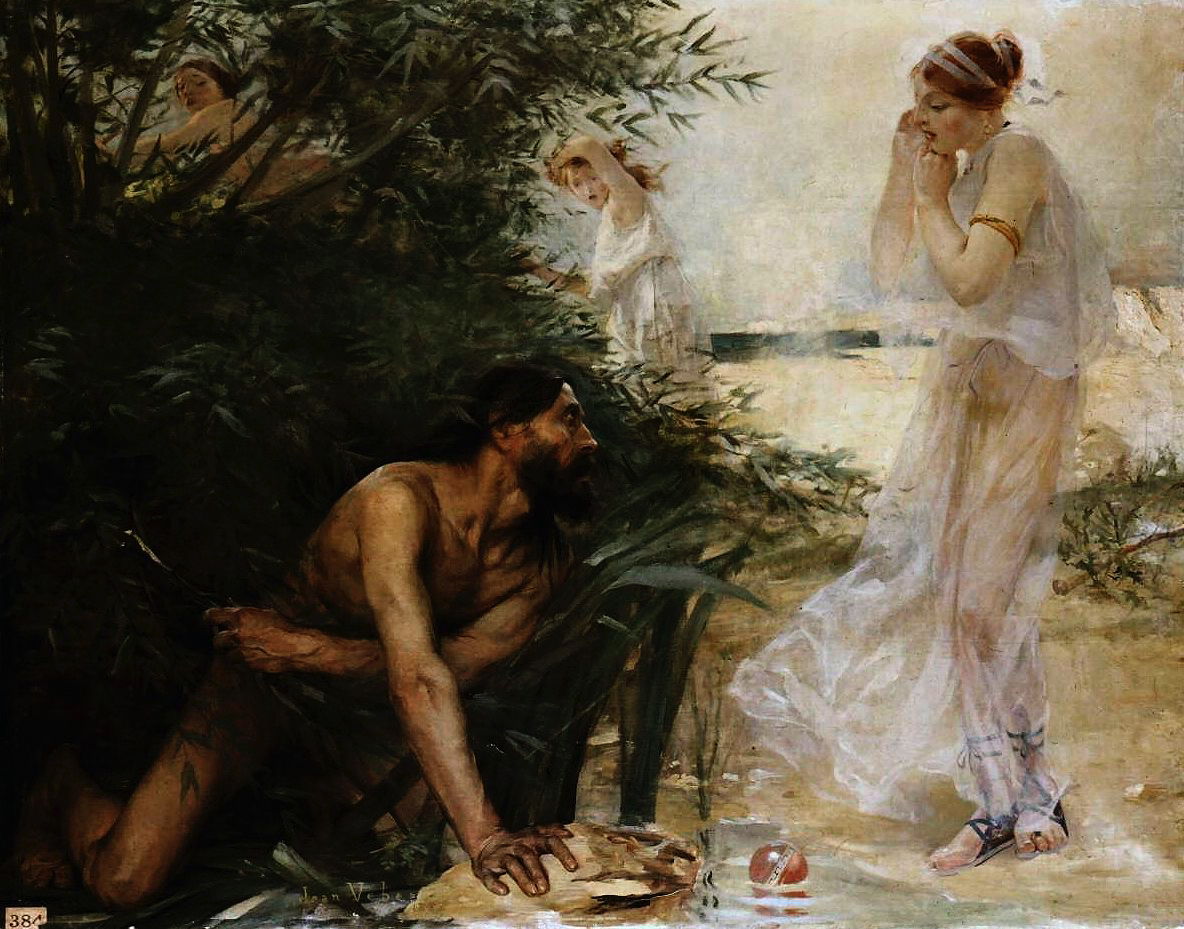
Jean Veber’s Ulysses and Nausicaä (1888) is richly narrative despite its apparent simplicity. It follows Homer’s text faithfully, showing the initial moment of contact between Odysseus and Nausicaä (at the right), with her handmaids scurrying off in shock. Veber also places a ball between the pair, as a further link to the text.

Lovis Corinth’s lithograph of Odysseus and Nausicaä from 1918 mixes the moments of the text narrative: Odysseus is shown at the right, still naked and clearly neither bathed nor oiled. He pleads with Nausicaä in the centre, who has one handmaid with her. Behind them is the mule wagon, mules in harness, with further handmaids on board.

Salvator Rosa’s Odysseus and Nausicaä (1663-4) shows a later moment in the story, where Odysseus is being given garments to cover his nakedness, although one of the handmaids still seems sufficiently shocked at his appearance that she needs to be comforted.

Michele Desubleo’s Odysseus and Nausicaä (c 1654) gives a fuller account of the text. Odysseus is naked, clutching the leafy branch strategically to his crotch with his left hand. His right arm is held out, apparently pleading his case to the princess, who is sat in beautiful robes, in the process of handing him an item of clothing.
Nausicaä holds in her left hand a wooden bat, following an apocryphal story that the ball game they were playing was an early form of real tennis, for which the ball is towards the lower edge of the painting. Behind her is the canopy of the wagon, and there is laundry drying towards the top of the canvas, and in the middle distance. There’s also a neatly folded pile at Nausicaä’s feet. The far distance shows a gentle Mediterranean coastline.

Joachim von Sandrart’s Odysseus and Nausicaä (c 1630-88) elaborates the scene of Odysseus pleading with Nausicaä. He’s naked apart from the leafy branch, on bended knee, while she is reaching for some clothes for him. One of her handmaids is just about to pass him a large bowl of fruit. There are also some ornaments and puzzles, of which the most prominent is a small dog by the princess’s right foot. But behind Odysseus, lurking in the shade, is another naked male wearing a garland of flowers on his head, who might be a river god.
In the background is a building which may be a temple of Poseidon, the first place in the city that Odysseus visits, in order to make peace with the god for his future sea travel. Watching from the heavens is Athena, who has been intervening to try to help Odysseus.
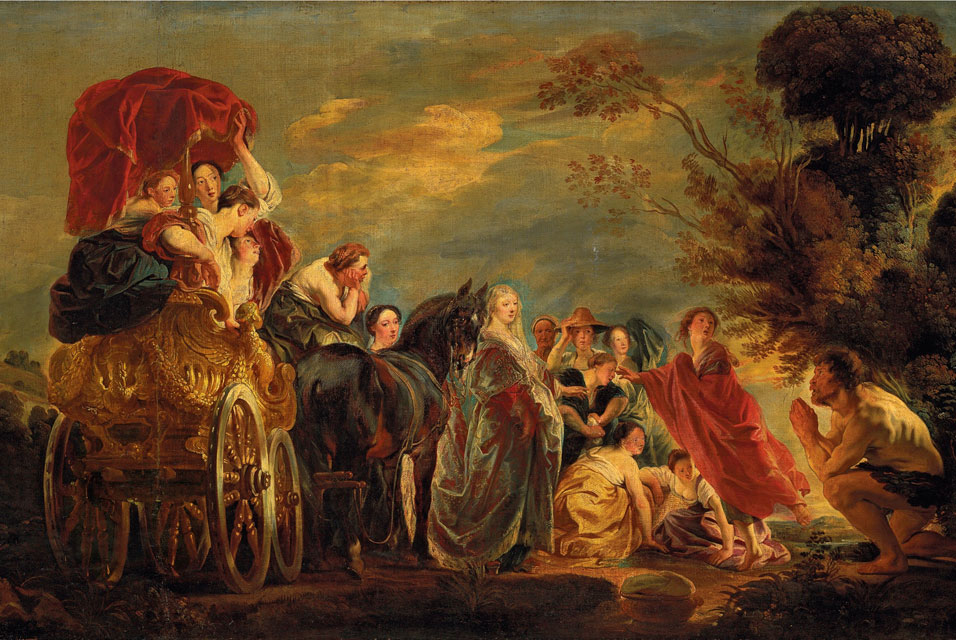
Jacob Jordaens’ The Meeting of Odysseus and Nausicaä (c 1630-40) connects with a tapestry cycle of the life of Odysseus designed by the artist. It’s a sophisticated re-casting of the original story in contemporary times, and repays careful study. A naked Odysseus has just emerged from the wood at the right, and crouches, hands held together to plead his case with Nausicaä. Her party is substantial, with an ornate carriage of state drawn by a pair of fine horses, and a second carriage with handmaids, behind the figure of Nausicaä complete with her beautiful robes.

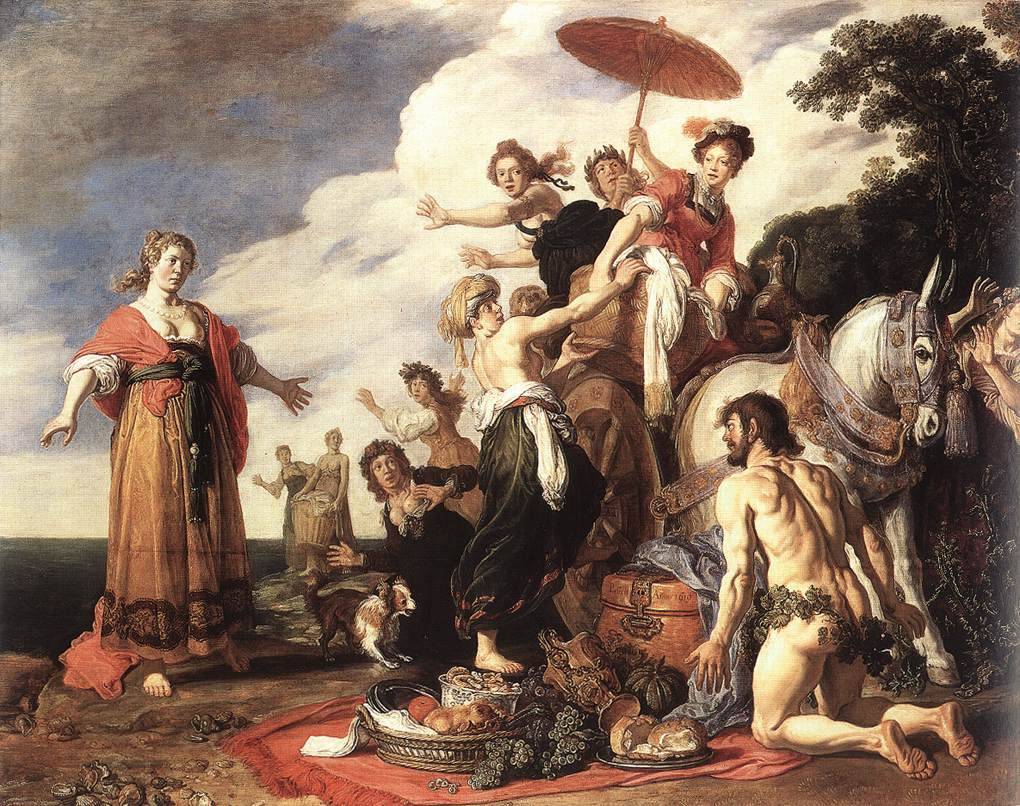
Pieter Lastman’s Odysseus and Nausicaä (1619) is a slightly earlier painting that may have influenced Jordaens. It too re-casts the story into more contemporary times, but preserves more references to the original. Odysseus is naked, save for his self-adhesive leafy branch, and is pleading his case with Nausicaä. She stands alone, magisterial and more matronly.
In front of Odysseus is a spread fit for a princess plus, complete with an ornate chest. Although the wagon is more rustic in construction, it’s drawn by a white horse. The handmaids on the wagon, who are loading baskets of washing, show fright if not panic and terror. In the distance two more handmaids are carrying another basket of washing to the wagon.

Pierre-Henri de Valenciennes’ Classical Landscape – Ulysses Imploring the Assistance of Nausicaä (1790) is not only a glorious imagined landscape, but also comes close to being a complete account of the story. Odysseus, wearing only a nappy/diaper of leafy branches, has just stepped out from the trees at the right, and is pleading his case with Nausicaä, who stands in sunlight slightly to the left of centre. Behind her are two mules by a chariot-like carriage. One handmaid is still down by the estuary washing clothes, but the others are hiding in a huddle below a small cliff above the beach. Further along the coast, at the left edge, is a city with a prominent pharos-like tower, a reference to the Phaeacians’ sea-going skills and Odysseus’ future travels.
King Alcinous provided Odysseus with more treasure than he would ever have received as spoils of the war against Troy, and one of his ships delivered Odysseus to a hidden harbour on Ithaca in the dead of night, while he was still asleep.

Claude Lorrain’s Embarkation of Ulysses (1646) is one of his later paintings with a port theme, also known as Odysseus Departs from the Land of the Phaeacians, showing Odysseus departing at dusk.
When Odysseus awoke on Ithaca he didn’t know where he was. It took Athena herself to confirm that he wasn’t on yet another distant land, but home at last. The goddess then hid the treasure given by the Phaeacians, and disguised him as a beggar so he could assess the situation in his kingdom before revealing himself as its long-lost king.

