
Now that it’s August, in the northern hemisphere at least it’s time to abandon the sweaty cities and head for the beach. When painters go on holiday, they often take their easel or a pochade box to record some of the stranger sights.
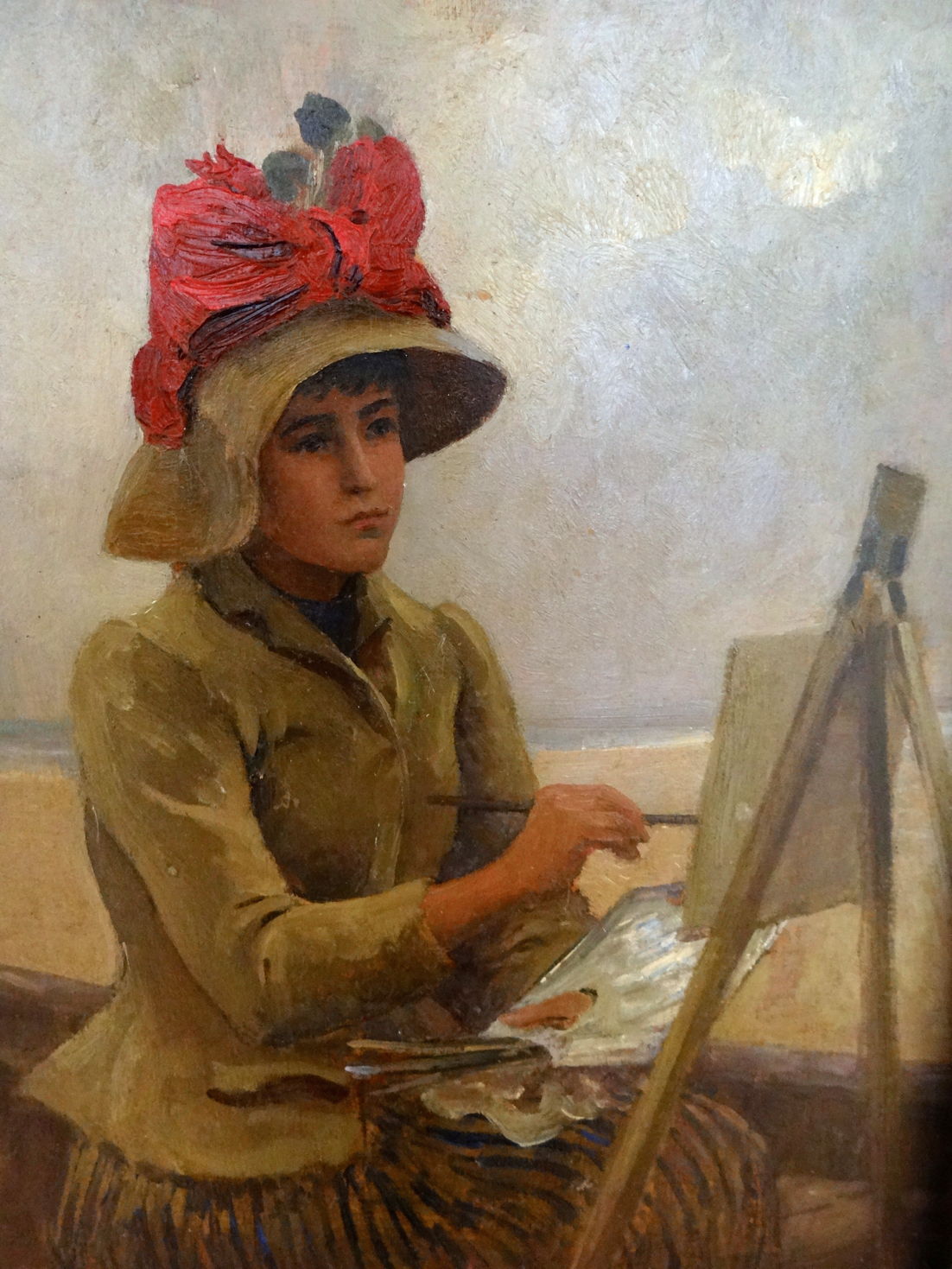
This detail of Virginie Demont-Breton’s Portrait of Marie Duhem (1889) shows one of her close friends and colleagues in the Wissant School, at work en plein air on the north French coast near their house. She appears to have set her easel up by a wooden groyne on the beach, although this surely can’t be August even in the Channel.
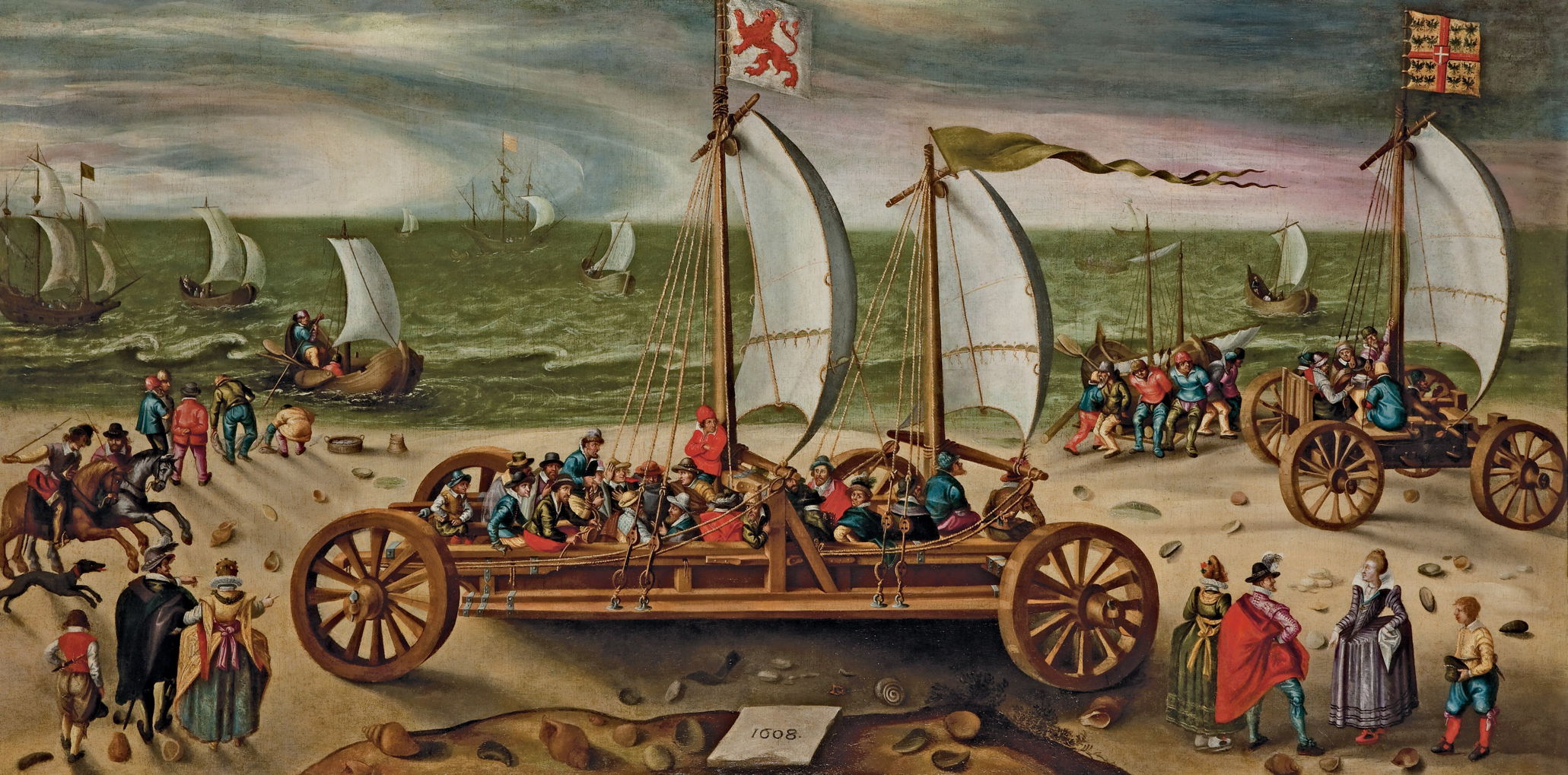
In this painting by one of the circle of Esaias van de Velde, we see a Sandyacht Race in the Presence of Prince Maurice of Nassau on the Beach at Scheveningen (1608). Four hundred years ago, the technology wasn’t as sophisticated as it is now, but there was no shortage of crews for these extraordinary vehicles. Those crews, and the bystanders, dressed very differently for the beach. So our ancestors did for centuries, whether they were relaxing there in the sun, or taking the waters in a bid to improve their health, as became widely recommended.
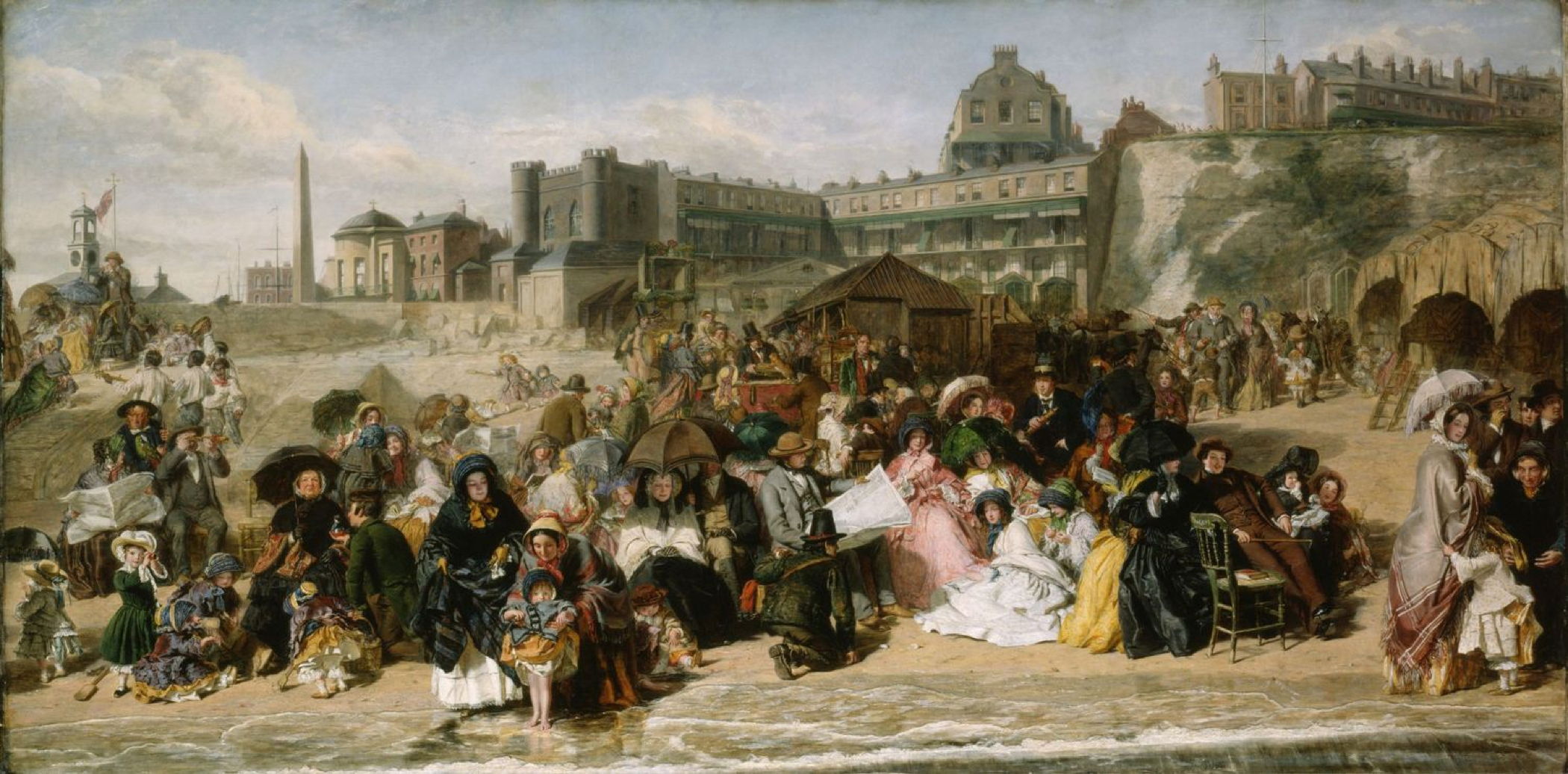
Nearly two-hundred and fifty years later, William Powell Frith’s painting of Ramsgate Sands (1854) proved his breakthrough, and the first of his great social panoramas. In 1846, the small town of Ramsgate on the coast to the north of Dover was connected by railway to London, from where the masses came to bathe in its waters. Frith holidayed there in 1851, when he made his first sketches on which he based this work. His beach is an eclectic mixture of different classes, reflected in their clothing and activities. Although there’s an array of changing tents at the right, no one has made use of them, and even small children are wrapped up in full dress.
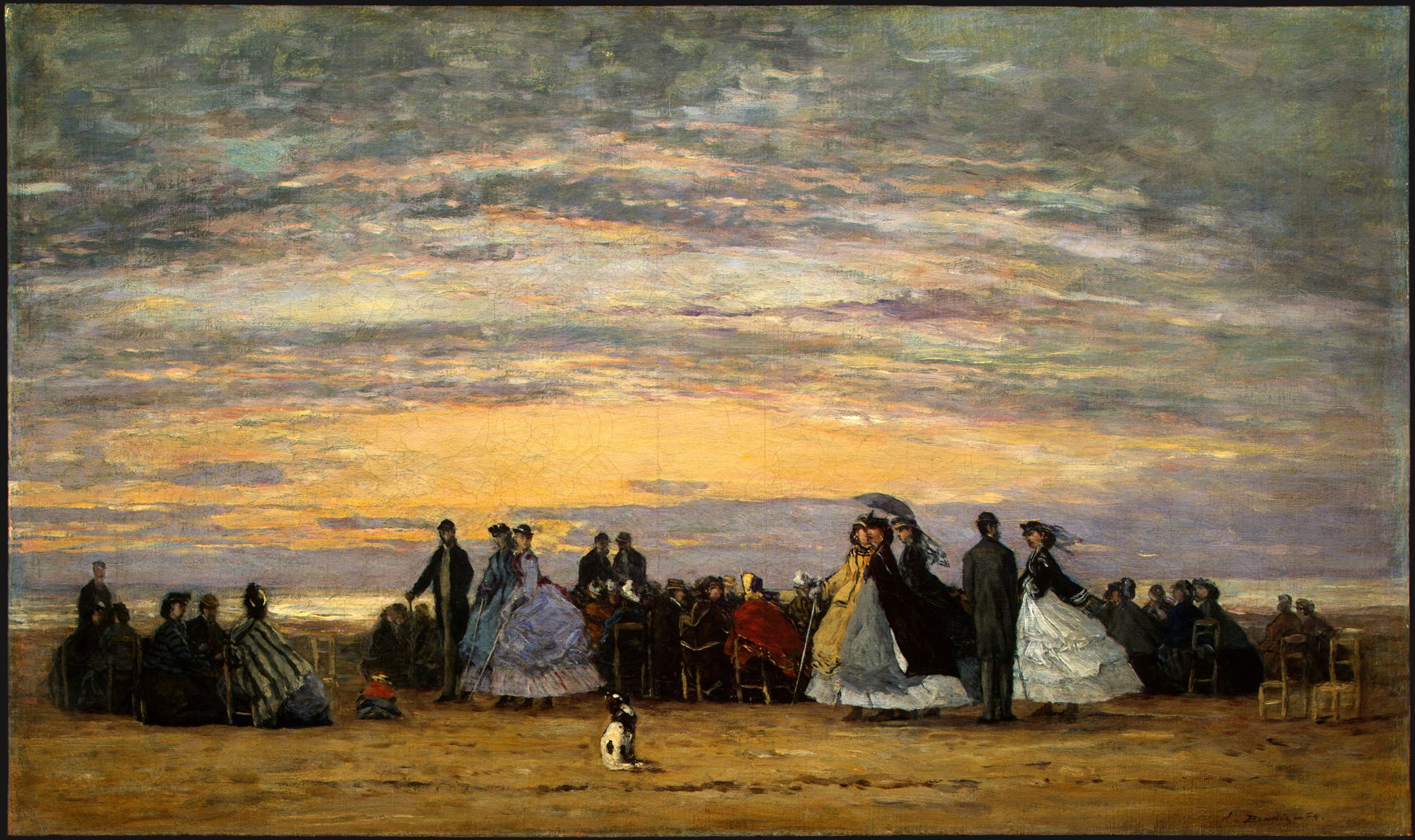
A century on and Eugène Boudin’s The Beach at Villerville (1864) shows another apparently incongruous sight: a crowd of mainly holidaymakers sitting on chairs as if in a city park. The ladies have great crinolines and fine gloves, parading their fashion in dozens of layers of outer and under garments.
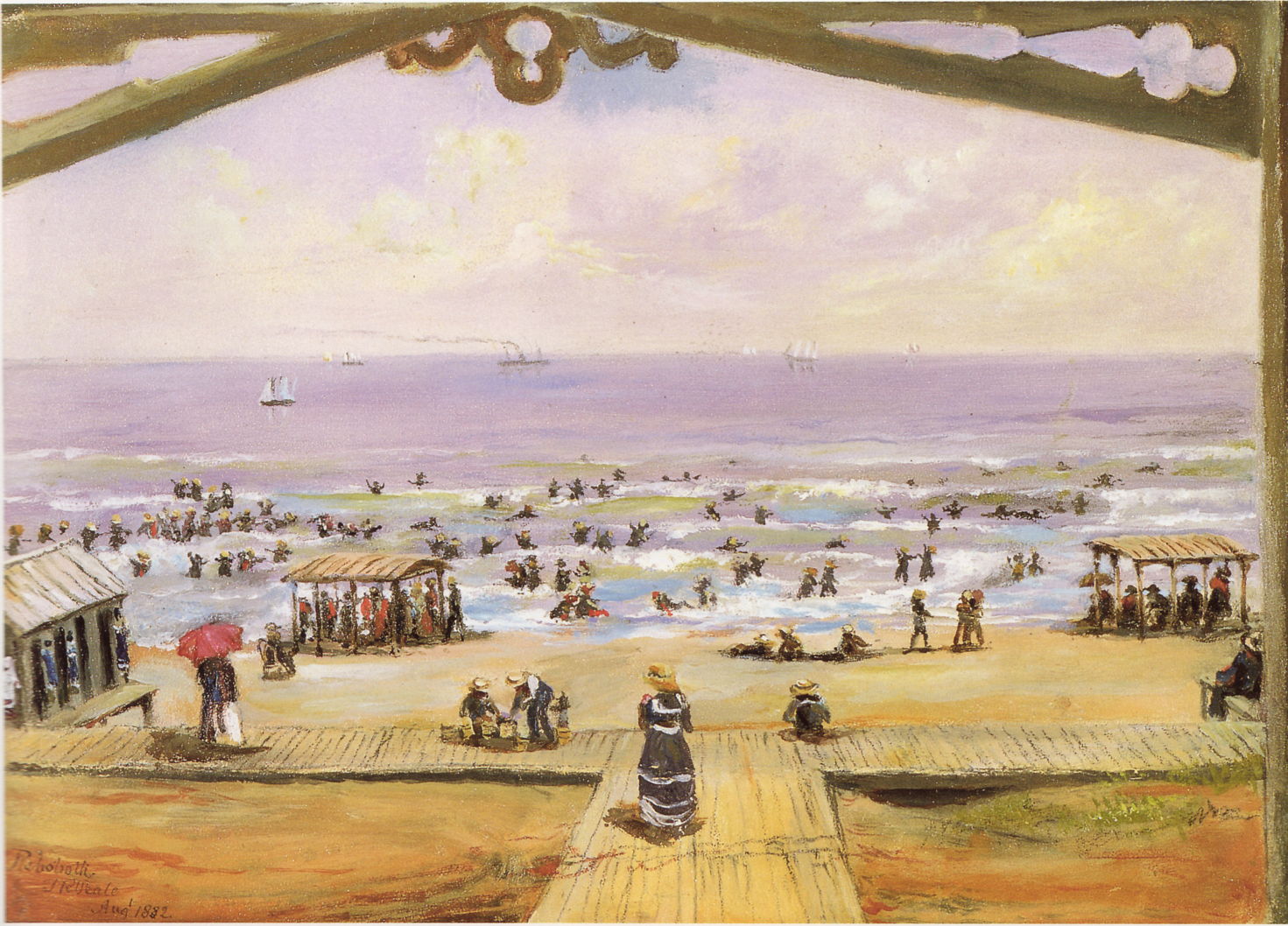
As Titian Ramsay Peale shows in his Bright House, Rehoboth Beach (1882), the sight of all those fully-dressed bathers is odd. This beach is on the Atlantic coast of the USA, in Sussex County of Delaware state, and has a subtropical climate. Until the late nineteenth century, it had been poor farmland, but in 1873 was established as a site for Methodist camp meetings. Its name is the Biblical Hebrew for broad spaces, and by 1893 it was becoming a popular beach resort for those working in Washington, DC.
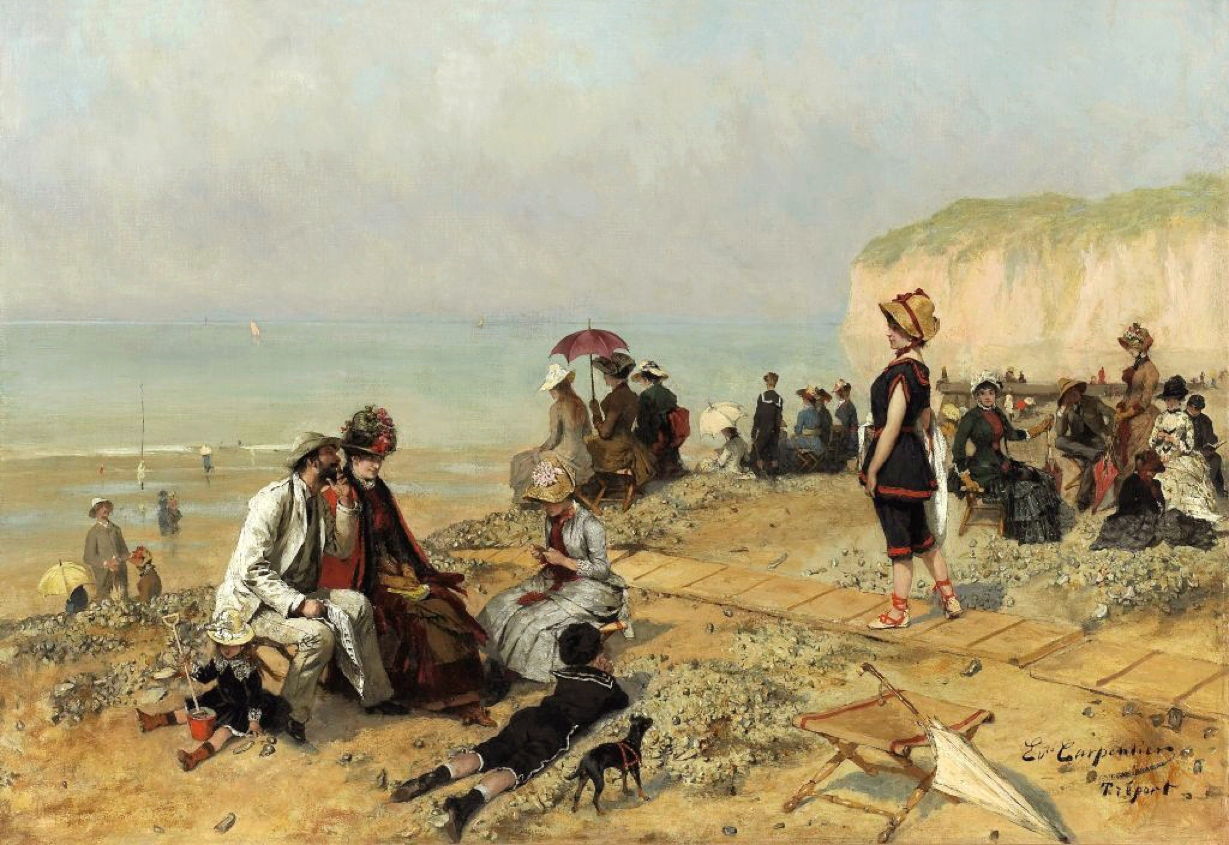
Later in the nineteenth century, at Le Tréport on the Channel coast of France near Dieppe, Évariste Carpentier’s Le Tréport, Bathing Time shows progress in the development of beach costume and culture. A young girl in the left foreground is playing with her bucket and spade, while her older brother is admiring the fashionable young woman parading her new clothes, so exposing her arms and lower legs.
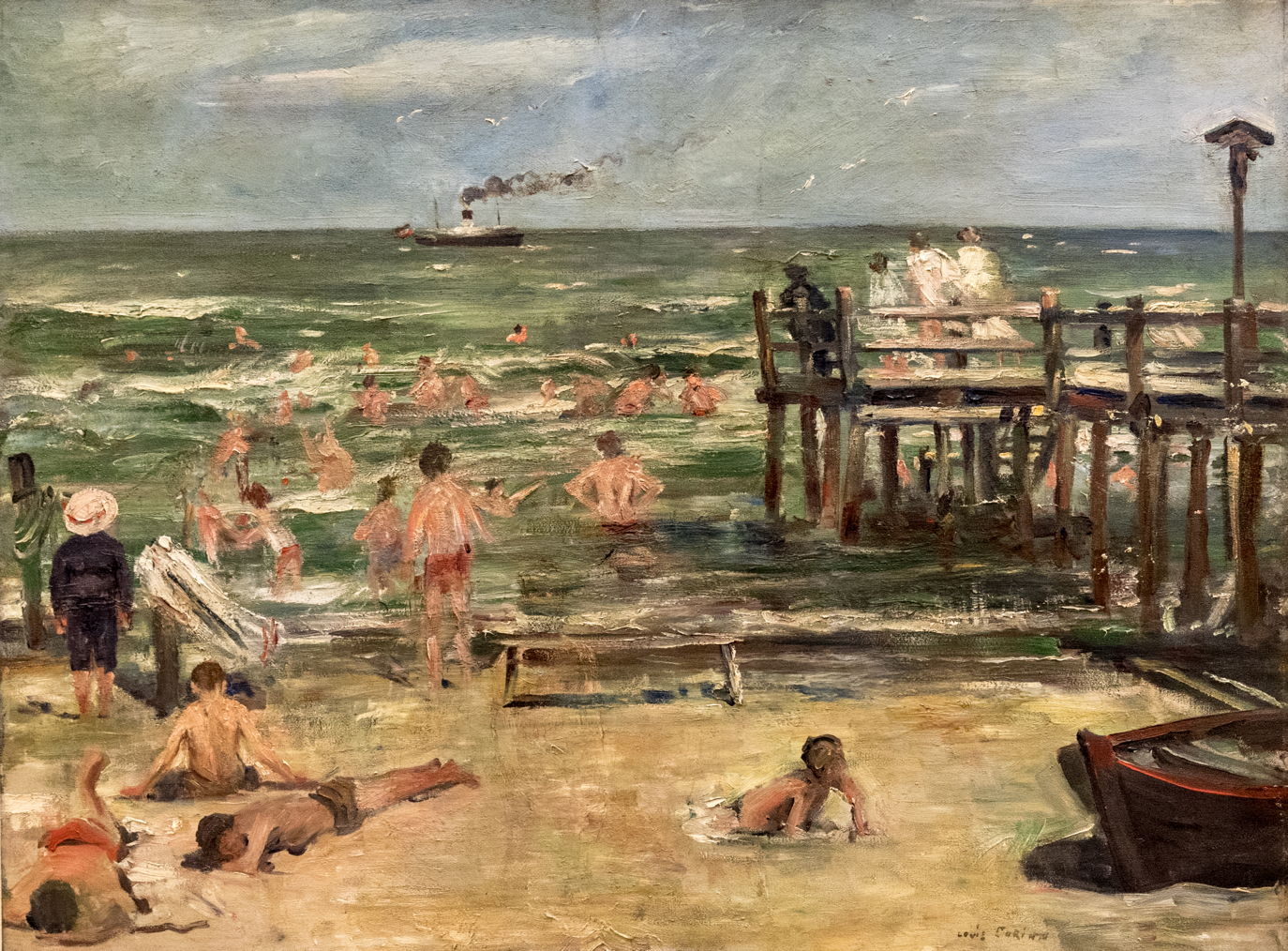
In Lovis Corinth’s view of Swimming in Horst – Ostsee the more bracing waters of the Baltic are proving popular with these men in their bathing trunks in 1902.

On the other side of the Atlantic, beach dress had progressed on Good Harbor Beach in Gloucester, MA, by 1915. Adults were then wearing light clothing exposing their arms and legs, as shown in Louise Upton Brumback’s bold and crisp style, and those down in the water even dared to wear bathing costumes.
There was more to visiting the beach than the promise of restored health. If you were lucky, you might chance on a mermaid.

Mermaids and mermen are mythical creatures with origins outside the classical Mediterranean civilisations. Conventionally, their upper body is human, while below the waist they have the form of a fish. Mermaids seem invariably young, beautiful and buxom, and are most frequently encountered by fishermen and those who go down to the sea including the occasional tourist. John William Waterhouse’s diploma study for the Royal Academy, painted in 1900, is a conventional image of A Mermaid, seen combing her long tresses on the shore.
The allure of mythical sea creatures also had appeal for women who went to the coast.

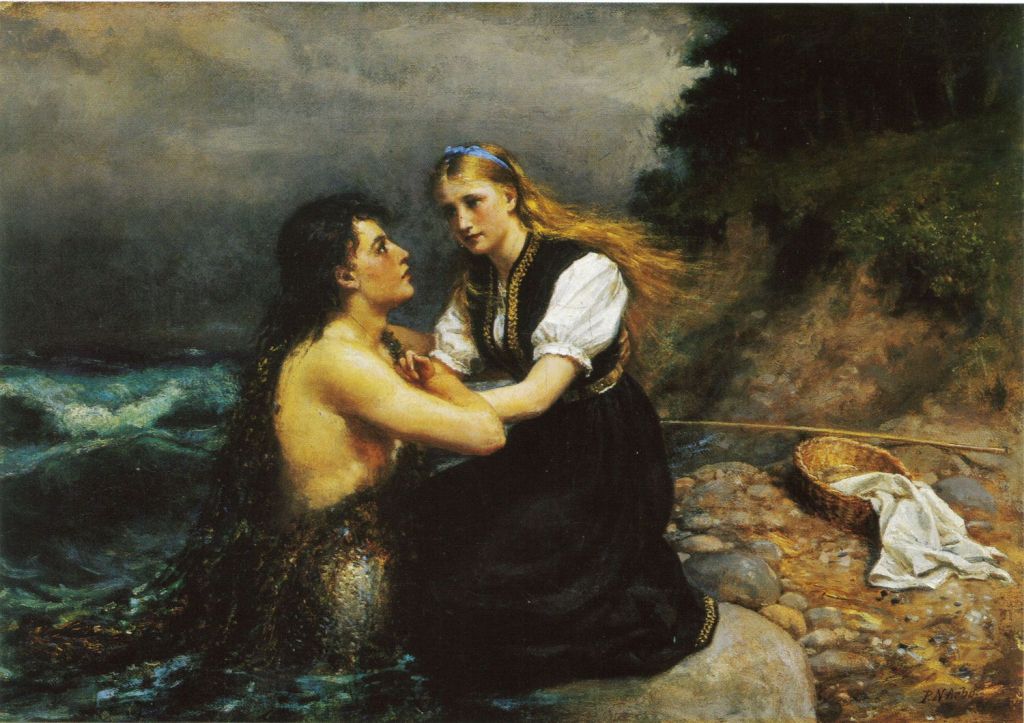
Peter Nicolai Arbo’s Liden Gunver and the Merman (1874-1880) is drawn from an opera The Fishers, by Johannes Ewald and Johann Hartmann, first performed in Copenhagen in 1780. The young woman Liden Gunver, on the right, is taken to sea by the alluring but deceptive merman on the left.

