

One of the great milestones in any nation’s culture is when it attains independence by training its own artists. Until then, most of the best have to live and learn in different traditions and societies. Although that has always been enriching, when it’s the only option it dilutes and stifles home grown art and cultural development.
In the late nineteenth century several modern nations attained artistic independence, among them Ukraine and the United States of America. Among the major painters who taught in the USA at that time were Thomas Eakins, John Ferguson Weir, Robert Henri, Frank Duveneck, and William Merritt Chase, perhaps the greatest of them all. No one knows how many students Chase taught, but they must have run into the thousands. He took his first student on in around 1879, and continued until well into the twentieth century, just a few years before he died.

Over that period, he had private students, the hundreds who flocked each summer to the Shinnecock Hills Summer School of plein air painting, and the large numbers who passed through the doors of some of the leading art schools of the day. The latter included his own Chase School of Art (opened in 1896), the Pennsylvania Academy of the Fine Arts, the Art Students League, and the Brooklyn Art Association.
Chase’s own training is an example of how many US painters had studied in Europe in the past. After an introduction by local self-taught artists, he studied at the National Academy of Design in New York, then at the Academy of Fine Arts in Munich, Germany, for two years before returning to New York.
This weekend I end my celebration of America’s two-hundred and fiftieth birthday with a brief survey of some of Chase’s many students, future generations who made American painting great into the twentieth century. They are given in order of their year of birth.
Eleanor Norcross (1854–1923)
Born Ella Augusta Norcross in Fitchburg, in 1854, she started her studies at what’s now Massachusetts College of Art and Design in Boston, where she earned her teaching certificate in 1876. When her father was elected to the House of Representatives, she moved with him to Washington, then went to New York City to study at the Art Students League under William Merritt Chase. In 1883, on Chase’s recommendation, she crossed the Atlantic to Paris, to study under Alfred Stevens.

Fireplace is one of her interiors featuring a mirror. Norcross seems to have had a particular fondness for mirror play in her paintings.
Emma Lampert Cooper (1855-1920)
Emma Lampert attended the Art Students League in New York City before 1886, where she was taught by William Merritt Chase and Agnes Abbatt, and Cooper Union. In 1886 she travelled to Paris and the Netherlands for further study, where she met Colin Campbell Cooper, whom she married.

Her undated Courtyard Scene was probably painted during one of her visits to Europe.
Silas Dustin (1855-1940)
He trained under Chase, and became the curator of the National Academy of Design. He was also an art dealer, and led the Biltmore Salon.
Dora Wheeler Keith (1857-1940)

Lucy Dora Wheeler was one of Chase’s first pupils, taught by him from 1879-1881, and he remained her mentor and friend. She went on to study at the Art Students League in New York, then spent two years at the Académie Julian in Paris.

She went on to become a successful portraitist, here in her pastel Portrait of Laurence Hutton, 1843-1904 from 1894. She painted Mark Twain and his family, and maintained studios in New York City, the Catskills, and Thomasville, GA.
Elizabeth Adela Forbes (1859–1912)
Elizabeth Adela Armstrong was Canadian, and first trained at what’s now the Royal College of Art in London, then between 1877-80 she studied at the Art Students League of New York under Chase. His advice took her to Munich, where she studied under J Frank Currier and Frank Duveneck, who in turn had been a fellow student of Chase. In the summer of 1884 she was taught again by Chase when she was in Zandvoort, the Netherlands, and the following year went to Newlyn, Cornwall. After moving to nearby Saint Ives, she married Stanhope Forbes, and the couple became the main driving force of the Newlyn School.

Her small oil sketch of Volendam, Holland, from the Zuidende, was painted when she and her husband were visiting the Netherlands in about 1895.
Lydia Field Emmet (1866-1952)

She was born in New Rochelle, New York, and attended the Académie Julian in Paris in 1884-5 with her older sister Rosina, then returned to New York to study with Chase and others. She later went back to Paris to study under Bouguereau, Collin, and Tony Robert-Fleury, and became a major portrait painter, with a long string of prizes awarded at expositions in the USA from 1893-1912.
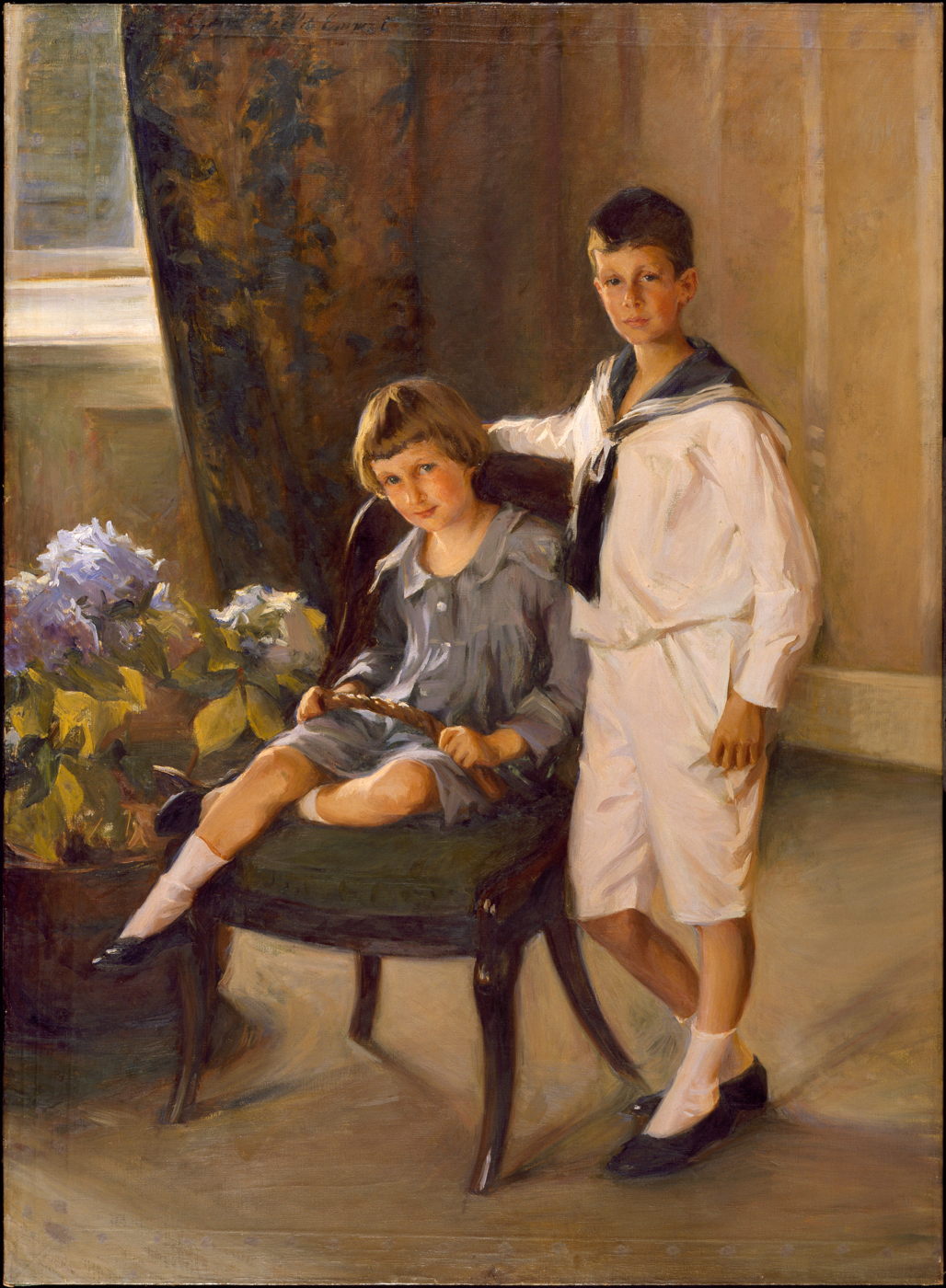
She is now best known for her portraits of children, including The Brothers, painted in 1909.
Louise Upton Brumback (1867-1929)
She was a comparative latecomer to painting, and first attended one of Chase’s Shinnecock Summer Schools in about 1900. She went on to the New York School of Art and the Pennsylvania Academy of the Fine Arts.

Gloucester, Massachusetts (1912) is an unusual view of part of what had been one of the USA’s busiest seaports, where she and her husband spent their summers.

Good Harbor Beach, painted in 1915, is close to Gloucester.

