
The tragic death of his friend Patroclus plunged Achilles into a combination of grief and burning desire for vengeance against the Trojan warrior Hector. Once Achilles’ mother Thetis had anointed Patroclus’ body with ambrosia and nectar to preserve it, Achilles prepared for battle, donning his new armour forged by the god Hephaestus (Vulcan). But the Greek warrior knew this would also bring his own death.
Zeus then allowed the deities to get involved in the war again. When Achilles and his Myrmidons trapped half the Trojan army in the river and turned it red with their blood, the river god Scamander demanded that the slaughter was stopped. Achilles refused, and the two fought until Hephaestus launched a firestorm at Scamander.

Charles-Antoine Coypel’s Fury of Achilles from 1737 captures Achilles, wearing his elaborate armour in the centre, as he’s being aided by Athena on the left and Hephaestus on the right. Further to the right is Scamander, shown traditionally with his large jar gushing water and a wooden paddle in his right hand. Beneath them are the bodies of Trojans, and the river is starting to run red with their blood. In the more distant chariot is Hera with one of her peacocks.
With this, the Trojans were put to flight, and the city’s gates were thrown open to let them back in to safety. But Apollo disguised himself as a Trojan, and lured Achilles away, allowing all but Hector to escape. When Achilles approached Hector ready to fight, the Trojan lost his nerve and ran around the city. Athena then tricked him into stopping and engaging Achilles, who quickly stabbed Hector in the neck and killed him.
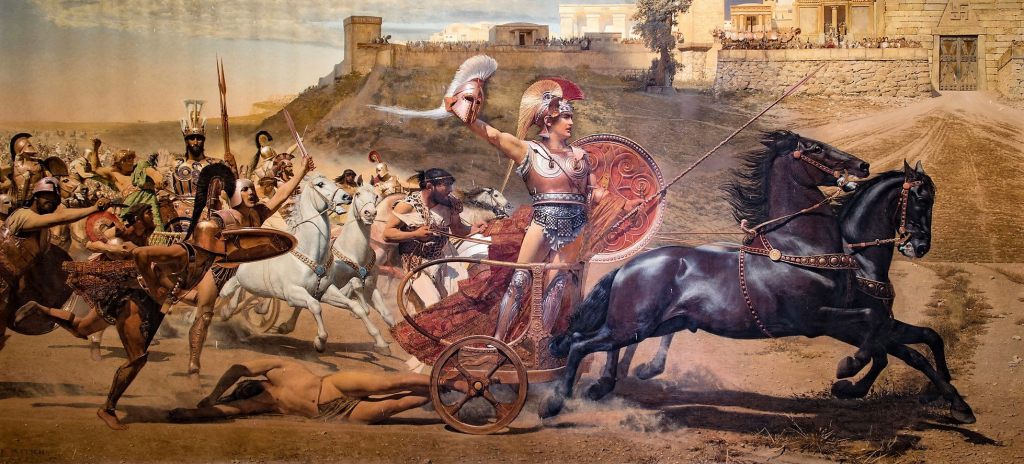
In return for the mistreatment Hector had given to the body of his friend Patroclus, Achilles stripped Hector’s body of armour, and dishonoured it by towing it around behind his chariot.

Franz von Matsch’s The Triumph of Achilles (1892) is at the top of the staircase of the Achilleion Palace, a celebration of the myths of Achilles, built on the island of Corfu for Empress Elisabeth of Austria. This shows Achilles in his chariot driving at speed around the walls of Troy, towing the naked body of Hector and followed by celebrating Greeks.
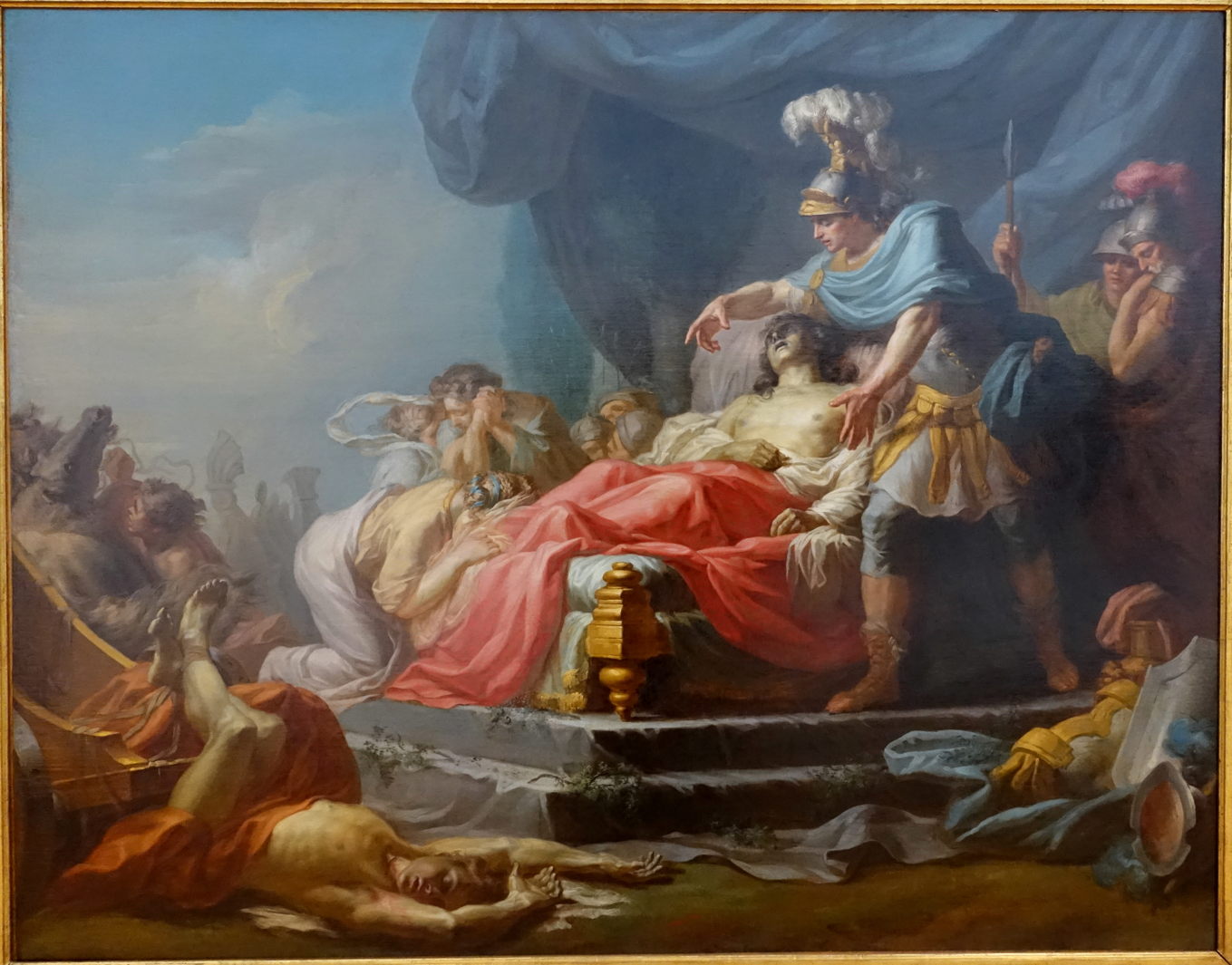
Jean-Joseph Taillasson’s Achilles Displaying the Body of Hector at the Feet of Patroclus from 1769 shows the two bodies together: Achilles is tending to that of Patroclus, raised on a throne, while Hector’s lies in the dust below, still tied to the chariot.
Achilles was visited by the ghost of Patroclus in a dream; his friend urged him to complete his burial rites so his spirit could move on to the Underworld. As a result, the body of Patroclus was cremated, and the Greeks held funeral games in his honour.

Carle Vernet, son of Claude Joseph and father of Horace, painted his grand vision of the Funeral Games in Honour of Patroclus in 1790. A chariot race is taking place in the left foreground, as Achilles stands proud to the right of centre. In the distance is the great walled city of Troy.
But the funeral of Patroclus did nothing to stop Achilles towing Hector’s body around, making the grief of the Trojans more bitter. Hermes led King Priam from the city with gifts for the Greeks in a mission to have his son’s body returned. The king threw himself at Achilles’ feet and pleaded with him, and soon they were both in tears, lamenting their losses.

Alexander Ivanov’s Priam Asks Achilles to Return Hector’s Body from 1824 shows the king grasping Achilles as he pleads for the body. In the foreground is Hermes’ caduceus with its distinctive entwined snakes.

Jules Bastien-Lepage’s second and last attempt to win the Prix de Rome was his Priam at Achilles Feet (1876). Achilles’ left hand has just reached Priam’s right hand, although the Greek still looks away coldly.
Achilles and Priam agreed a truce of twelve days, to allow the Trojans a period of mourning; after they ate together, the king carried his son’s body back into the city, where the funeral of Hector took place.
Achilles was left still mourning Patroclus, mindful of his own imminent fate.
With the leading Trojan warrior Hector dead, and his body returned to his father King Priam, the Greeks and Trojans observed a truce of twelve days for the funeral and mourning. It’s here that Homer’s Iliad closes, long before the culmination of the war, and we rely instead on fragments of a third epic in the cycle, Aethiopis, and other accounts.
During the ten years of the Trojan War, various warriors and groups came to give support to each of the sides. After Hector’s death came Penthesileia, a leader of the Amazons and noted warrior. She may have previously been associated with Priam, and could have accidentally killed her sister Hippolyte, giving her motive to fight for the Trojans. She arrived in Troy on the day of Hector’s funeral, was greeted and entertained by Priam, then went to fight the following day, the first after the truce.
She went into battle at the head of her group of Amazons, acquitted herself well in combat, but fell to the hand of Achilles, who impaled her with his spear. When he removed her helmet, he was struck by her beauty and filled with remorse that he had killed her.

Tischbein’s Achilles and Penthesileia from about 1823 is a highly romanticised depiction of Achilles’ remorse, the Amazon’s body miraculously showing not a single mark despite its earlier impalement by a spear. As an Amazon, Penthesilea’s right breast is inevitably bared.
Thersites, a constant critic of Achilles and Odysseus, then mocked Achilles’ remorse, causing the warrior to kill him instantly. Penthesileia’s body was returned to the Trojans, who burned her corpse on a pyre shortly afterwards.
Next to arrive to fight for the Trojan cause was King Priam’s nephew, Memnon, who brought his army of ‘Aethiopians’ with him from Africa. After his reception by Priam, they went out to fight and scored some successes, with Memnon killing Nestor’s son Antilochus, a friend of Achilles. In his anger, Achilles then killed Memnon, and those Trojan forces fled back into the city.
Achilles had known all this time that the death of Hector had sealed his own fate. It was only a matter of time before he too met a similar end. One account is that Achilles made the same mistake that his friend Patroclus had, in pursuing the Trojans back to the gate of the city, after the death of Memnon. He came within range of Paris, who was standing on the walls and released an arrow at Achilles, who by this time was just outside the Scaean Gate. Apollo then guided the arrow to strike Achilles in his only vulnerable point, his ankle (or heel), by which his mother Thetis had held him when she had dipped him into the River Styx as an infant.
Ordinarily, an arrow piercing an ankle would hardly have proved fatal. Whether the arrow had been poisoned, or his ankle was just a point of exceptional vulnerability, that was the end of Achilles.

Of the very few artists who have painted this death, it was Rubens who has told the story most vividly, in a series on Achilles painted between 1630-35, towards the end of his own career and life. This painting of The Death of Achilles is an oil sketch on a smaller panel.
Achilles, an arrow piercing straight through his right foot, is shown in the centre foreground, overtly moribund. But Rubens doesn’t place Achilles in battle, as do classical accounts: he has been standing at a small altar to the goddess Artemis, with her strong associations with archery. At the door to the left, Paris is still holding the bow that loosed the arrow, and behind him is Apollo aiding and abetting the killing.

Rubens’ finished painting of The Death of Achilles adheres faithfully to the sketch. Achilles’ face is deathly white, and this brings to life the supporting detail, particularly the lioness attacking a horse at the lower edge of the canvas, symbolising Paris’s attack on Achilles.

Much later, Alexander Rothaug’s undated Death of Achilles is true to the original accounts, with the arrow passing through the warrior’s Achilles tendon. Paris, still clutching his bow above, looks mortified, and Apollo stands behind him.
Greatest grief at Achilles’ death was in his mother Thetis, whose lament was painted by Henry Fuseli.

In the foreground, Achilles’ body lies like a fallen statue on his shield, his great spear by his left side. There is no sign of any wound, arrow, or injury. At the water’s edge, his mother Thetis is waving her arms in lament for her dead son. Another deity is flying past in the distance, and is seen white against the dark and funereal sea and sky.
 The Eclectic Light Company