
Brushstrokes: Constable and Turner

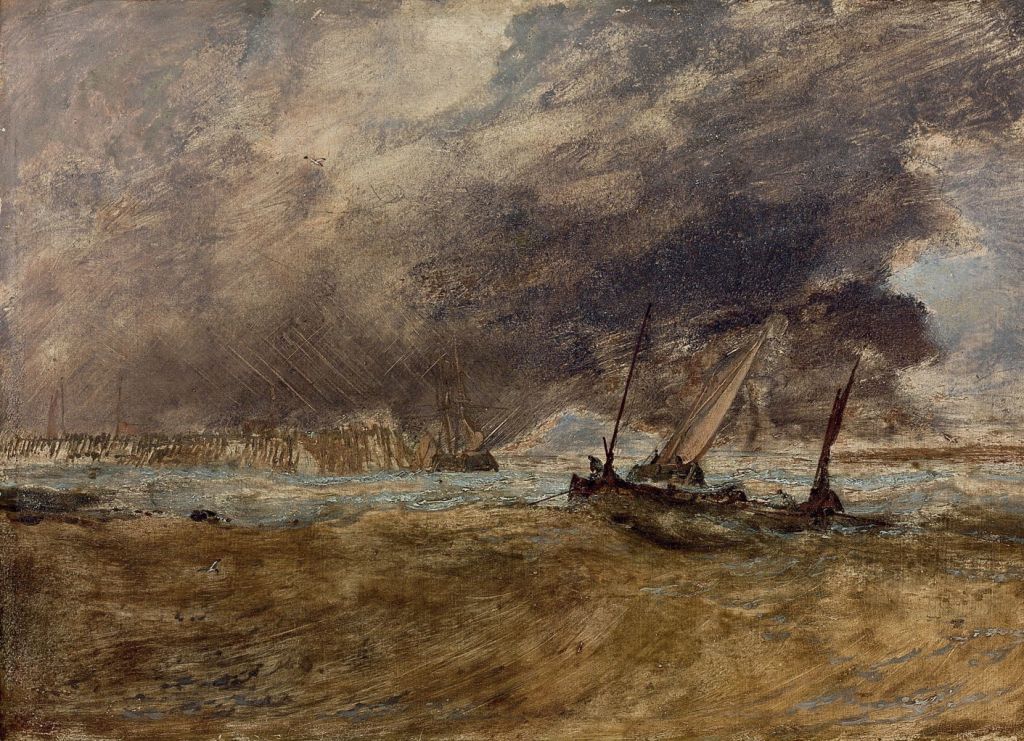
Joseph Mallord William Turner (1775–1851), Seapiece with fishing boats off a wooden pier, a gale coming in (date not known, possibly c 1801), oil on panel, 31.8 x 44.5 cm, Private collection. Wikimedia Commons.

As oil sketches became more popular at the end of the eighteenth century, artists became less reserved about leaving brushstrokes and other marks in their paintings, although the great majority of those sketches were never intended to be seen by the public.
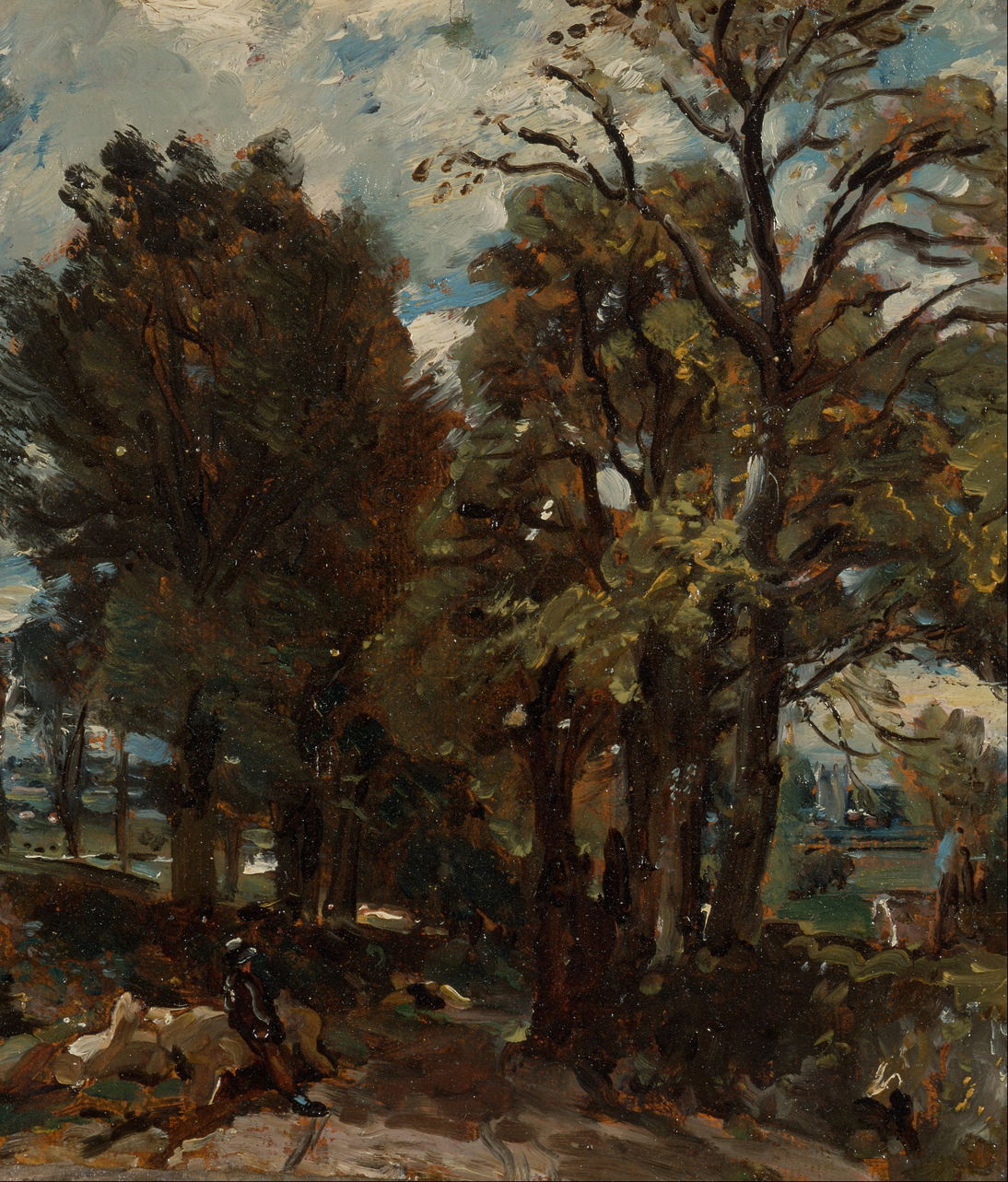
John Constable (1776–1837), Fen Lane, East Bergholt (c 1811), oil on paper laid on canvas, 22.1 x 19.5 cm, Yale Center for British Art, New Haven, CT. Wikimedia Commons.
John Constable (1776–1837), Fen Lane, East Bergholt (c 1811), oil on paper laid on canvas, 22.1 x 19.5 cm, Yale Center for British Art, New Haven, CT, https://collections.britishart.yale.edu/catalog/tms:653 Wikimedia Commons.

John Constable’s oil sketches are amazingly modern in appearance, and still contain individual figures in among the squiggles and blobs of paint, in this case making up his sketch of Fen Lane, East Bergholt, painted in about 1811.
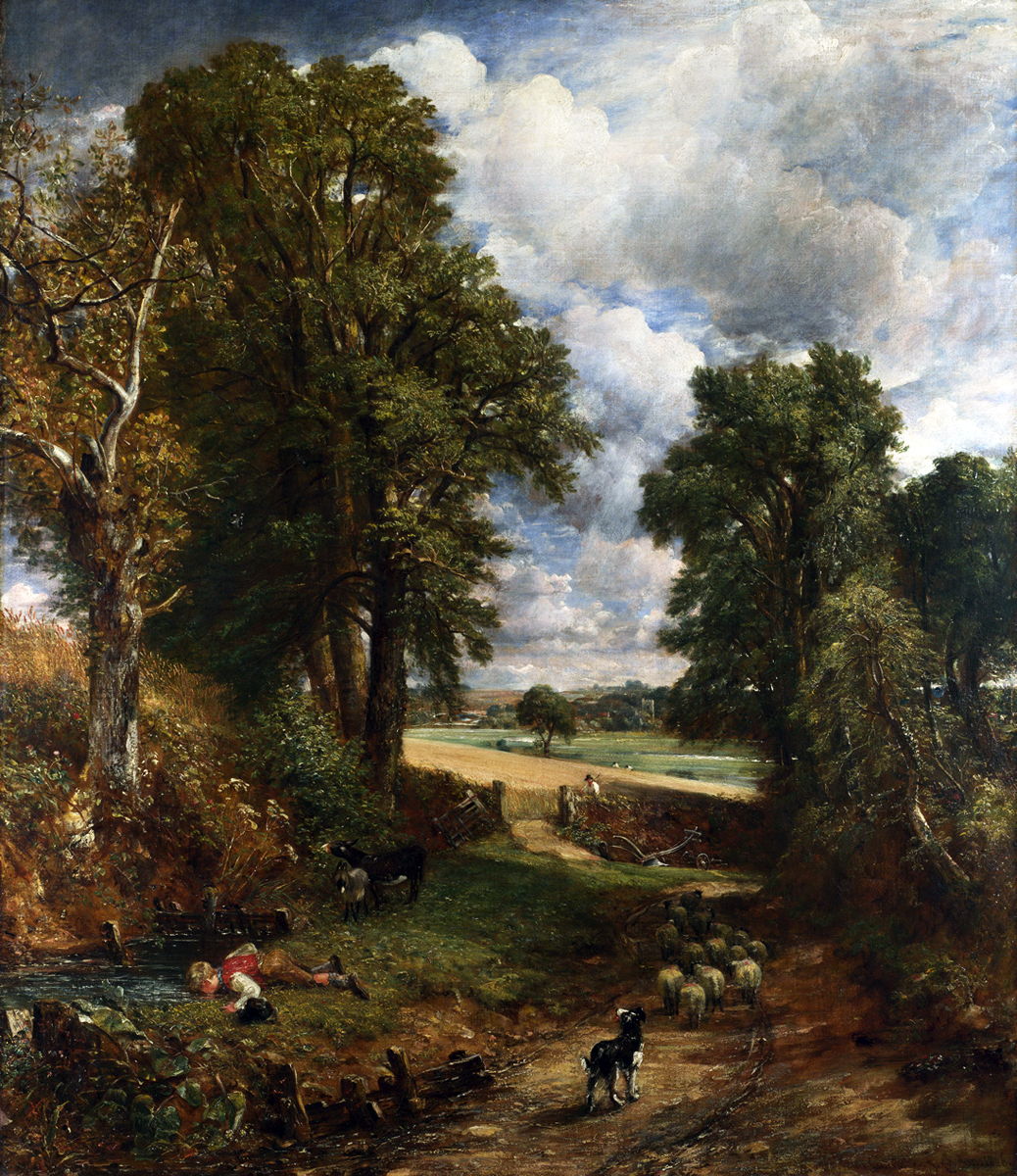
John Constable (1776–1837), The Cornfield (1826), oil on canvas, 143 x 122 cm, The National Gallery, London. Wikimedia Commons.

It wasn’t until fifteen years later that he painted his finished landscape based on that oil sketch. The Cornfield (1826) is a view down the same Fen Lane in East Bergholt.

Constable was an inveterate sketcher in paint and a seasoned skyer who often went out to open spaces to make studies of trees and impressions of the sky and clouds. Each of his major finished paintings was preceded by an ordered succession of studies, many of them in oils. Yet in every case his painterly mark-rich preparation ended up in landscapes showing no marks of a brush.

constablehadleighcastlesk
John Constable (1776–1837), Hadleigh Castle (sketch) (1828-29), oil on millboard, 20 Γ— 24 cm, Yale Center for British Art, New Haven, CT, https://collections.britishart.yale.edu/catalog/tms:38526 Wikimedia Commons.

This early sketch of his late Hadleigh Castle (1828-29) already contains some surprisingly detailed passages: at the far left, a shepherd, his black dog by his side, with a small flock of sheep grazing near the ruined tower. There’s a brown and white blob on the seaward slope, probably a cow grazing. Wheeling in wrinkles of impasto above the tower are a few birds resembling small runnels of liquid metal like solder.
constablehadleighcastle
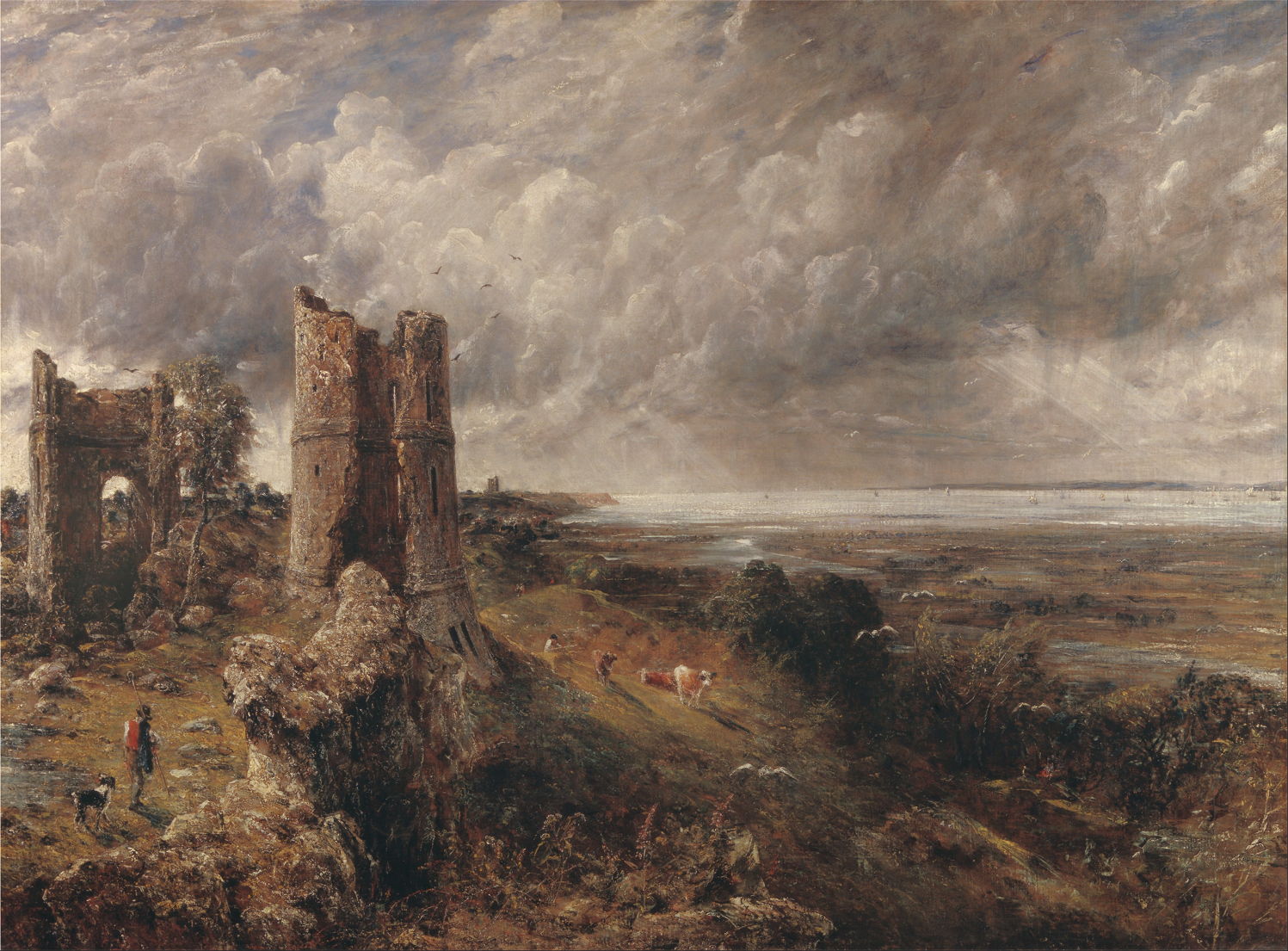
John Constable (1776–1837), Hadleigh Castle, The Mouth of the Thames – Morning after a Stormy Night (1829), oil on canvas, 121.9 x 164.5 cm, Yale Center for British Art, New Haven, CT, https://collections.britishart.yale.edu/catalog/tms:5001 Wikimedia Commons.

By the finished work, the splendid Hadleigh Castle, The Mouth of the Thames – Morning after a Stormy Night (1829), the basic disposition of those figures has changed little, but Constable has changed each to suit his image. The shepherd, still carrying his long crook, is separated from his dog, and has lost his sheep, which have become scattered rocks. The single cow on the sloping grass has gained a couple of friends and a cowherd. Beyond them are another couple of tiny specks of figures, and there are more by the wood in the lower right corner.

His contemporary JMW Turner was just as addicted to sketching, using various media including oil paint and watercolours. However, in his later years the techniques he used in sketching extended into the works he showed to the public.

turnerseapiecefishingboats
Joseph Mallord William Turner (1775–1851), Seapiece with Fishing Boats off a Wooden Pier, a Gale Coming In (date not known, possibly c 1801), oil on panel, 31.8 x 44.5 cm, Private collection. Wikimedia Commons.

For example, in his Seapiece with Fishing Boats off a Wooden Pier, a Gale Coming In, possibly from as early as 1801, Turner used extensive sgraffito, made using a knife, brush handle, or even his fingernails for all we know.

Snow Storm: Hannibal and his Army Crossing the Alps exhibited 1812 by Joseph Mallord William Turner 1775-1851
Joseph Mallord William Turner (1775–1851), Snow Storm: Hannibal and his Army Crossing the Alps (1812), oil on canvas, 146 x 237.5 cm, The Tate Gallery (Turner Bequest 1856), London. Photographic Rights Β© Tate 2018, CC-BY-NC-ND 3.0 (Unported), https://www.tate.org.uk/art/artworks/turner-snow-storm-hannibal-and-his-army-crossing-the-alps-n00490

One of JMW Turner’s most radical early works, showing Snow Storm: Hannibal and his Army Crossing the Alps, from 1812, marks the start of his departure from convention.

turnerslaveship
Joseph Mallord William Turner (1775–1851), Slave Ship (Slavers Throwing Overboard the Dead and Dying, Typhoon Coming On) (1840), oil on canvas, 90.8 Γ— 122.6 cm, Museum of Fine Arts, Boston, MA. Photo by Museum of Fine Arts, Boston, via Wikimedia Commons.

By 1840, in his famous Slave Ship, also shown in detail below, everything is assembled from marks, from its blood-red sky and violent sea to the ghastly evidence in the foreground.

turnerslaveshipdet
Joseph Mallord William Turner (1775–1851), Slave Ship (Slavers Throwing Overboard the Dead and Dying, Typhoon Coming On) (detail) (1840), oil on canvas, 90.8 Γ— 122.6 cm, Museum of Fine Arts, Boston, MA. Photo by Museum of Fine Arts, Boston, via Wikimedia Commons.
Snow Storm - Steam-Boat off a Harbour's Mouth exhibited 1842 by Joseph Mallord William Turner 1775-1851
Joseph Mallord William Turner (1775–1851), Snow Storm, Steam Boat off a Harbour’s Mouth (1842), oil on canvas, 91.4 x 121.9 cm, The Tate Gallery (Accepted by the nation as part of the Turner Bequest 1856), London. Photographic Rights Β© Tate 2016, CC-BY-NC-ND 3.0 (Unported), http://www.tate.org.uk/art/artworks/turner-snow-storm-steam-boat-off-a-harbours-mouth-n00530

Several of Turner’s late masterpieces including Snow Storm, Steam Boat off a Harbour’s Mouth from 1842, turn the whole canvas into a vortex, with the subject emerging near the centre.

turnerrainsteamspeed
Joseph Mallord William Turner (1775-1851), Rain, Steam, and Speed – The Great Western Railway (1844), oil on canvas, 91 x 121.8 cm, The National Gallery (Turner Bequest, 1856), London. Courtesy of and Β© 2018 The National Gallery, London.

These peaked in Turner’s famous painting of a Great Western Railway train crossing the River Thames at Maidenhead: Rain, Steam, and Speed, exhibited at the Royal Academy in 1844. The whole image is fogbound and vague, and proved a precursor to the approach adopted by the Impressionists after his death.

We have come a long way since the Venetian pioneers of the sixteenth century.