
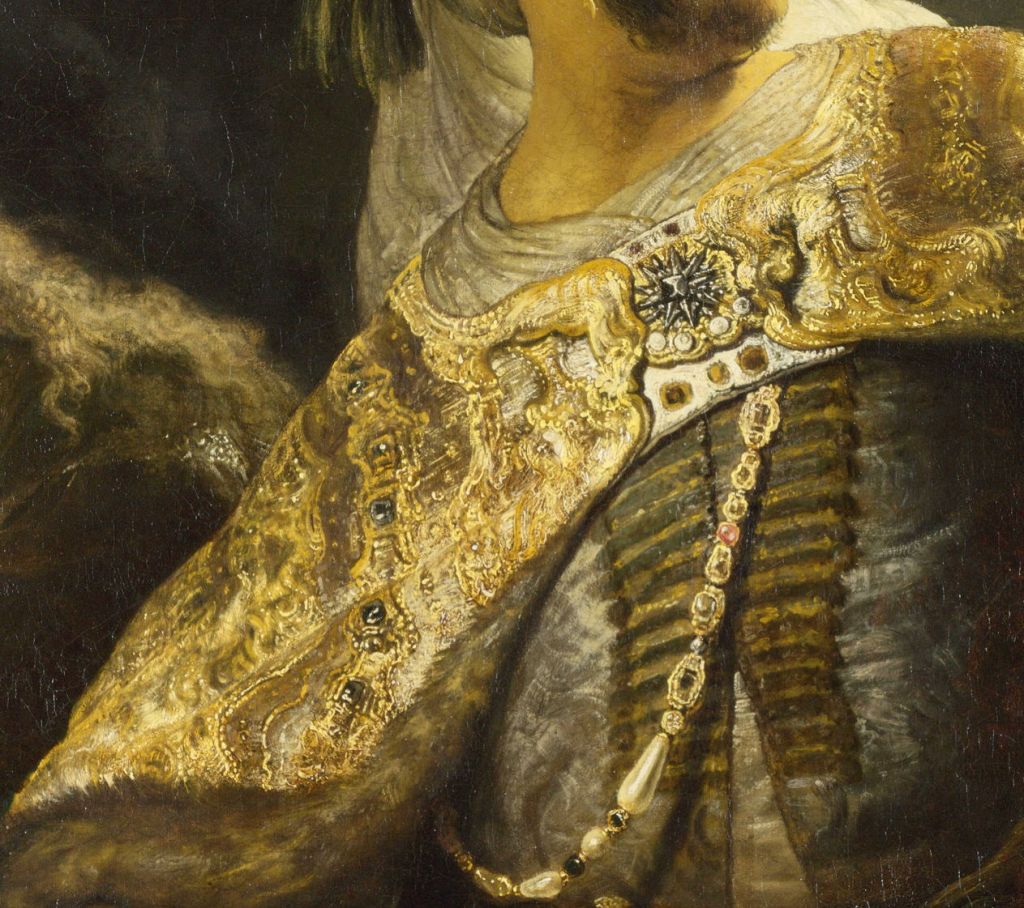
By the late sixteenth century, well-known painters were showing their brushstrokes in textures of fabrics and hair, but flesh and most other details continued to be rendered precisely. This was to change again in the early seventeenth century, in the paintings of El Greco, Rubens and Rembrandt.
El Greco was originally Greek, and his real name was Doménikos Theotokópoulos (Δομήνικος Θεοτοκόπουλος), but he was born on the island of Crete when it was a Venetian colony. He trained in post-Byzantine art there, and travelled to Venice in about 1567. In 1570 he moved to Rome, and finally settled in Toledo, Spain, in 1577, when he was 36. Thus his tendency towards colorito rather than disegno may be the result of his Venetian training.
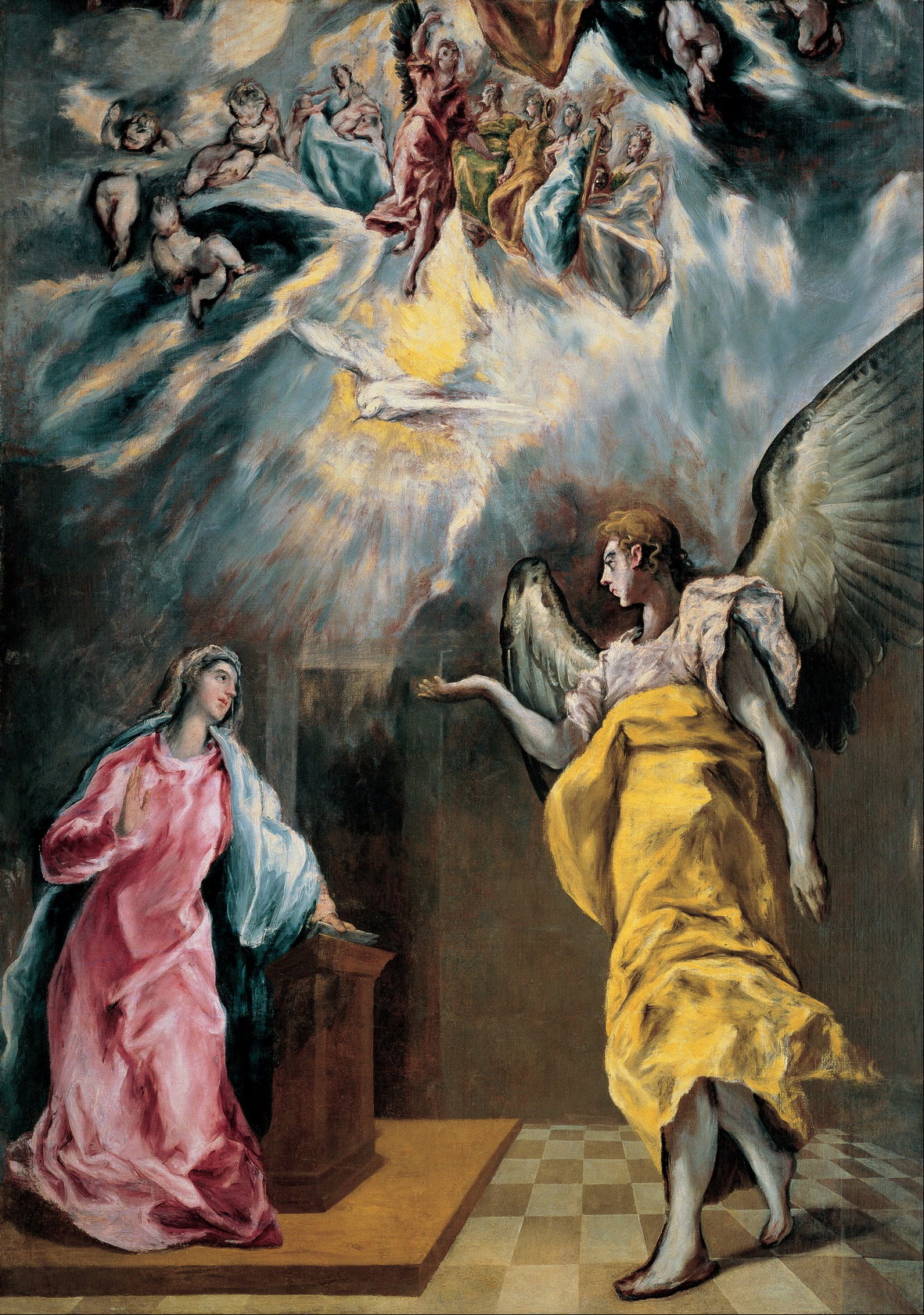
El Greco’s Annunciation (1614) is obviously rich in visible brushstrokes, particularly in its fabrics, and the heavenly host above.

More detailed examination of those figures in the heavens shows how sketchy they are, with an abundance of visible marks.

Another of his late works, The Vision of Saint John (1608-14) is quite unlike anything being painted by others at the time, and bears obvious marks in several passages, particularly those depicting fabrics.

This detail shows the rich brushstrokes in fabrics, and in the sky.
Peter Paul Rubens is at his most painterly in the many oil sketches he left as evidence of his much looser style.

This breathtaking study of Two Sleeping Children (c 1612-13) looks much later and looser than his finished works. Looking at the detail of the bedclothes below, there are abundant marks visible. In textiles and fabrics his marks give a natural feel to the material.

A further example is in Rubens’ study showing the Expulsion from the Garden of Eden (1620), where we don’t even need to look at details to see his marks.
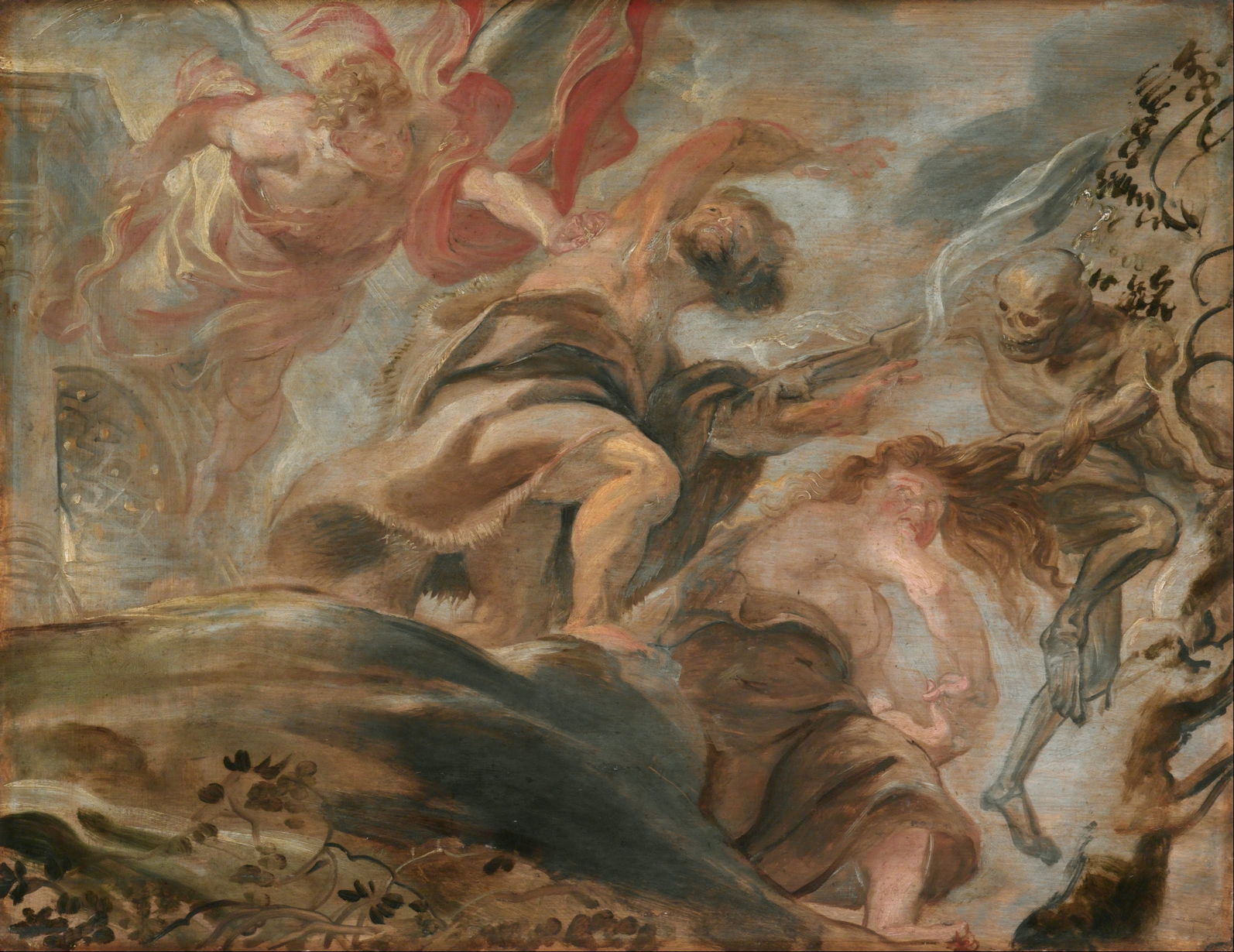
My final painting from Rubens is an oil sketch, or modello, that he made of Aurora abducting Cephalus (c 1636), for one of a series of works commissioned by Philip the Fourth of Spain to decorate his hunting lodge just outside Madrid.

His marks are even more obvious in the detail view below, where they’re most prominent in fabrics.

The other Master whose work shows brushstrokes like no other until the nineteenth century is Rembrandt. Best-known for his large and highly-finished paintings, a unique exhibition of his late works in Europe in 2014-15 showed how radical were his changes in style.
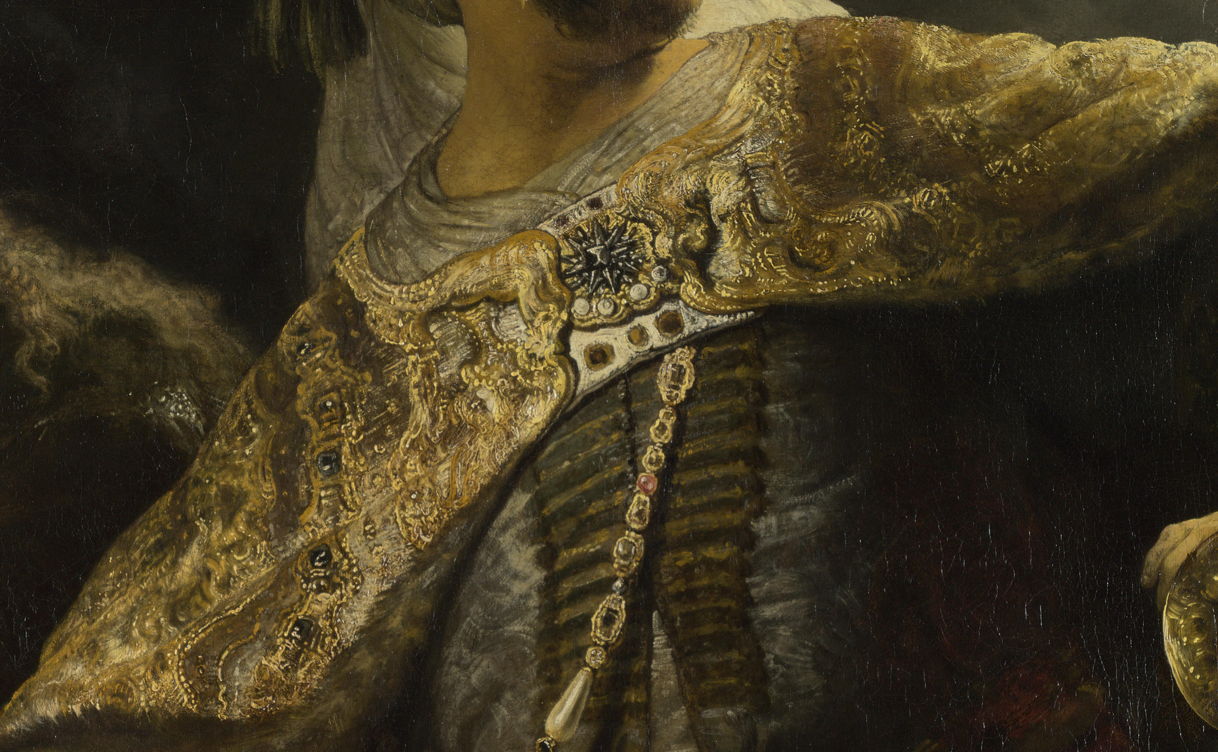
These started when he was still enjoying commercial success, during his marriage to Saskia, as shown in this detail of some of the fabric of clothing in Belshazzar’s Feast (c 1635-8).

His mark-making increased, both in the passages in which he left visible marks, and in the surfaces which he marked, right up to his death. It appears in the hands of the elderly, the glint of a knife, but above all in fabrics, as shown in the detail below of The Jewish Bride of about 1667.
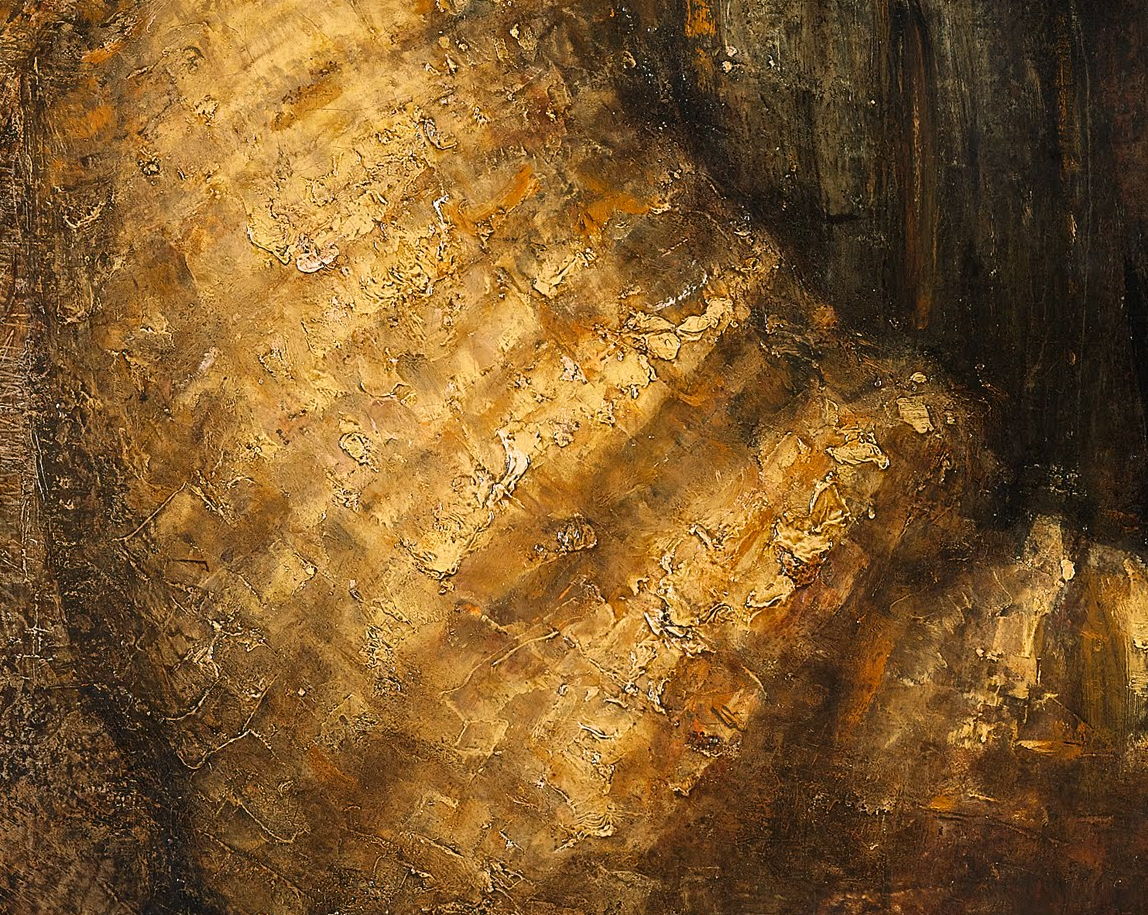
Inevitably, this led to criticism for making his paintings ‘so coarse’, just as was going to happen two centuries later to Monet and his colleagues. For, as far as I can tell, Rembrandt was the first major artist to intentionally leave prominent passages in finished paintings with obvious brushstrokes and other marks. Their visual effect is stunning.
References
Bikker J & Weber GJM et al. (2014) Rembrandt, the Late Works, Yale UP. ISBN 978 18 5709 557 9.
Sutton P, Wieseman ME, van Hout N (2004) Drawn by the Brush, Oil Sketches by Peter Paul Rubens, Yale UP. ISBN 978 0 300 106268.
Sohm PL (1991) Pittoresco: Marco Boschini, his Critics, and their Critiques of Painterly Brushwork in Seventeenth- and Eighteenth-Century Italy, Cambridge UP. ISBN 978 0 5213 8256 4.
 The Eclectic Light Company