

Early in his career, Peter Paul Rubens (1577–1640) had collaborated with some of the greatest landscape painters of the day, in particular Jan Brueghel the Elder, who painted landscape passages in some of the greatest works of Rubens’ younger years.

By about 1625, Rubens was painting his own landscape settings, as seen in this Stormy Landscape with Philemon and Baucis. Stormclouds are building over its hills, with bolts of lightning, a raging torrent pouring down the mountainside, and the four figures on a track at the right. Philemon and Baucis are struggling up the track with their sticks, Jupiter points to a rainbow formed over a waterfall at the lower left corner, and Mercury is all but naked. Several prominent trees feature details of rich lichen growth on their trunks and branch structure that must have been based on studies from life.
By 1635 Rubens wanted to retire. His second wife was still in the bloom of youth at the age of 21, he was feeling the effects of his many years of hard work painting commissions, and was fast approaching sixty. He was rich enough to be able to buy himself a comfortable estate just to the south of Antwerp, and wanted a few years to enjoy life with his family, which continued to grow: his last child was born eight months after his death.
He couldn’t stop painting, though, and clearly kept himself busy in his studio there, producing some of the most wonderful works of his career, mainly landscapes. What he created then was an important influence on future generations, including Thomas Gainsborough and British artists through John Constable.
Far from the pressures of commissions, and their patrons, Rubens was able to make careful observations of nature, the natural world, and some of the transient effects of light that are all too often taken for granted. He still painted these works in the studio, on sometimes substantial oak panels made for him through his Antwerp workshop, but based them on many superb drawings and gouache studies made in front of the motif.

This example, known simply as Landscape, is a careful and detailed sketch in gouache of a group of trees on the bank of a small river, painted during his retirement. The evidence from the tree in the mid-right is that he constructed them anatomically, by putting in the structural curves and lines of the branches, then laying down areas of foliage, a method developed during the Renaissance and still widespread today.
Rubens assembled these details into carefully composed and somewhat idealised views. They are more true to a given location than, say, Poussin’s landscapes, but less than Constable’s. Because they were not documented commissions, but private works, there remains considerable uncertainty of the dates of these paintings, but the six I show below are generally agreed as works painted between 1635 and Rubens’ death in 1640. In which order he painted them is a matter of speculation.

Evening Landscape with Timber Wagon (1635-40) is a smaller panel, now in Rotterdam, suggestive of much later works by Gainsborough and even Constable. The sky is starting to darken with a small pink glow from the setting sun, and birds are returning to their nests. A man drives his timber wagon down into a ford, as he grows near to home, and his evening meal. Its large clumps of trees dominate the scene, and it opens out behind them to farmland.
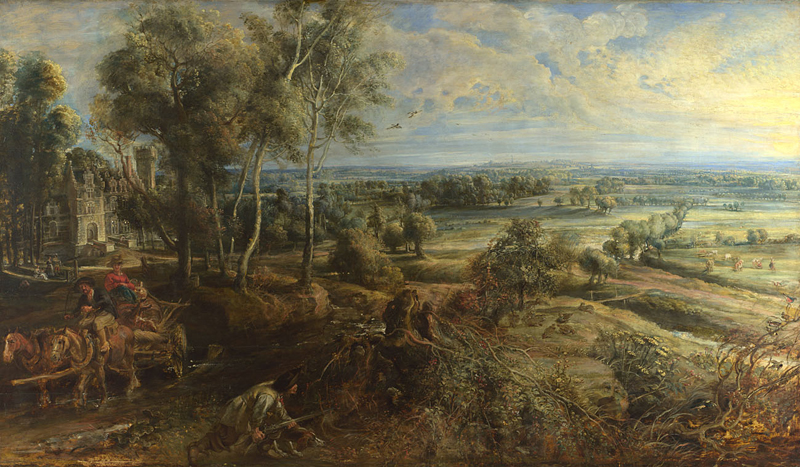
An Autumn Landscape with a View of Het Steen in the Early Morning (c 1636) is one of the larger panels, now in The National Gallery in London. As the sun is rising off to the right, a man drives a cart, on top of which a woman is perched precariously, away from Ruben’s castellated mansion. Beside that stream, a hunter is stalking game with his gun and dog.
The left third of this view is dominated by trees with high crowns, implying the area around Rubens’ mansion was formerly dense deciduous woodland, in contrast to the open fields on the right and into the distance.

Landscape by Moonlight (1635-40) is a medium-size panel, now in The Courtauld Institute, London, and one of the most exciting of the group. I am sorry that the only available image doesn’t do justice to this stunning nocturne, again set in the mixed pasture and woodland of the country near Antwerp.
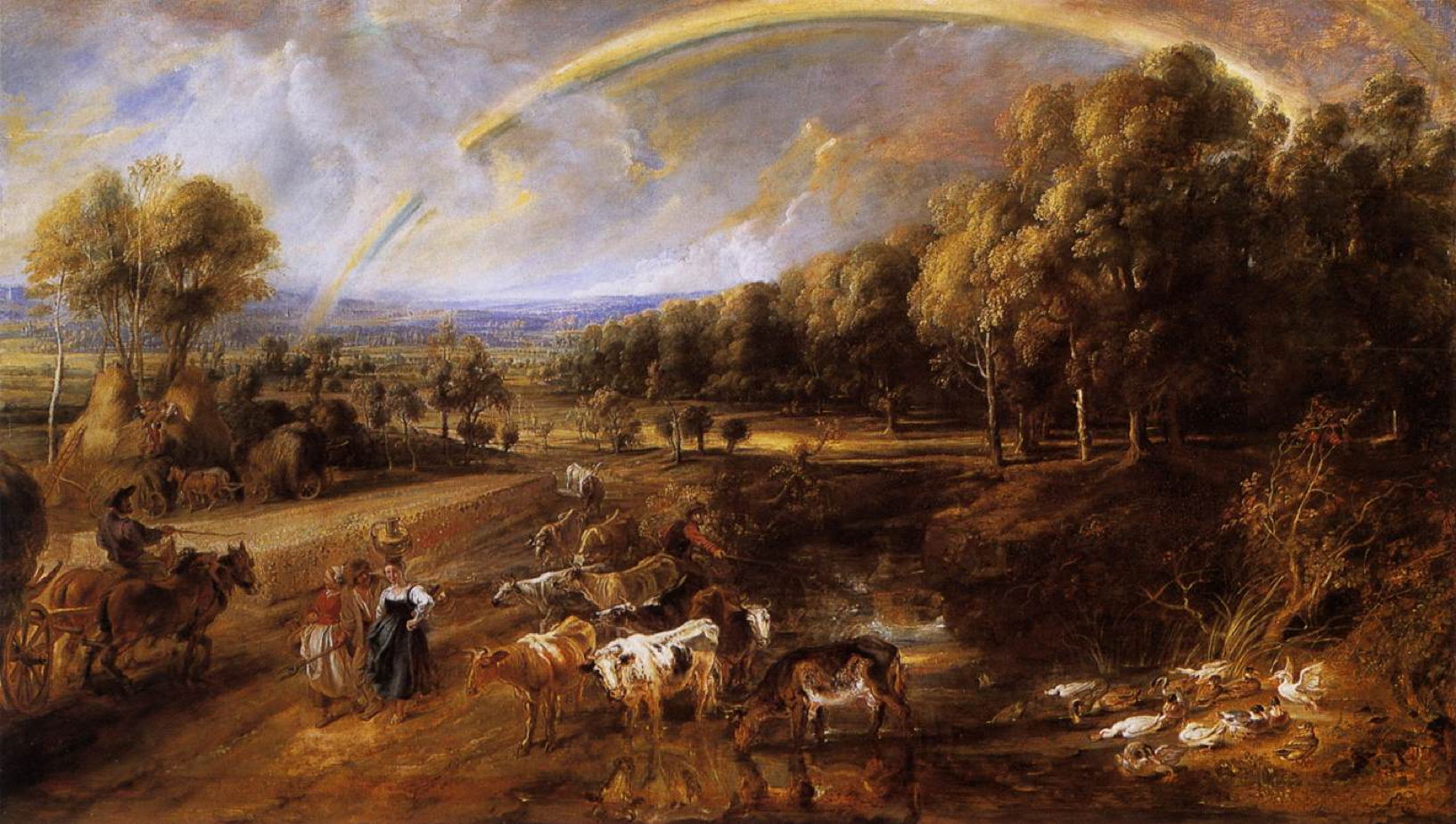
Landscape with a Rainbow (c 1638) is another of the larger panels, in the The Wallace Collection in London. Here Rubens shows the countryside, and its people, at work. At the left, the harvest is in full swing, with haystacks being constructed. The wagoner passes by a couple of young women, one of whom is carrying a vessel on her head, and being propositioned by a man.
In the centre foreground, a small herd of cows are being controlled by their herdsman, while at the right is a gaggle of geese and ducks by the river. Above all this the sky is full of one of nature’s great spectacles: a rainbow, as a series of showers sweep across the gently rolling meadows and the edge of dense woodland below.

Landscape with the Return from the Harvest (c 1637) is one of the larger panels, in the Palazzo Pitti in Florence. When this image was made it was in need of cleaning, but it shows another arrangement of country people on their way back after a hard day’s work at the harvest. Trees on the right are lining what appears to be a broad ditch or small river.
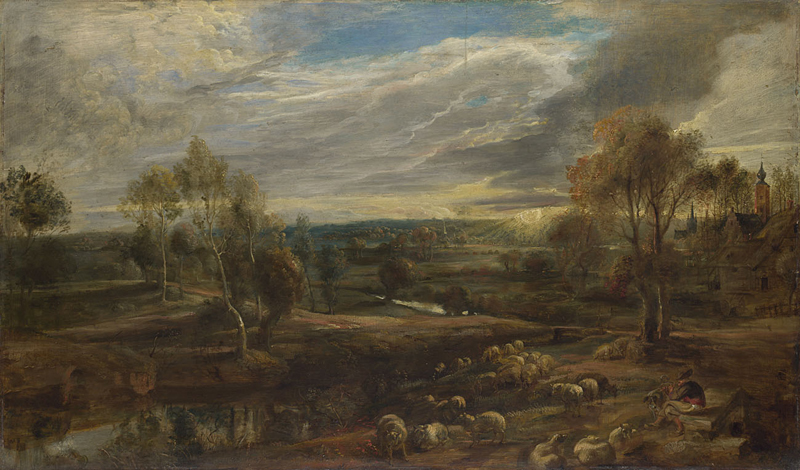
A Landscape with a Shepherd and his Flock (c 1638) is a smaller panel, also in The National Gallery in London, showing a pastoral view perhaps at the back of Het Steen, as the sun is low in the sky. The high crowns of many of its trees suggest they’re the relics of dense woodland from the Middle Ages.

