
Shortly after Edward Lear had returned from India, and at the end of Vasily Vereshchagin’s visit, the prolific traveller and botanical artist Marianne North (1830–1890) visited in 1877-79, as she was returning from a trip to south-east Asia and the Indonesian Archipelago.
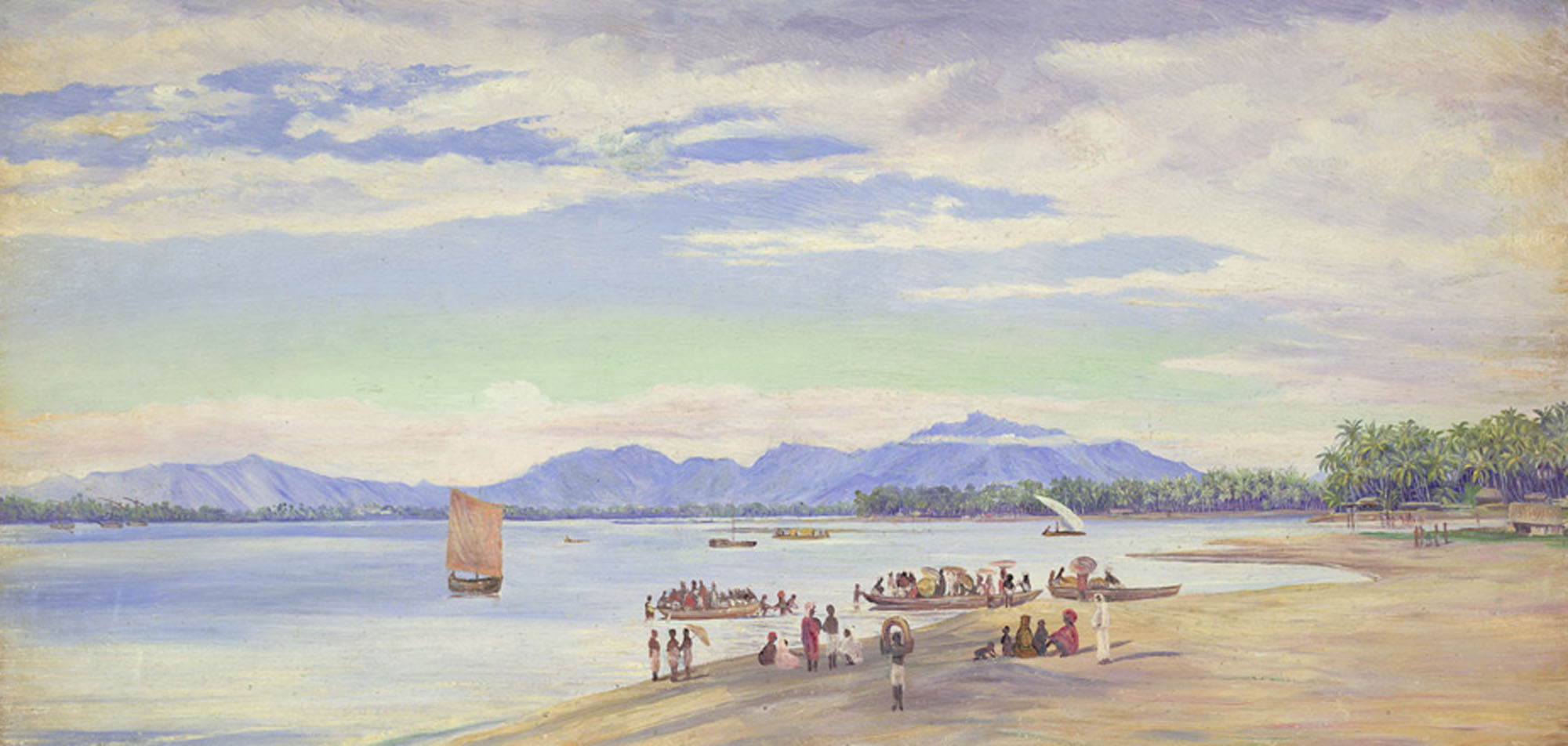
When North visited India, she stayed for a while in the west coastal resort of Beypore, India (c 1877-79), in the state of Kerala. She rented a large room over the railway station, just a hundred yards from the water of the Indian Ocean. It appears idyllic.
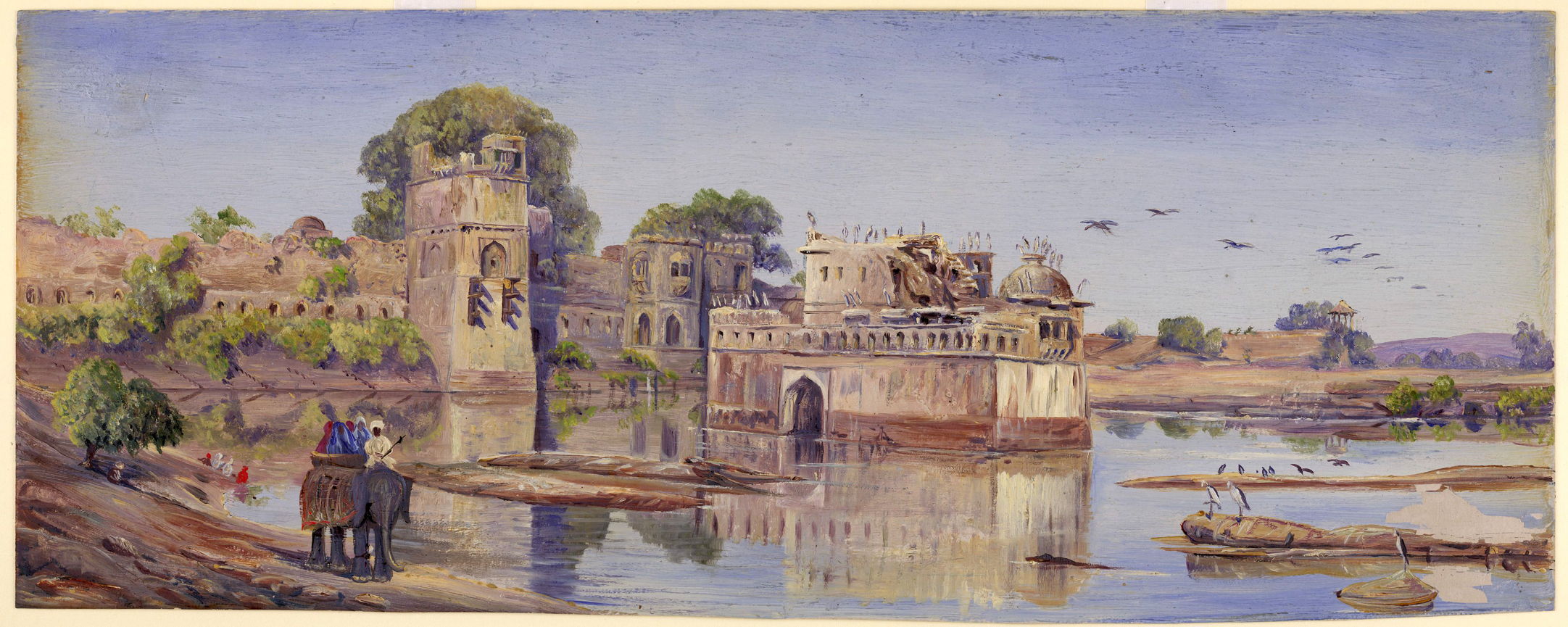
In the north-west, she visited the city of Chittaurgarh in Rajasthan, where she painted Water Palace – Chitore. India in December 1878. This city is centred on its major fort, which dates back to the seventh century CE, and has two major palaces, Rana Kumbha’s and Rani Padmini’s, the latter being shown here. Padmini was a legendary queen of the 13th to 14th centuries.
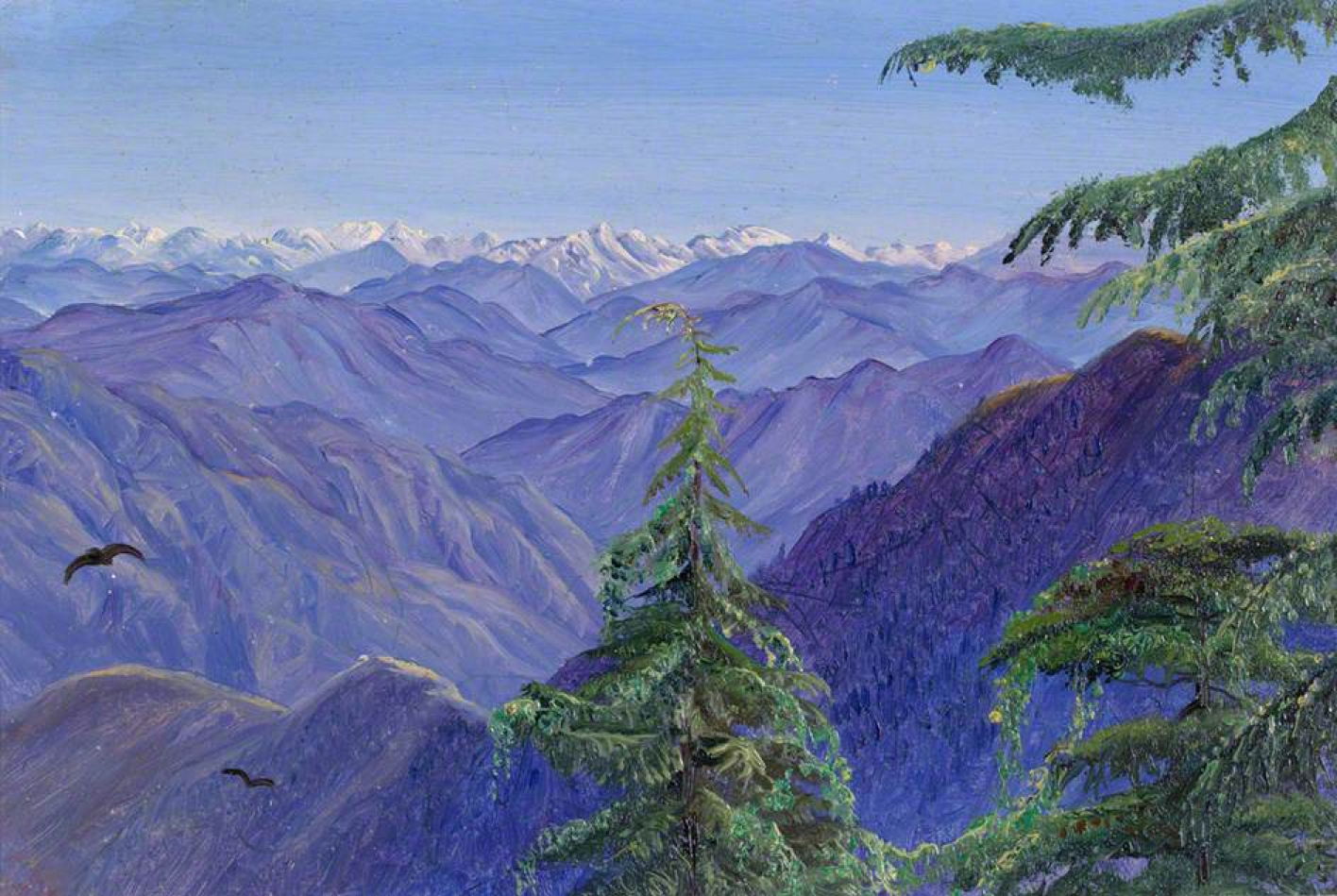
North’s breathtaking mountain view From Nahl Dehra near Simla (Shimla), Himachal Pradesh, India (1878) shows the rugged hills near the capital city of Himachal Pradesh, in the Western Himalaya. From 1864, that city was the summer capital of British India because of its far more equitable climate.

Mount Everest or Deodunga from Sundukpho, North India (c 1878) is another impressive view of the Himalaya. Deodunga has been used by several of the British in India as the name of the world’s highest mountain before it was renamed.
Valentine Cameron Prinsep (1838–1904) was born in Kolkata (then Calcutta), India, to a British colonial family. One of his aunts was Julia Margaret Cameron, the pioneer photographer who lived near Alfred, Lord Tennyson’s home on the Isle of Wight. Another was the grandmother of Virginia Woolf, the novelist, and Vanessa Bell, the Bloomsbury painter. The family home back in England was Little Holland House, the dower house to Holland House, in Kensington, London, and the focal point of a lively artistic social group.

In 1876 or 1877, Prinsep returned to India to research what was to become a huge painting of the Delhi Durbar, completed in 1880. The Durbar of 1877 was an official event marking the proclamation of Queen Victoria as Empress of India, although she didn’t attend in person, but was represented by her Viceroy. Unfortunately it coincided with the Great Famine, and came to mark the beginning of the campaign for a free India.
Among the other paintings he completed during that visit is Martaba, a Kashmiree Nautch Girl (c 1878), exhibited at the Royal Academy in 1878. Queen Victoria and her court had a particular fondness for portraits of ‘loyal subjects’ of the empire, and many are still on show at her former palace of Osborne House on the Isle of Wight, where she died.

Prinsep’s View of the Lal Darwaza on the Matwa Road, between the Purana Qila and Old City, Delhi around 1878, is a remarkably loose oil sketch, probably completed en plein air.
He eventually presented his huge painting of the Delhi Durbar to Queen Victoria, and it was hung in Buckingham Palace.
In 1913, the year before the start of the First World War, the American painter of skyscrapers Colin Campbell Cooper (1856–1937) and his artist wife Emma Lampert Cooper (1855–1920) travelled to India, apparently on a commission for an affluent woman patron in the USA. They visited, and painted in, what are now India, Pakistan, Sri Lanka and Myanmar.

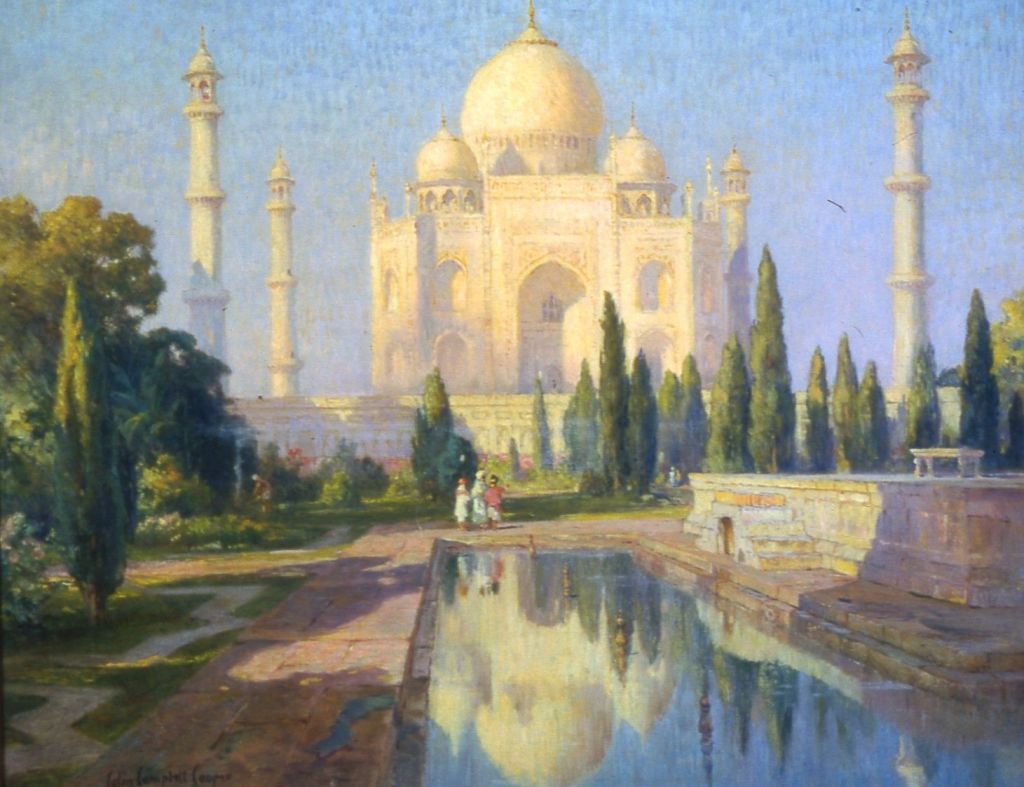
Taj Mahal, Afternoon (c 1913) is probably his best-known painting resulting from that trip, and on their return it was exhibited in Rochester, NY, in 1915. Shown here in warm low-angle light, Cooper deftly avoided the more usual perfectly symmetric view.
The last of my visitors also stayed the longest of them all. The Russian-American artist Nicholas Roerich (1874–1947) first took his family to Darjeeling in 1923 to start exploring the Himalaya. He met members of the 1924 British Everest Expedition there, before returning to the US later that year.
His first proper expedition to the Himalaya left New York in 1925 for Sikkim and Asia. Over the next 4-5 years, he, his family and six friends travelled through Punjab, Sikkim, the Karakoram Mountains, the Altai Mountains, Mongolia and Tibet. Their official mission was to act as the embassy of Western Buddhism to Tibet, but they also had scientific and artistic purposes. For a year, between 1927-28, the expedition was believed to have been lost, after it had been attacked in Tibet and detained there by the local government. They were confined for months in extreme conditions and with minimal rations, during which five members of his team died.
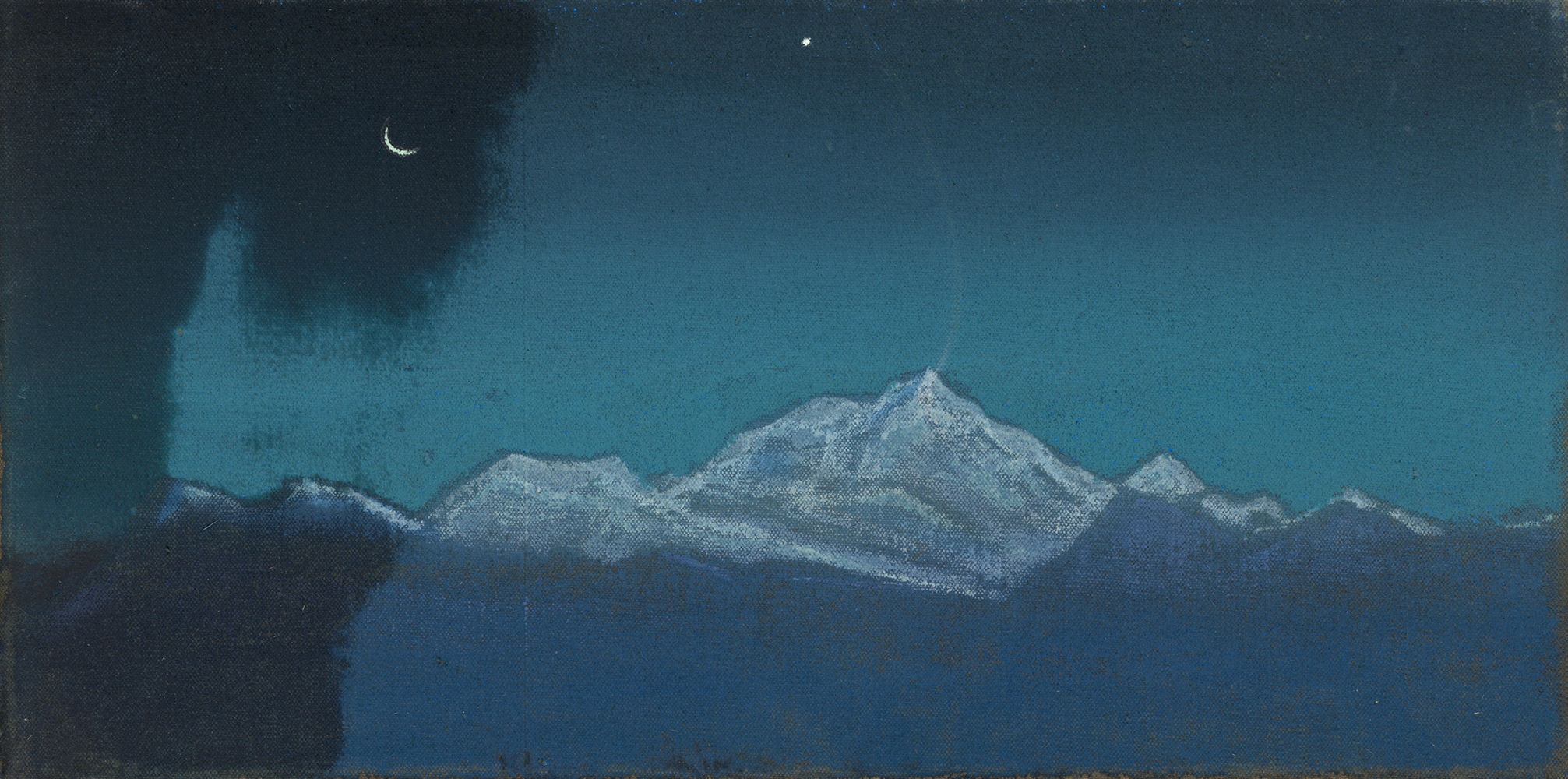
Himalayas, Sikkim (c 1928-29) appears to be a ‘tempera’ sketch made on canvas in the Himalaya. This is now an Indian state bordering on Tibet and Nepal, and includes Kangchenjunga.
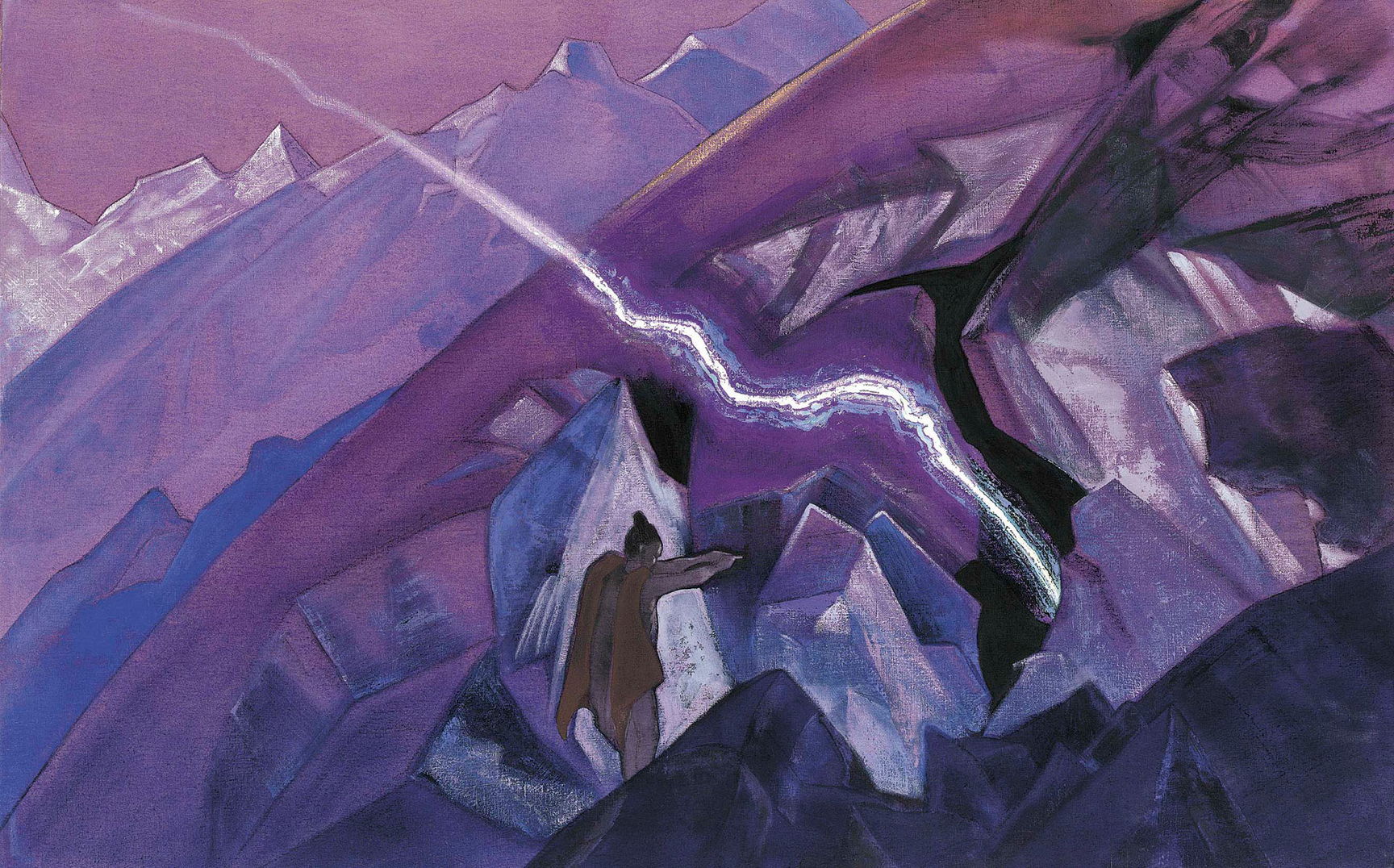
Roerich painted several series using mountain scenes which he may have derived from the many views he sketched during his expeditions. Arjuna, from his Kulu series, was painted in 1929-30, and shows the main protagonist from the Sanskrit epic Mahabharata with a bolt of lightning among Himalayan peaks.
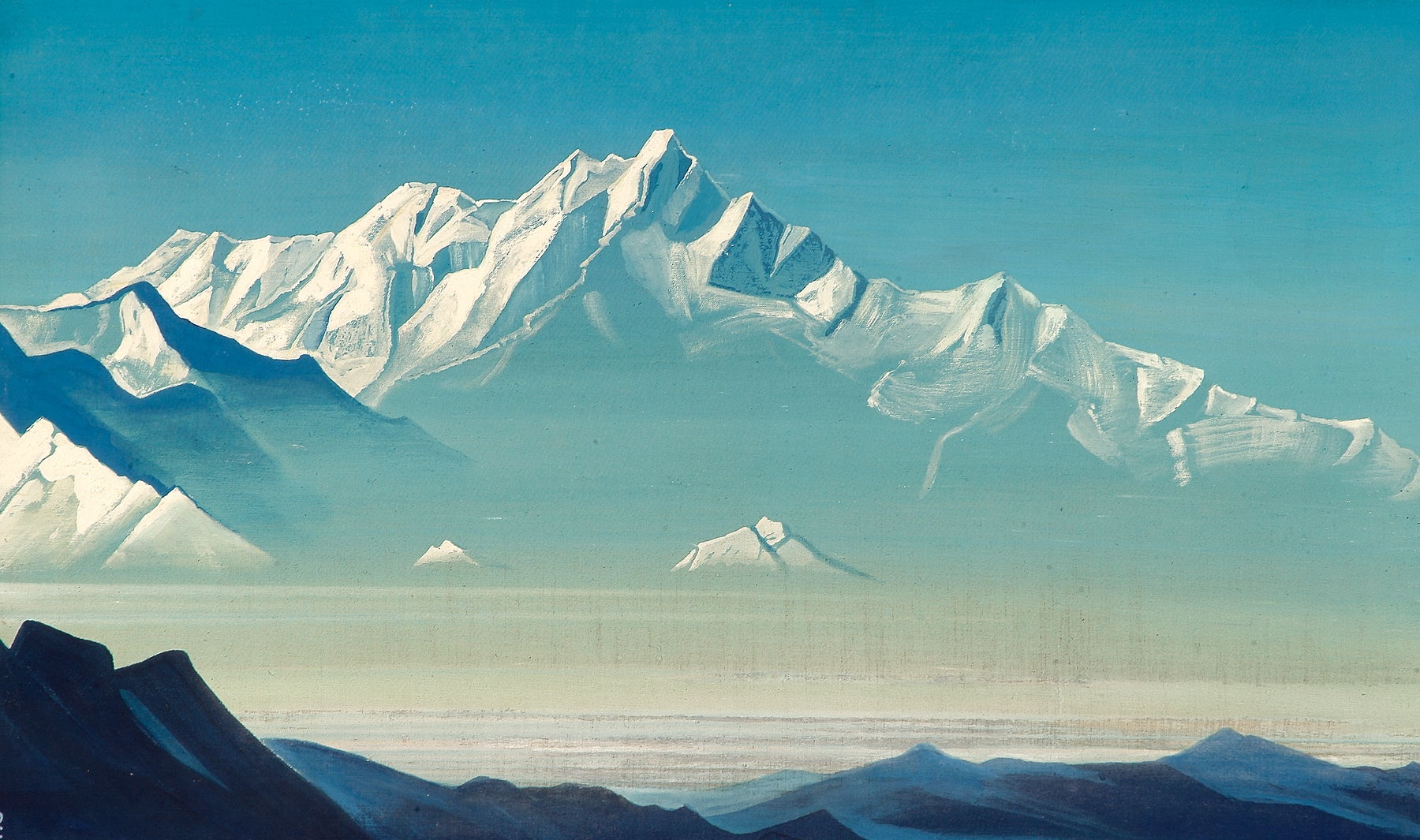
Mount of Five Treasures (Two Worlds), from his Holy Mountains series, was painted in 1933, and probably shows Kanchenjunga again.
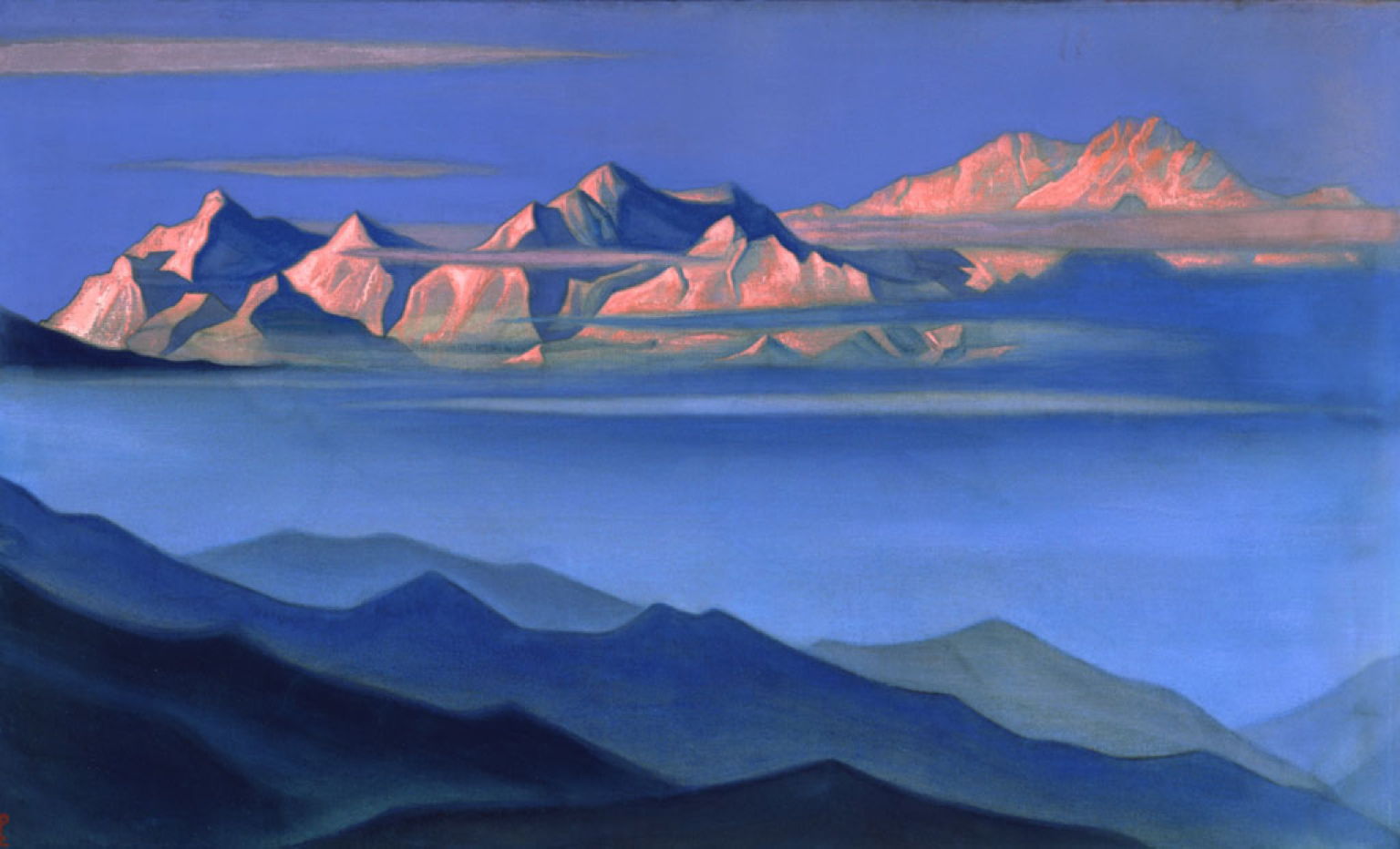
Roerich painted this superb view of the distant mountain Kanchenjunga in 1944, when he was living in India. This view may have been painted in Darjeeling, and shows the mountain in the rich light of dusk.
Roerich died in Kullu, Himachal Pradesh, India, in 1947.
Of course the Indian sub-continent has a long and rich painting tradition of its own. To end with, here are two classical works to enjoy.
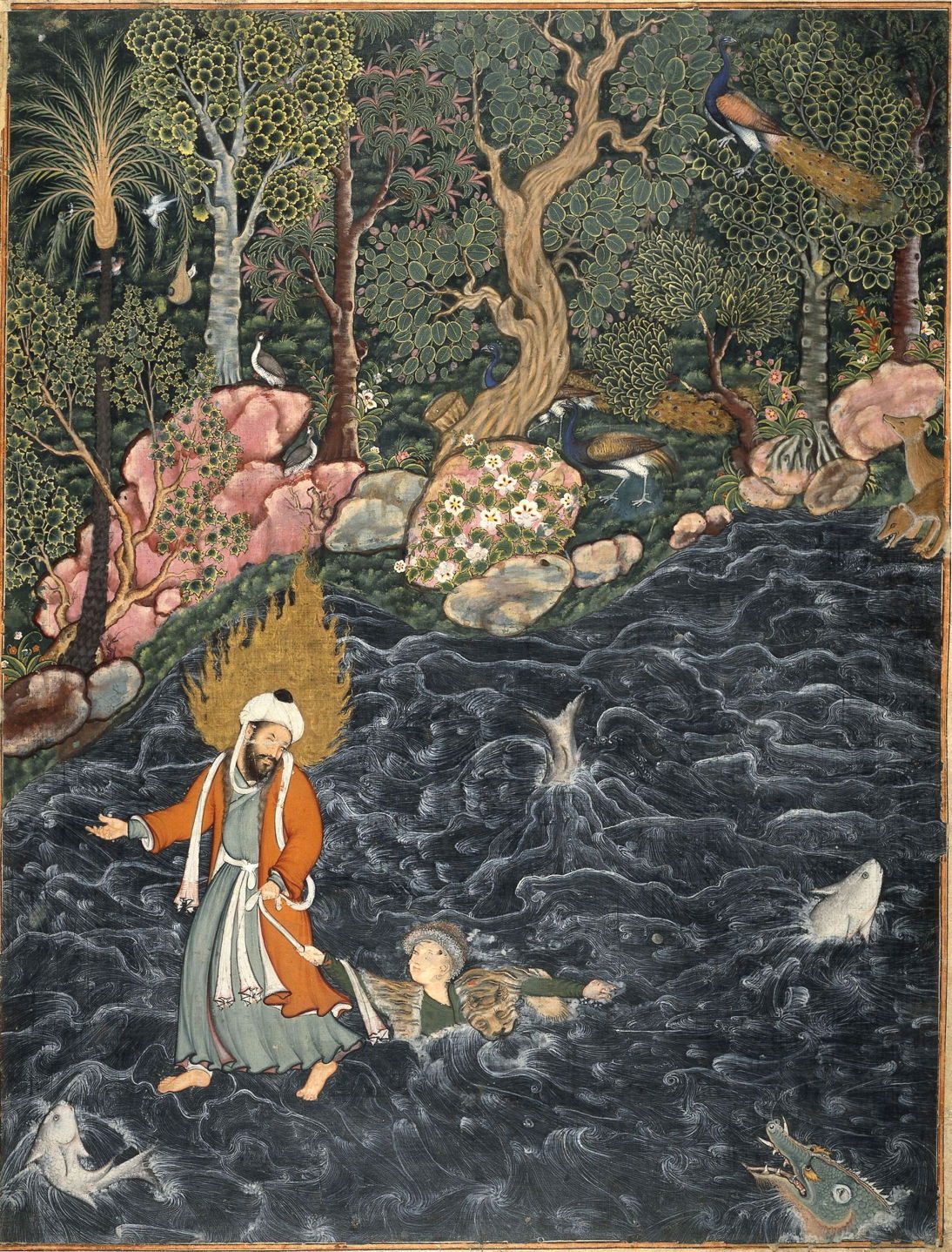
This is a miniature from the Hamzanama Manuscript dated to about 1567-72, and shows The Prophet Ilyas Rescues a Prince.
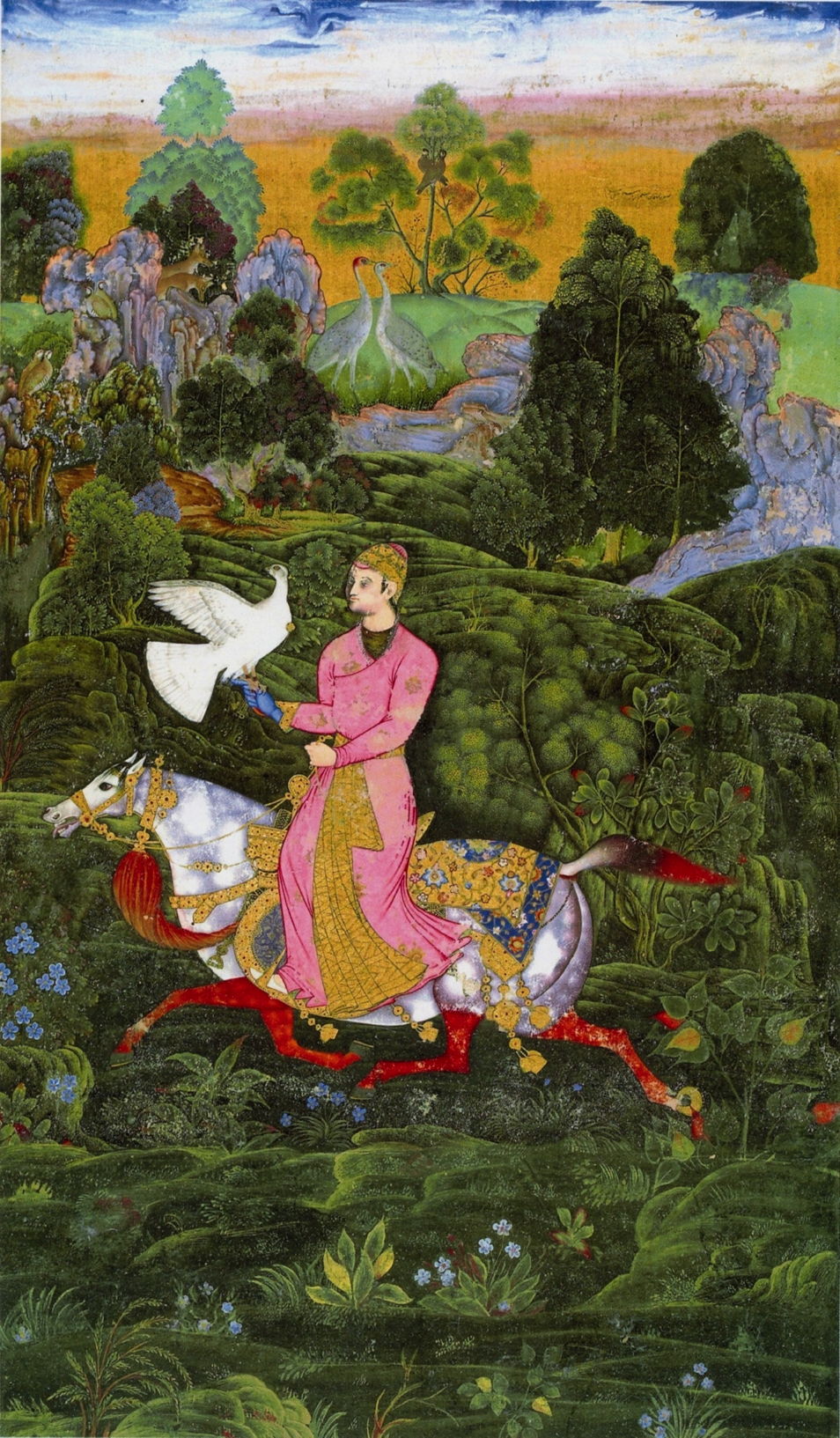
This watercolour by Farrukh Beg shows Ibrahim Adil Shah Hawking, and was painted in about 1590-95.

