
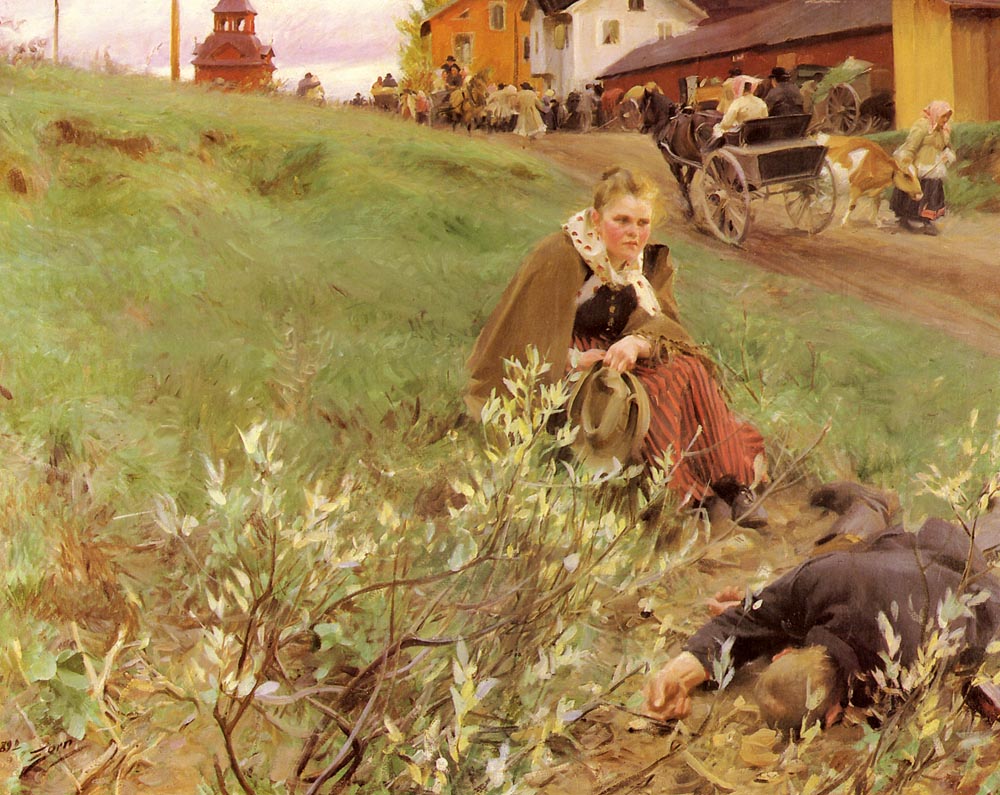
Many Naturalist artists continued to paint in the style until late in their career, but two younger aspiring painters passed through a phase of Naturalism on their way to greatness in the early twentieth century, Joaquín Sorolla in Spain, and Anders Zorn in Sweden. Neither is now generally recognised as having been Naturalist at that time, though.
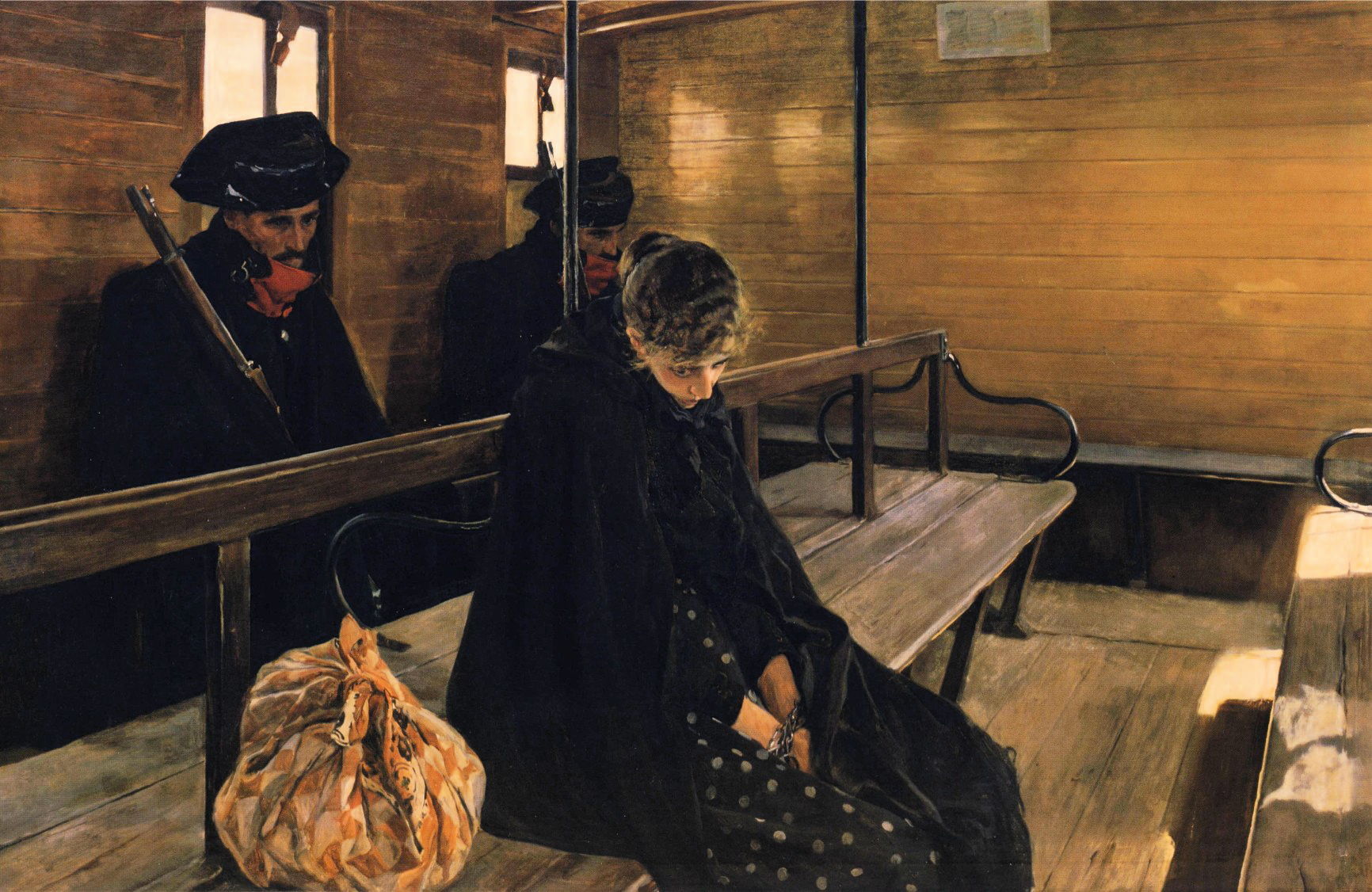
Sorolla had his first great success with a gold medal at the 1892 National Exhibition in Madrid, for Another Marguerite! which went on to win first prize at a Chicago International exhibition.
A young woman sits, hunched up and dejected, with chains around her wrists and her possessions tied up in a small bundle next to her. Sat behind her in the cattle-class compartment of the railway train are two armed National Guards, near-identical figures who are escorting her in custody to face trial. She appears already to be sitting in the cell which awaits at her destination.
Sorolla’s title explains, with its reference to Gounod’s opera Faust (1859), itself based on Goethe’s Faust. There, Marguerite was seduced by Faust, made pregnant, and then killed her baby. The artist was apparently inspired to paint this in the summer of 1892 in Valencia, by a real-life episode in which he had seen a woman being transported in custody to face a tribunal for an identical charge.

And They Still Say Fish is Expensive! (1894) is set in the hold of one of the larger Valencian fishing vessels, amid spare tackle, a large barrel, and some of its catch. Two older men are attending to a youth, who appears to have been wounded, presumably as the result of an accident at sea. Around the boy’s neck is a pendant good-luck charm; he is stripped to the waist and pale, and one of the men is pressing a dressing against his abdomen. Lit from an open hatch at the top left, the painting has the immediacy of a photographic ‘snap’ and looks documentary.
Sorolla’s title is incisive social comment about the values of a society which is happy to see young boys go to sea to fish, putting their lives at risk so that those ashore can enjoy cheap seafood. This was painted during the summer of 1894, again in Valencia, and went on to great acclaim in the Paris Salon the following year, where it was bought for the Museo del Prado in Madrid.

Another painting that Sorolla exhibited successfully at the Salon in 1895 was White Slave Trade (1895), an epitome of the contemporary trade in prostitutes in Spain.
Set in a similarly bleak railway compartment to Another Marguerite, four young women are asleep while being transported in the care of a much older woman. In contrast to their guardian, who wears black, the young women are dressed in bright-coloured Valencian regional costumes, and wear fashionable shoes. Their few possessions are stacked on the bench at the right, and include a guitar. The ‘slave trade’ to which Sorolla’s title refers is, of course, the movement of prostitutes between brothels. This could have been from Valencia to the port of Cartagena, then over to Orán and Algeria, as suggested by Powell for example.
The theme of prostitution had been brought to the fore in Naturalism by the Norwegian painter and writer Christian Krohg, whose first novel published in 1886 had documented its problems in Oslo, and which he had depicted in Albertine in the Police Doctor’s Waiting Room (1885-87), a work Sorolla is unlikely to have seen, but may well have heard about.

Sorolla’s Portrait of Dr. Simarro at the Microscope from 1897 shows Doctor Luis Simarro Lacabra (1851-1921), who was an eminent psychiatrist in Madrid. He also undertook pioneering research looking at the fine structure of the brain. Among his many achievements was a modification of an established technique for staining microscopic sections of brain, which proved a major advance and an inspiration to the great Spanish neurohistologist Ramon y Cajal. This portrait was exhibited at the National Exhibition in Madrid in the same year.

Research, or under its original Spanish title of Una investigación o El Dr. Simarro en el Laboratorio, from the same year, goes on to look at Dr. Simarro at work in the laboratory among colleagues and students. He is here preparing specimens for microscopy, presumably using his staining technique. The table is covered with bottles of chemicals used in that process, and the chunky metal object in the centre foreground is a microtome, used for cutting very thin sections of tissue embedded in paraffin wax, prior to their staining, for study under the microscope.
Anders Zorn’s Naturalism flourished when he was painting the realities of country life in the rural town of Mora, Sweden, where he had been born and brought up.
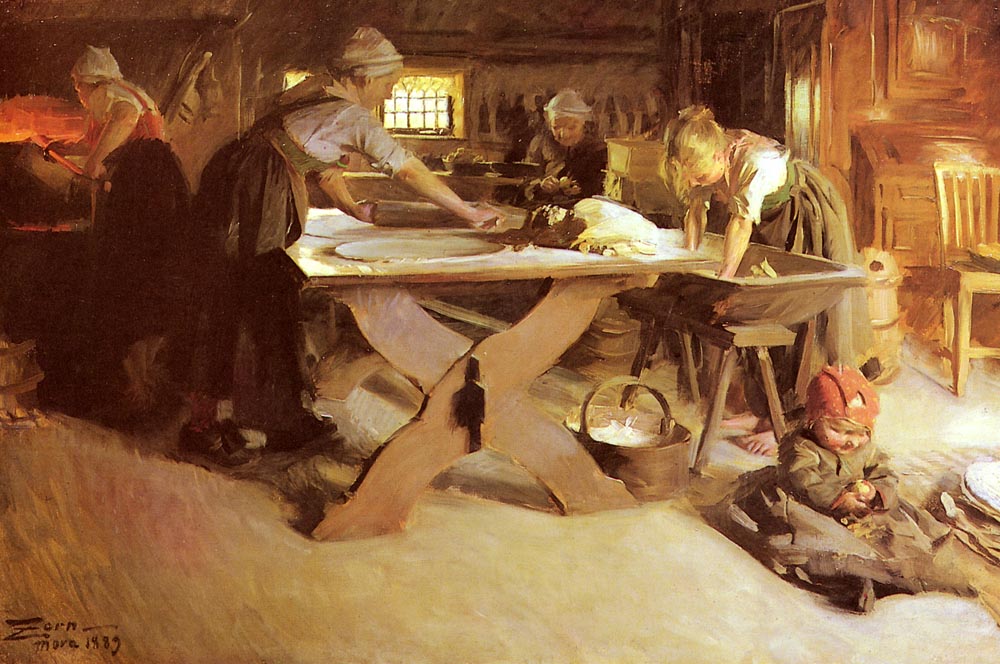
In Baking Bread, painted in Mora in 1889, Zorn captures each step in the process in documentary fashion, from kneading the dough, through rolling and preparing it, to its baking. There’s even an infant in the foreground who looks ready to consume it. This is painted in his characteristic limited palette derived from his transition to oils when he was in Saint Ives, Cornwall.
My favourite painting from this period in his career is another showing country events near his family home, at Mora Fair, from 1892. Against a background of crowds and carts going to and leaving the fair, a young woman sits looking completely fed up. Not far from her feet, her partner is slumped face down amid the weeds, presumably from an excess of alcohol.

A couple of years later, he stole some time from painting the rich and famous when he was staying in Venice, for some more serious work, here showing The Lace Makers (1894).

