
Mirror play in paintings isn’t uncommon, but there can be few major artists who have returned to it repeatedly over a period of more than forty years, as did Pierre Bonnard. In this article and its sequel tomorrow I show a selection of his work featuring reflections in plane mirrors.

The Lamp, from about 1899, is one of Bonnard’s earliest paintings featuring a reflection, here a complex world in miniature seen in a spherical glass part of a lamp. The reflection shows two of the lamp’s arms, one of the bottles of wine, and the bowl of fruit on the white tablecloth.
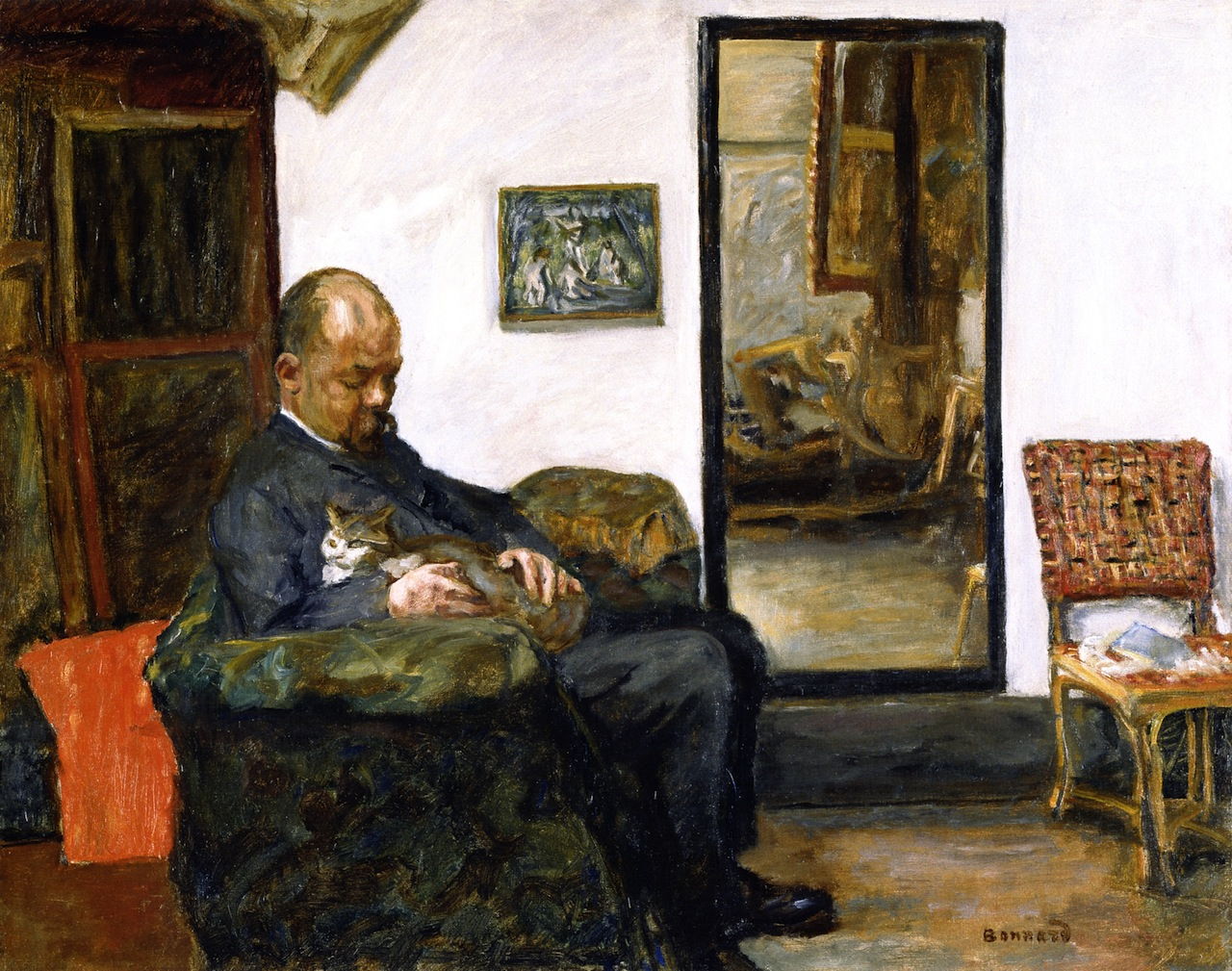
His portrait of Ambroise Vollard from about 1904-05 is perhaps his first use of a large planar mirror in a figurative painting. It shows some of the art dealer’s collection, including a painting on an easel. Here he uses the reflection to extend the field and scope of the painting.

In the early years of the twentieth century, Bonnard used mirrors and reflections in several paintings, including this Interior from about 1905. It is an unusual composition, with but a little of the woman’s back visible in the mirror; Bonnard instead shows the reflection of a chair placed in front of the mirror, and what appears to be the artist sat at a table.
His purpose in placing the chair in front of the mirror was, I think, to demonstrate that the artist’s eye is in line with the chair and with his own reflection, confirming that it is him who is sat at the table, although he doesn’t have an easel, neither is there any canvas or palette in sight.
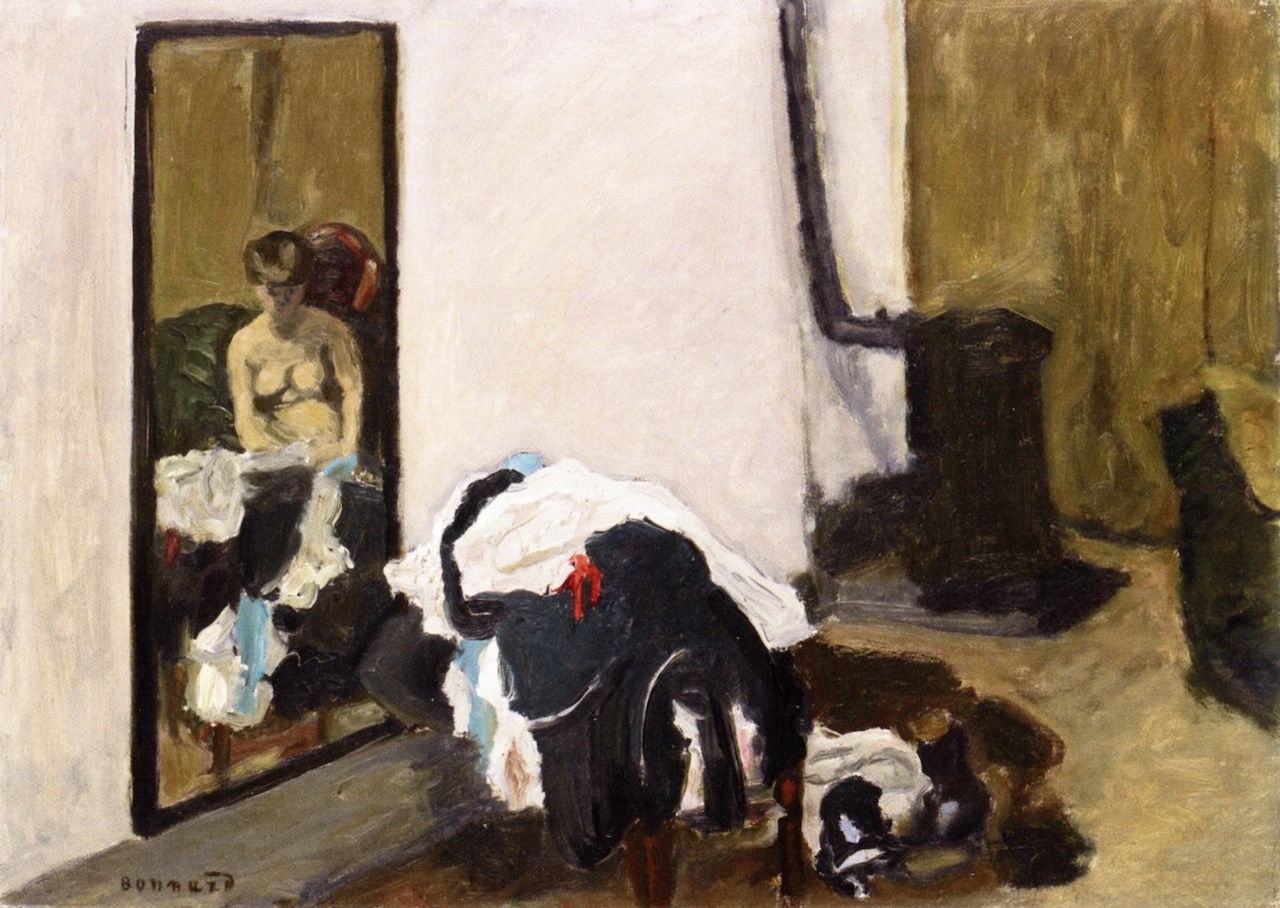
Woman Getting Dressed (1906) is a second example of Bonnard’s optical play with reflections. Dominating the centre of his canvas is a pile of women’s clothing on a low item of furniture, and a heater. A flat mirror at the left reveals the subject, who is sat beyond the right edge of the painting, getting dressed.
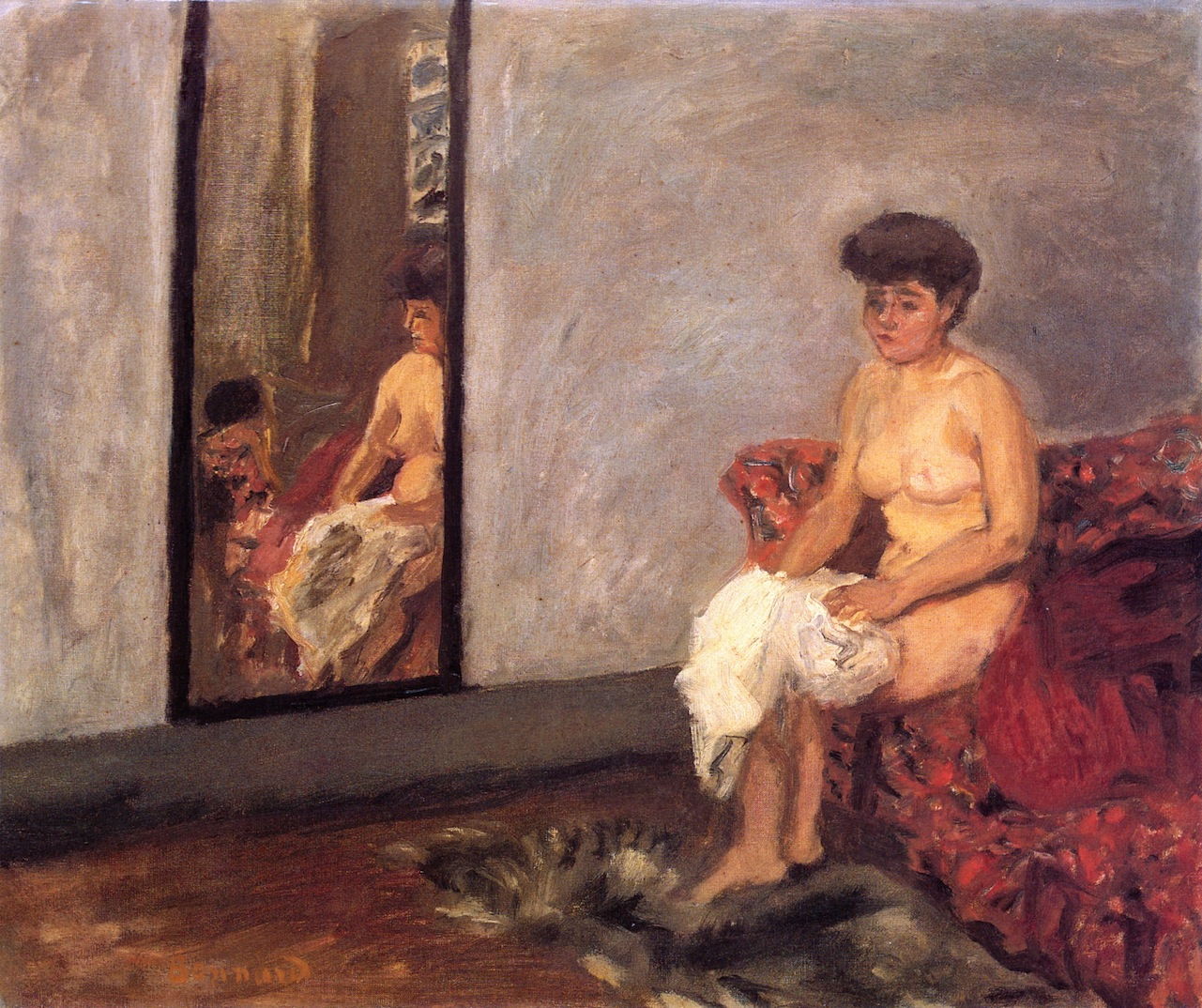
Bonnard continued to paint figures from models. Nude Seated on a Red Sofa (1908) engages in gentle mirror-play without the sophisticated compositions of previous years.

His intimate visual diary of Marthe’s life was becoming the focus of his development and innovation. In El Tocador, which means The Dressing Table (1908), Marthe’s headless torso is seen only in reflection. The direct view is of the large bowl and pitcher which she used to wash herself. This opens a new chapter of scenes shown in the mirror of a dressing table.

Mirror in the Dressing Room (1908) shows a similar dressing table and mirror, but in contrasting blue decor. A woman’s nude back and buttocks now appear in the mirror, as another woman sits at the left drinking a cup of coffee.
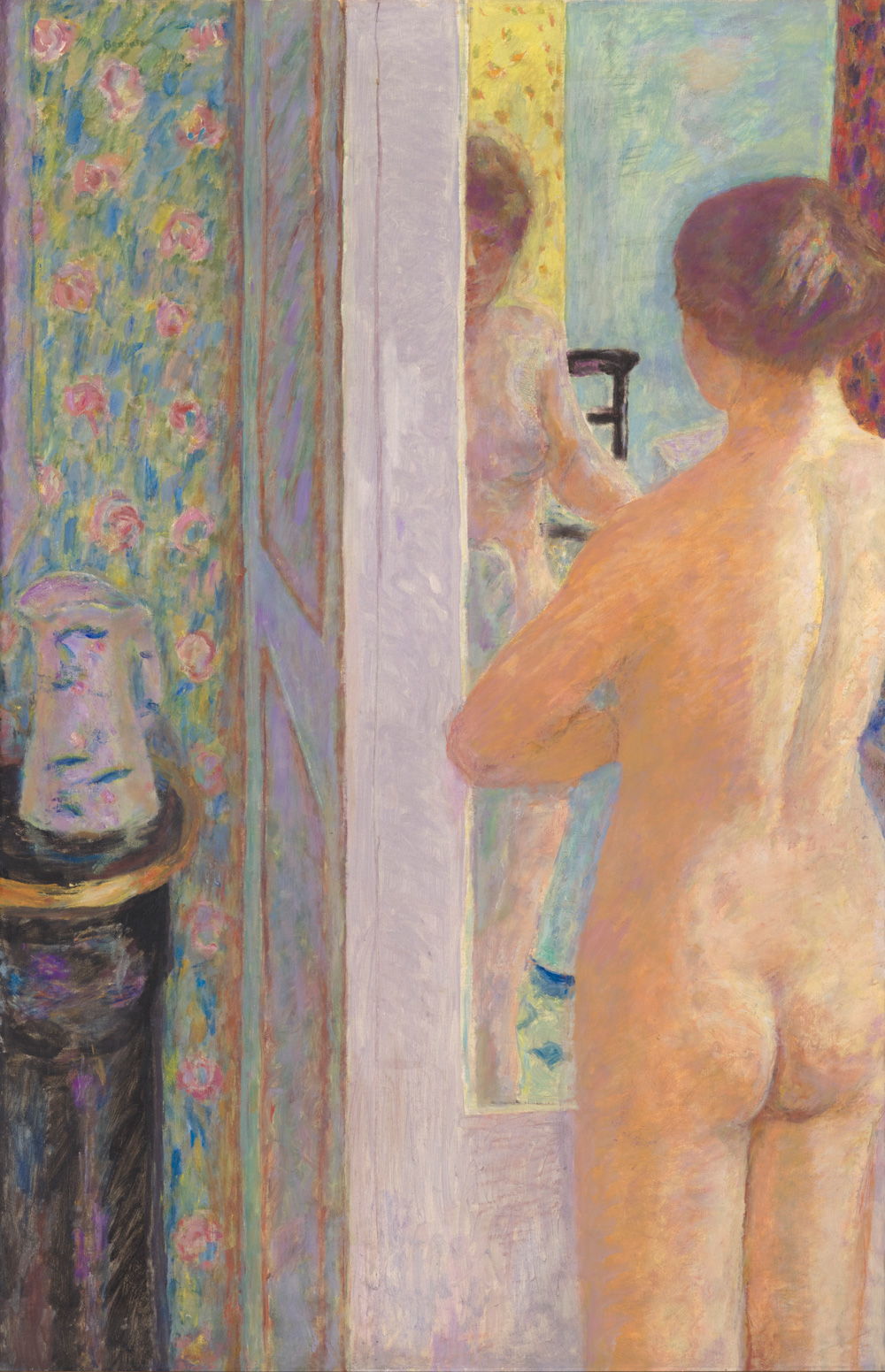
In The Toilet, alias The Toilet in Pink, from about 1908, a nude woman stands drying herself in front of a vertical mirror. This painting sets a trend for these intimate domestic scenes to be lighter.

Of all these works painted in 1908, my favourite is The Bathroom, or The Dressing Room with Pink Sofa, which anticipates those from later in his career, when he was living in the south of France. Looking at a brightly-lit window from a slightly elevated position, Bonnard’s partner Marthe’s body is seen against that light, and the bright colours of the room. There is still some subtle mirror play, with her headless torso shown in the dressing table mirror, in which the artist is replaced by an empty chair. Its last reflection is that of the window frame in the residual water in the shallow metal bath at the left.

