

Beata Beatrix was Dante Gabriel Rossetti’s next step, started in earnest in 1864, two years after Lizzie’s death, and completed in 1870, although he had been making preliminary studies when she was still alive. The background sets this in Florence, with its distinctive Ponte Vecchio over the River Arno, and the sundial sets the time as nine o’clock in the morning, the time of Beatrice Portinari’s death.

Behind the ecstatic figure of Beatrice are Dante (right) with his cap, and the angelic figure of Love at the left. Beatrice is pale and her death is approaching. Her eyes are closed, waiting for release. A red bird with a halo has brought her a poppy flower, a direct association with sleep and laudanum. Beatrice is unmistakably Lizzie.
For once, we have the artist’s account of the reading of his own painting, in a letter Rossetti wrote to its first owner in 1871. He establishes that his literary reference is Vita Nuova, and the work embodies “symbolically the death of Beatrice as treated in that work.” But it doesn’t represent death as such, rather ‘renders’ it “under the semblance of a trance”, in which she is suddenly “rapt” from Earth to Heaven.
The red bird is the messenger of death, who drops a poppy flower into Beatrice’s hands, as she has closed her eyes to see the face of God. This could equally have referred to Lizzie rather than Beatrice.
Rossetti never worked this obsession out of his system. In 1871, he returned to the theme in what proved to be his largest painting ever, based on an original watercolour study, now in the Tate Gallery, he had made as early as 1856.

A decade after Lizzie’s death, Rossetti wove the more complex Dante’s Dream on the Day of the Death of Beatrice, of which this is the artist’s 1880 copy of his 1871 original. There are references to Beata Beatrix, in the red birds at the left and right edges, and his model for Beatrice was Jane Morris, wife of William Morris, designer and close friend. Jane Burden, as she was before her marriage to William Morris, had a similar background to Lizzie Siddall, from humble origins to artists’ model, then into the Pre-Raphaelite circle. Jane and Rossetti became lovers in around 1865 when he was still working on Beata Beatrix, but their relationship cooled later.
Rossetti casts the dream insert in red, for love, showing a red and winged angel of love kissing the dying Beatrice. He clutches not a flower – there are red roses strewn all over the floor – but an arrow of love. The model for the woman on the right was Marie Spartali Stillman, and her husband William James Stillman modelled for Dante’s face.

The finest among Rossetti’s last paintings of Beatrice is The Salutation of Beatrice (1880-82), painted in the last couple of years of his life. It is drawn in part from the figure of Beatrice in the left panel of his earlier Salutation of Beatrice, again using Jane Morris as his model. Sat on a well in the distance are the figures of Dante and the same red angel of Love, or maybe death after all.
In that couple of years before his death, as Rossetti was working on his last paintings of Dante’s beloved Beatrice, two other artists associated with the Pre-Raphaelites were also at work on their depictions of her. Henry Holiday was researching for his 1883 painting Dante meets Beatrice at Ponte Santa Trinita, and Marie Spartali Stillman painted the first of her several watercolours of Dante and Beatrice.

The year after Rossetti’s death, Henry Holiday completed his painting of the second occasion on which Dante claimed he had met with his beloved, in Dante meets Beatrice at Ponte Santa Trinita (1883). Holiday devoted great effort to making this view as authentic as possible. In 1881, the year before Rossetti’s death, he travelled to Florence to make studies, and researched the buildings at the time, which he turned into clay models for a 3D reference. He also got John Trivett Nettleship, a noted animal painter, to paint the pigeons so that they were faithful.
Marie Spartali, as she was before her marriage in 1871, was one of a trio of beautiful young women from Greek migrant families in London who had become known as the Three Graces. Her father, then a wealthy merchant, entertained Pre-Raphaelite painters including Rossetti, who referred to Marie as a “stunner”.
The Three Graces modelled for the artists of the day, and Marie appears as one of the figures in Rossetti’s painting of Dante’s Dream on the Day of the Death of Beatrice (1871, 1880). She learned to paint in private lessons from Ford Madox Brown, and was soon making her own images based on the writings of Dante, and Rossetti’s translations of them into English.

The full title of her “Certain ladies of her companionship gathered themselves unto Beatrice…” (1880) actually quotes even more from Dante’s Vita Nuova: “Certain ladies of her companionship gathered themselves unto Beatrice where she kept alone in weeping. And as they passed in and out, I would hear them speak concerning her, how she wept.”
This refers to the ladies of Florence who paid their respects to Beatrice as she kept vigil following her father’s death. Dante is shown sat outside the house, wearing his customary chaperon hat, his head bowed, and being comforted by two of the women who had visited Beatrice inside.

In 1896, Marie Spartali Stillman revisited Dante’s Vita Nuova through Dante Gabriel Rossetti’s popular translation into English. Her earlier version of Beatrice (1896) shows Dante’s beloved Beatrice lost in contemplation while reading, an intimate insight set firmly in the Pre-Raphaelite mediaeval, also seen in detail below.

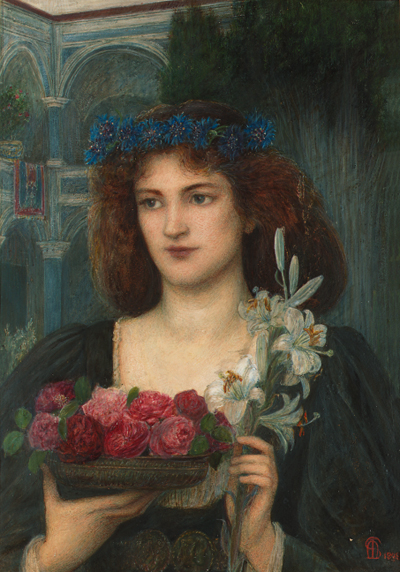
Her second treatment of Beatrice (1898) employs similar floral language, perhaps emphasising innocence in its lilies, but is less contemplative and more sensual, in a manner perhaps more typical of Rossetti.
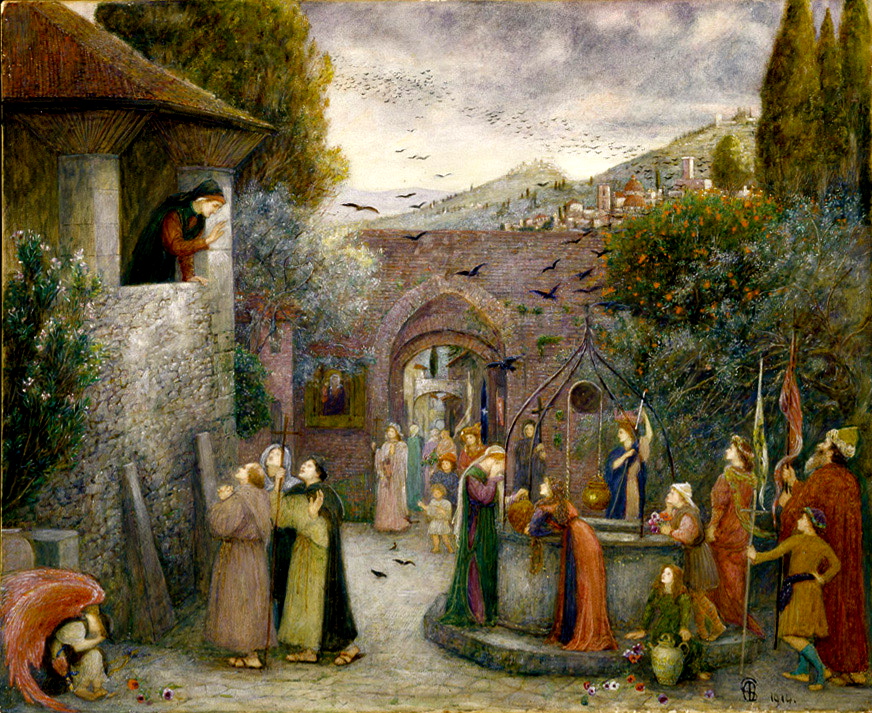
In the months before the outbreak of the First World War, she painted The Pilgrim Folk (1914), which may well have been a double valediction, as both her last major painting and her farewell to Italy. It again refers to Dante’s Vita Nuova via Rossetti, a quotation from which was shown with the painting. This passage contains Dante’s account of Beatrice’s death to a group of newly-arrived pilgrims.
Dante leans out from a window at the left, addressing three pilgrims below. At the lower left corner, the winged figure of Love crouches in grief, poppies scattered in front of him, a reference to Rossetti’s paintings. Pilgrims around the well are taking refreshment after their travels, and more are arriving through the alley beyond. Black crows fly in flocks above, symbolising death. The landscape behind is very Italian, and the whole has a fairy-tale unreality about its mediaeval details.
Stillman had used Rossetti’s symbols elsewhere too, including in one of her finest paintings, Love’s Messenger completed in 1885, three years after his death.

A young woman stands by her embroidery at an outside window. On her right hand is a messenger dove/pigeon, to which a letter is attached. She clutches that letter to her breast with her left hand, implying that its contents relate to matters of the heart. The dove is being fed corn, which could either be its reward for having reached its destination (thus the woman is the recipient of the message), or preparation for its departure (she is the sender).
On balance, the presence of corn on the windowsill implies that it is more likely that the dove has just arrived, and the woman is the recipient. But look closely at the embroidery, and she is making an image of one of Rossetti’s angels of love, complete with red wings and a bow and arrow.
There’s another artist who is perhaps the most surprising of all those who painted Beatrice: Odilon Redon (1840–1916), a contemporary of Stillman, who is perhaps as different as you could get in terms of background and style.

Redon’s pastel portrait of Beatrice from 1885 was turned into a print a decade or so later, and appears to have been laid down in pure gold. Like so many other portraits of her, it contains no literary references to indicate whether she is the possibly physical Beatrice from Vita Nuova, or the spiritual guide from the Divine Comedy.
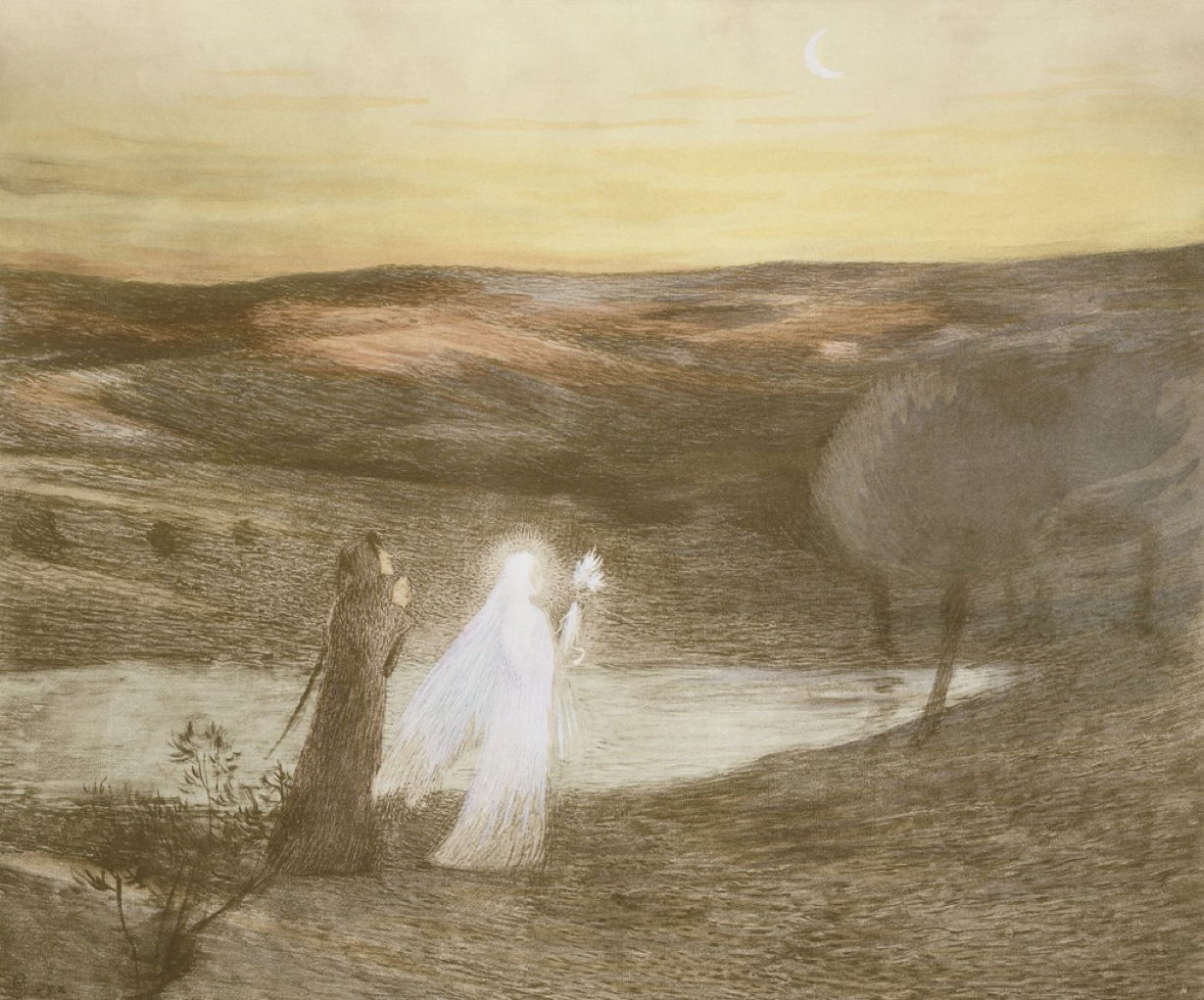
Throughout his career, Henri-Jean Guillaume Martin painted scenes from Dante’s Divine Comedy. This colour lithograph refers to the end of the middle book Purgatory, in which Dante is reunited with his beloved Beatrice, who leads him through the final book, Paradise.
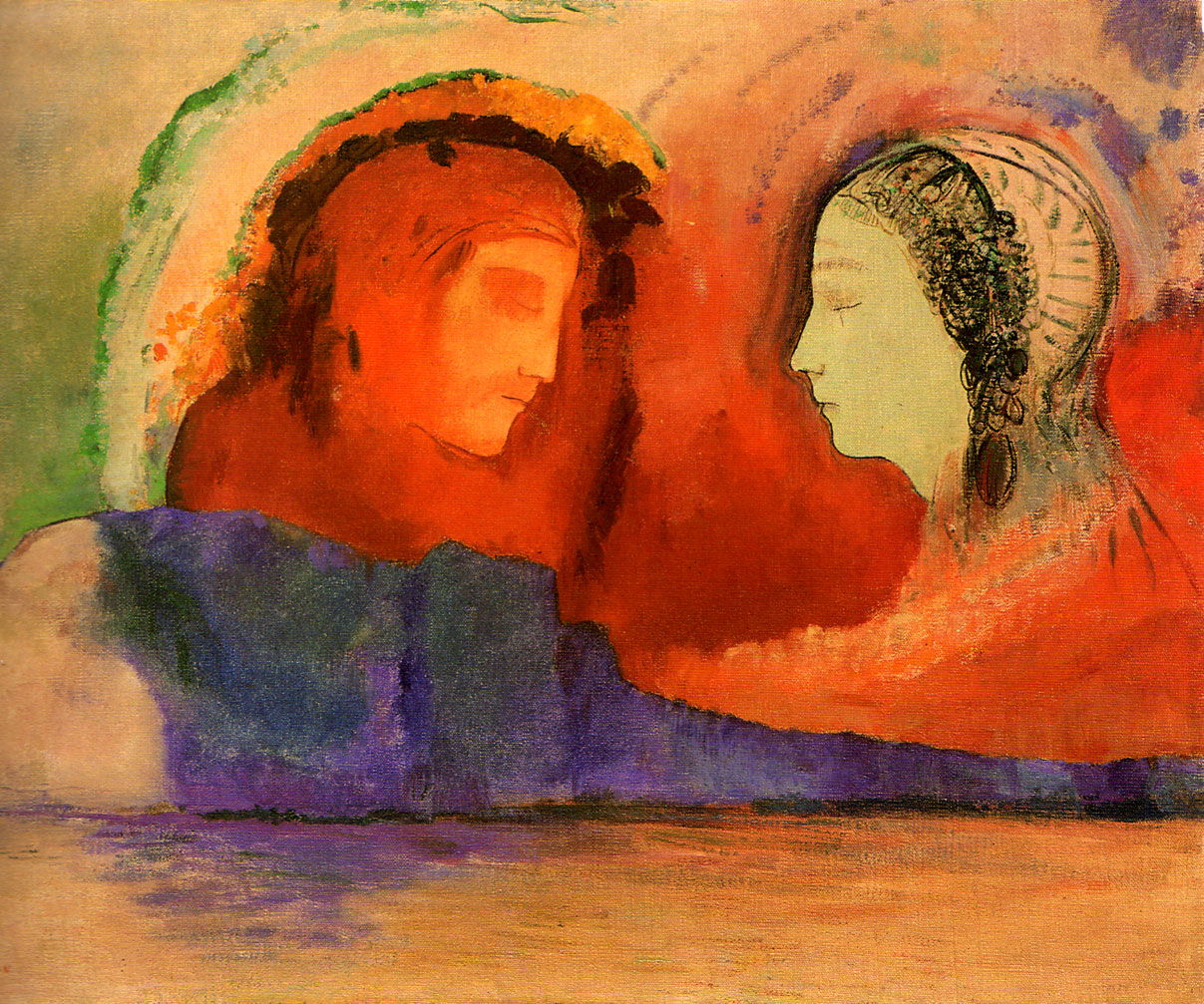
At the same time that Stillman was painting her Pilgrim Folk above, Redon painted one of his relatively few works in oils, of Dante and Beatrice (1914). Their heads, with eyes closed so they can see their God, are among the clouds above the cliffs of a coastline suggestive of Purgatory.
So who was Beatrice Portinari?
Born in Florence in about 1265, making her about the same age as Dante, she was the daughter of a rich banker. By the time she was about 22, she had married another banker, Simone dei Bardi. She is mentioned in the will that her father made in 1287, and is thought to have died in Florence on 8 June 1290, at the age of about 25.
Beyond that, and Dante’s non-specific references to a Beatrice, who could quite easily be someone completely different, or a symbolic figure, there seems nothing to tell. But there are so many wonderful paintings of such an unknown woman.

