
On 11 February 1862, Lizzie, wife of the leading Pre-Raphaelite artist and writer Dante Gabriel Rossetti, died of an overdose of laudanum (tincture of opium) at the age of only 32. A couple of years later, Rossetti embarked on an unusual post-mortem portrait of her in the role of Dante’s beloved Beatrice. Although Dante never revealed her true identity, many have believed her to represent Beatrice di Folco Portinari, who had died even younger almost six hundred years earlier, at the age of only 25. Beata Beatrix is one of Rossetti’s major paintings.

The strangest thing about Rossetti’s Beata Beatrix (c 1864–70) is that it represents a woman who, beyond Dante’s writing, is almost unknown, yet she’s become one of the most painted women in history. This weekend’s two articles look at some of the better-known paintings of Beatrice, from before Rossetti’s image, and afterwards, spanning some of Europe’s most visionary artists, from William Blake to Odilon Redon.
Dante wrote about Beatrice in two of his most popular works: his youthful Vita Nuova, and in two of the three books in his Divine Comedy. Early commentators don’t appear to have made any association between his literary figure and a real person, let alone a married woman who, at best, only met Dante twice before her early death. Many scholars believe Dante’s figure is symbolic rather than physical, which is more likely in her role in the Divine Comedy. Nevertheless, she has proved a popular subject, particularly during the nineteenth century.

The American Romantic artist and poet Washington Allston shows her in a straightforward portrait of Beatrice from 1819. He makes no literary allusions, although this is most likely to refer to Vita Nuova.
It was William Blake’s paintings for his unfinished illustrated edition of the Divine Comedy that started to explore her in the context of Dante’s narrative.
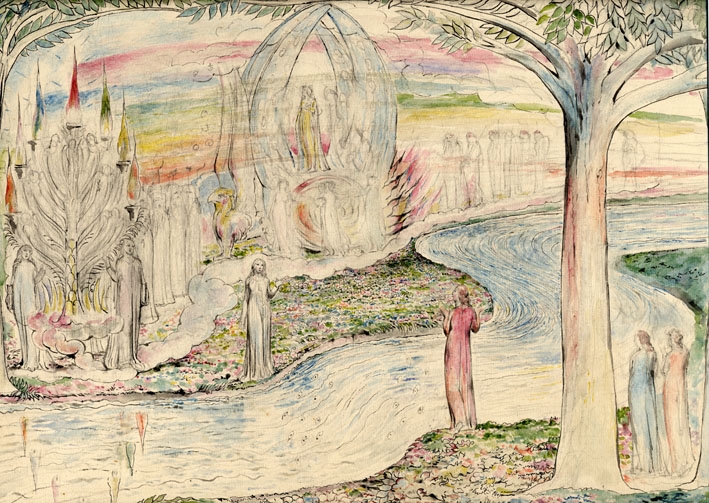
Beatrice on the Car, from 1824-27, shows her appearing in a chariot or ‘car’ in the midst of a religious procession, which takes place in the earthly paradise on the summit of the island-mountain of Purgatory.

Blake’s best-developed painting of her, Beatrice Addressing Dante from the Car, from the same few years prior to his death, shows her admonishing Dante for his recent straying from the path of righteousness. This is rich with symbols and graphic devices, such as its vortex of heads and eyes, and the marvellous gryphon pulling Beatrice’s chariot.
Dante’s works enjoyed a revival during the nineteenth century, bringing other artists to use them as themes for their paintings, with the Divine Comedy the more common.

Carl Wilhelm Friedrich Oesterley’s conventional and Romantic view of Beatrice and her chariot follows Dante’s description literally, even down to the colours of her clothing.
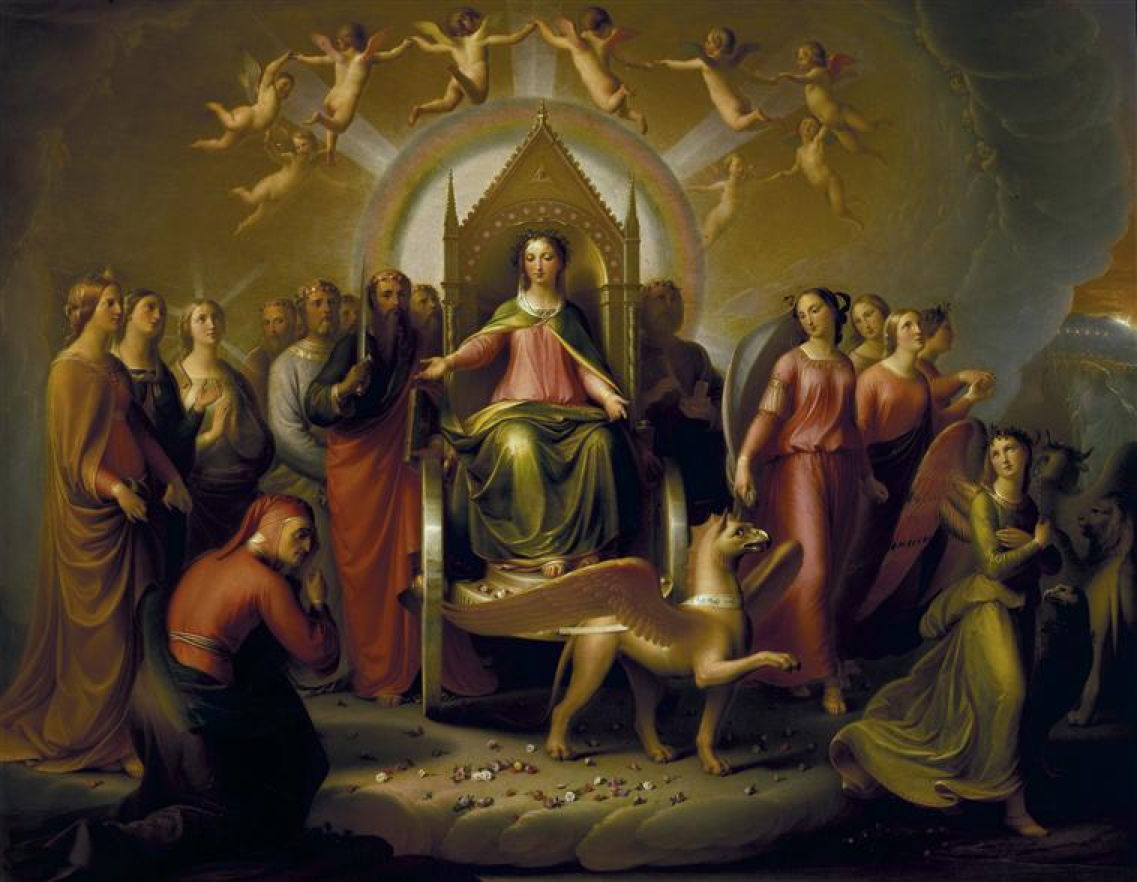
Andrea Pierini’s curiously antiquated version from 1853 is also literal in its detail.

William Dyce returned to portraiture style for his painting of Beatrice in 1859, when Rossetti was peaking in his obsession with her. Dyce had considerable exposure to paintings of the Divine Comedy: when he was in Rome in 1827-28, he is thought to have been friends with Friedrich Overbeck, the Nazarene artist who had just been painting frescoes of Tasso’s Jerusalem Delivered alongside others of the Divine Comedy, in the Casa Massimo. When he returned to London, Dyce was responsible for introducing the Pre-Raphaelites, including Rossetti, to the influential critic John Ruskin.
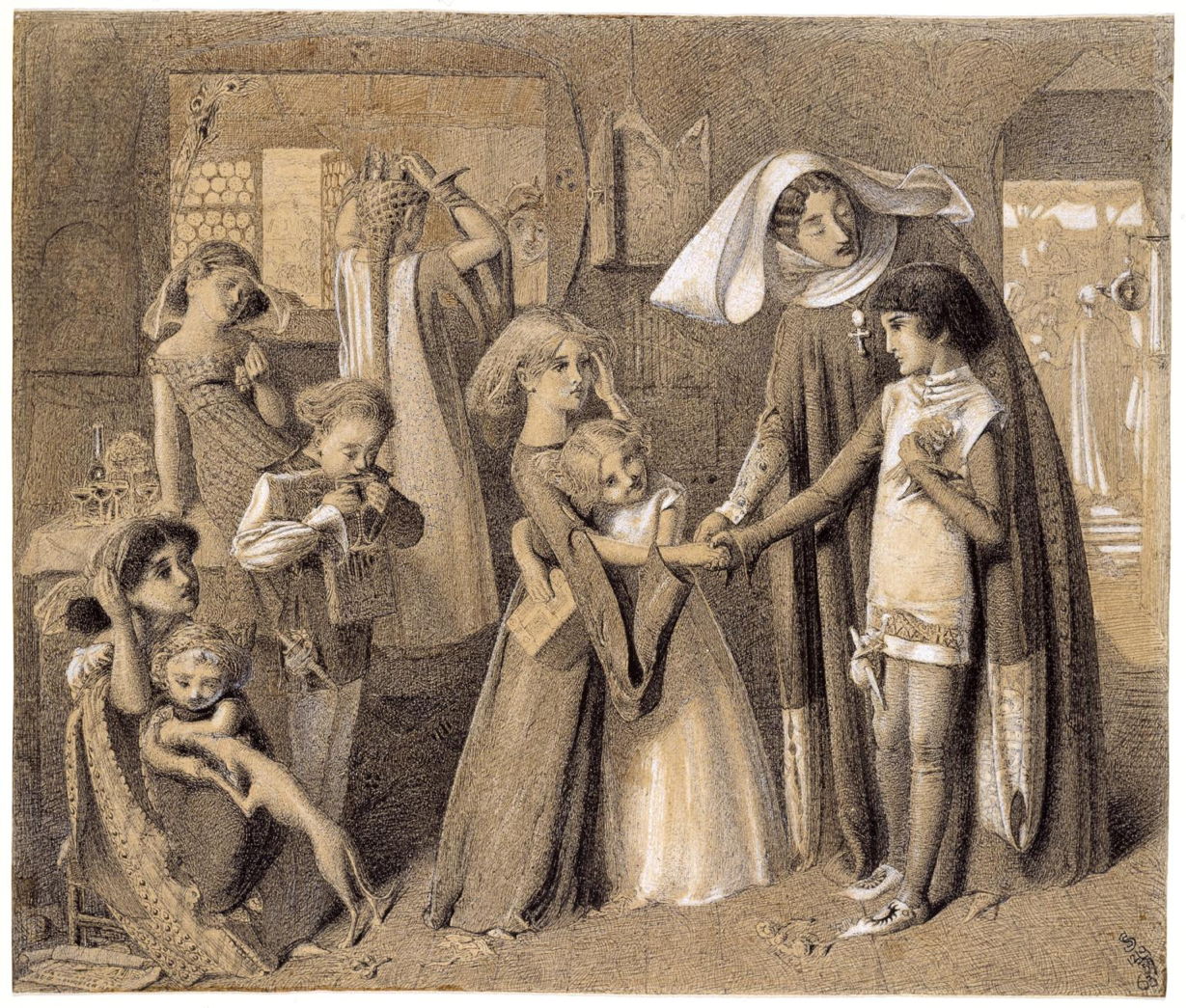
Others involved with the Pre-Raphaelites also adopted Beatrice as a theme. Simeon Solomon’s ink and watercolour painting of Dante’s First Meeting with Beatrice (1859–63) is taken from Vita Nuova, and its description of the two nine year-olds meeting in about 1274.
Dante Gabriel Rossetti had started to become obsessed with his name-sake and Beatrice soon after his early success as a Pre-Raphaelite painter. In December 1849, he wrote a short story titled Hand and Soul which was published the following month in the first issue of the Germ, the movement’s magazine, edited by Rossetti’s brother William Michael.
His story tells of courtly love, artistic and religious fervour of an imaginary mediaeval painter in the Italian city of Arezzo, who is in a strictly Platonic relationship with “his mystical lady, now hardly in her ninth year”, the same age as Beatrice was when Dante claimed to have met her.
Shortly afterwards, Rossetti started sketching for a painting of their meeting in Purgatory.
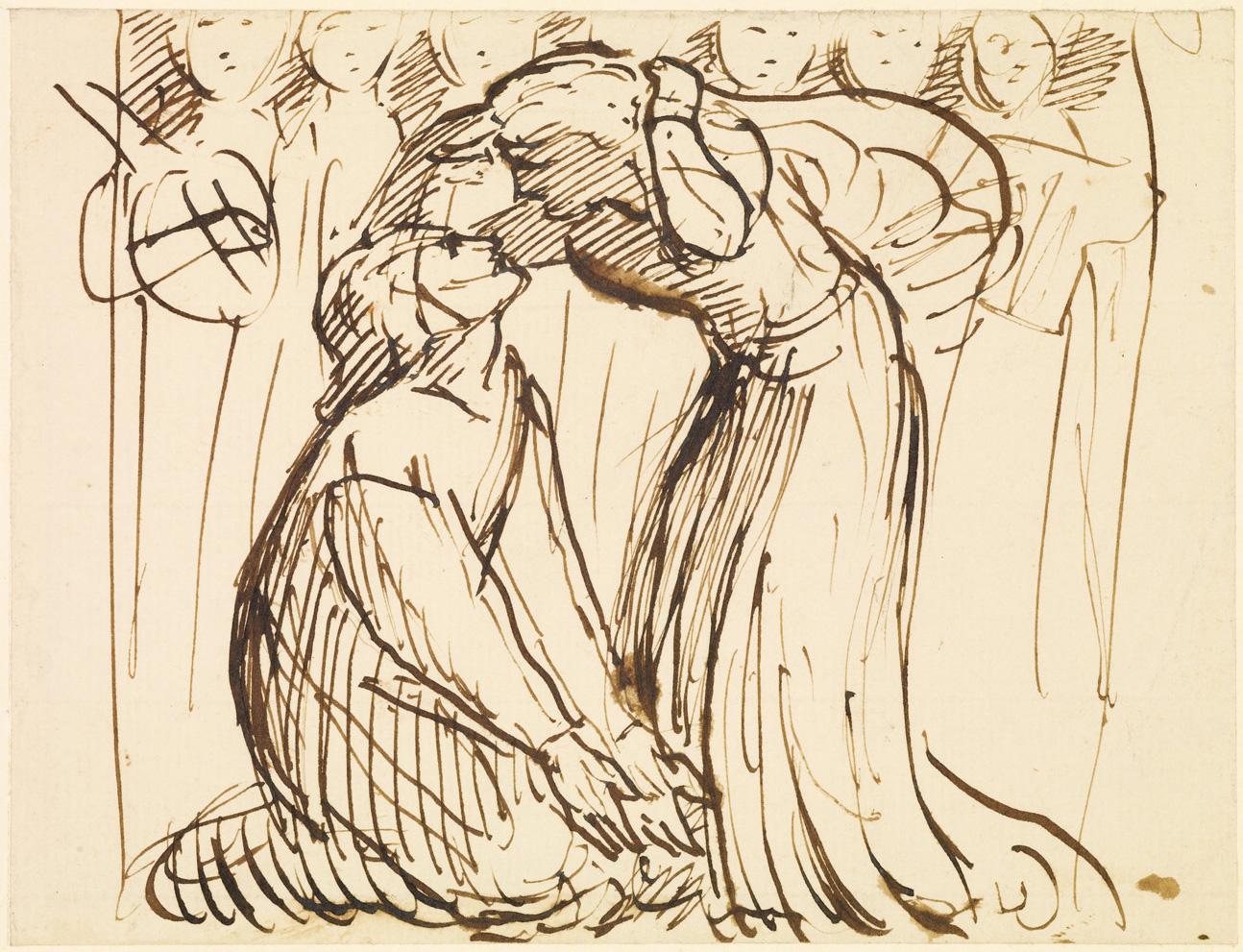
In this figure sketch for The Meeting of Dante and Beatrice in Purgatory, made in 1852, Dante is on his knees as his beloved Beatrice admonishes him for straying from the path of righteousness.
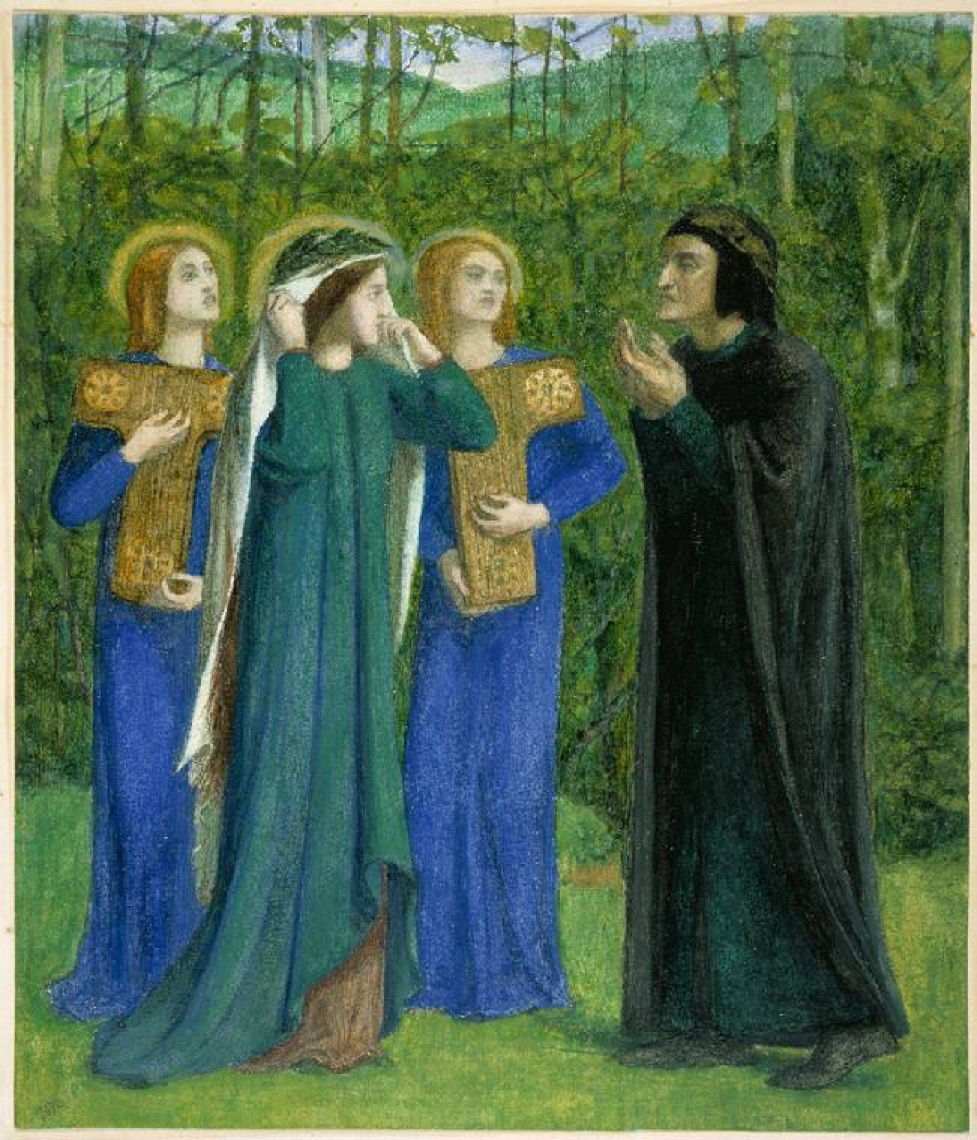
Rossetti had second thoughts, and in 1853-54 painted this more conventional composition, showing Dante in full spate, and Beatrice flanked by angels carrying golden crosses. His details are at odds with Dante’s account, though.

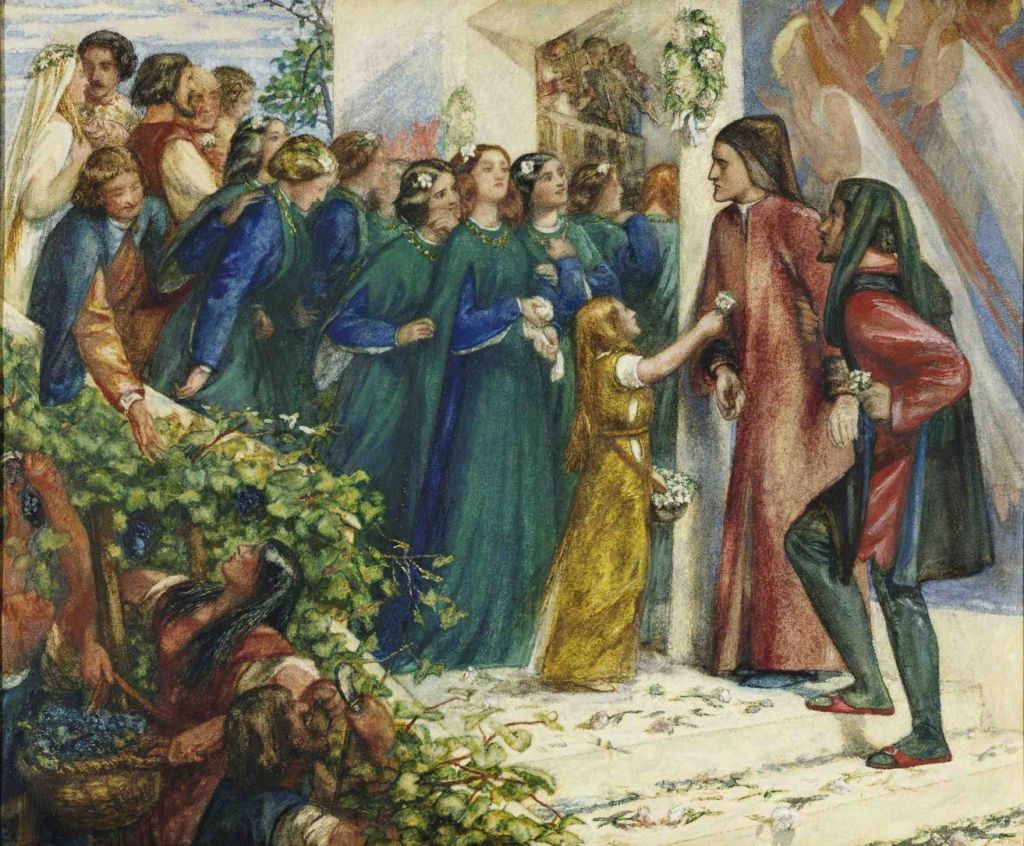
At about the same time, Rossetti was working on a more narrative watercolour of another meeting between the two, this time based on the Vita Nuova, in Beatrice Meeting Dante at a Marriage Feast, Denies Him Her Salutation (1852). Dante, dressed in his traditional red, is here being ignored by his beloved, after they had bumped into one another at a wedding. This is thought to be Rossetti’s first painting in which Elizabeth ‘Lizzie’ Siddall is the model for Beatrice.
Lizzie was about 22 at that time. A working class woman, who initially worked at a milliner’s shop in London, she couldn’t have been further from the minor nobility and affluence of Beatrice Portinari. Neither was Lizzie noted for her beauty: she first modelled in around 1849 for Walter Deverell, who chose her for her plainness. Lizzie continued to model for Pre-Raphaelites, and in 1851-52 achieved fame as the model for John Everett Millais’ Ophelia.
Lizzie became an artist in her own right, although her paintings are now sadly neglected. In 1852, she moved in to live with Rossetti, but her health started to deteriorate, probably as a result of tuberculosis.

Rossetti then went on to a more fictionalised watercolour of The First Anniversary of the Death of Beatrice (1853), showing Dante being comforted as he is drawing an angel on that day of remembrance for his beloved. This is situated in central Florence according to the view through the window at the right, but there’s an incongruous country garden seen through the door at the left.

As Lizzie’s health declined, Rossetti created more ornate and icon-like paintings of Beatrice. The Salutation of Beatrice from 1859-63 uses oil and gold leaf on conifer wood, set in a frame Rossetti designed and painted himself. It brings together the literary Beatrice from Vita Nuova on the left, with the spiritual Beatrice from the Divine Comedy at the right, where they meet in earthly paradise atop Purgatory. On the frame are inscriptions taken from the respective works, and in the middle is the date and time (on a sundial) of Beatrice Portinari’s death in 1290.
When the couple married in Hastings in 1860, she had to be carried around the corner to attend the church. She became depressed, and was addicted to laudanum (tincture of opium). In 1861, she had a stillborn daughter, and later that year became pregnant a second time. She died on 11 February 1862, as a result of what was almost certainly a deliberate overdose of laudanum.

