
Although Naturalism in literature continued well into the early twentieth century, in painting it was fading before 1900. This article shows some examples from those later years.

The Danish artist Erik Henningsen’s Evicted from 1892 returns to a theme perhaps more appropriate to ‘social realism’, as a family of four is evicted into the street in the winter snow. With them are their meagre possessions, including a saw suggesting the father may be a carpenter. In the background he is still arguing with a policeman.
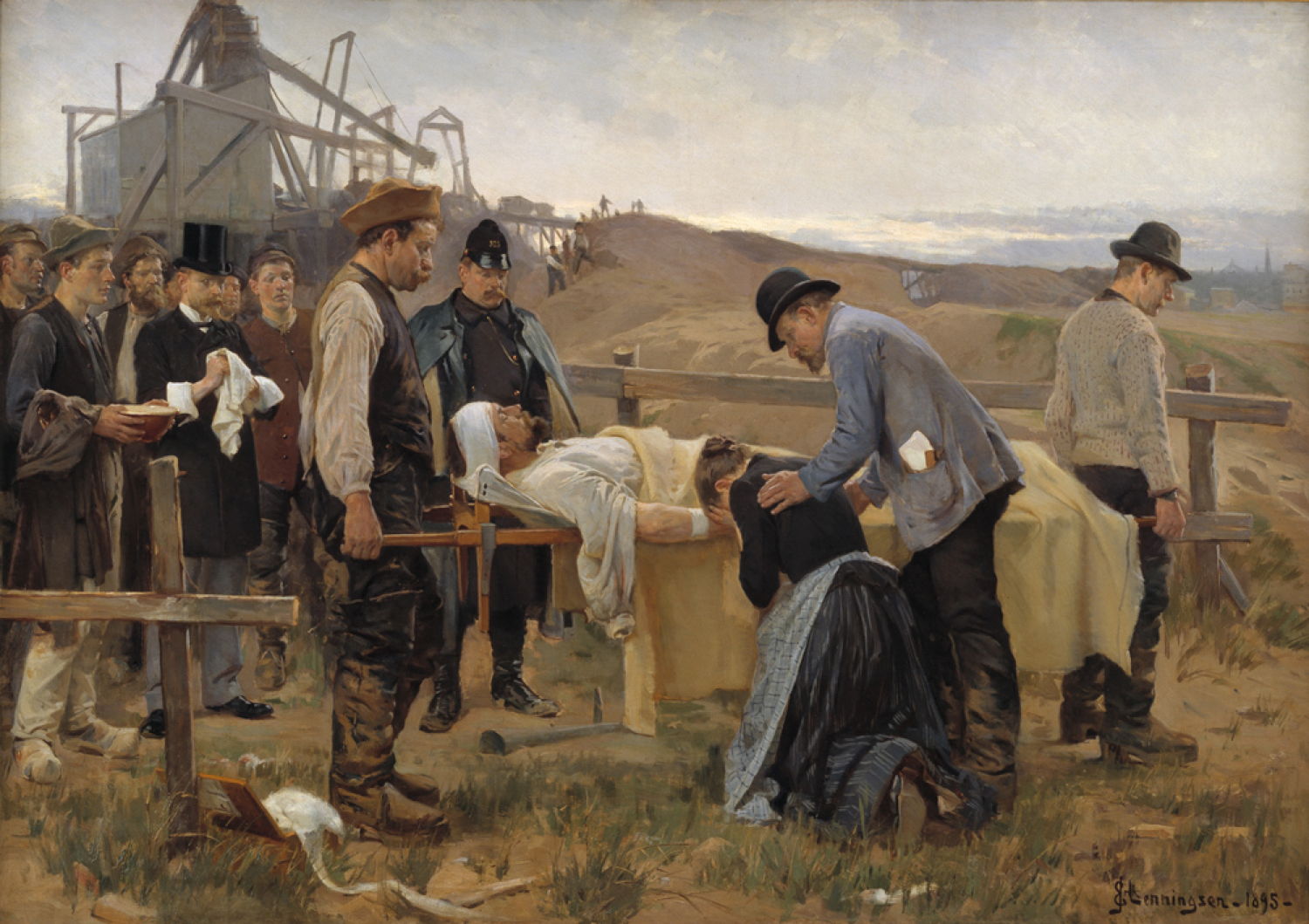
In An Injured Worker from 1895, Henningsen tackles another major social issue. The scene is a gravel or sand pit outside a town (in the distance at the right). A worker has just been injured, and is being carried away on a stretcher. By his side is his wife, who is in tears and being comforted by one of her husband’s managers. Behind and to the left are a policeman, and a doctor who wears a top hat and is wiping his hands after dressing the man’s wounds.

In France, the veteran Léon Augustin Lhermitte painted this pastel of the Vegetable Market in St-Malo in 1893. It’s a good example of his balance between detail, as seen in the distant crowd and shop fronts, and a more painterly style.

In 1889, Lhermitte was commissioned to paint Les Halles, the main and most central market in the city of Paris. He completed this, perhaps his last major work, in 1895, when it was exhibited at the Salon. The market’s origins were mediaeval, then during the nineteenth century it grew even busier, and was re-housed in iron and glass buildings erected during the 1850s. Lhermitte’s friend Émile Zola set his novel Le Ventre de Paris (1873) in this market.

Émile Friant’s Sorrow (1898) visits a municipal cemetery for a funeral, and an intimate study of the grief of a widow, who is being helped by two younger women. Their overt reactions contrast with the cluster of men, with their stern beards, at the left.
In the 1890s, Friant became a passionate aviation enthusiast. Together with a friend from Nancy, one of the oarsmen in his painting of 1887, he founded an aviation society, and flew in balloons and early aircraft.

Journey to Infinity (1899) is an extraordinary flight of fancy in a balloon, which is soaring high above a bank of grey clouds (or possibly a rugged mountain ridge) containing the forms of five nude women, one of them apparently performing a handstand. I suspect this painting may have been made for Marie Marvingt (1875-1963), an athlete, mountaineer, and pioneer aviator, who had moved to Nancy in 1889.
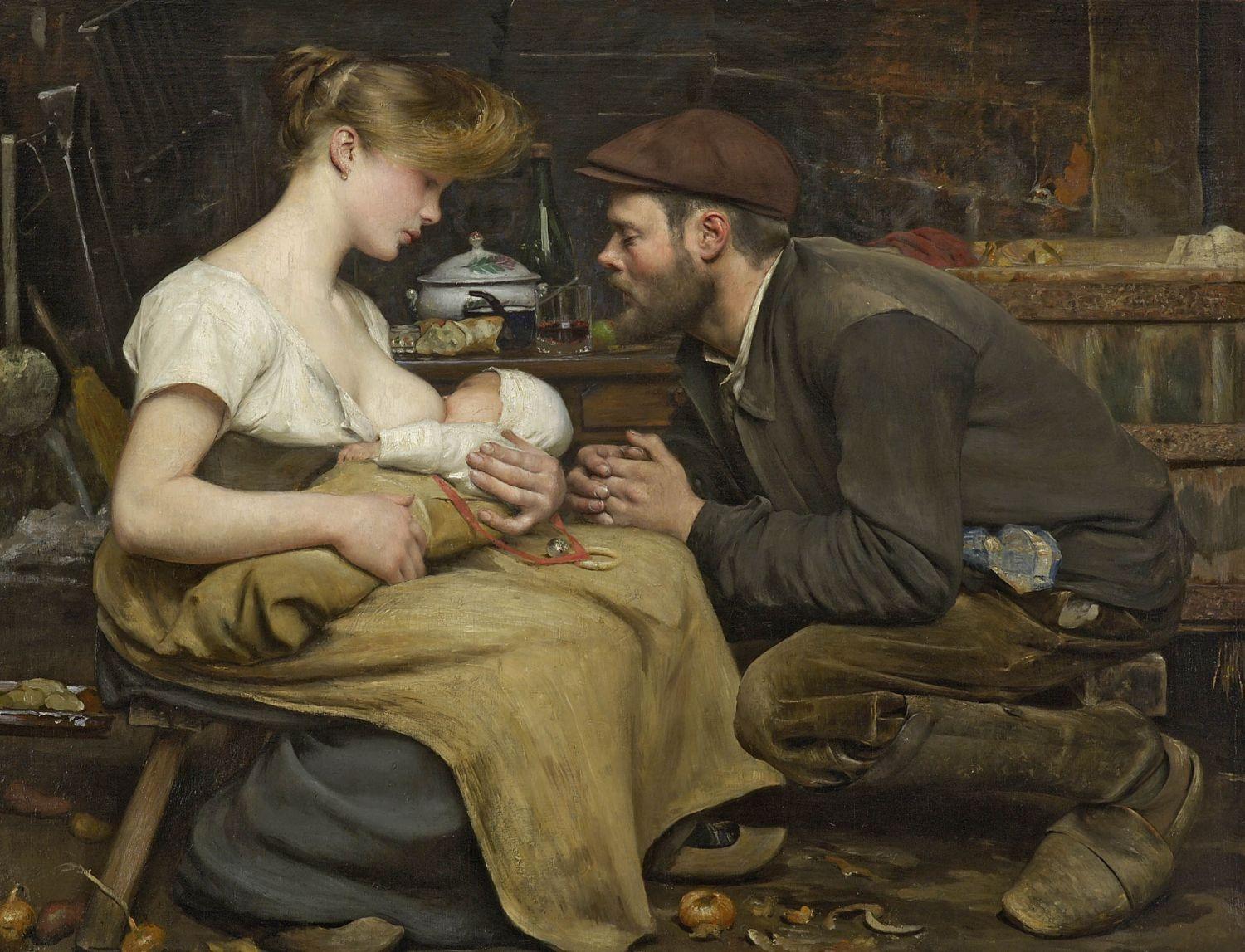
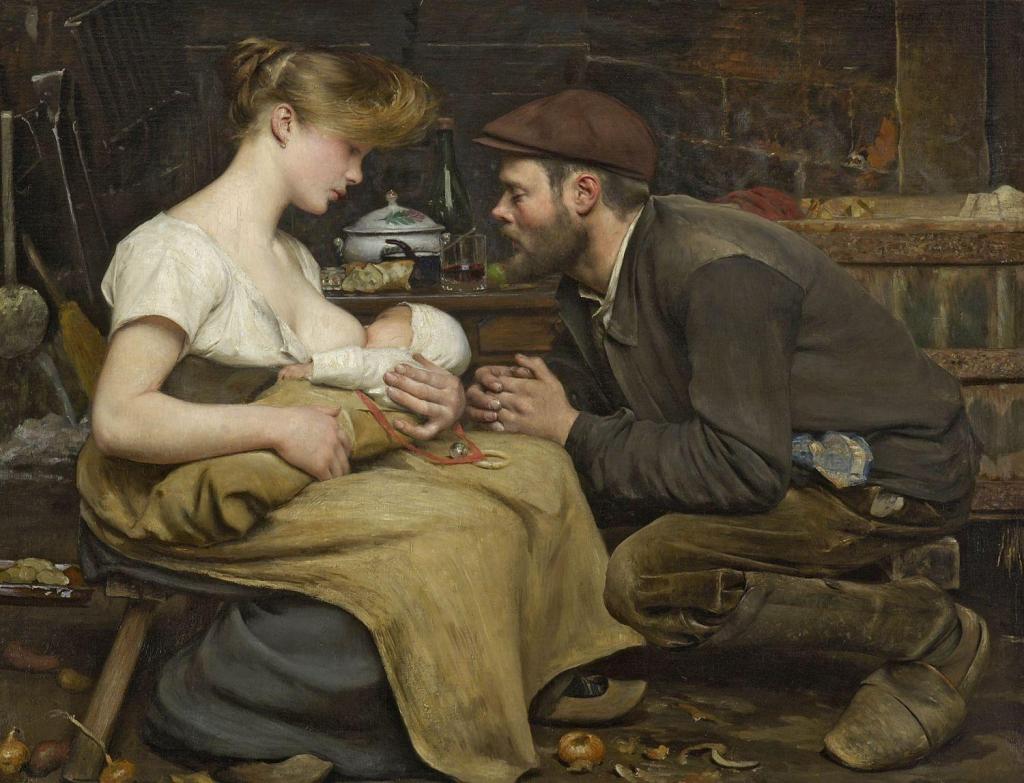
Jean-Eugène Buland returned to poor working families in his Parental Happiness from 1903. A young couple are nursing their first baby, and appear to be living in an agricultural outhouse. The floor is strewn with vegetables and their parings, and the husband is dressed as a labourer, with worn working shoes, his wife in wooden clogs.

Buland’s The Tinker (1908) is busy at his cottage industry, repairing damaged pots, pans, and domestic metal objects. The stone wall at the left glistens with the damp.
During this period two aspiring artists who were to achieve greatness in the early twentieth century went through a period of Naturalism, Joaquín Sorolla in Spain, and Anders Zorn in Sweden, the subject of the next article in this series.

