
This weekend, as the season moves steadily towards summer, we’re on a whistle-stop tour of six famous parks in five great cities, that for many are the closest they’ll get to real countryside.
As cities grew during the nineteenth century, what had been countryside in and around them was swallowed up by housing and factories. In the first couple of decades, livestock grazed and cows were milked within a couple of miles of the centre of London.

The American history painter Benjamin West painted this view of Milkmaids in St. James’s Park, Westminster Abbey beyond in about 1801. Two cows and attendant milkmaids are providing a supply of fresh milk for the crowds in this royal park with Buckingham Palace on its edge. This remains 57 acres (23 hectares) of grass, trees and lakes in central London.

John Linnell’s Evening, Bayswater from 1818, only two centuries ago, shows what was then a rural part of London, out to the west of what’s now Paddington Station, in more peaceful times before this area was assimilated into the growing city. Although it has retained some garden squares, this became a densely populated area during the nineteenth century.

The lake shown in Giuseppe De Nittis’ view of The Serpentine, Hyde Park, London from 1878 is the eastern section of a single body of water marking the boundary between Hyde Park and Kensington Gardens. Once fed from a small river, that became so polluted it has long been supplied by water from three boreholes. It hosts a swimming club, rowing boats, and a solar-powered ferry.

Alice Maud Fanner painted this view of the edge of Hyde Park, London, in about 1900. The London plane trees are leafless, indicating this is a fine day in the winter, although the figures look lightly dressed for that time of year. The view looks north-east towards the road encircling the park and mansions in Park Lane beyond. This park is, at 350 acres (140 hectares), the largest of a chain of Royal Parks running from Kensington Gardens in the west, past Buckingham Palace to St James’s Park to the southeast.

Kensington Gardens: Vicinity of the Pond, painted by Paul Fordyce Maitland in about 1907, shows the Oval Pond in the middle of these gardens, another of the Royal Parks in London, to the west of the Serpentine Lake in the adjacent Hyde Park.
Over the same period, central Paris was extensively rebuilt, but preserved some of its green spaces, including the gardens of the Tuileries Palace.
The Tuileries Garden in central Paris is the city’s best-known open space. It runs between the Louvre and the Place de la Concorde with its iconic Arc de Triomphe, an area of 63 acres (25.5 hectares). Shortly before painting his most famous scene in the Tuileries, Édouard Manet completed a smaller and less ambitious work set among its trees, Children in the Tuileries Garden (c 1861-2).

Seen now as the work which gave him the idea for his second painting, this shows a small group of children apparently being directed by an older girl in black, with a blue bonnet. There’s an eery impersonality about the figures, though, as they’re either viewed from behind, or have little or no detail in their faces.

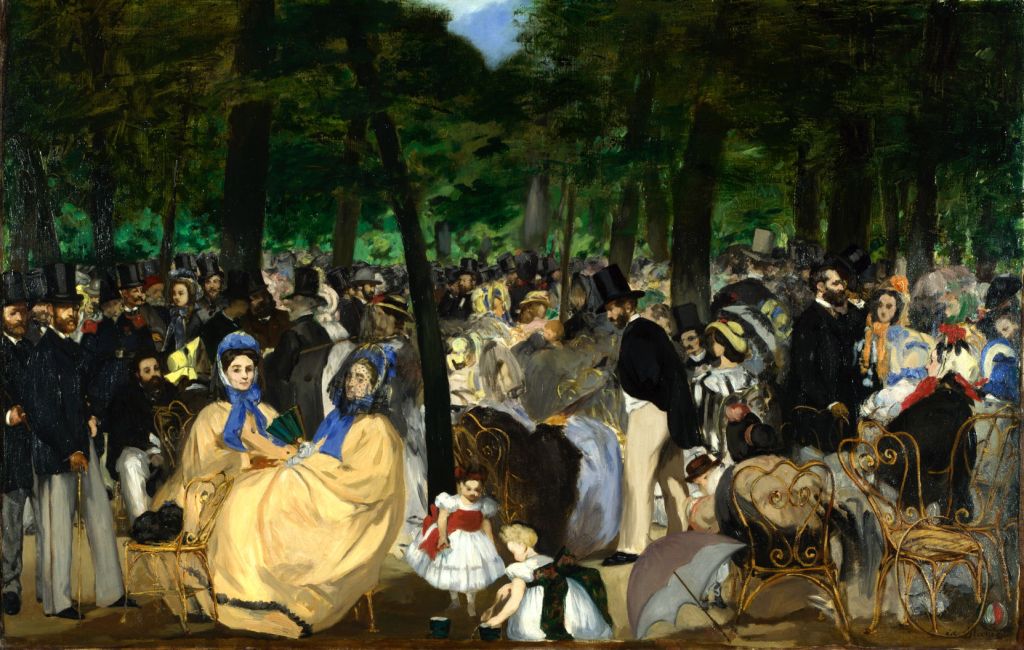
Manet’s Music in the Tuileries from 1862 is one of ten paintings shared between the National Gallery in London, and the Hugh Lane in Dublin, as part of the Hugh Lane bequest. Packed into its rhythmic layout of trees are members of the fashionable Parisian crowd, who have come to listen to the music, socialise, and chat. Historians have identified many of Manet’s circle among them: the poet Baudelaire, novelist Gautier, composer Offenbach, Fantin-Latour the painter, and the artist’s brother Eugène, a painter who married Berthe Morisot, the Impressionist.

Adolph Menzel’s Afternoon in the Tuileries Gardens from 1867 is assumed to have been inspired by Manet’s Music in the Tuileries, and has compositional similarities. He includes some direct quotations of figures in homage to Manet’s work. However, Menzel remained a realist, as shown in finely detailed foliage, foreground shadows and the figures. He was known to have made several sketches in the Tuileries Gardens, but painted this work back in his Berlin studio. Conventionally this would have been based on those sketches, but when Menzel first showed the work he claimed it was executed from memory.

The Tuileries Gardens, Paris (1895) may have been painted shortly before Maurice Brazil Prendergast left the city to return to Boston, MA. While he was in Paris he met Édouard Vuillard, whose influence appears to have extended to his use of colour here, and Pierre Bonnard, an addicted sketcher of street scenes in Paris.

Pissarro’s Garden of the Tuileries on a Spring Morning from the same year is an aerial view of the gardens when they’re well into Spring, with the trees in full leaf, in their brilliant fresh green foliage.
Tomorrow we’ll resume in the city of Rome.

