
Stories are at the centre of our lives, and the focus of many of those is the origin of our species and societies. Ancient myths account for the first men and women, and how the world came to be as we know it. Whatever the scientific truth, we still tell stories about events long before historical records, among them the myth of Pandora and her box containing pain and evils.
Although earliest records of Pandora’s story stretch back to around 750 BCE, in one of the oldest Greek anthologies of myth, they weren’t included in the most popular compilations such as Ovid’s Metamorphoses, so seldom appeared in paintings, although it did enter English usage in the sixteenth century. It wasn’t until the late nineteenth century that Pandora’s box caught on and became a popular theme in images. This weekend I trace Pandora’s history in European paintings.
The story of Pandora and her ‘box’ is told most fully in Hesiod’s Works and Days, where she is the original woman, created by Hephaestus (Vulcan) for Zeus, as punishment for humans receiving the gift of fire that had been stolen by Prometheus. After she was formed from earth by Hephaestus, other gods gave her properties to determine her nature.
Athena dressed her in a silvery gown, and taught her needlecraft and weaving. Aphrodite shed grace on her head, together with cruel longing and cares. Hermes gave her a shameful mind and deceitful nature, together with the power of speech, including the ability to tell lies. Other gifts were provided by Persuasion, the Charities, and the Horae.
Pandora also carried with her a large earthenware jar (in Greek, pithos) containing toil and sickness that bring death to men, diseases, and a myriad of other pains. Zeus gave her as a gift to Epimetheus, brother of Prometheus. She then opened her jar, and released its evils into the earth and sea. The only thing remaining in the jar was Hope, who stayed under its lip.
This marked the beginning of Hesiod’s second age of mankind, its Silver Age, in which people knew birth and death, as humans had become subject to death, and Pandora brought birth too. In later accounts, Epimetheus married Pandora, and the couple had a daughter Pyrrha, who married Deucalion with whom she survived the flood.
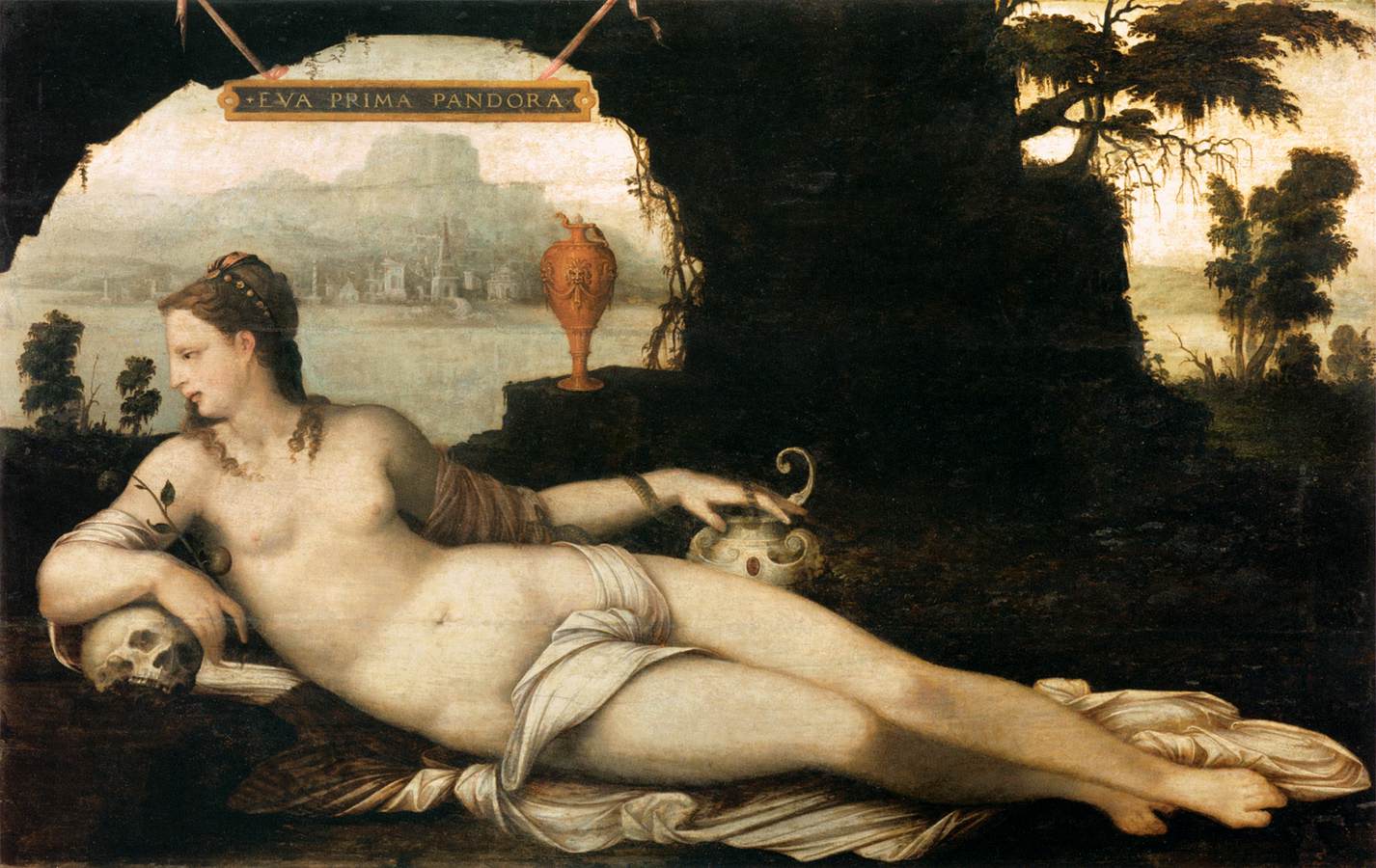
As with other classical myths, at the time that Jean Cousin painted Eva Prima Pandora, in about 1550, it had been mixed with Christian religious narrative, in this case of Eve and the Fall of Mankind. No longer clothed in Athena’s silvery gown, Eve/Pandora lies naked, propped against a human skull. Her left hand clutches the dreaded jar, which she hasn’t opened yet. Her right hand holds a fruiting sprig of the apple tree, an allusion to the traditional Biblical story of Eve. Coiled around her left arm is a serpent, another reference to the Fall of Mankind.
Pandora seems to have been very seldom if ever painted after that, until the nineteenth century.
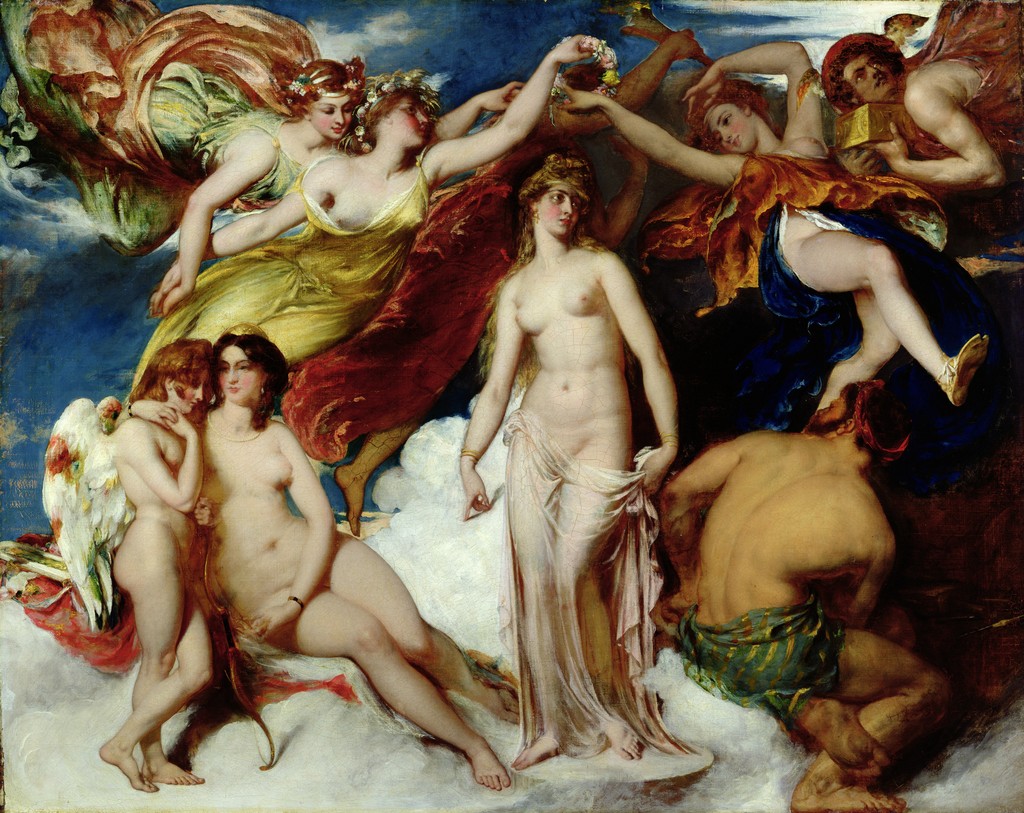
When William Etty painted her, in Pandora Crowned by the Seasons in 1824, the significance of the crux of the story, Pandora opening the jar, had become lost in the other detail, and she was just another opportunity to paint a statuesque and almost naked young woman.

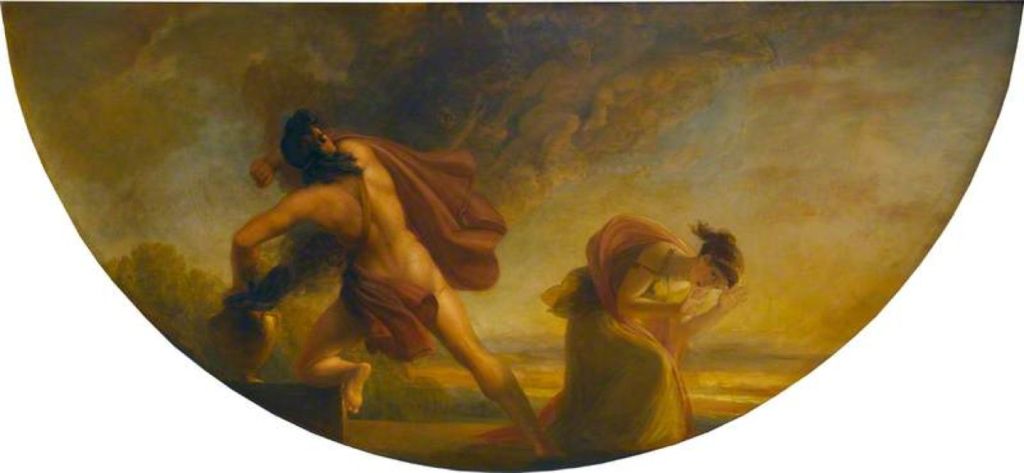
It was the now-forgotten Henry Howard who first painted The Opening of Pandora’s Vase in 1834. Pandora, more correctly dressed, crouches to duck the torrent of woe, evil and pain as it streams from the jar, as Epimetheus tries in vain to reseal its lid. This is the story as told by Hesiod in his Works and Days.
The literary story seems to have changed Pandora’s jar into a box as the result of a mistranslation in the sixteenth century, but that transition doesn’t appear to have occurred in paintings until between 1834 and 1860. It also seems more likely that it resulted from confounding of this story with that of Psyche, who had a box she couldn’t open.
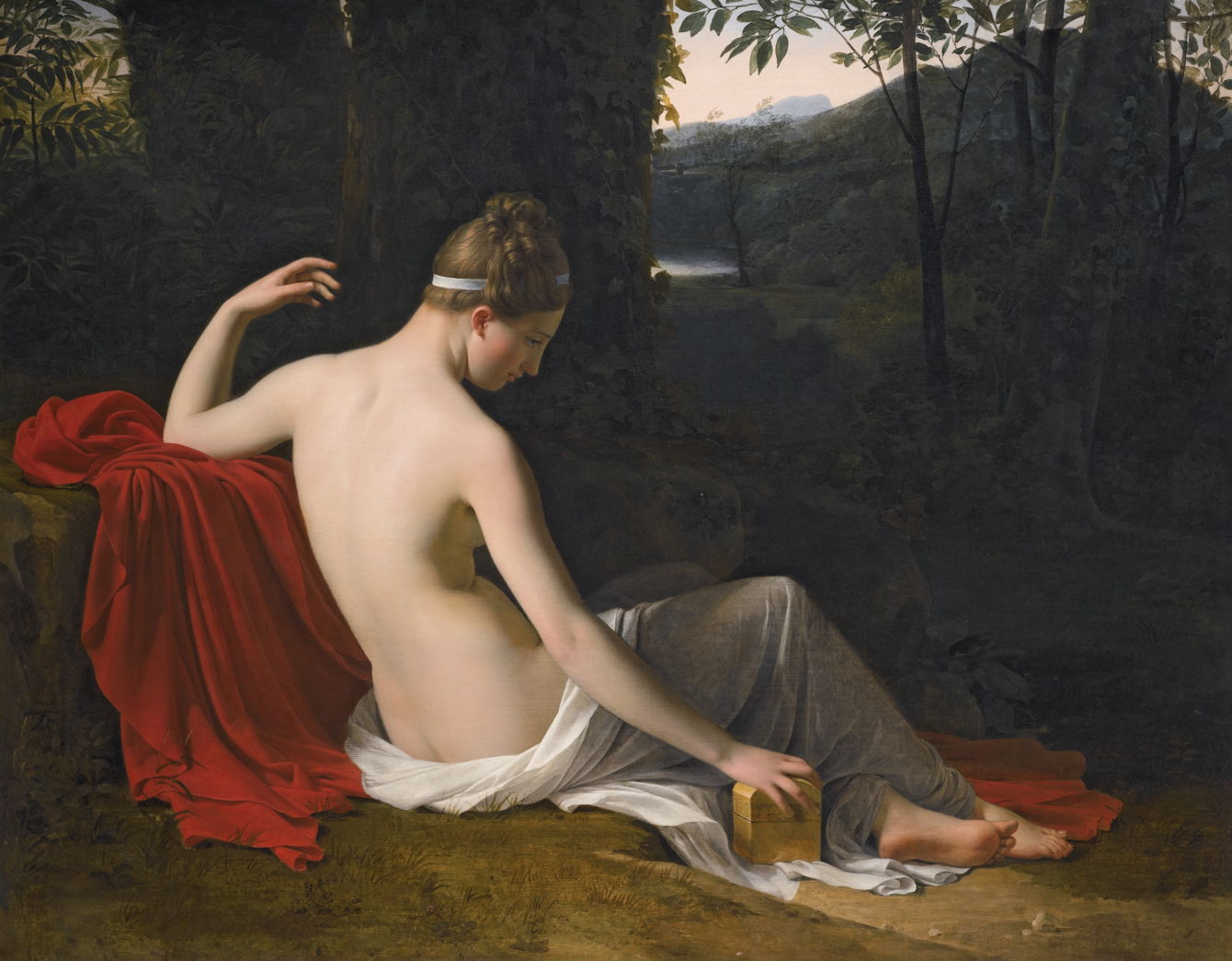
This undated painting attributed to Louis Hersent of Pandora Reclining in a Wooded Landscape gives the revised account, with the box firmly shut in Pandora’s right hand, and the motif an uncommitted combination of landscape, nude figure, and weak narrative.
In the 1870s, this suddenly became one of the most popular subjects for mythological paintings. This doesn’t appear to have been the result of it being told in another creative medium, though.

Dante Gabriel Rossetti’s first painting of Pandora, completed in 1871, shows a moody, brooding Pandora, modelled by Jane Morris. She has just cracked open the lid of the jewelled casket in her left hand, and it’s emitting a stream of noxious red smoke. As this coils around her head, winged figures appear in the fumes. The inscription on the side of the jewel casket reads “Nascitur ignescitur”, meaning born of flames.
This was one of Rossetti’s earlier paintings of Jane Morris, wife of his friend William Morris, and later to be the subject of Rossetti’s passionate obsession. Rossetti’s source for the story was most probably Lemprière’s dictionary of classical mythology, which erroneously referred to Pandora’s box, not jar. It was commissioned by John Graham for 750 guineas, who was so pleased with the result that he exhibited it, against Rossetti’s wishes, in Glasgow the following year.
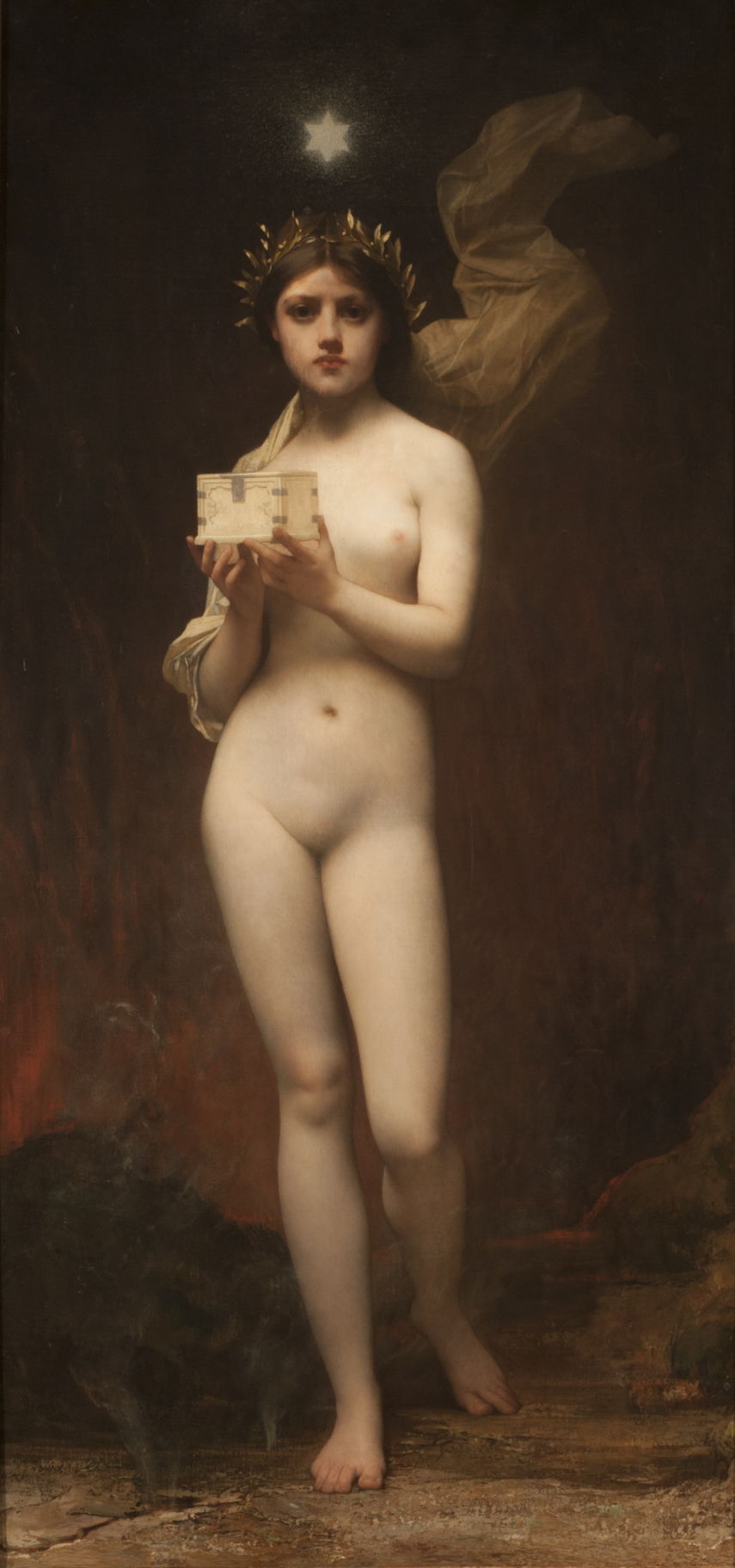
Jules Lefebvre was another artist who painted Pandora more than once. This initial version from 1872 shows her walking with the fateful box held in both hands, its lid firmly shut. Ominous smoke rises from a series of fumaroles in the ground around her. She is nude, wears an unusual coronet, and there is a six-pointed star above her head.

Next was Alexandre Cabanel’s portrait of the Swedish soprano Christina Nilsson (1843-1921) as Pandora, from 1873. As a portrait rather than a faithful account of the myth, the box is closed, almost concealed, and its significance suppressed.

In 1877, the elderly Paul Césaire Gariot’s Pandora’s Box places her in a primeval world of rock, studying the closed box intently, wrestling internally with the desire to open it.

The following year, Dante Gabriel Rossetti made this chalk study for a second painting of Pandora, again using Jane Morris as his model. Her face shows a faint agony this time, as a decorative golden stream emerges from a crack in the lid. Here the inscription reads “Ultima manet spes” – hope remains last, perhaps a candidate for Rossetti’s own epitaph.

Lawrence Alma-Tadema sought a compromise in his Pandora of 1881, in which she holds not a box but a small pot, suitably decorated with a Sphinx. In what appears to be a skilfully painted watercolour, Pandora hasn’t yet given way to the temptation to open the pot.
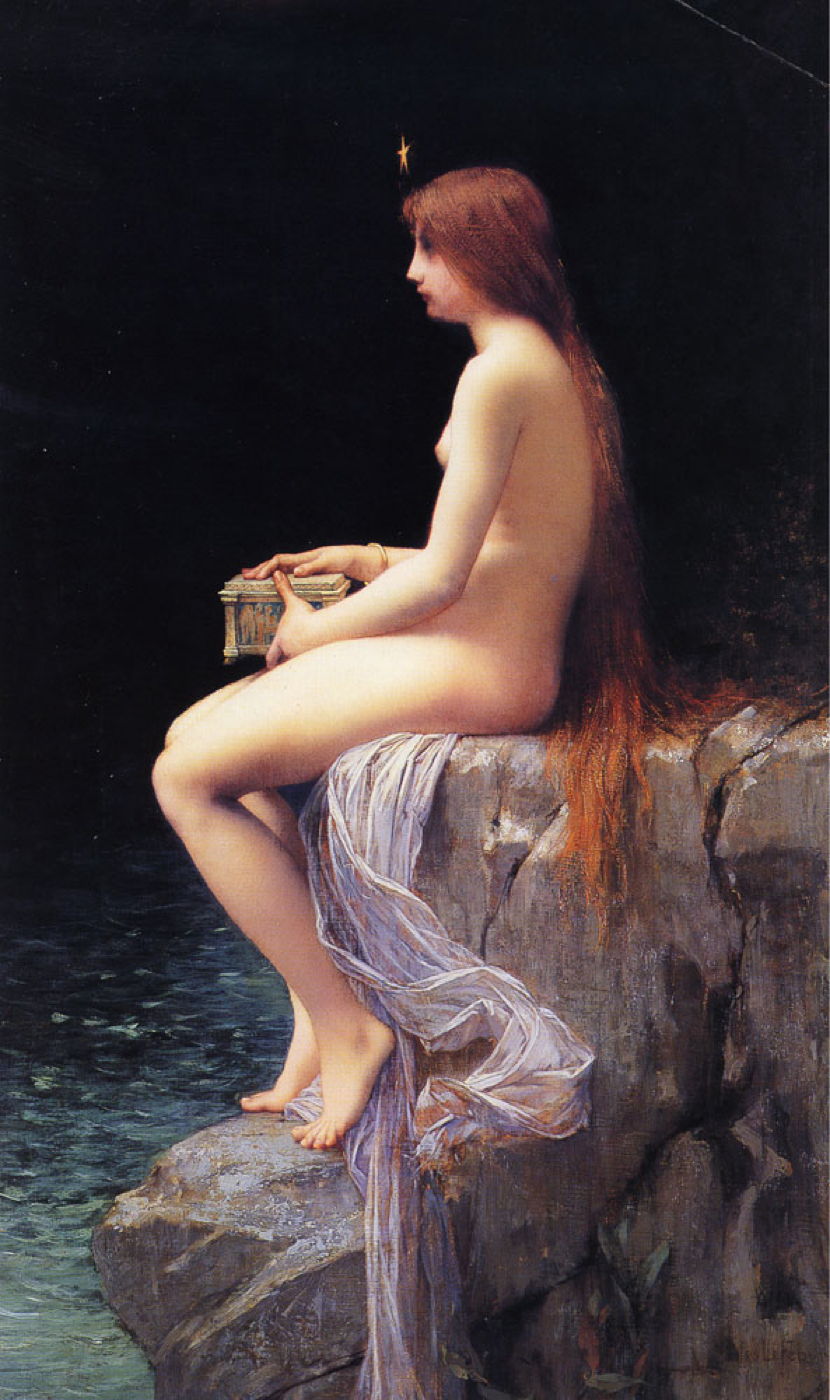
Jules Lefebvre’s second painting of Pandora made in 1882, a decade after his first, places her in profile next to the sea. She has a star just above her forehead, but that has become five-pointed rather than six, perhaps to dodge any Jewish connotations. His previous gentle narrative has all but vanished.
By this time only one artist had attempted to depict the crux of the story, and that had been Henry Howard almost fifty years earlier.
Reference
Wikipedia on the myth of Pandora.

