
When reading a painting of classical myth, the feet and footwear can be very important. Although they’re by no means common, if you see a figure wearing what could be winged sandals, you can narrow them down to one of two: Hermes or Mercury as messenger of the gods, and the hero Theseus. However, their depictions aren’t always consistent, and the absence of winged sandals doesn’t mean you can exclude them, unfortunately.
I start with the god, whose talaria were fashioned from gold by Hephaestus/Vulcan to enable him to fly as fast as any bird.

One of the most famous depictions of Hermes, typically in a supporting role, is in Botticelli’s magnificent Primavera from around 1482.
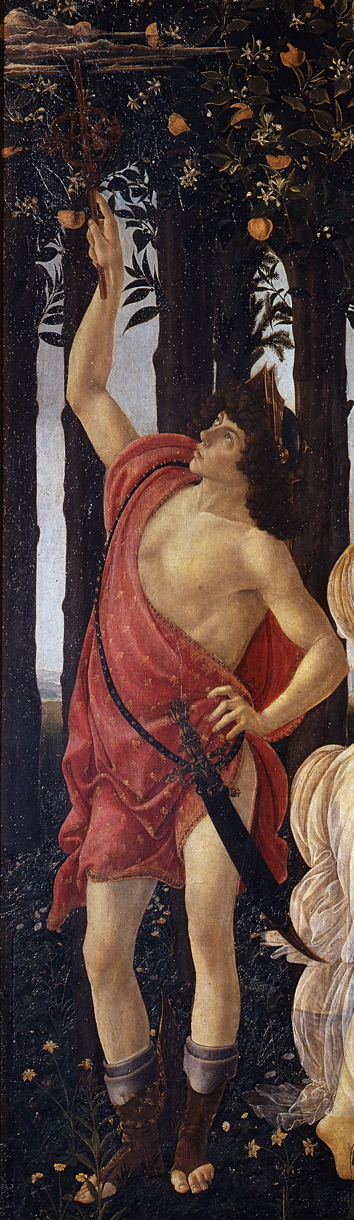
Hermes’ mother Maia gave her name to the month of May, so is associated with Spring. Botticelli has chosen to give the serpents on his caduceus wings to make them resemble small dragons. The god is also more typically seen with his caduceus in his left hand, rather than his right as shown here, and his winged sandals clearly aren’t made of gold.

Hermes is a frequent figure in paintings of gatherings of deities, including Andrea Mantegna’s Mars and Venus, known better as Parnassus (1496-97), painted for Isabella d’Este. At the right of this complex gathering is Hermes with his winged sandals and caduceus, and Pegasus the winged horse. Apollo is at the far left, making music for the Muses on his lyre.
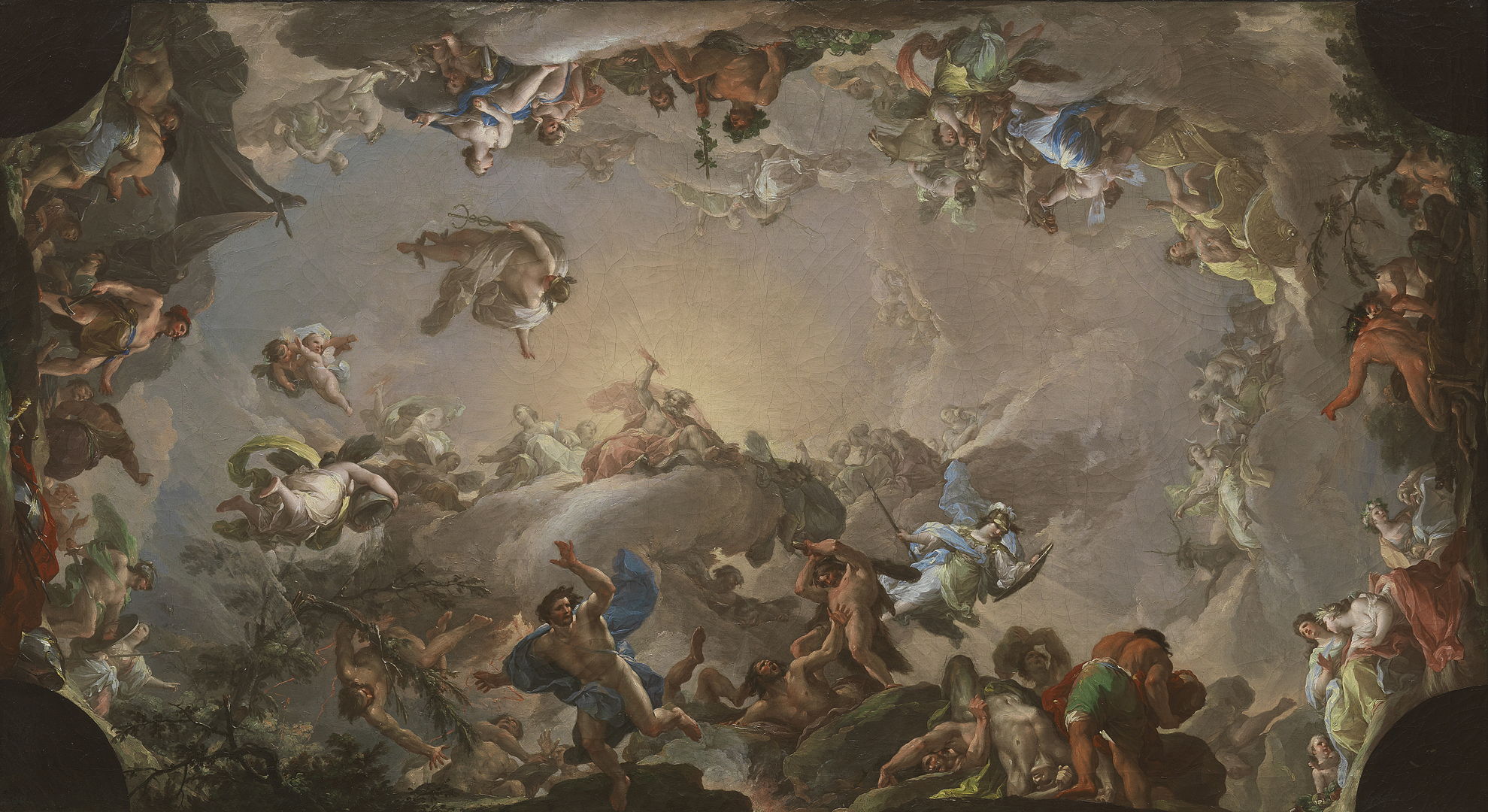
Francisco Bayeu y Subías was Goya’s brother-in-law. His Olympus: The Fall of the Giants from 1764 shows the war between the Titans and Olympian gods, and was presumably hung under a ceiling. Just to the upper left of its centre, holding his caduceus and wearing winged sandals, is Hermes.

Auguste Renoir’s account of The Judgment of Paris, from about 1908-10, demonstrates his skill as a narrative painter. After Paris has accepted Aphrodite’s bribe of Helen, he is shown awarding her the golden apple provided by the discordant Eris from the garden of the Hesperides. Watching on is Hermes, complete with his winged helmet and sandals, and caduceus.
Hermes seldom lent out his talaria, but there’s one occasion that has become well known. When Perseus was on his mission to obtain the head of Medusa, he was kitted out with Hermes’ sandals, the cap of Hades for invisibility, and a kibisis or sack in which to conceal the Gorgon’s severed head.

This Pompeian account of Perseus Freeing Andromeda from about 50-75 CE shows Andromeda still chained to the rock by her left wrist, and partially clad rather than naked as the myth related. Perseus has Medusa’s head tucked behind him, her face shown for ease of recognition. He is wearing his winged sandals, and carrying his sword in his left hand, although there’s no sign of Cetus the sea-monster yet.

Peter Paul Rubens’ Perseus and Andromeda from about 1622 contains most of the cues and clues to the original narrative. Andromeda is almost naked, although unchained at this stage, on the left. Perseus is clearly in the process of claiming her hand as his reward, for which he is being crowned with laurels, as the victor. He wears winged sandals, and holds the polished shield that still reflects Medusa’s face and snake hair. Much of the right of the painting is taken up by Pegasus, and at the lower edge is the dead Cetus, its fearsome mouth wide open.
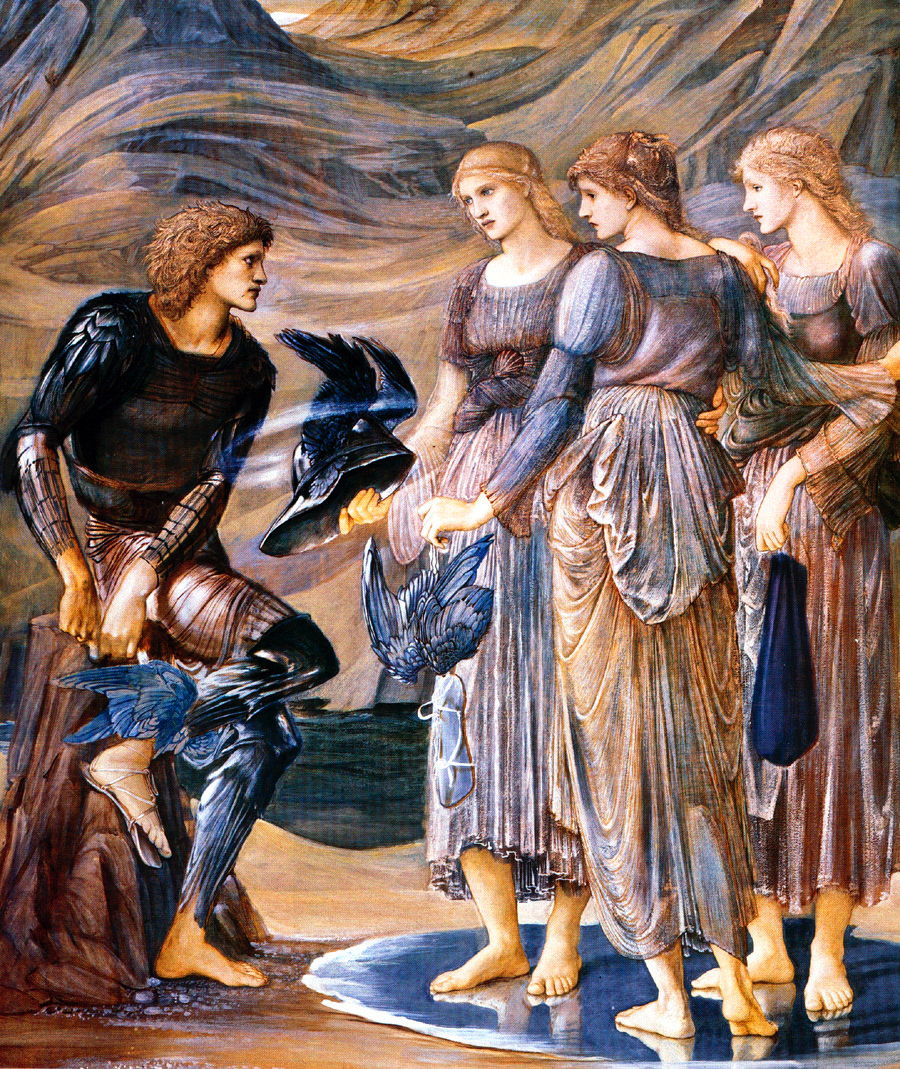
In Edward Burne-Jones’ Perseus Series, the hero’s winged sandals are one of its less consistent features.
The third painting, Perseus and the Sea Nymphs (1877), shows the Hesperides equipping Perseus with the kibisis at the far right. Burne-Jones combines with that his donning the winged sandals (centre) and Hades’ helmet, as provided by Hermes and Zeus.

Further on in the series, in his finished oil version of The Doom Fulfilled (1888), the sandals are shown clearly as Perseus takes on Cetus.

In one of Frederic, Lord Leighton’s last paintings, of Perseus On Pegasus Hastening To the Rescue of Andromeda from about 1895-96, the wings on his sandals are tiny but distinctive.

