
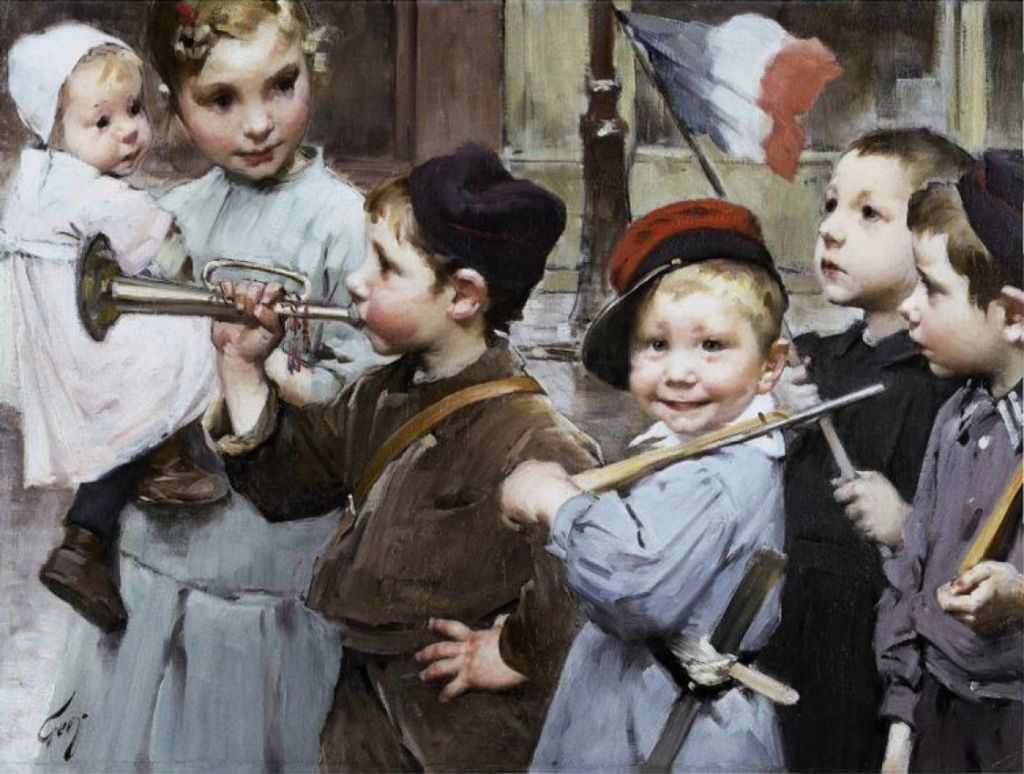
One of the main priorities of the Third Republic in France was to secularise the nation, and one of its pillars was the introduction of free and mandatory education. This was accomplished in the Jules Ferry laws of 1881 and 1882, whose changes swept across every part of France, and became an important theme in French Naturalist painting.

Jean-Baptiste Jules Trayer’s wonderful watercolour of A Breton Infants School from 1882 predates any celebration of the Republican policy: the crucifix high on the wall at the right confirms this is one of the older Catholic schools. It shows a teacher helping one of her students with writing, in a class wearing only traditional Breton costume. There’s clearly room for improvement, though, as one girl is sleeping on her book, doubtless exhausted from her early morning work on the family farm.

By 1882, Jean Geoffroy had entered the schools where he was to be most successful and prolific; he apparently lodged above a school, with a couple of teachers. Snack Time shows the pupils outside their primary school during a break, armed with their lunchboxes and baskets. He tells their stories using subtle hints including their clothes. A well-dressed girl in white is being harassed by a smaller boy into surrendering some of her food. He wears rougher clothes but seems in control of the situation, as others watch on and laugh.

Within two years of the early death of Jules Bastien-Lepage, Paul Louis Martin des Amoignes’ In the Classroom (1886) looks as if it may have been painted from photographs. One boy, staring intently at the teacher in front of the class, is caught crisply, pencil poised in his hand. Beyond him the crowd of heads becomes more blurred.

Geoffroy’s Primary School Class from 1889 doesn’t give us the same depth of field effect, but shows one of the Republic’s new lay teachers working diligently in the classroom with her pupils. They’re still a bit of a shower, with the younger ones at the back working on traditional slates, but this is the public face of the modern Republican School.

In 1895 Geoffroy shows a Drawing Lesson in a class of older boys, who are following the classical tradition of drawing casts and appear remarkably diligent and well-behaved.

In his In School from about 1900, another lay teacher in a modern Republican infants class is caring for the French men and women of the future.

The Third Republic believed in catching its future citizens young. In 1899, Geoffroy painted The Nursery, one of very few images to show the state’s approaches to the early rearing of children. Hospitals developed a rigorous almost military approach to nurseries and feeding that endured well into the twentieth century, and separated mothers from their infants for much of the time.
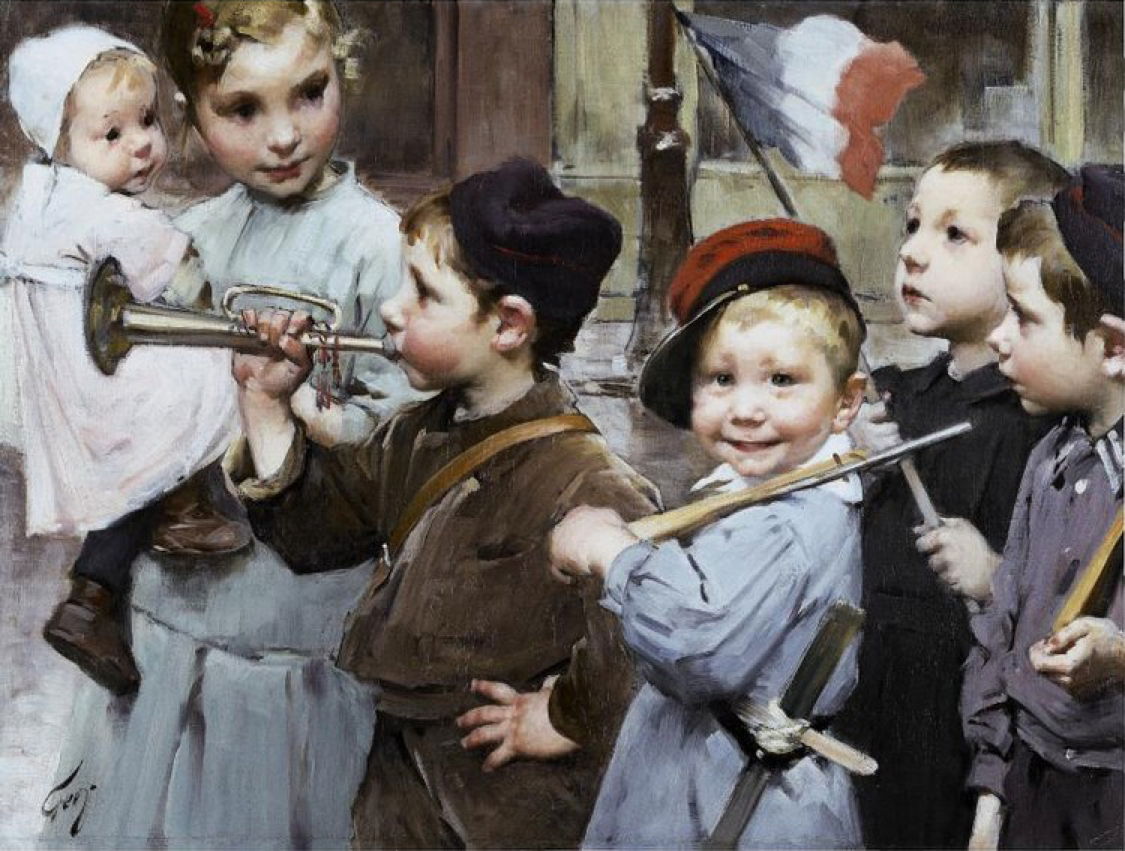
It was only right that those citizens of the future should celebrate the national day of France, Bastille Day, on 14 July, as painted by Geoffroy in about 1900. For young boys in the years before the First World War, this was becoming increasingly militaristic rather than just patriotic.

I have been unable to locate an image of Geoffroy’s painting from which Charles Baude made this print of Prize-Giving at an Infants School in 1904, but it’s a fine example of the artist’s depictions of the social interactions within groups of young children.

Geoffroy’s undated painting of It’s Hard to Share shows another of the tribulations of childhood. These young boys have just emerged from a sweet shop, and the child in the centre is reluctant to share the paper cone of sweets he has just bought. His face says it all, as he looks with great suspicion at his less fortunate friend, and a dog also looks up expectantly.
The Third Republic also opened up higher education to French women.

In Jean Béraud’s undated The Thesis of Madeleine Brès (or The Doctoral Jury) he shows us one of the early woman doctoral students defending her thesis before the academic jury. At the time, this was a major landmark in the improvements in women’s rights, and their archaic academic dress emphasises this change.

