

Landscape painting of the early twentieth century included individualists whose approach to the depiction of reflections on water departed from those of the past. This article looks at two very different artists from central Europe: Ferdinand Hodler with his Parallelism, and Gustav Klimt who mainly painted landscapes during his summer holidays.
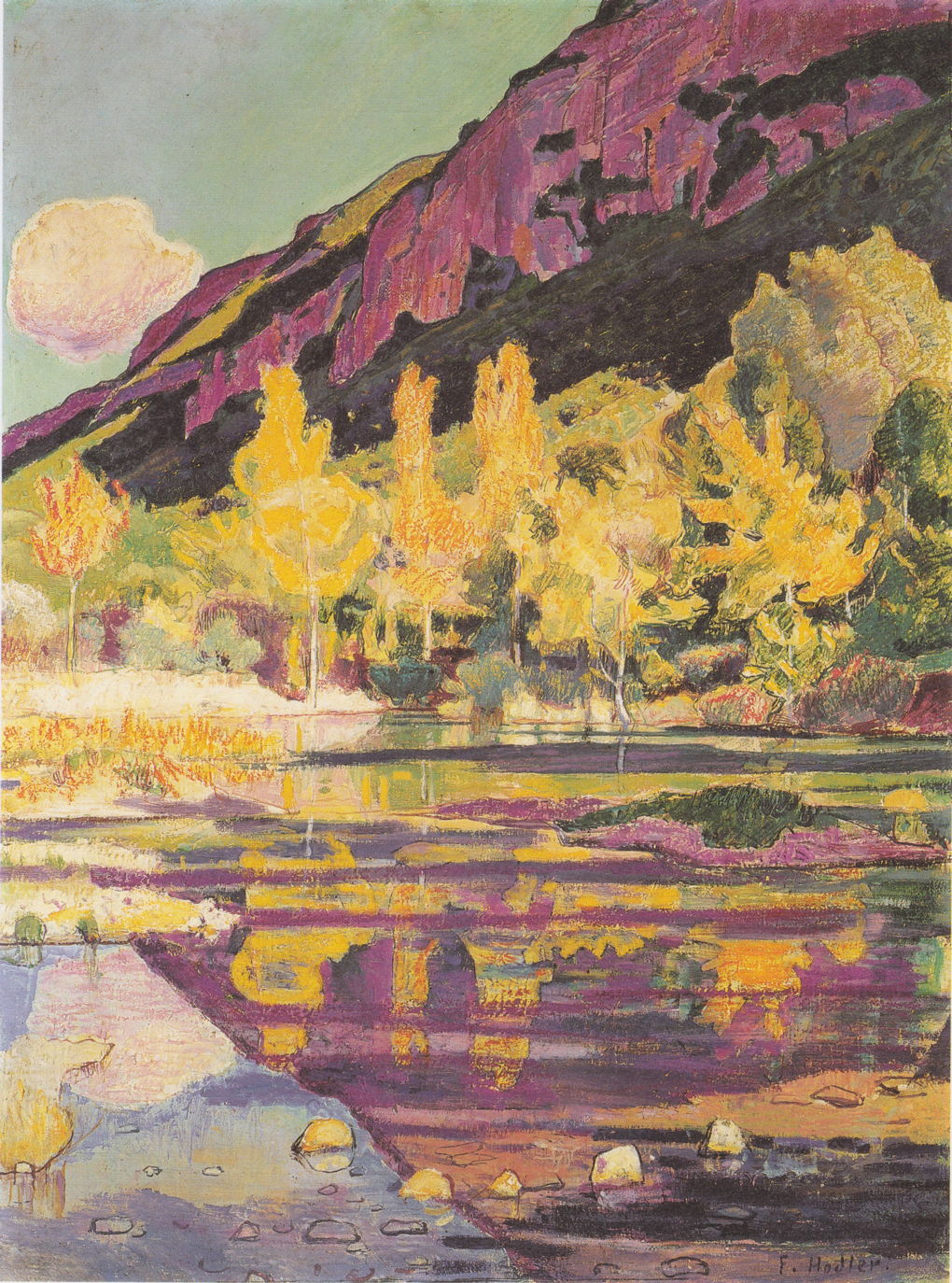
Hodler often painted the same landscapes repeatedly, although not in the same way as Claude Monet’s formal series. His view At the Foot of Petit Salève from about 1893 breaks up the reflections of the golden trees with bands of black and purple that don’t appear to be correlated with those of the original image above.

In contrast, this view of Lake Thun with Symmetrical Reflection Before Sunrise from 1904 appears to be meticulously faithful to optical principles.

However, in 1908 when he was in pursuit of Parallelist ideals, he painted this Rhythmic Landscape on Lake Geneva. This was a second version of a view he had previously painted three years earlier, when he wrote “This is perhaps the landscape in which I applied my compositional principles most felicitously.” Most of his symmetry and rhythm is obvious; what may not be so apparent are the idiosyncratic reflections seen on the lake’s surface. The gaps in the train of cumulus clouds here become optically impossible dark blue pillars, responsible for much of the rhythm in the lower half of the painting.

In the last few months of his life, Hodler simplified reflections into bands of colour. Lake Geneva with Mont Blanc in the Morning Light (1918) has a much simpler structure, with the water, a band of reflections, the mass of the far shore and mountains merged, and the dawn sky. The dominant colour is the yellow to pale red of the sky and its reflection.

Lake Geneva with Mont Blanc in the (Red) Dawn Light (1918) is simplified further to the water coloured by the sky, a zone of blue reflections of the far bank, the merged distant shore and mountains, and the sky.
Gustav Klimt developed his approach to reflections during the summers he spent with his partner’s family on Lake Attersee, when he painted extensively using a telescope.
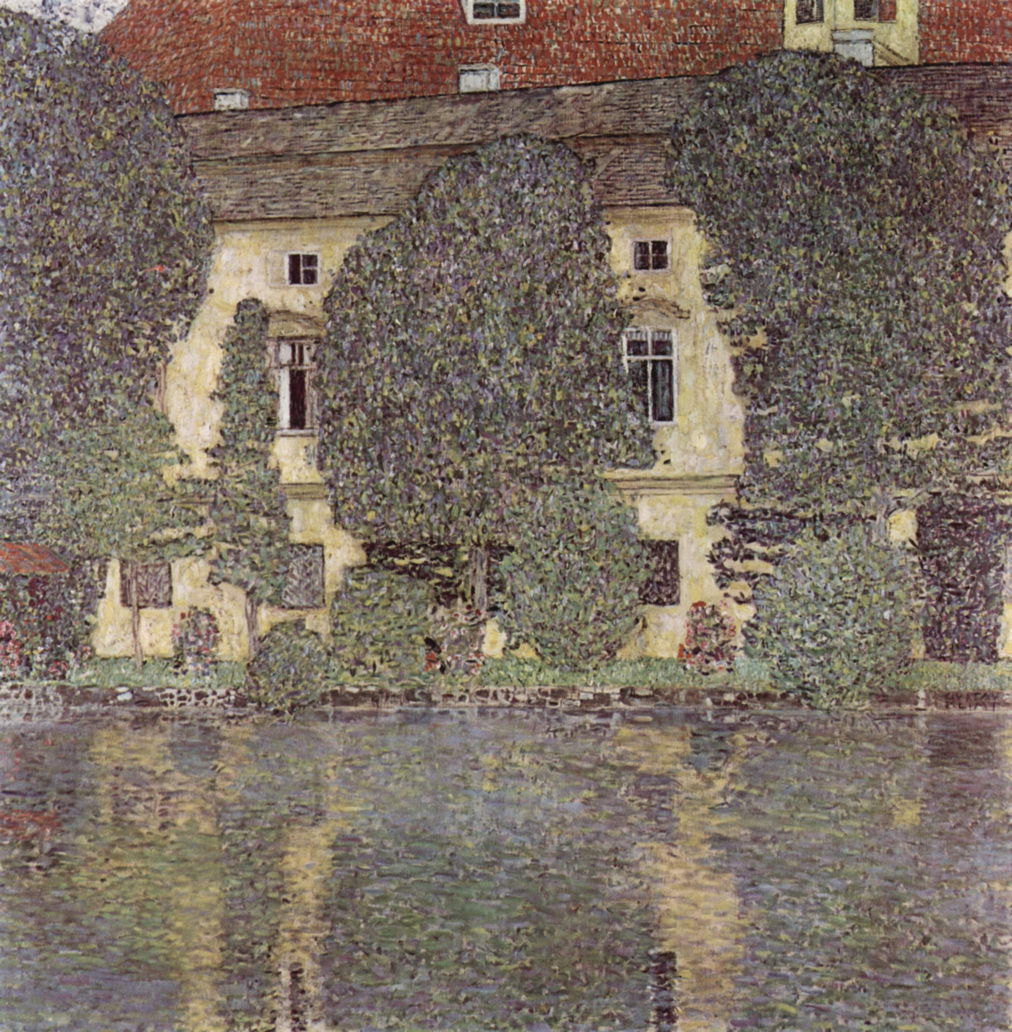
Schloß Kammer at Attersee (1910) is Klimt’s view across the lake of this manor house, with contrasting textures in foliage, walls and roofs. The reflections have lost the granular texture of the original image, giving them a glassy appearance, and appear optically faithful.
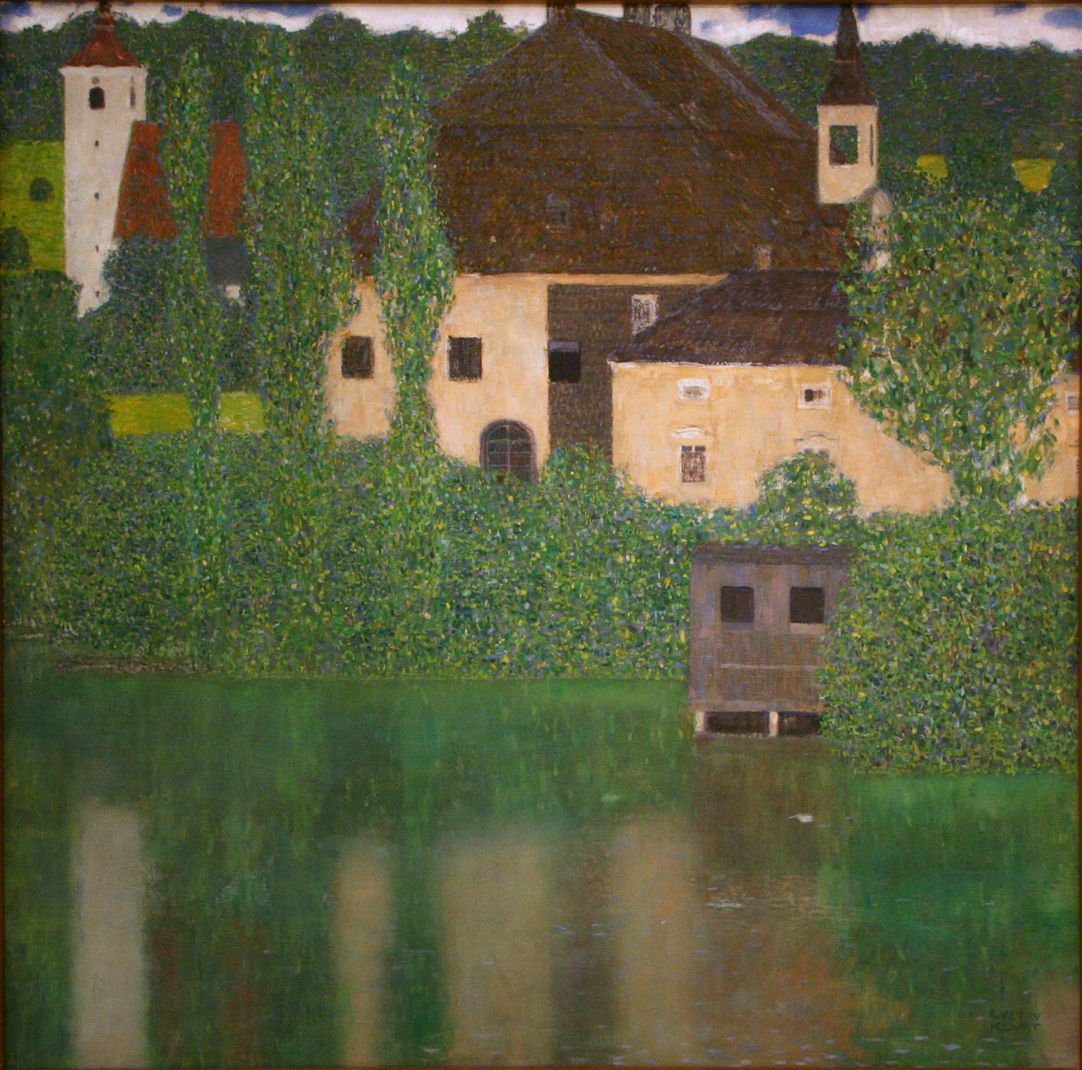
Castle with a Moat shows Unterach Manor on the Attersee Lake, and was probably painted in 1908 or 1909. It incorporates his almost Divisionist dotted foliage with contrasting smooth-textured walls of buildings, again softened in the reflected image. However, there’s some mismatch apparent in the hut on the water’s edge. Given the water between the motif and the artist, this must have been painted through a telescope, or possibly from a boat on the lake.
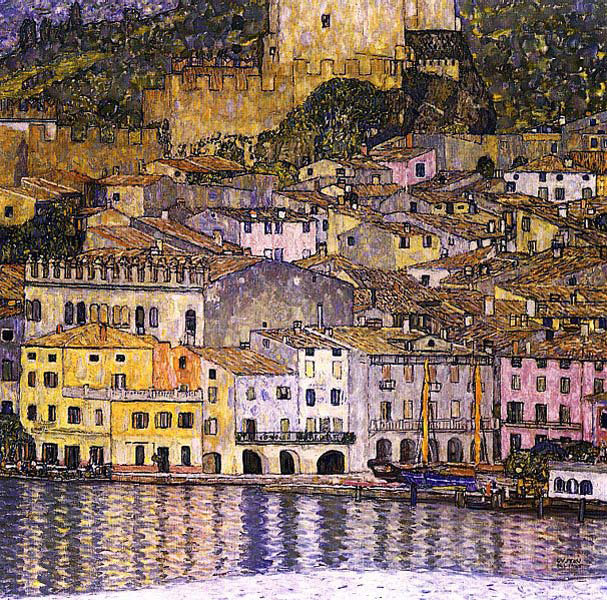
The same flattening is seen in his view of Malcesine on Lake Garda from 1913. The terraced properties running to the left of the centre of the painting are shown in a parallel projection, without any nearby vanishing point, which is again characteristic of a view through a telescope or similar optical instrument. However, the reflections owe more to Hodler’s Parallelism than they do to optics.

