
Colouring glass is ancient in origin, and in Europe its use in church windows reached its height during the Middle Ages. As a craft it has tended to develop independently of fine art painting, but since the nineteenth century’s revivals of better integrated arts and crafts, some painters have designed stained glass windows. At the same time, other painters have been depicting them.
In the Italian Renaissance, several artists best-known as painters, among them Paolo Uccello and Donatello, designed stained glass windows for Florence Cathedral and other churches. In the nineteenth century revival of the craft, contemporary arts and crafts movements drew established painters from the Pre-Raphaelite movement in Britain, and Art Nouveau across much of Europe. Among those who created successful designs are Edward Burne-Jones, Alfonse Mucha, Koloman Moser and Marc Chagall.

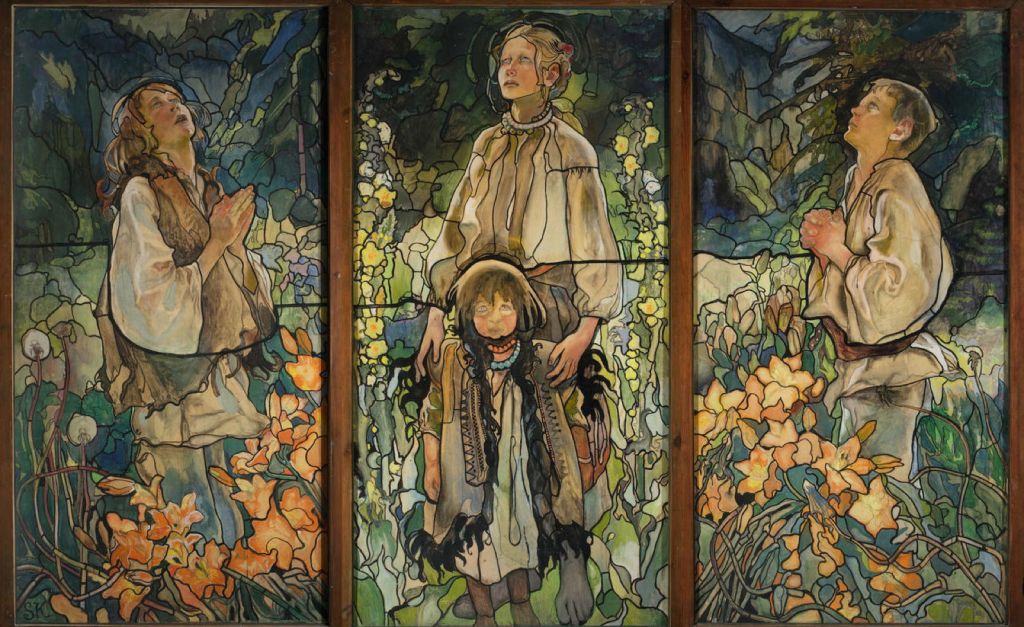
Koloman Moser’s Art is one of his design sketches from 1897 intended for a round stained glass window in the new Secession Building in the centre of Vienna.
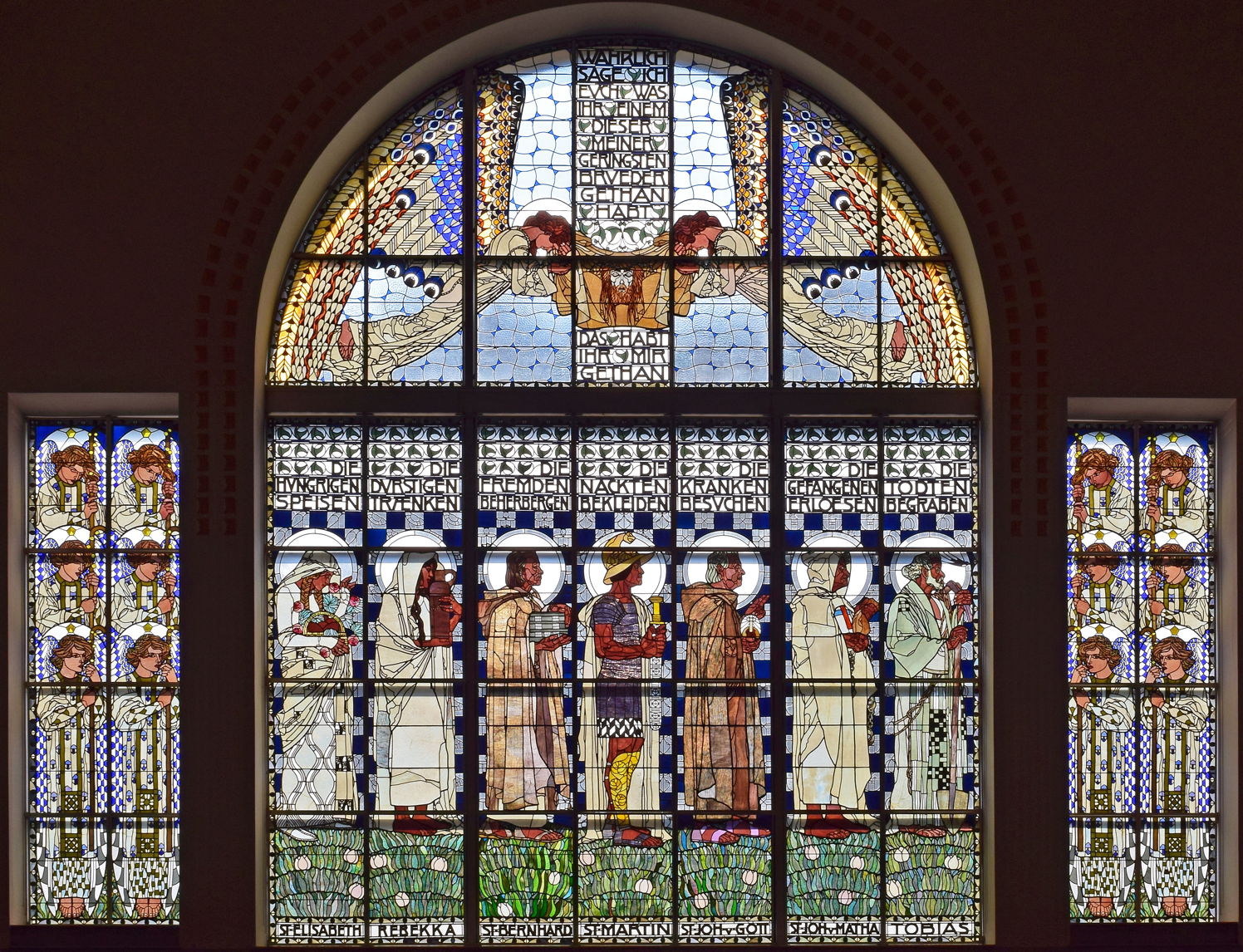
In 1905-07, Moser collaborated with Leopold Forstner (1878-1936), already famous for making mosaics and stained glass, in the design and production of windows and mosaics for the Kirche am Steinhof (also known as Otto-Wagner-Kirche) in Vienna. Most impressive among these is this window of The Physical Virtues.
Am Steinhof, as it was widely known then, is a large psychiatric and neurological hospital complex planned by the architect Otto Koloman Wagner (1841-1918), and built between 1904-07 in a suburb to the west of Vienna. Its architecture is Art Nouveau, and it contains several of the finest examples of that style, particularly its Roman Catholic oratory: Wikipedia has an excellent article about it here, and an extensive library of images in Wikimedia Commons.
At the same time, artists started featuring stained glass windows in their paintings.

John Everett Millais’ final version of Mariana (1851) was first shown at the Royal Academy in 1851, and refers to Tennyson’s poem of the same name. This richly-coloured painting is full of symbols: fallen leaves to indicate the passage of time, her embroidery as a means of passing that time, the Annunciation in the stained glass contrasting her with the Virgin’s fulfilment, the motto ‘in coelo quies’ (in heaven is rest), and the snowdrop flower in the glass meaning consolation. Mariana’s posture is intended to indicate her yearning for her lover Angelo.

Paul César Helleu’s Interior of the Basilica of Saint-Denis (c 1891) is an example of his interest in churches and their stained glass, which included Reims Cathedral. The Basilica of Saint-Denis was the burial place for almost every French king between the tenth and eighteenth centuries, and it now lies within the north of the city of Paris, although Saint-Denis was formerly its own city. The window shown is that of the north transept, featuring the tree of Jesse; a south transept rose shows the Creation.
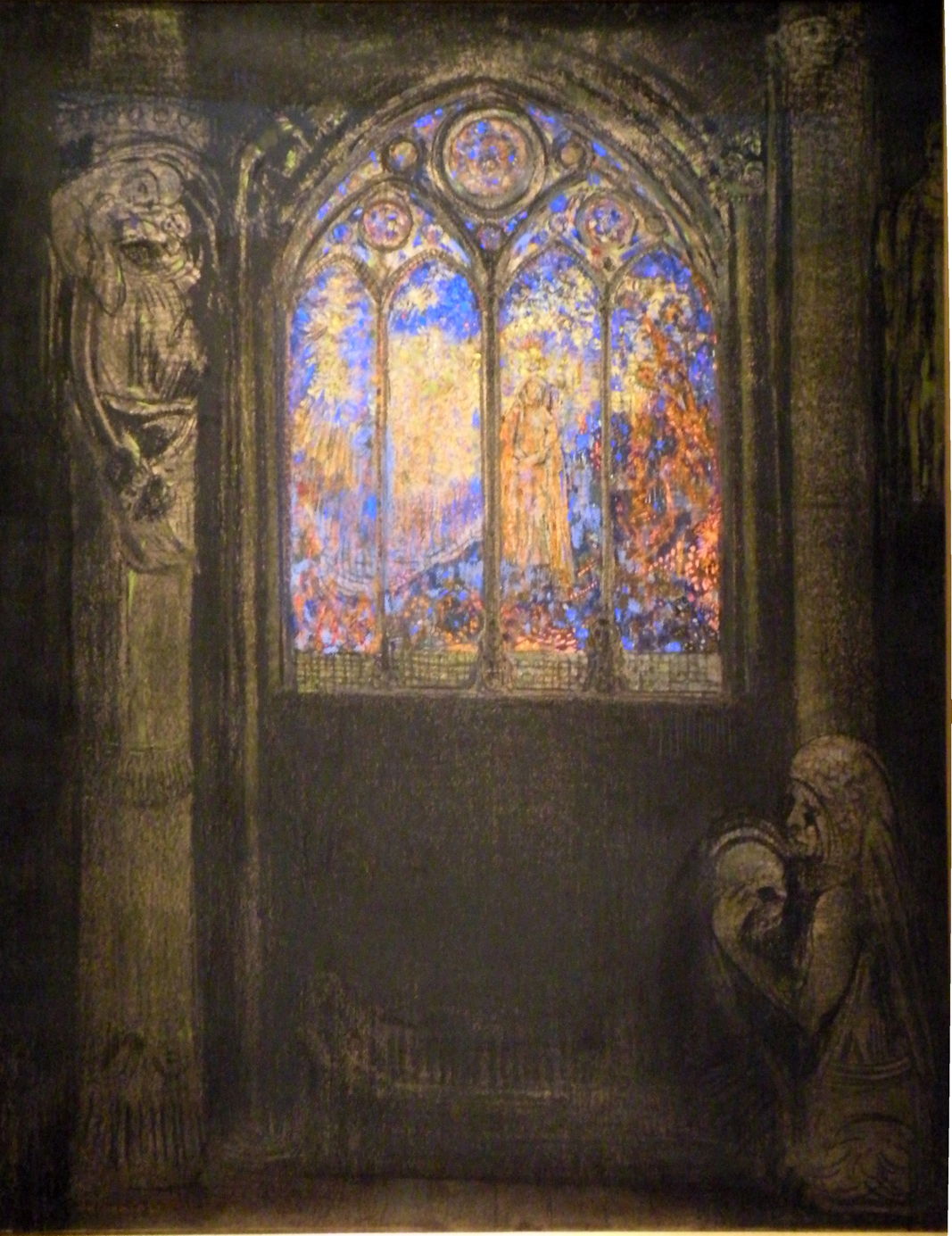
Odilon Redon’s The Large Window, from 1904, is one of the most remarkable pastel paintings that I have seen. Framed by carved masonry shown in the dull greys of charcoal, a mediaeval stained glass window dazzles with its bright, rich colours, the pure pigment of pastel at its best.
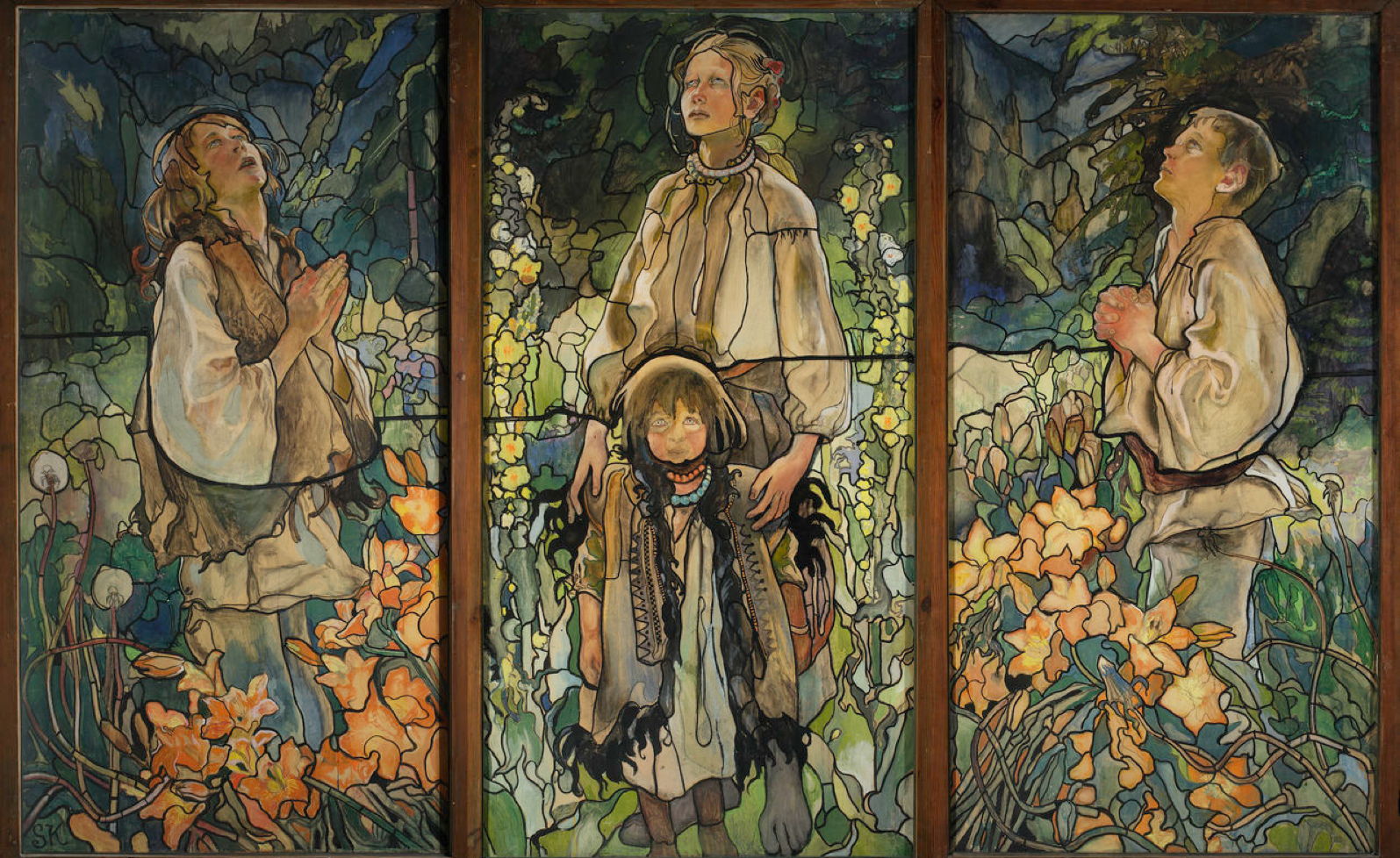
Three years after Kazimierz Sichulski painted his first triptychs, he used mixed media of tempera and pastel to create some that look as if they’re stained glass. His Spring Triptych from 1909 bridges the religious and secular, with the centre panel showing a woman and child.

Léon Augustin Lhermitte had painted a few religious works earlier in his career, but his late pastel of The Prayer, the Church of Saint-Bonnet (before 1920) is probably the most moving.

At the start of the First World War, the cathedral of Notre-Dame de Reims, where the Kings of France were once crowned, had been commissioned as a hospital and demilitarised. German shells hit the cathedral during opening engagements on 20 September 1914, setting alight scaffolding, and destroying some of the stonework. The fire spread through woodwork, melting the lead on the roof, and destroying the bishop’s palace. The French accused the Germans of the deliberate destruction of part of its national and cultural heritage.
Georges Rochegrosse’s Interior of the Cathedral of Reims in Flames (1915) casts this in a curious combination of the physical reality of the shattered masonry and fire, the ancient glory of the cathedral’s stained glass, and an Arthurian figure (possibly the Madonna herself) reaching up to seek divine intervention.

