

In addition to his account of the battle between Lapiths and centaurs at the wedding feast of Pirithous and Hippodame, Ovid tells the story of Nessus the centaur and his attempt to abduct Hercules’ wife.
Nessus had set himself up as the ferryman on the river Euenos, in western Greece. One day, Deianeira, the beautiful wife of Hercules, wanted to cross the river, so she mounted Nessus’ back and he took her across. As he was doing so, he decided to try to abduct and rape her. However, Hercules was on the bank they had just left, and heard her cries. He drew his bow and shot Nessus in the breast with an arrow whose tip was poisoned with the blood of the Lernean Hydra.
As Nessus lay dying, in an act of revenge he told Deianeira that his blood would act as a love charm to ensure that Hercules would be true to her forever, which she foolishly believed. She collected his blood, and kept it ready for use. Some years later, Hercules was having an affair with the young and beautiful Iole. When Deianeira discovered this, she spread Nessus’ blood on a shirt (chiton), which she gave to her husband to wear, in the hope that it would bring him back to her.
When Hercules was away, Deianeira accidentally spilt some of Nessus’ blood on the floor, where it lay smoking in the light of dawn. She realised that Nessus had tricked her, and that his blood would harm Hercules. She sent a messenger to warn him, but that was too late for Hercules, whose body had been horribly burned by the shirt. He took himself out to die a noble death on a pyre of oak branches, from where Zeus took him to Mount Olympus.
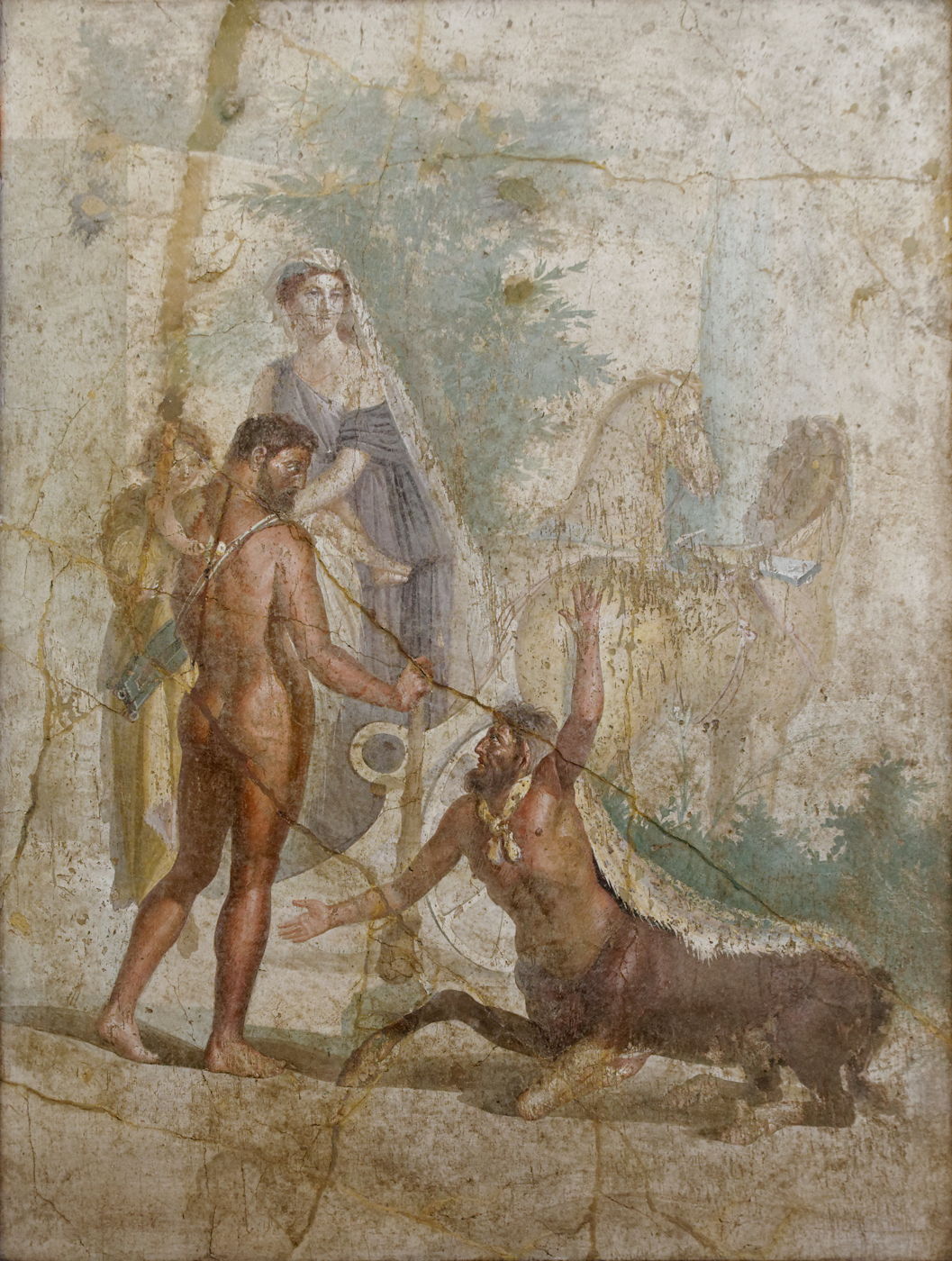
This story is shown on several Greek pots, and this Roman fresco from around 50 CE. Although an interesting painting, it seems to show a variant to the story involving Hercules’ son Hyllus and a chariot. The artist has also chosen to show the group before Nessus carries Deianeira across the river, thus before the attempted abduction, a puzzling choice.
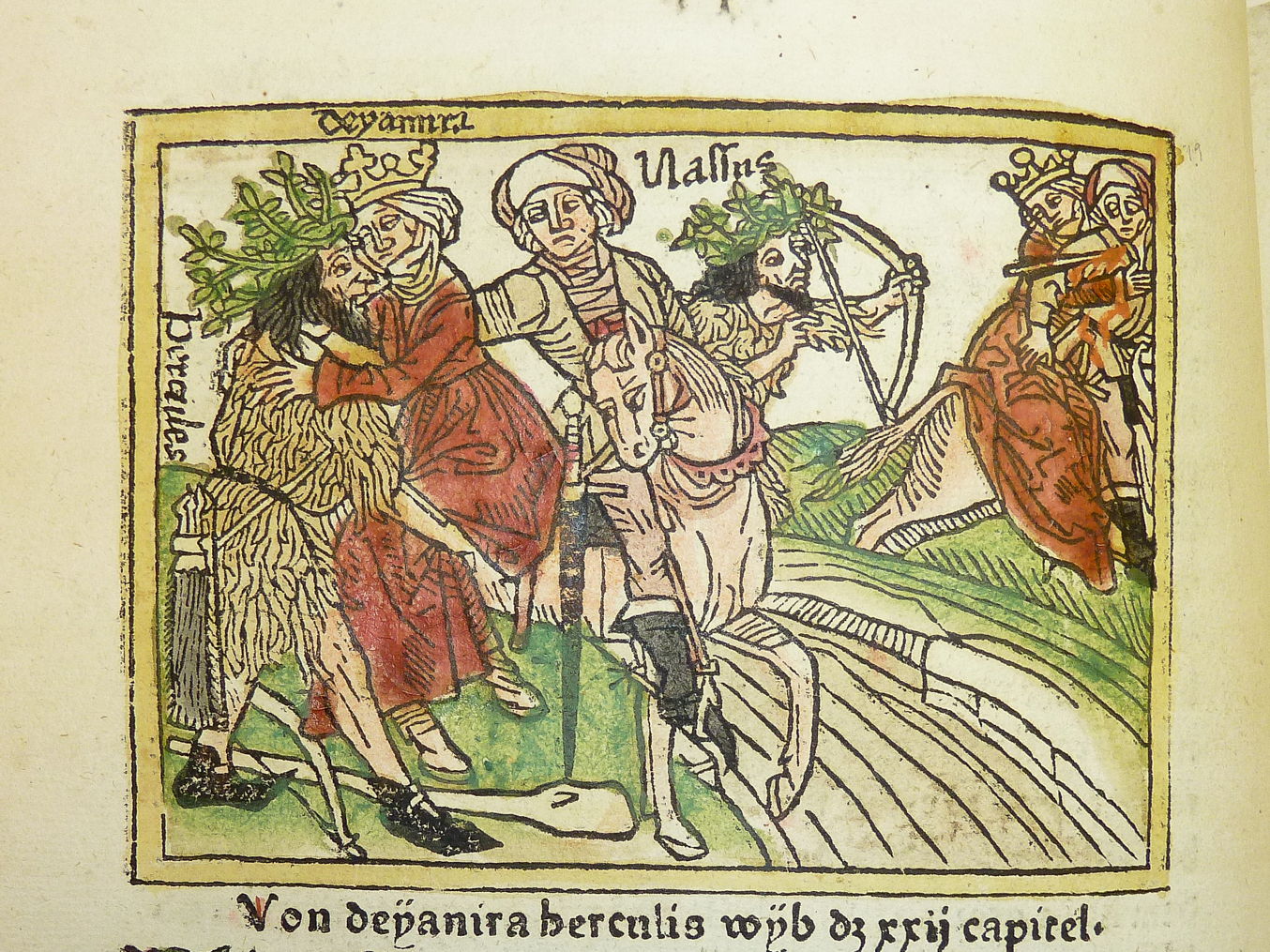
This wonderful woodcut from around 1474 may not have quite grasped what a centaur is, but includes two complete copies of the protagonists in its single frame. Hercules is first seen placing Deianeira onto a horse, then Hercules has shot the horseman. In trying to squeeze these two instants into the image, it runs out of space at the right.
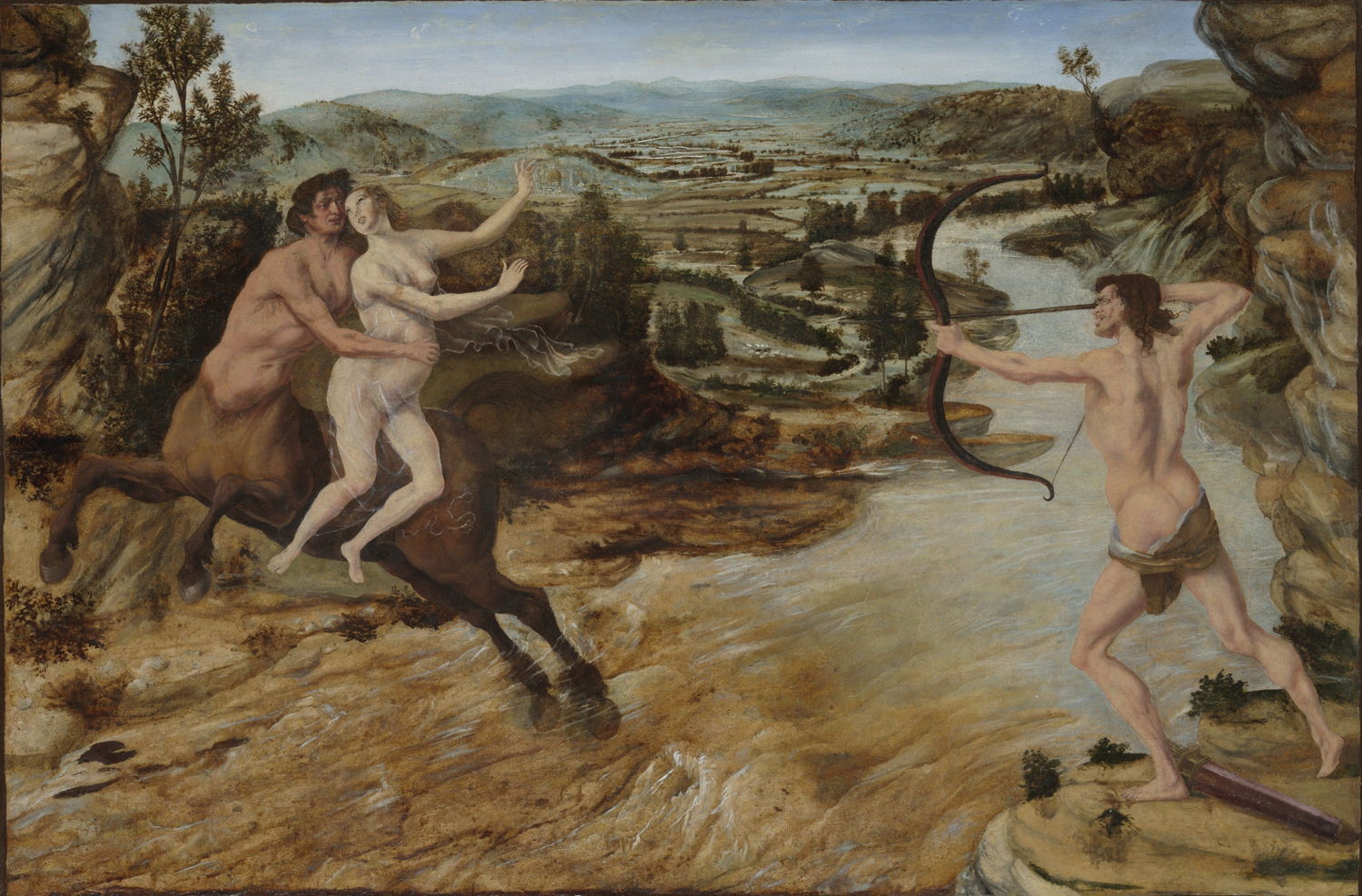
Antonio del Pollaiolo’s painting from about 1475–80 tries a side-on view, requiring Nessus to be shot while still in the river, a slight adjustment to the original story. Deianeira appears precariously balanced, and must be grateful that Nessus’ muscular arms save her from being dropped into the river below. The artist also leaves it to the viewer to know that Hercules’ poisoned arrow strikes Nessus rather than Deianeira.
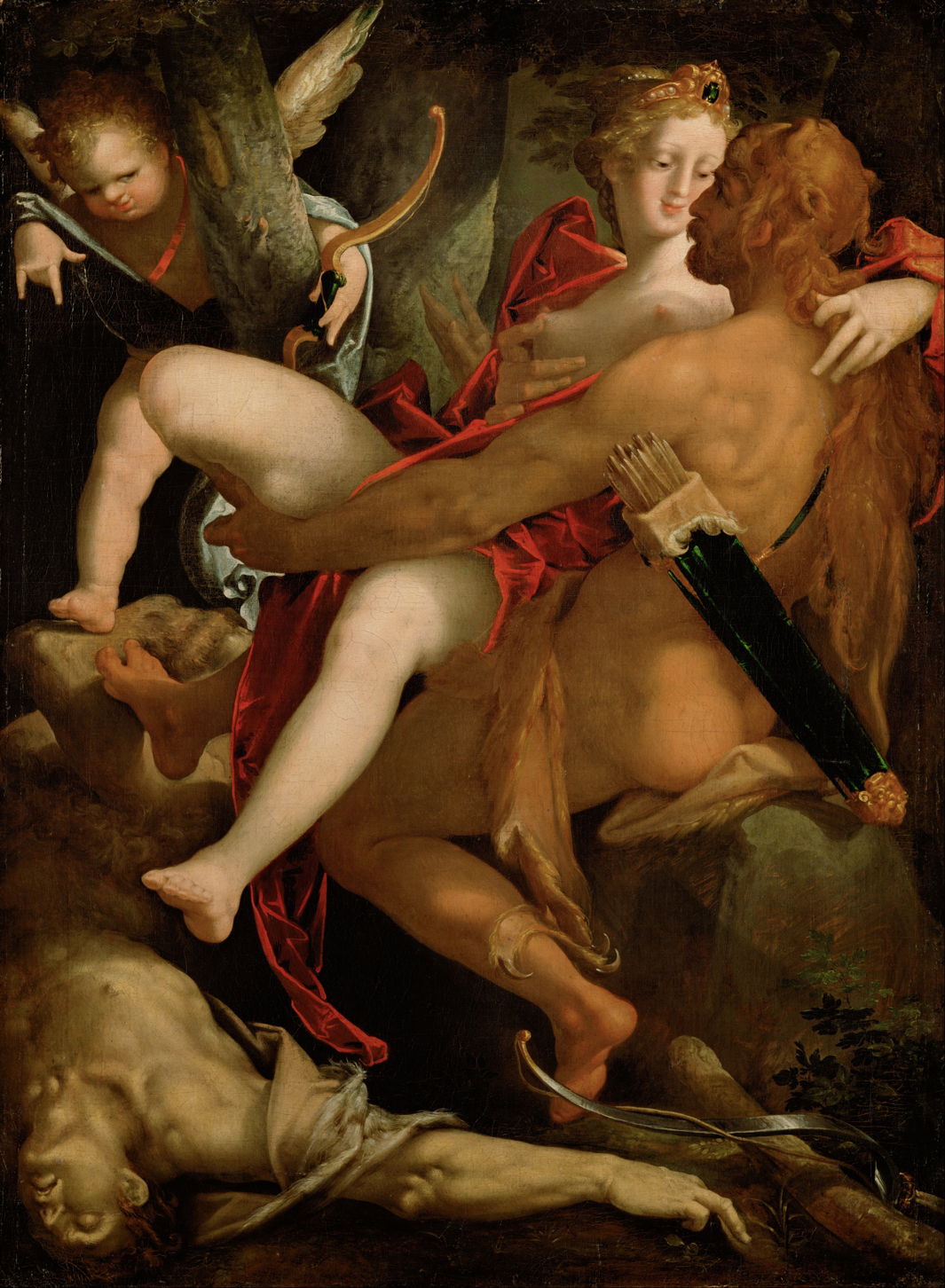
In about 1580, Bartholomeus Spranger painted one of the few accounts timed after the death of Nessus. Hercules has caught his wife up in his arms, and a winged Cupid looks a little puzzled from the top left, as if wondering how his arrow could have killed the centaur. The sequel story, relying on Nessus’ blood, appears to have been lost in the joy of reunion, leaving the viewer confused as to how this matches the literary narrative.

Paolo Veronese’s painting from about 1586 elects for a much earlier moment, as Hercules is readying his bow and arrow, with Nessus just reaching the opposite bank. He also shows the scene from Hercules’ position, but discovers the problems with that point of view: Nessus and Deianeira are now small, and Nessus is looking away (and his chest concealed), and even Hercules’ face is turned from the viewer.
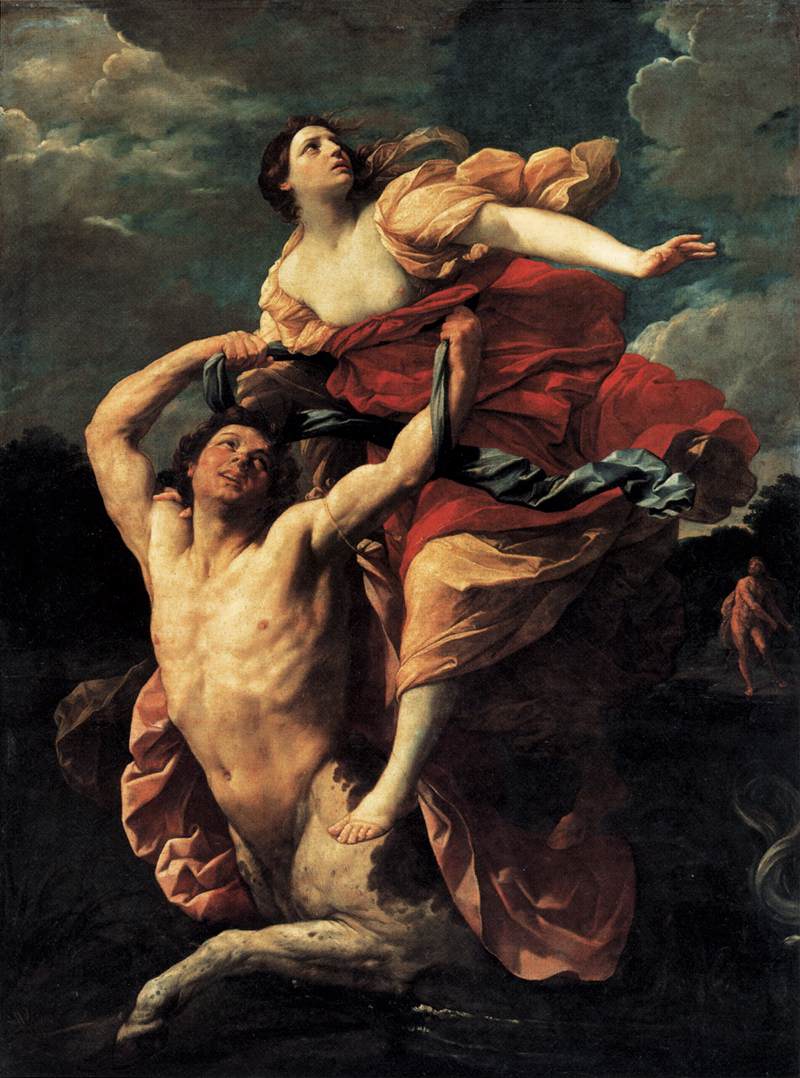
Guido Reni’s masterly painting from around 1620, one of the finest of its period in the Louvre, almost fills the canvas with Nessus, who looks worryingly heroic, and Deianeira, who seems to be flying. The small figure of Hercules in the distance is well-lit, but loses the details of bow and arrow. In any case, the arrow could hardly strike Nessus in the chest.

This painting is almost certainly not the work of Peter Paul Rubens, but was probably painted in his workshop around the time of Rubens’ death, in 1640. Like Veronese, the artist adopts the point of view from the bank on which Hercules is poised to shoot his arrow into Nessus. By turning the centaur round, to run across the width of the canvas, his face and chest are well exposed, and Hercules’ target is feasible. Even Deianeira appears more comfortable with the force of gravity.
They have added a winged Cupid, to make clear Nessus’ intentions, and Deianeira’s facial expression is marvellously clear in intent. The additional couple, in the right foreground, might be intended to be a river god and naiad, who would be superfluous apart from their role in achieving compositional balance.

Noël Coypel’s painting from around 1680 includes more narrative elements than others, but in doing so I fear becomes confusing to read. Nessus has been struck, is bleeding, and holding out some cloth that is slightly blood-stained. An arrow lies on the ground in front of him, but none in his chest. Deianeira is still on his back, although his legs have buckled under him, and he looks distressed. Approaching them with a heavy club in his right hand is Hercules, perhaps coming to finish the centaur off.
To those Coypel adds three winged putti, who seem to be pointing out those clues to the story, and behind them is a river god, and another couple of figures, watching but not apparently part of this story.

In about 1706, Sebastiano Ricci embroidered the story further, showing Hercules, his left hand grasping Nessus’ mouth, about to club the centaur to death, while a slightly bedraggled Deianeira watches in the background. There is no arrow in Nessus’ chest, and Hercules’ quiver is trapped under Nessus’ right foreleg. Three other figures of uncertain roles are at the right, and a winged putto hovers overhead, covering its eyes with its right hand.
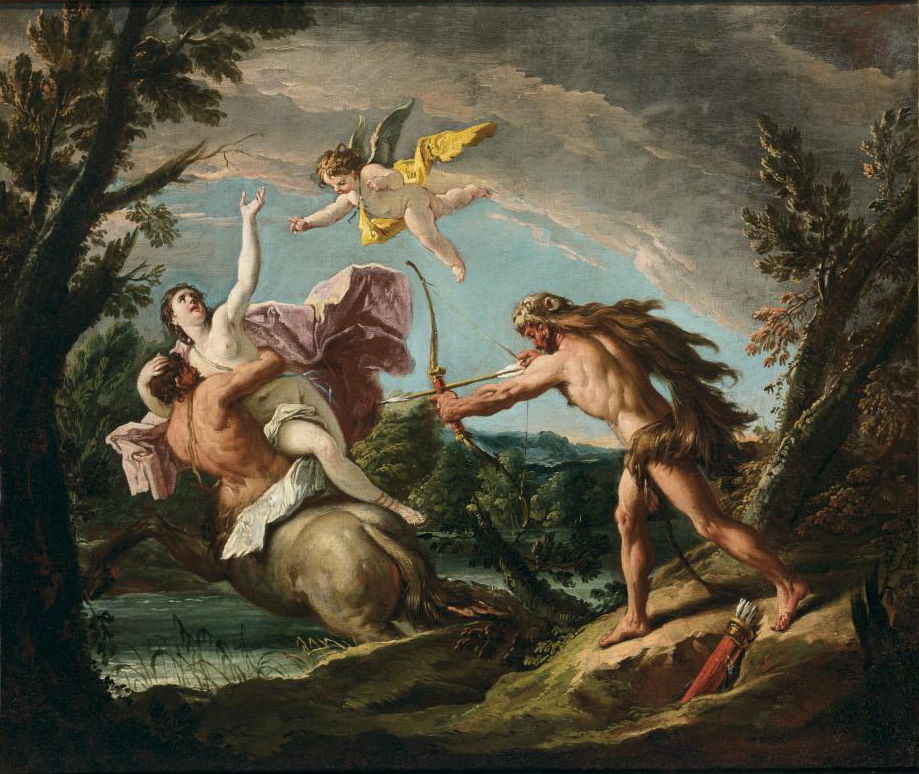
Although Gaspare Diziani returned to the original story in his painting of about 1730, he fell foul of the same compositional problems as in earlier works. Nessus is making off with Deianeira as he is crossing the river. He clutches the woman in his arms, which at least allows us to see her face, and the hand calling for assistance, but his face and chest are almost occluded.
Hercules has to stand so close as to almost be able to touch him, so it is feasible for his arrow, when loosed, to enter the right side of the centaur’s chest, under the armpit. Hercules is looking down at his feet, although drawing back ready to shoot Nessus. Above them an incongruous winged putto forms the apex of a triangle with the other figures. Where will Hercules’ arrow strike?
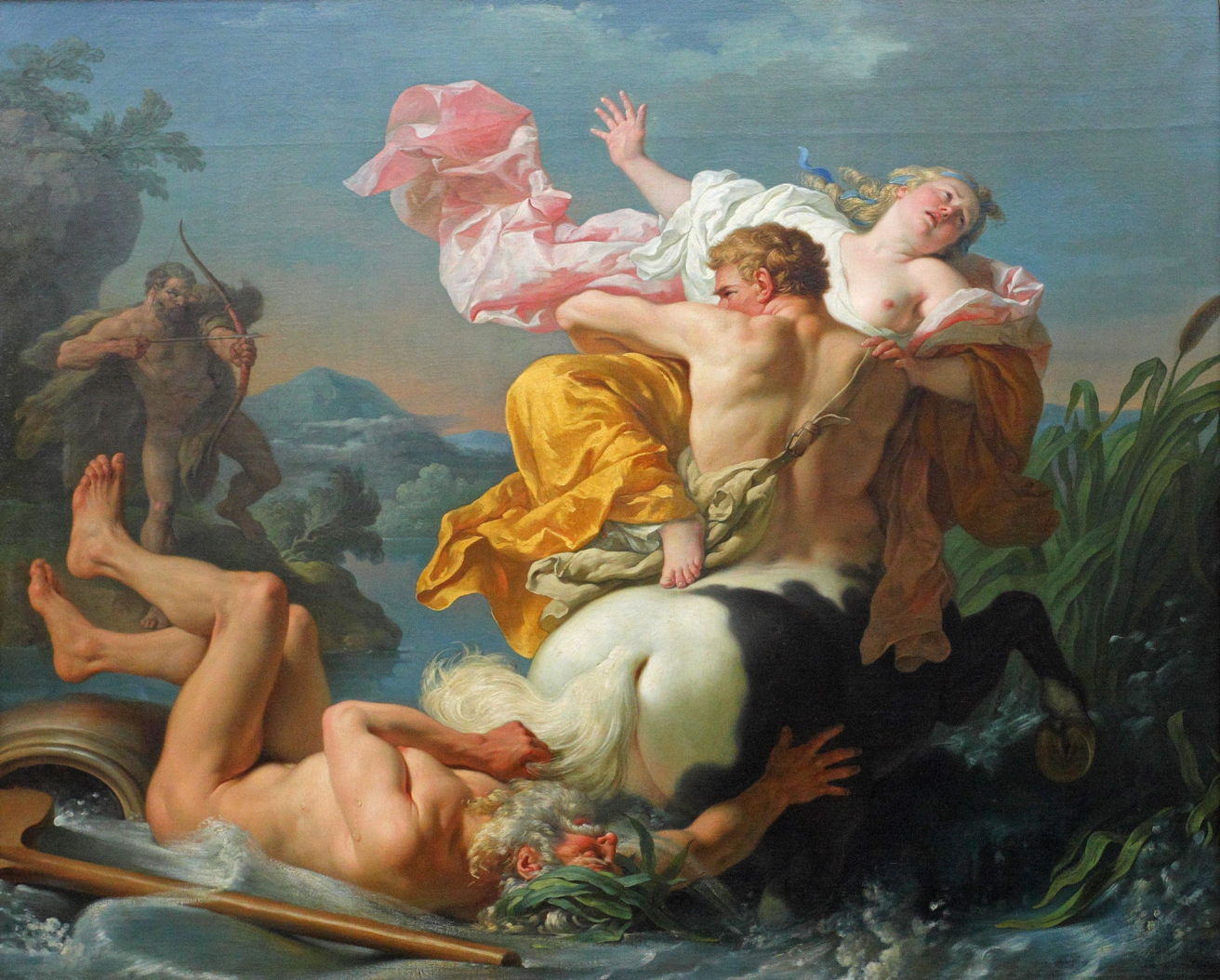
In 1755 Louis-Jean-François Lagrenée clearly understood the compositional problem. His solution is unfortunately no better, despite his beautiful painting. Nessus, bearing a distressed Deianeira in his arms, has just reached the opposite bank, in the foreground. Hercules is on the left in the distance, and we can at least see his face, bow and arrow. Unlike Reni, he has not lit Hercules to best effect, and there appears to be no way that Hercules’ arrow could impale Nessus’ chest, without first passing through some of the abundant Deianeira. He also adds a river god, who seems to have been knocked over in Nessus’ haste to make off with his captive.

Gustave Moreau’s final drawing of about 1860, squared up and ready to transfer to canvas for painting, alters the story to make its composition feasible. He puts Nessus in the foreground, with the attendant risk of making him appear the hero, somehow supporting the upstretched body of Deianeira. In the right distance, Hercules has already loosed the fatal arrow, which is prominently embedded not the front of Nessus’ chest, but his back. The centaur’s legs have collapsed under him, and his head and neck are stretched up in the agony of death.

Moreau’s eventual painting of Nessus and Deianeira, in 1872, was titled Autumn (Deianeira), and quite different from that drawing. Deianeira and Nessus are in very similar postures, although reversed onto the opposite bank of the river, with Nessus still very much alive, and Deianeira apparently in a trance-like state. Hercules may be lurking in the dense wood around them, but for the moment I cannot see him.

My last example is also the most puzzling: Arnold Böcklin’s painting from 1898. Nessus is far from part-human, and Deianeira not the beauty that she was claimed to be. As those two wrestle grimly, Hercules has stolen up behind them, and is busy pushing a spear into Nessus’ bulging belly. Blood pours from the wound, but Deianeira seems to be in no position to collect it.
 The Eclectic Light Company