
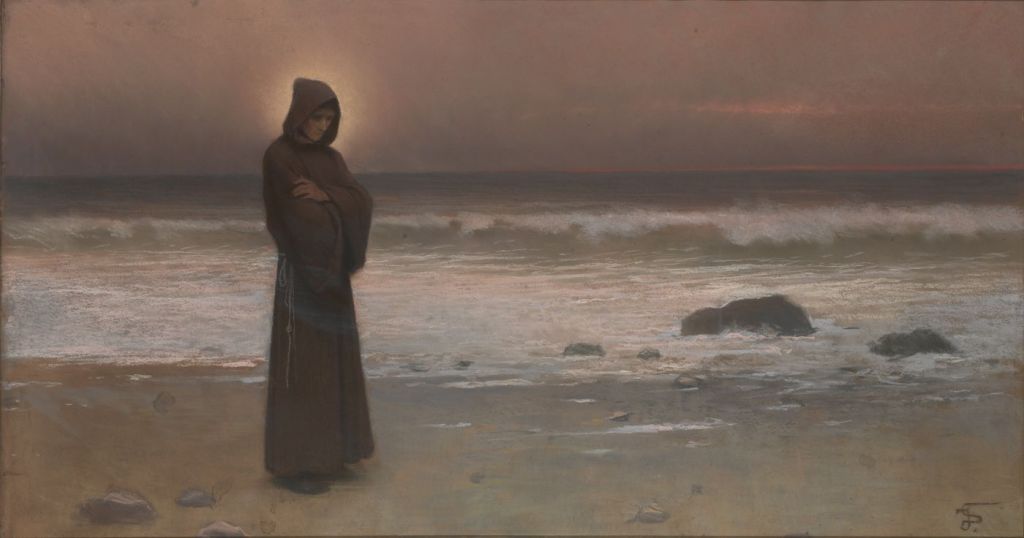
As with many items of clothing, the term hood is applied to a wide range of garments. For the purposes of this selection of paintings, I confine it to a shaped covering for the head that is part of a garment also covering at least part of the upper body. This includes the cowl integrated into the robes of many monks, and the hooded cape known as a chaperon, described below. It would also include the modern hoodie that became popular in the 1970s.
Hoods are commonly worn by figures associated with death, such as the Grim Reaper, where they provide sinister concealment of the face.
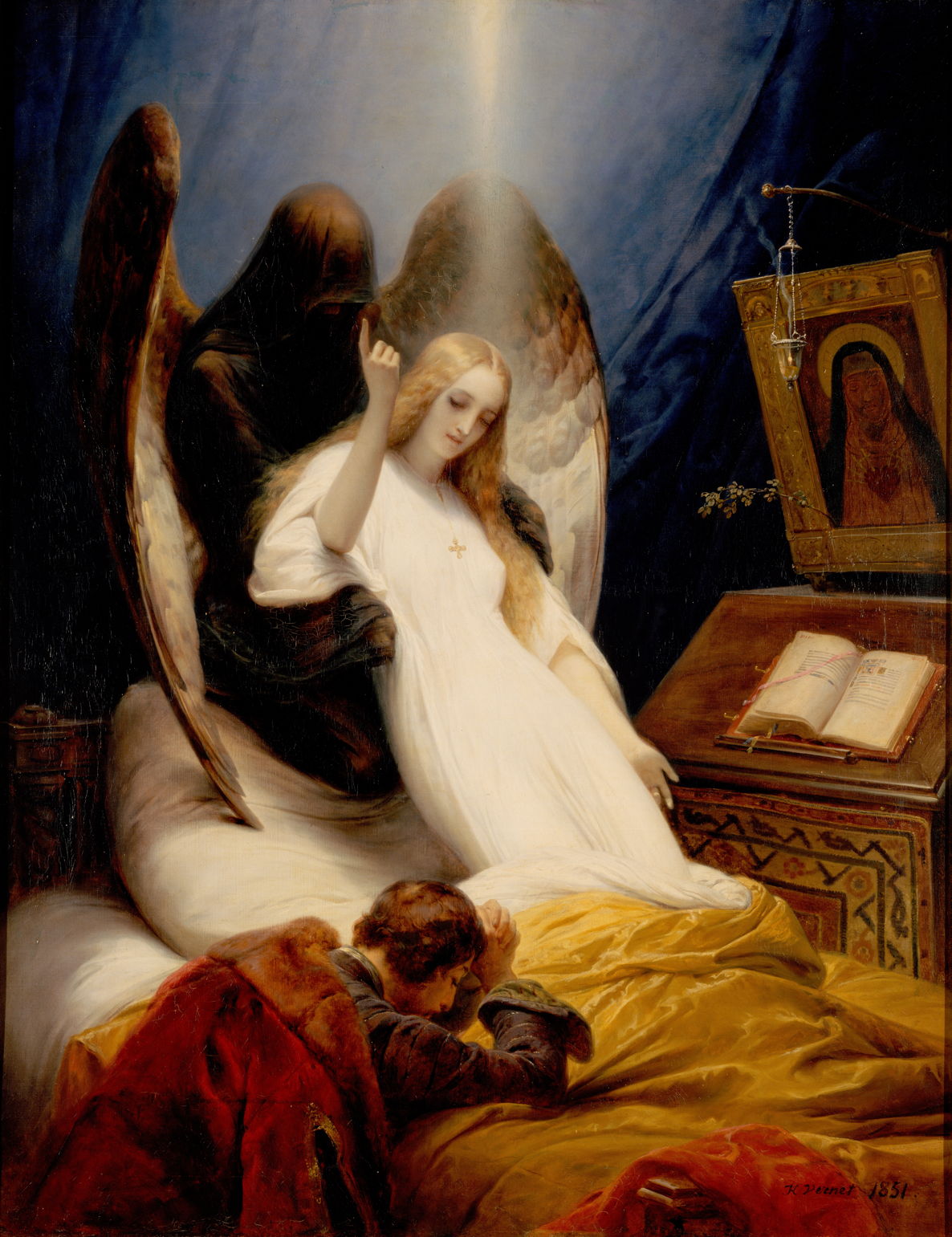
In Horace Vernet’s The Angel of Death from 1851, a young man is praying over the side of a bed, kneeling, his hands clasped together. Opposite him, an illuminated Bible is open, above that an icon hangs on the wall, there’s a sprig of flowers, and a flame burns in prayer. But the occupant of the bed, a beautiful young woman, is being lifted out of it. Her right hand is raised, its index finger pointing upwards to heaven. Behind her, the Angel of Death, the outer surface of its wings black, and clad in long black robes, its face concealed beneath a hood, is lifting her out, to raise her body up towards the beam of light shining down from the heavens.
Cowls are a common feature of the robes worn by hermits as well as monks.
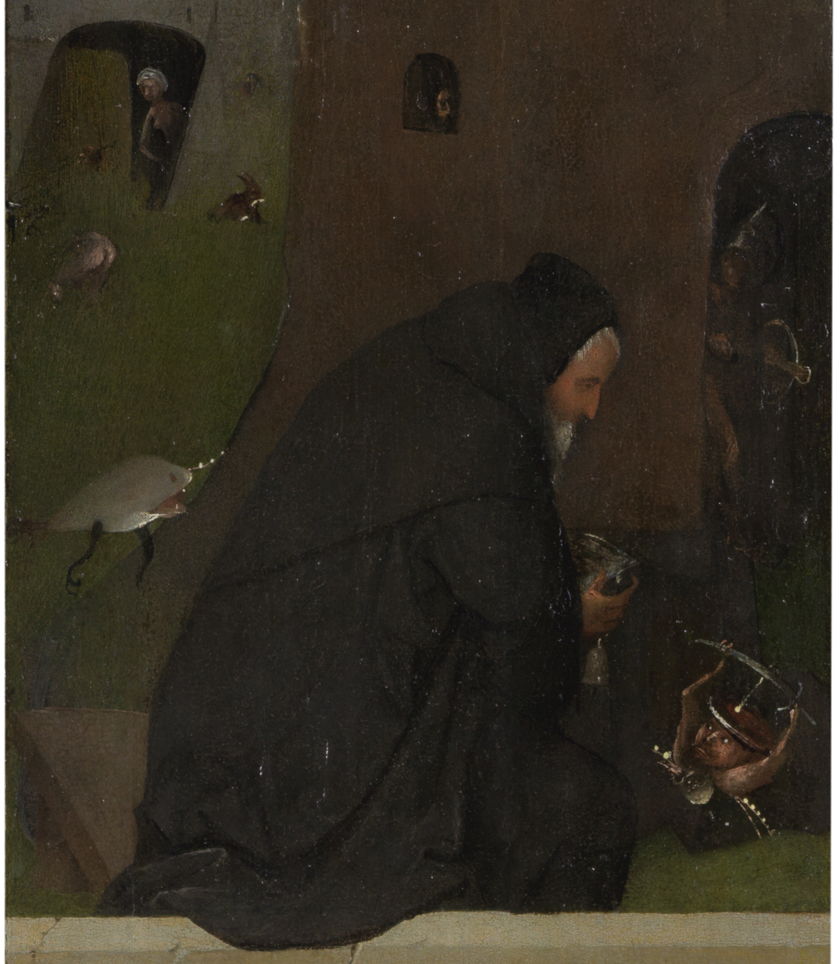
The figure at the foot of the left panel of Hieronymus Bosch’s Saint Wilgefortis Triptych (c 1495-1505) has some visual similarity with Saint Anthony in his Hermit Saints triptych, and appears to be holding a small bell, one of that saint’s attributes.

Richard Dadd painted this Portrait of a Monk on 11 April 1857, from memory of his previous travels in the Middle East.
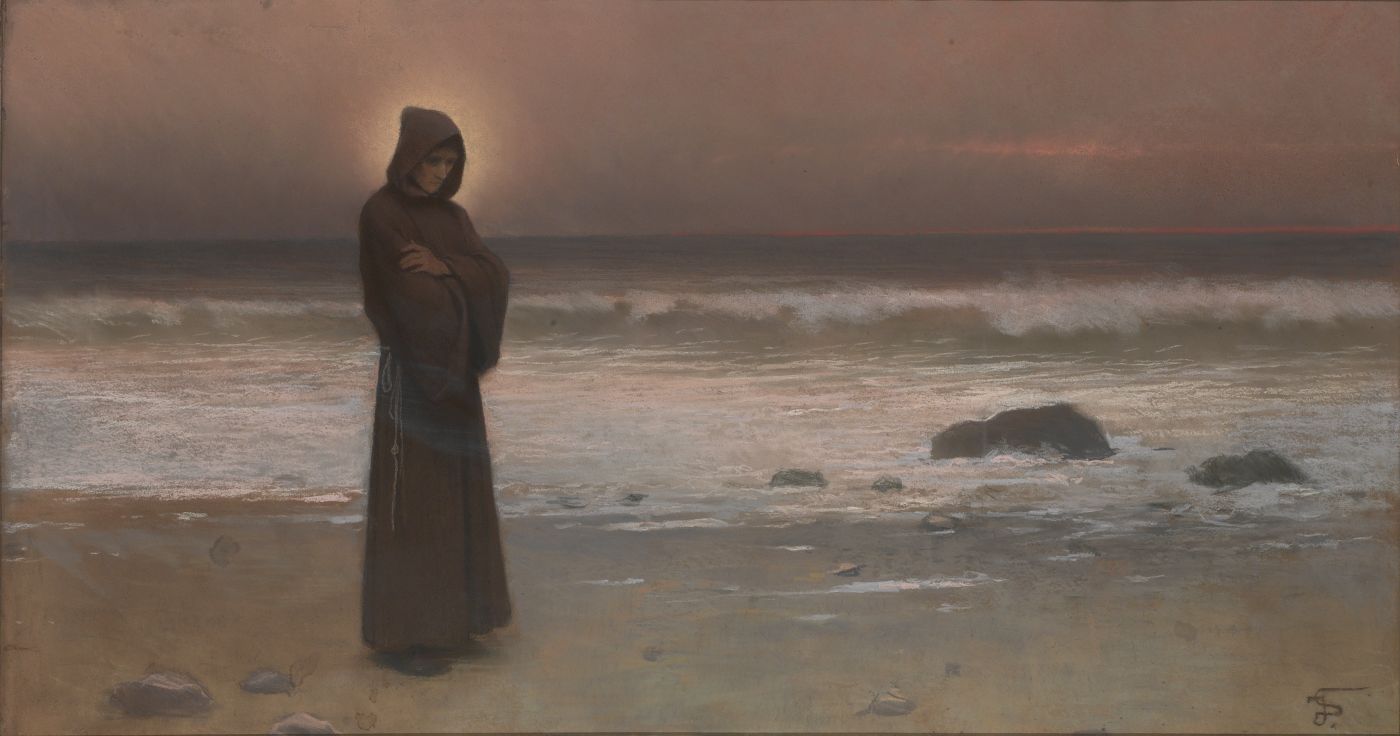
Jakub Schikaneder’s undated Contemplation, the Monk on the Seashore shows a hooded monk on the foreshore, just in front of the water, apparently lost in thought.
Cowls have also been incorporated into other religious dress, where they’re often worn with hats, making them appear vestigial and primarily symbolic.

Raphael’s magnificent Portrait of a Cardinal from 1510-11 shows the elements of this cardinal’s choir dress: the soft matte surface of the biretta on his head, the subtly patterned sheen of his mozzatta (cape) with its hood, and the luxuriant folds of his white rochet (vestment).
Another uniform that incorporates symbolic hoods is formal academic dress, in which the colours and cut of the hood denote the university and degree.

In Jean Béraud’s undated The Thesis of Madeleine Brès (or The Doctoral Jury) he shows us one of the early woman doctoral students defending her thesis before the academic jury, who are wearing what might appear now to be fancy dress hats in addition to their colourful hoods. At the time, this was a major landmark in the improvements in women’s rights, and the archaic headwear serves to emphasise this change.
The chaperon had evolved before 1200 as a hooded short cape, then developed into variants that remained popular until becoming unfashionable in about 1500. In paintings it’s most strongly associated with Dante in accounts of his Divine Comedy.
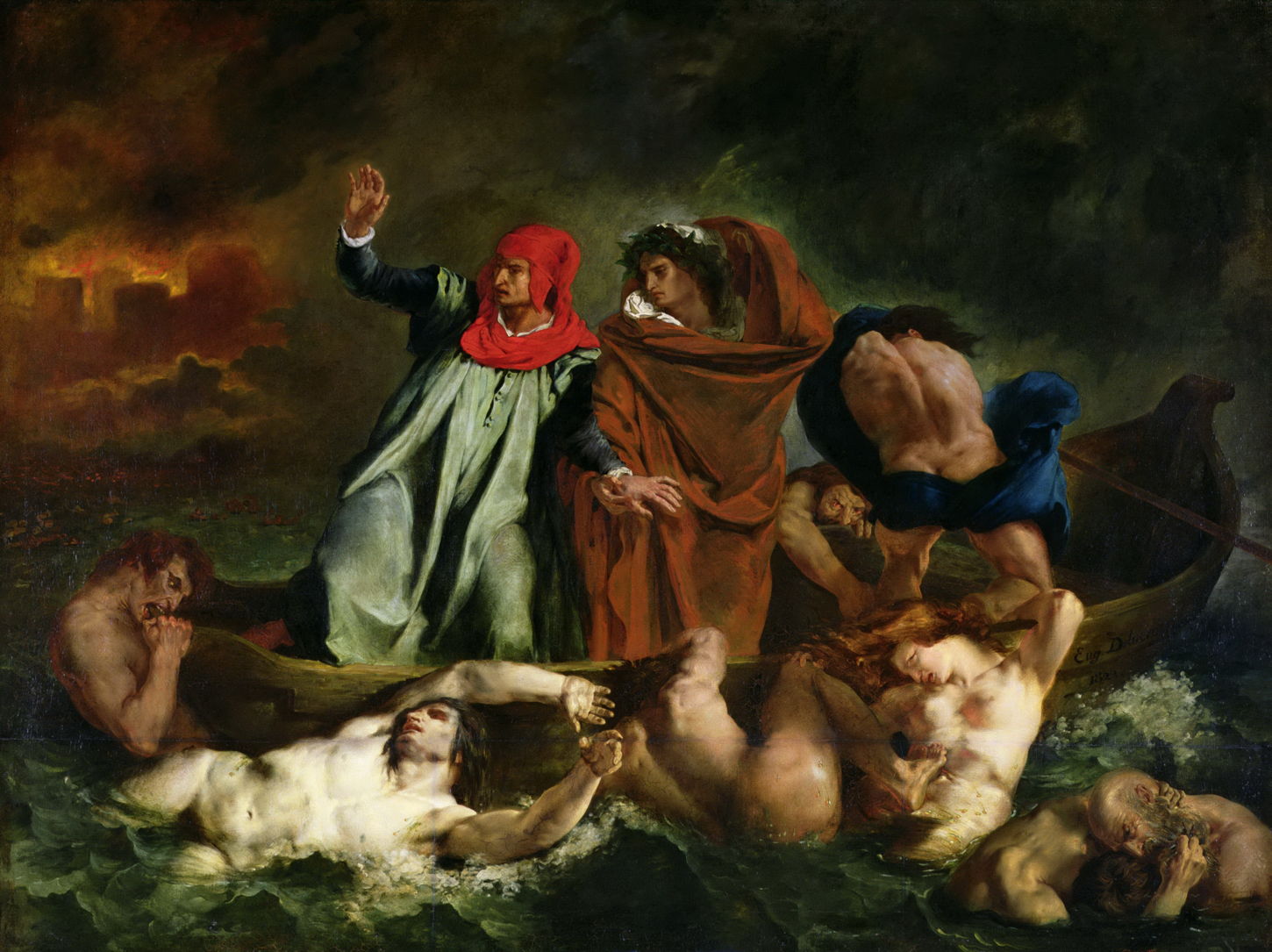
In Eugène Delacroix’s painting of The Barque of Dante from 1822, Dante is inevitably wearing his trademark red chaperon.

The woman’s equivalent of the chaperon persisted until modern times in the hooded cape worn by Louis Welden Hawkins’ Peasant Woman, from about 1880. She is seen near to the rustic village of Grez-sur-Loing, which had become an artist’s colony.
Strangely, the word chaperone (with an added e) is now most commonly used to describe an older woman who accompanies a younger one to ensure that no improper behaviour occurs when in the company of a man.
Before the decline in popularity of hats in the twentieth century, hoods had been relatively uncommon in the general population.

Carl Gustaf Hellqvist’s large history painting of Valdemar Atterdag holding Visby to ransom, 1361 from 1882 is an encyclopaedic guide to late medieval dress. Few of its crowd have hoods, and one of those few appears to be a monk, shown in the detail below.

Hoods have also been popular with travellers, and from the nineteenth century were incorporated into popular weatherproof capes.

Ford Madox Brown’s The Last of England (1852/55) shows a young couple with their infant emigrating from England. Tucked under the mother’s weatherproof hooded travelling cape is their baby son.
It seems extraordinary that in the twenty-first century hoodies have been banned as inappropriate items of clothing associated with anti-social behaviour. Perhaps there’s a market for reviving chaperons.
 The Eclectic Light Company