
Impressionism had developed rapidly in the late 1860s, with its first buds appearing in Renoir and Monet’s paintings at La Grenouillère in 1869, and flowered in the first Impressionist Exhibition five years later. Naturalism had a slower evolution, and blossomed in the Paris Salons of 1883 and 1884 in the paintings of Jules Bastien-Lepage.
Born as Jules Bastien in the village of Damvillers in the northeast of France, he showed an early aptitude for drawing, and his father taught him to paint. He enrolled in the École des Beaux-Arts in Paris in 1868, where he adopted the surname of Bastien-Lepage by incorporating his mother’s maiden name. While there he was taught the Academic and Salon tradition by Cabanel.
He fought, and was wounded, in the Franco-Prussian War of 1870-1, but managed to have his first work accepted for the Salon in 1870. Unfortunately this, and another acceptance in 1872, passed unnoticed by the critics and public. It wasn’t until 1874 that his portrait of his grandfather, painted at home the previous year, was awarded a third class medal at the Salon, and he started attracting more attention. He entered the prestigious Prix de Rome in 1875, and by public reaction would have received the award. However, the jury rejected his painting on a trumped-up technicality.

Bastien’s submission for the final was The Annunciation to the Shepherds (1875), in accordance with the prescribed subject of “the annunciation of the nativity of Christ by the angel to the shepherds of Bethlehem”, as in the Gospel of Luke, chapter 2, verses 8-15. When he was unsuccessful, the jury attempted to avert outcry by awarding him a consolation prize, but it was too late, the damage had been done. He retreated to his rural village, and the pursuit of truth in his painting. He tried a second time the following year, but was again unsuccessful, so abandoned his ambition of becoming a history painter.

His Diogenes (1877) tackles human anguish in his depiction of this ancient Greek philosopher and cynic. Traditionally shown living in a barrel, Bastien gives him cruelly mutilated feet, and one of the most expressive faces since Rembrandt.

He returned to the Salon in 1878 with Haymakers (1877). It provoked debate over what was considered to be its harsh portrayal of life and work in the country. It was also a pioneering composition for him, with its high horizon and fine detail in the foreground. Together these give the impression that the whole canvas is meticulously realist, although in fact much of its surface consists of visible brushstrokes and other painterly marks. At the same time its deep recession and broad inclusion of land gives it the illusion of a wide-angle panorama, enhancing the exhaustion and desolation of its figures.

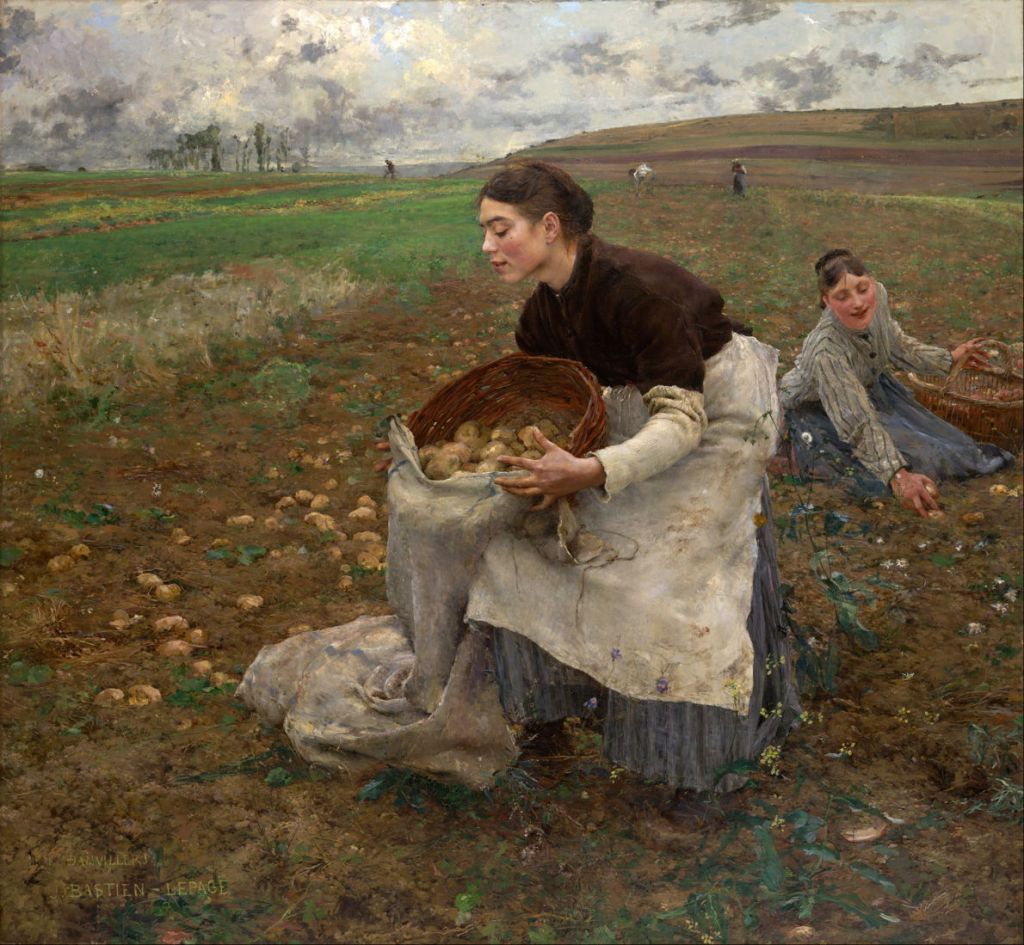
The following year, Bastien returned with what is now sometimes known as October or Potato Gatherers (1878), but was originally shown as October: Potato Harvest. He employs the same compositional scheme: high horizon, fine foreground detail, deep recession here enhanced by the distant figures, and broad land. This time, though, his rural poor are smiling and happy in their labour, and it proved a huge success.

All Souls’ Day, also completed in 1878, was a more sentimental incursion into the outskirts of the city, as a grandfather is taken for a walk by two of his young grandchildren. They are strolling through land that had been, until recently, open fields. It has now been transformed as smoky factories sprawl from the edges of the cities, with a narrow no-man’s-land of allotments and smallholdings as seen here.
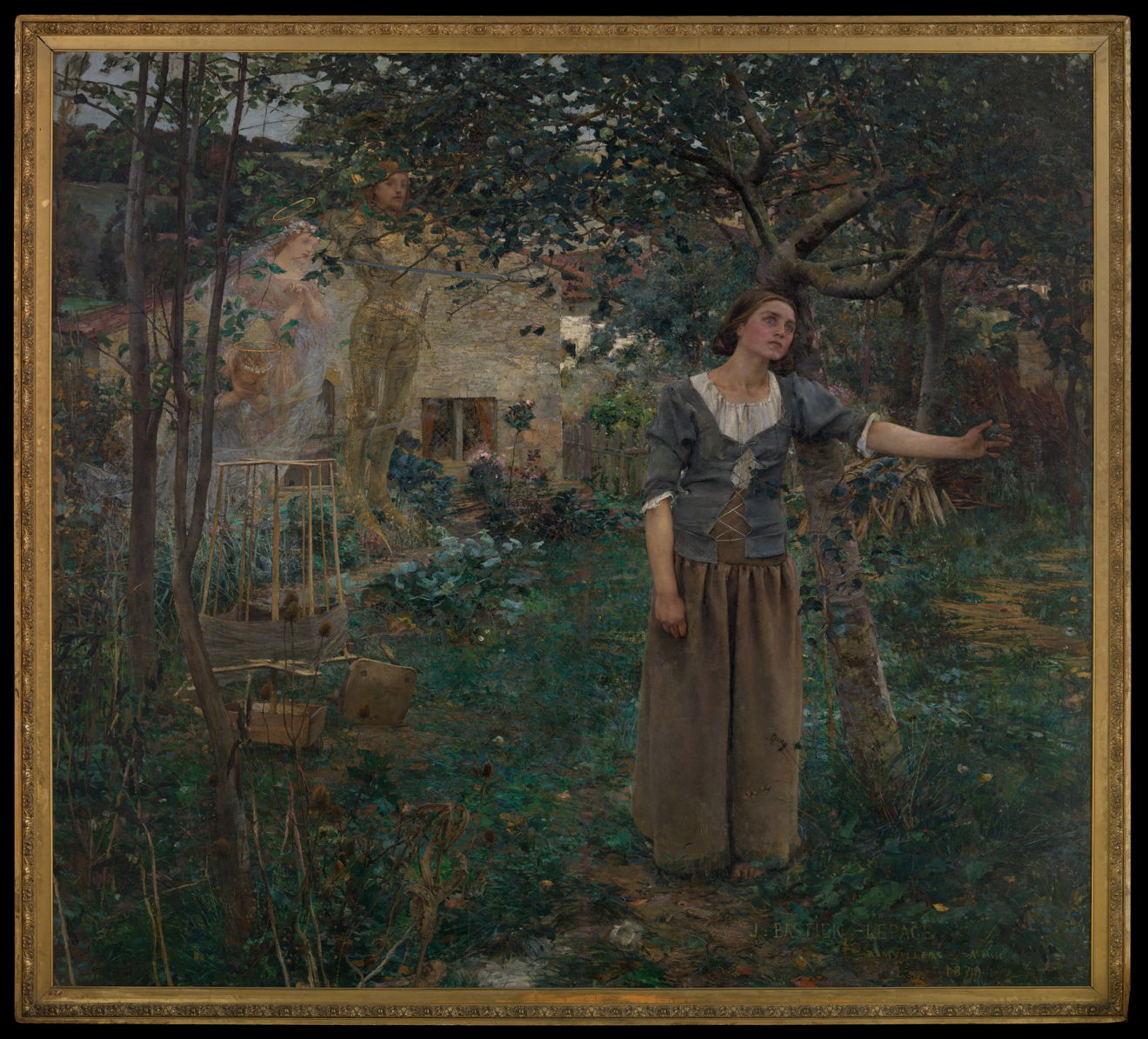
Then in 1879, Bastien revisited history painting with his new formula in Joan of Arc. Its horizon is so high that little sky is visible beyond the trees. The lower half of the canvas is its intricately detailed foreground, even down to the clutter of woolworking apparatus, an ingenious link to the thread of fate, and the unkempt garden.
The corner of a house sharply divides the painting into halves. On its right is the very real and tangible figure of Joan of Arc, her piercing blue eyes staring into the distance, as she receives her call to arms. On the left are the ethereal figures of Saints Michael, Margaret, and Catherine, which gave rise to a surprisingly hostile reception by critics.
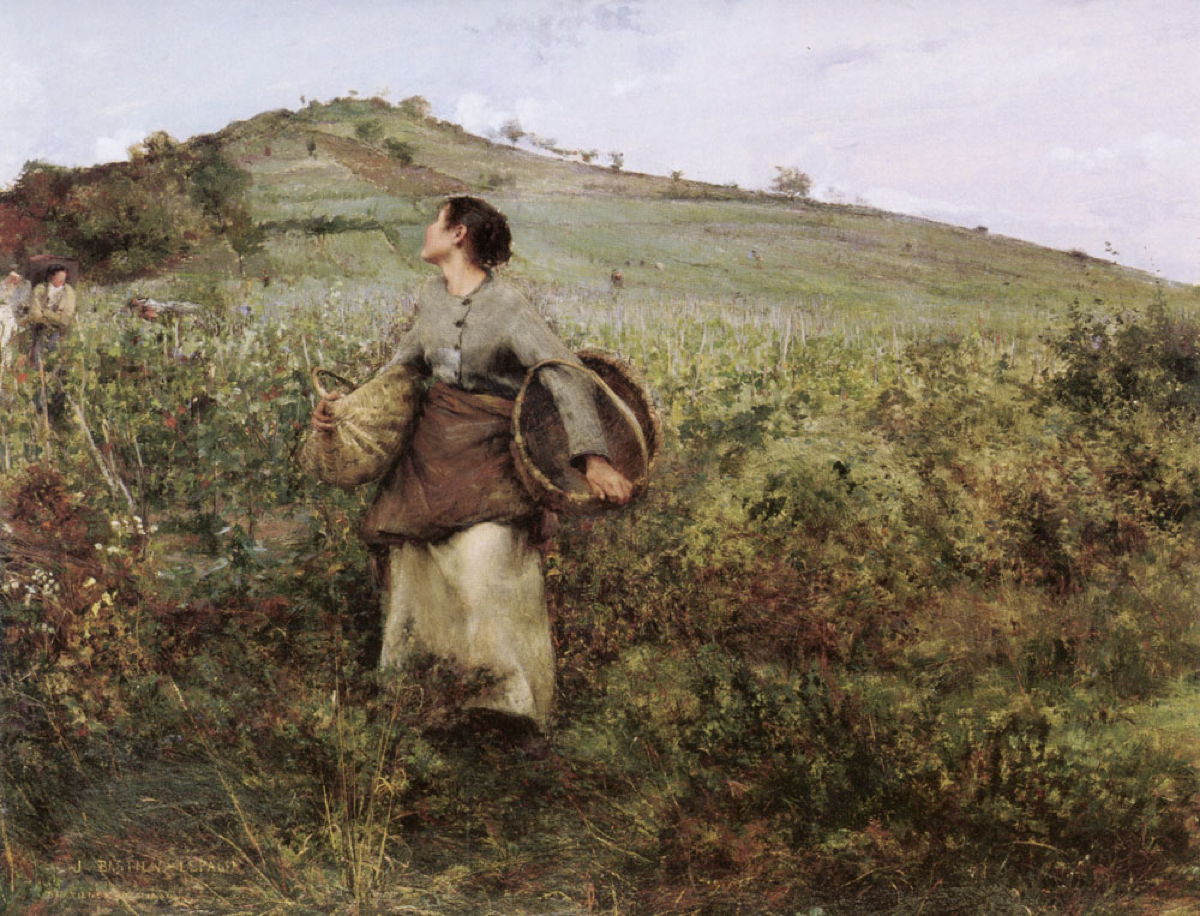
The Grape Harvest, also known as Harvest Time, (1880) varies the compositional formula, and doesn’t produce the same effects. Its horizon draws the eye more strongly, distracting from the foreground detail, and the land rises too soon to achieve the deep panorama of his earlier paintings.

Back in his native Damvillers, Bastien-Lepage painted portraits of the poor. The Beggar (1880) shows an old man who has apparently been knocking on doors in his quest for charity. A well-dressed young girl stares sadly at him as he walks away from her house, and she is closing the door on him.
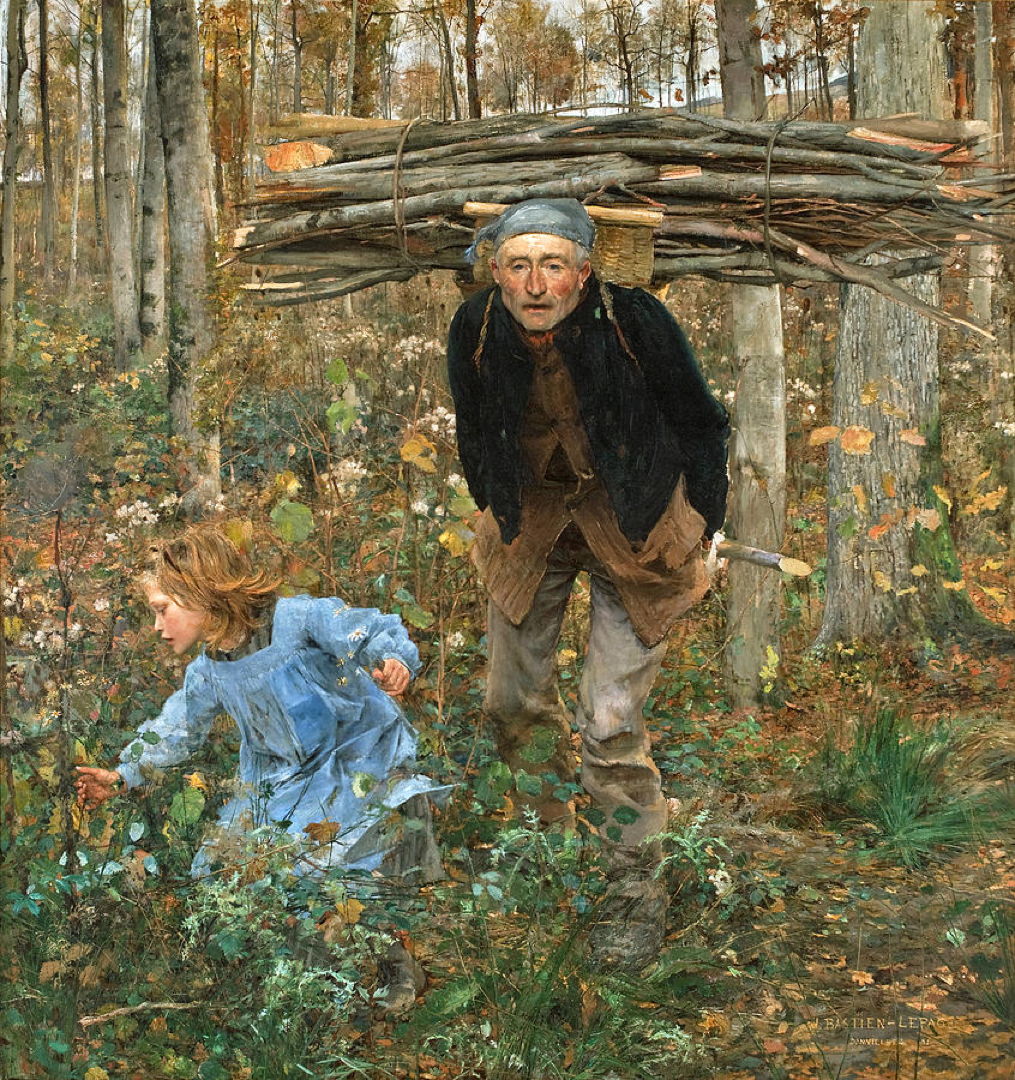
Bastien’s The Wood Gatherer (Father Jacques) (1881) is one of the key Naturalist works of art, also one of the most successful examples of his compositional formula. Its high horizon and woodland break its thin slice of sky into fine fragments. The detailed foreground includes both of the figures, who are diametric opposites: an old man bent with his load of firewood, who at any moment could keel over and die, and a young child (probably a girl) who runs free among the wild flowers. The perception of depth is enhanced by the recession of tree forms, although here the space is enclosed rather than open.
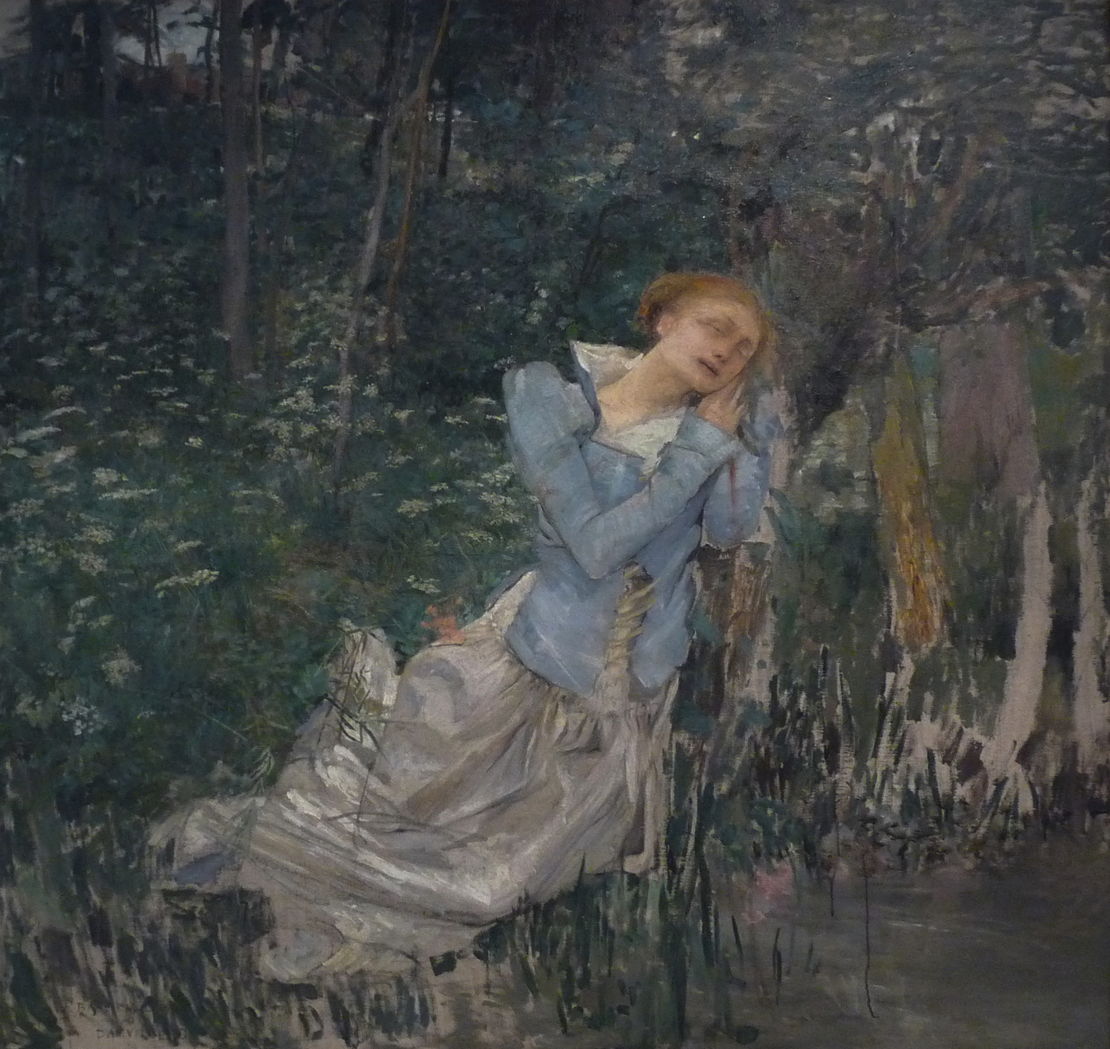
His formula can be seen in progress in his Ophelia (1881), showing the character from Shakespeare’s play Hamlet as her anguish is about to drive her body down into the water to drown her. At the time of his death, Bastien still had to paint all the foreground detail. This would have covered the lower half of the canvas, and given it a finely detailed appearance overall.
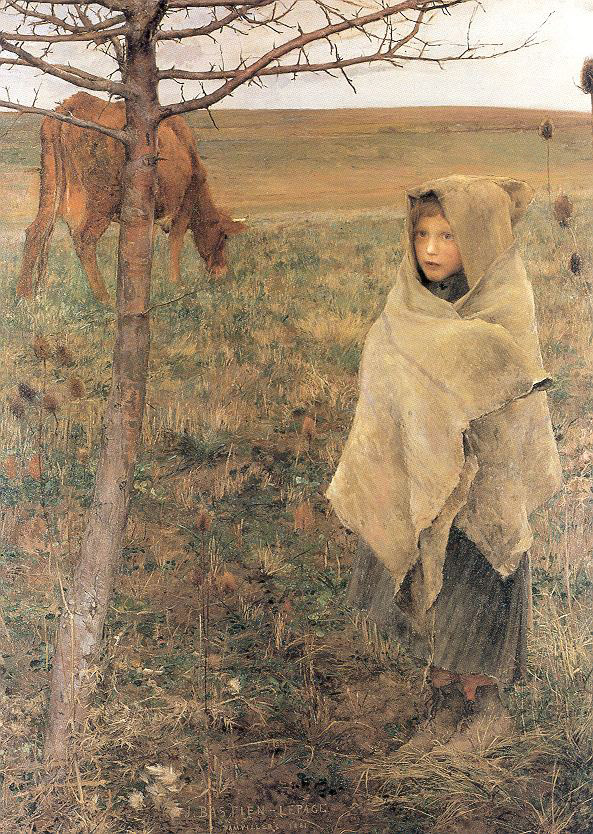
Back in Damvillers, he returned to the rural poor, now focussing on children as innocent victims. The formula is applied again, this time with the superimposition of a leafless sapling and the thyrsus-like flower-heads of the teasel. The tree is placed most unusually over the grazing cow, and the whole painting cropped as if a photograph.
The following year marks the high-point of Bastien’s Naturalism.
 The Eclectic Light Company