
Following the early death of Thomas Girtin in 1802, there was no successor who proved as prolific in painting the cathedrals of Britain, and attention was transferred to those further south.

In 1894, Benjamin Williams Leader painted this view of Worcester Cathedral backing onto the River Severn. This was built between 1084-1504 in an unusual mixture of styles from Norman to Perpendicular Gothic, and contains the tomb of King John in its chancel. Judging by the smoke rising from the chimneys, this was painted in the early autumn.

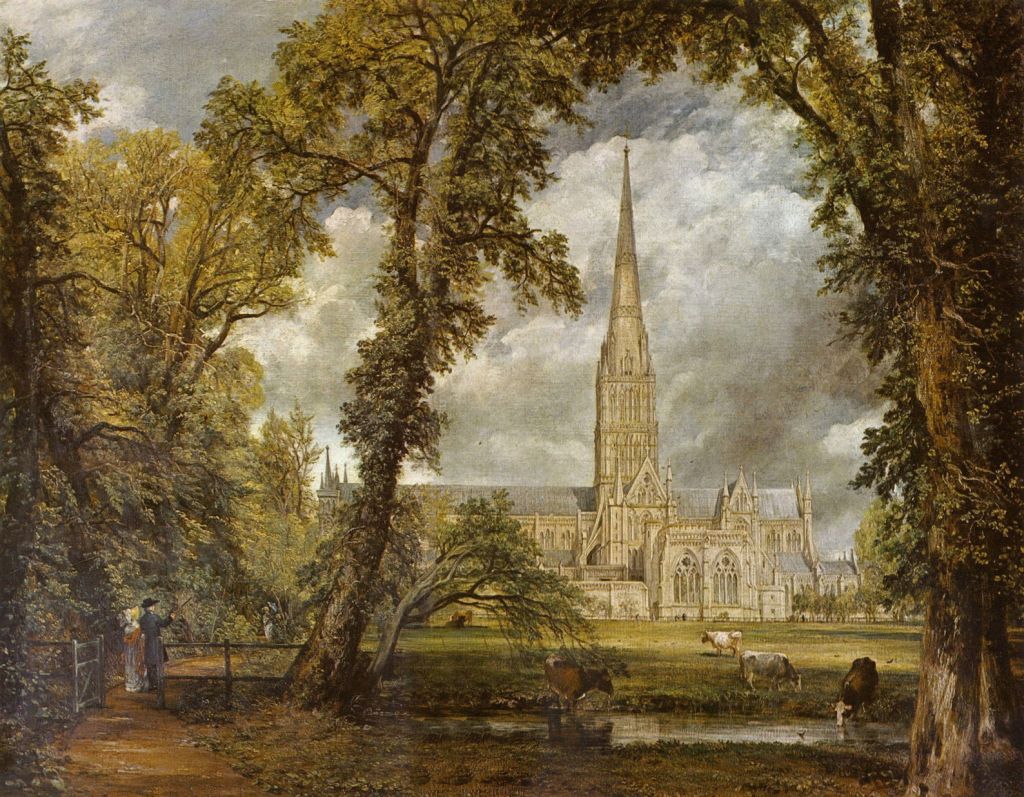
If any artist came close to Girtin’s achievement it must have been John Constable. In about 1820, Bishop John Fisher commissioned him to paint Salisbury Cathedral from the grounds of his Palace, and Constable started to prepare sketches and studies for that medium-sized painting Salisbury Cathedral from the Bishop’s Garden, completed in 1823.

Constable was still battling with depression after the death of his wife when Archdeacon John Fisher, younger cousin of the Bishop, who had died in 1825, encouraged him to paint a larger and more ambitious view of Salisbury Cathedral, from the nearby meadows on the banks of the River Nadder. This late oil sketch was sold by auction in 2015 for more than five million dollars.

Constable completed his finished painting above for exhibition in the Royal Academy in 1831. It is perhaps a little over-egged with its storm clouds, rainbow and bolt of lightning. Despite several showings, it remained unsold when Constable died. Salisbury Cathedral was almost entirely built within the period 1220-1258, although its tower and spire, the tallest in England, were completed by 1330.
Although there is a Westminster Cathedral in London, it’s Roman Catholic, unlike the more famous Westminster Abbey, a collegiate church of the Church of England that has long been popular for coronations and interments of British monarchs and the nation’s most distinguished figures. The present building was constructed between 1245-1269 close to the Palace of Westminster on the north bank of the River Thames.

Samuel Scott’s Westminster from Lambeth, with the Ceremonial Barge of the Ironmongers’ Company (c 1745) shows a section of the River Thames on a windy day, with showers not far away. Teams of rowers pull their boats out to attend to the ceremonial barges in the foreground, reminiscent of Venetian boat ceremonies. The opposite bank shows, from the left, the imposing twin towers of Westminster Abbey, the old Palace of Westminster almost hidden behind trees, and Westminster Bridge.

The American history painter Benjamin West painted this view of Milkmaids in St. James’s Park, Westminster Abbey beyond in about 1801. Two cows and attendant milkmaids are providing a supply of fresh milk for the crowds in this royal park with Buckingham Palace on its edge. This remains 57 acres (23 hectares) of grass, trees and lakes.
The Church of England cathedral in London is of course Saint Paul’s, on Ludgate Hill a few miles to the east in the centre of the city of London. It was built between 1675-1710 to the designs of Sir Christopher Wren, following the destruction of its predecessor in the Great Fire of London of 1666.

Canaletto painted this imposing view of St. Paul’s Cathedral when he was working in England in about 1754. This Venetian artist lived and painted in London between 1746-1755 when the War of the Austrian Succession disrupted the art market in Venice.
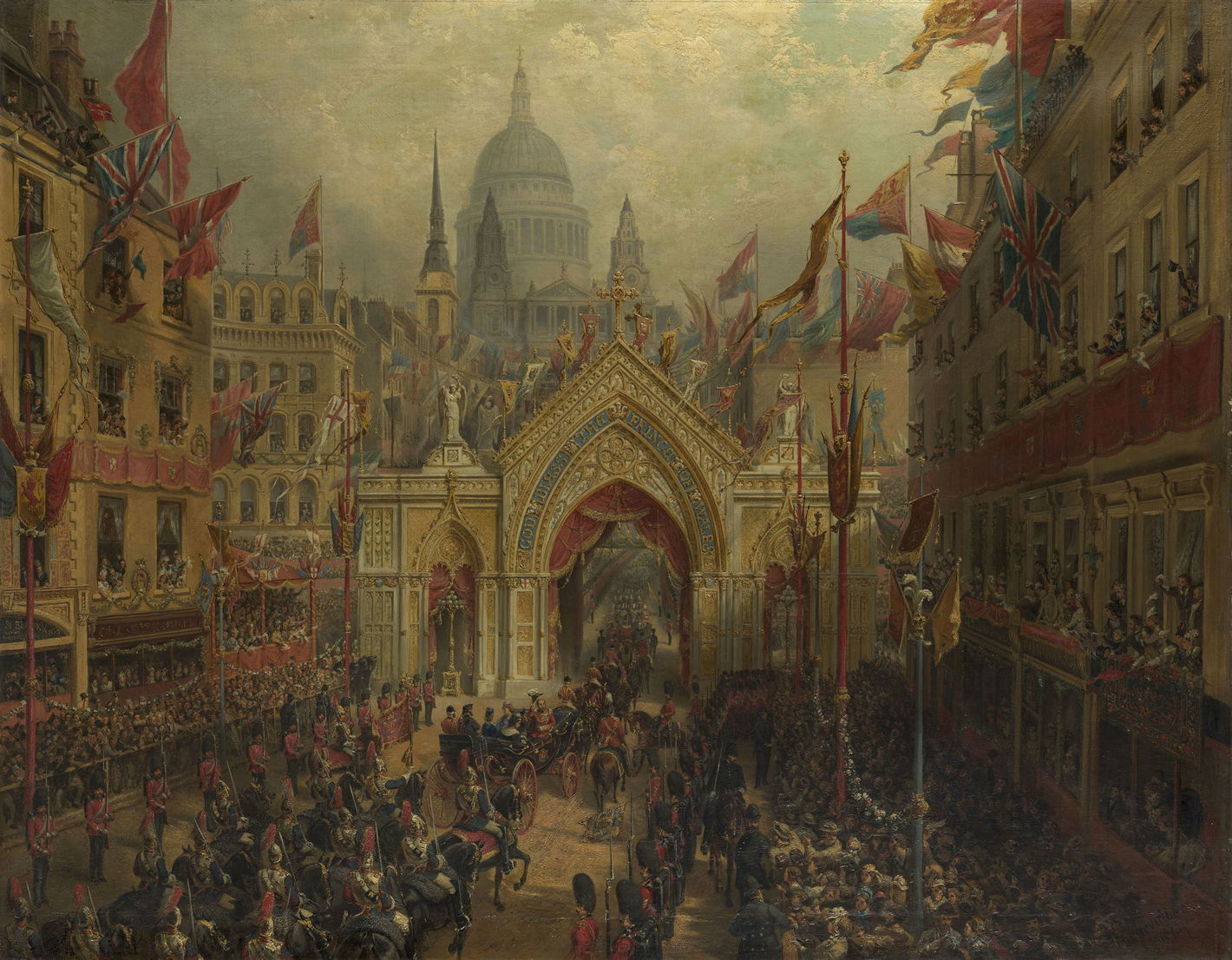
Nicholas Chevalier painted ‘Thanksgiving Day’: The Procession to St Paul’s Cathedral, 27 February 1872 shortly after this royal event. Not to be confused with US Thanksgiving, this was a one-off state thanksgiving for the recovery from severe illness of the Prince of Wales. The widowed Queen Victoria and her son Prince Edward attended Saint Paul’s Cathedral (the obvious dome in the distance) to give public thanks to God. Approaching the arch is the carriage containing the royal party.
Canaletto wasn’t the only visitor from continental Europe to paint Wren’s prominent dome.
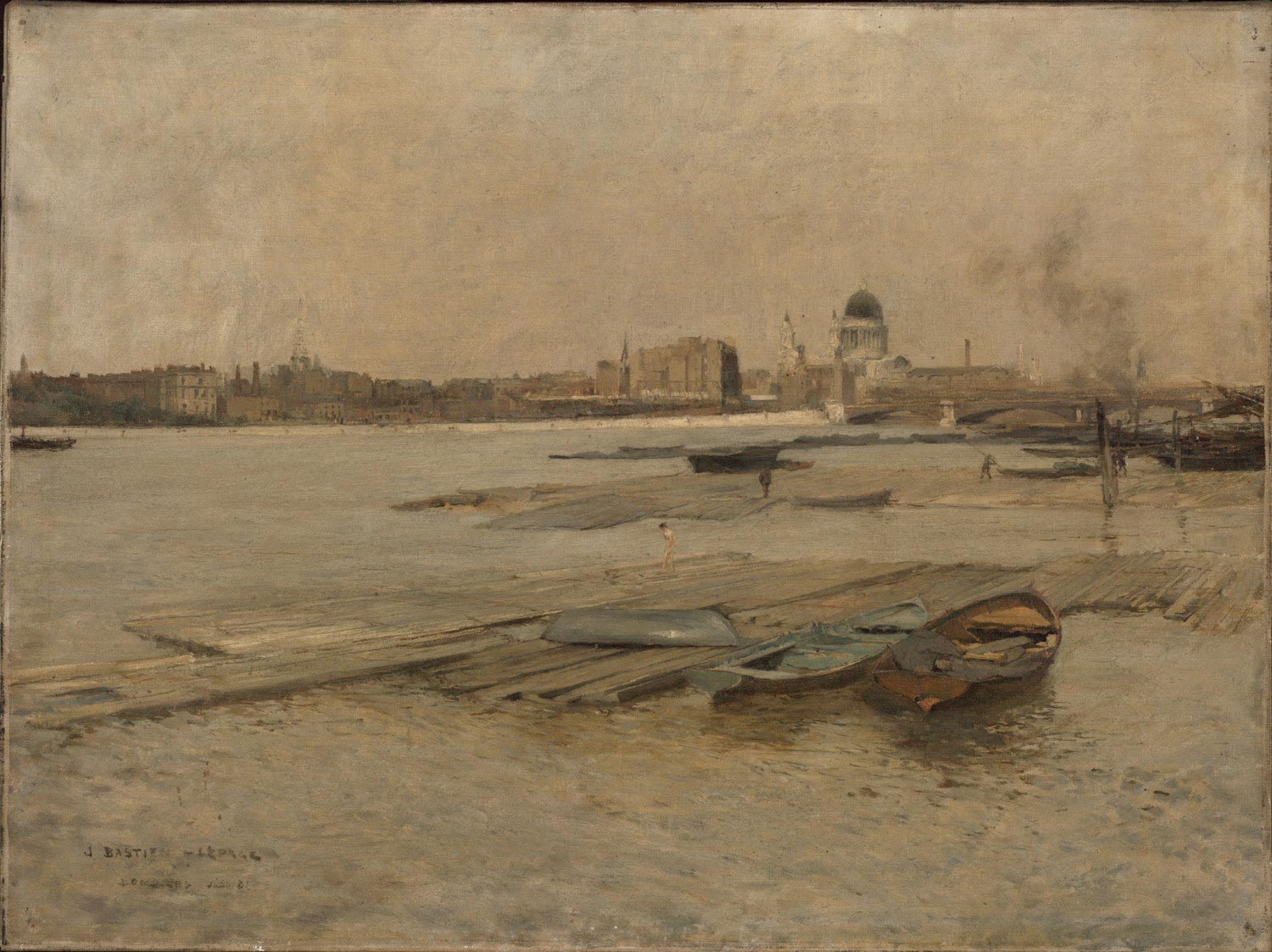
From 1880, Jules Bastien-Lepage visited London repeatedly. Blackfriars Bridge and the Thames, London (1881) is his fine depiction of this stretch of the River Thames, with his characteristic gradation of detail from its foreground into the distance. Standing proud on the skyline towards the right is the distinctive dome of Saint Paul’s.

Henri Le Sidaner also visited Britain on several occasions, and in 1906-07 painted this view of St. Paul’s from the River: Morning Sun in Winter, which may have been inspired by Monet’s series paintings of Rouen Cathedral, here expressed using his own distinctive marks.
In case you think Wren’s Saint Paul’s appears recent compared with Britain’s older cathedrals, in my lifetime I have seen two new Church of England cathedrals consecrated: Coventry in 1962, replacing an older building destroyed during the Second World War, and Guildford in 1961, built on a new site altogether over a period of twenty-five years.
 The Eclectic Light Company