

There’s a popular and relatively recent myth that European painting in the late nineteenth century consisted almost entirely of Impressionist landscapes and their descendants in Post-Impressionism, or the dying embers of the Academic past. That oversimplification carefully omits many of the innovative artists of the day, who developed the social realism of Jean-François Millet and Gustave Courbet into what became Naturalism. Among its other key influences were Édouard Manet and the novelist and critic Émile Zola (1840-1902), who were also associated with Impressionism.
Impressionism was primarily a revolt against established ideas as to how paintings should be made, and how they should look. Although the term has been extended to other arts, it’s only really meaningful in the context of painting.
Naturalism arose first and became most extensive in literature. Among its great influences was the pioneering French physiologist Claude Bernard (1813-1878), whose writings were read avidly by Naturalists including Zola. Bernard’s approach to science stressed not only the importance of observation, but of experiment, forming the basis for his accounts of the working of the body, and the scientific foundations of medicine. Bernard’s Introduction to the Study of Experimental Medicine, published in 1865, convinced Zola to use an experimental approach to writing his novels. He thus watched people in life and filled notebooks with his observations. He then set characters up in the scenario for a novel, and they behaved according to his observations. He finally documented this imaginary experiment as his next novel.
Naturalist painting made no attempt to follow Zola’s experimental approach, but aimed to document ordinary people going about their normal daily activities in their normal surroundings, with a degree of objectivity rather than sentiment. Its style is a neutral realism showing as much fine detail as necessary for its purpose, and sometimes being almost photographic in quality.
Naturalism and Impressionism were by no means mutually exclusive, but served different purposes. Some of the finest artists of the last thirty years of the nineteenth century were exponents of both. Landscapes were predominantly approached as Impressions, while figurative paintings worked better using Naturalist techniques. Here are some examples from about 1883, when both were at their height.
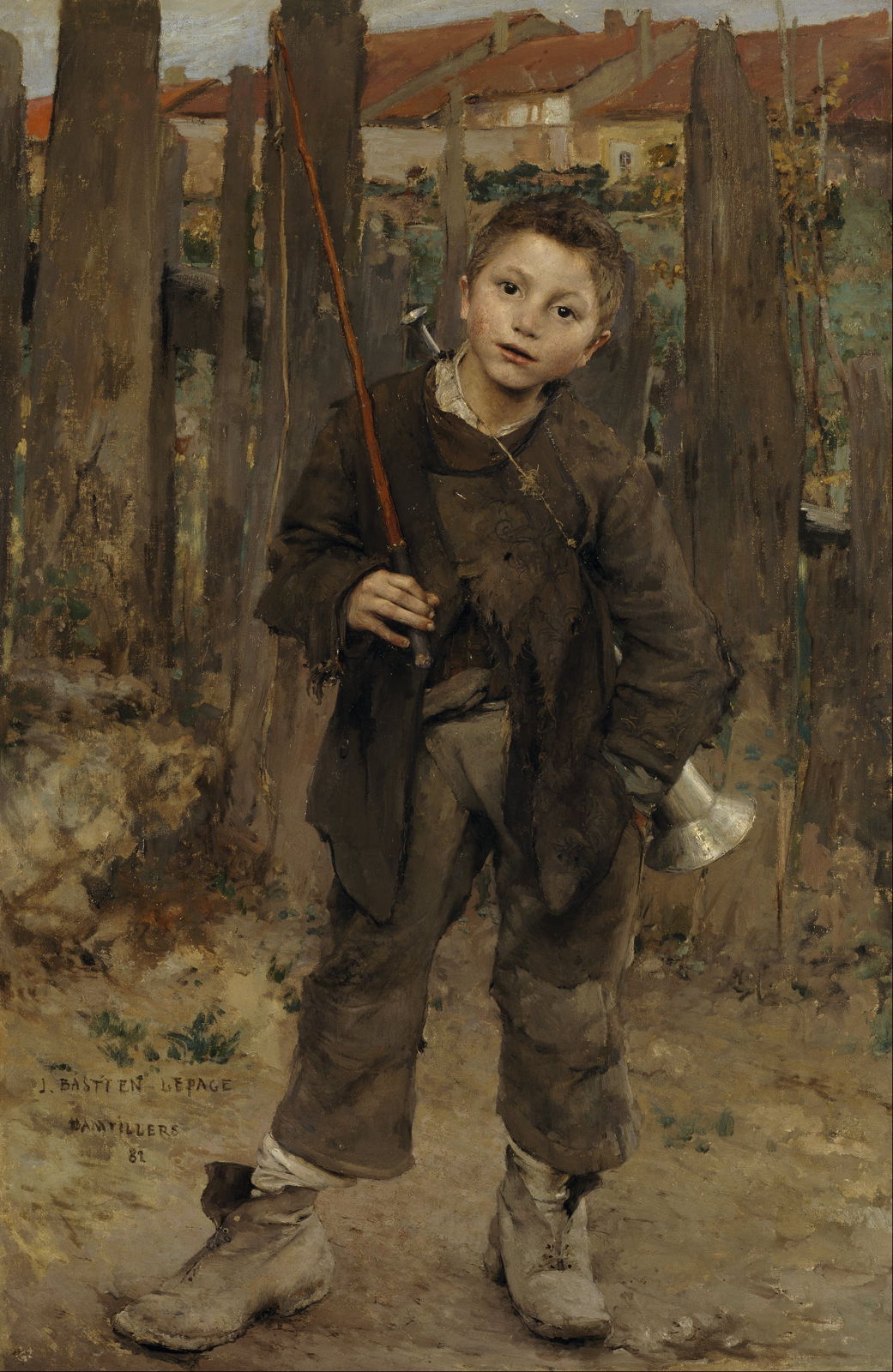
At that time, it was Jules Bastien-Lepage who was having greatest impact at the Salon with his Naturalist portraits of the rural poor. Pas Mèche (Nothing Doing) (1882) catches this cheeky ploughboy equipped with his whip and horn, on his way out to work in the fields. His face is grubby, his clothing frayed, patched, and dirty, and his boots caked in mud and laceless. It has other traits of Bastien’s style, such as its high horizon almost shutting the sky out, and his careful control of detail. The boy’s face is meticulous, but the cottage gardens behind have been sketched in roughly.

Bastien’s Little Chimneysweep (Damvillers) from the following year is unusual as its subject isn’t shown standing, face-on to the viewer, but sits and looks down at the kitten at the lower right. This young boy is also the dirtiest of Bastien’s waifs, his left hand still black with soot from his work. He appears to be living in a hovel, with the embers of a fire at the left edge, once again sketched loosely.

Bastien’s combination of detailed realism blended with more painterly passages is seen in one of Marie Bashkirtseff best portraits, The Umbrella (1883). This girl’s tenacious stare at the viewer quickly becomes quite unnerving. This earned her an honourable mention in the Salon.
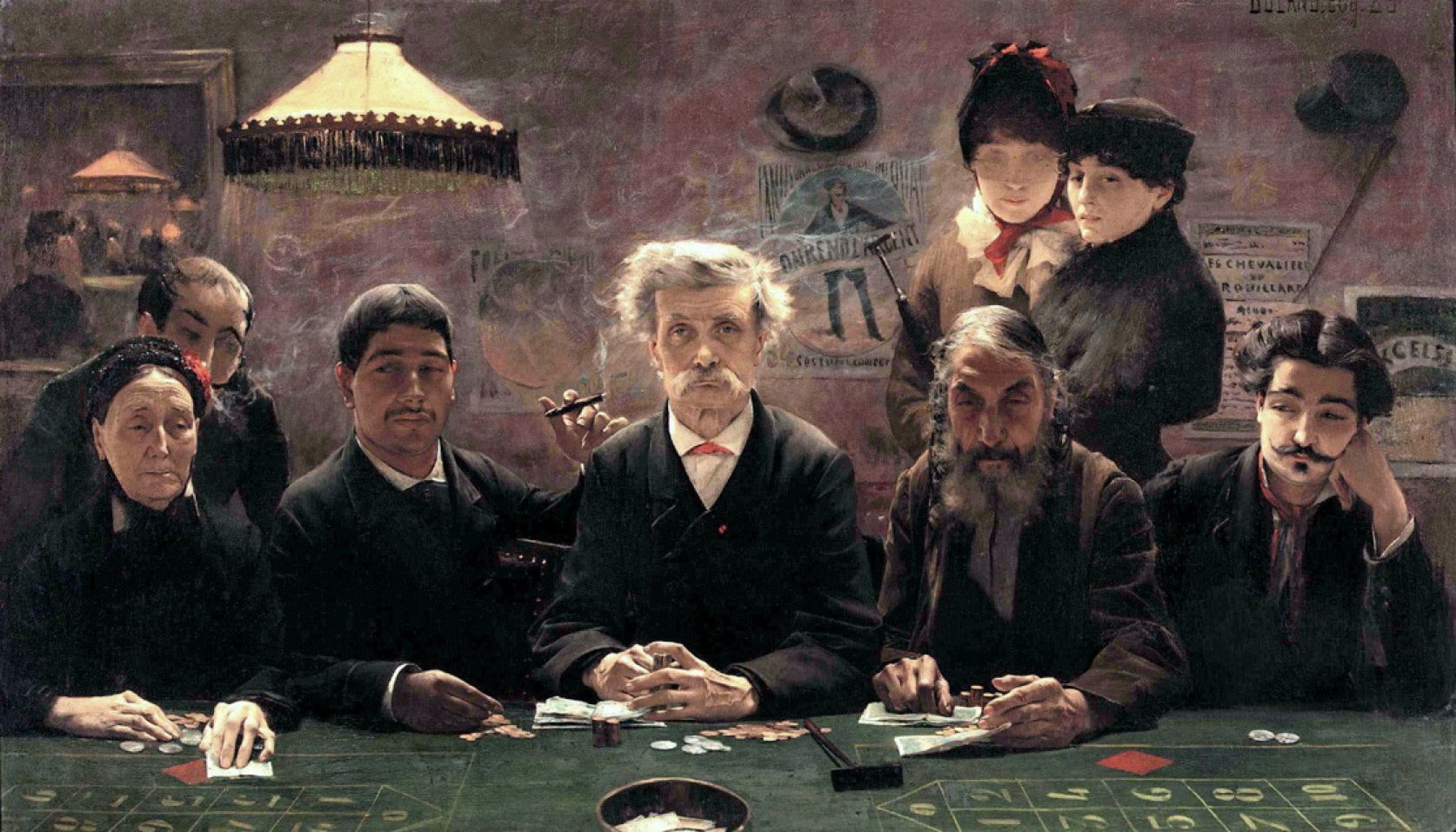
In the same year, Jean-Eugène Buland’s The Dive is set in a seedy, downmarket gambling den, as a group portrait of five hardened gamblers at their table. Each is rich in character, and makes you wonder how they came to be there. A little old widow at the left, for example, looks completely out of place, but is resolutely staking her money. Looking over her shoulder is a man, whose face is partially obscured. Is he, perhaps, a son, or a debtor? A young spiv at the far right is down to his last couple of silver coins, and looks about to lose them too. The air is thick with smoke, the walls in need of redecoration, and a pair of young streetwalkers prowl behind them, looking for a winner who will spend some of their cash on them.
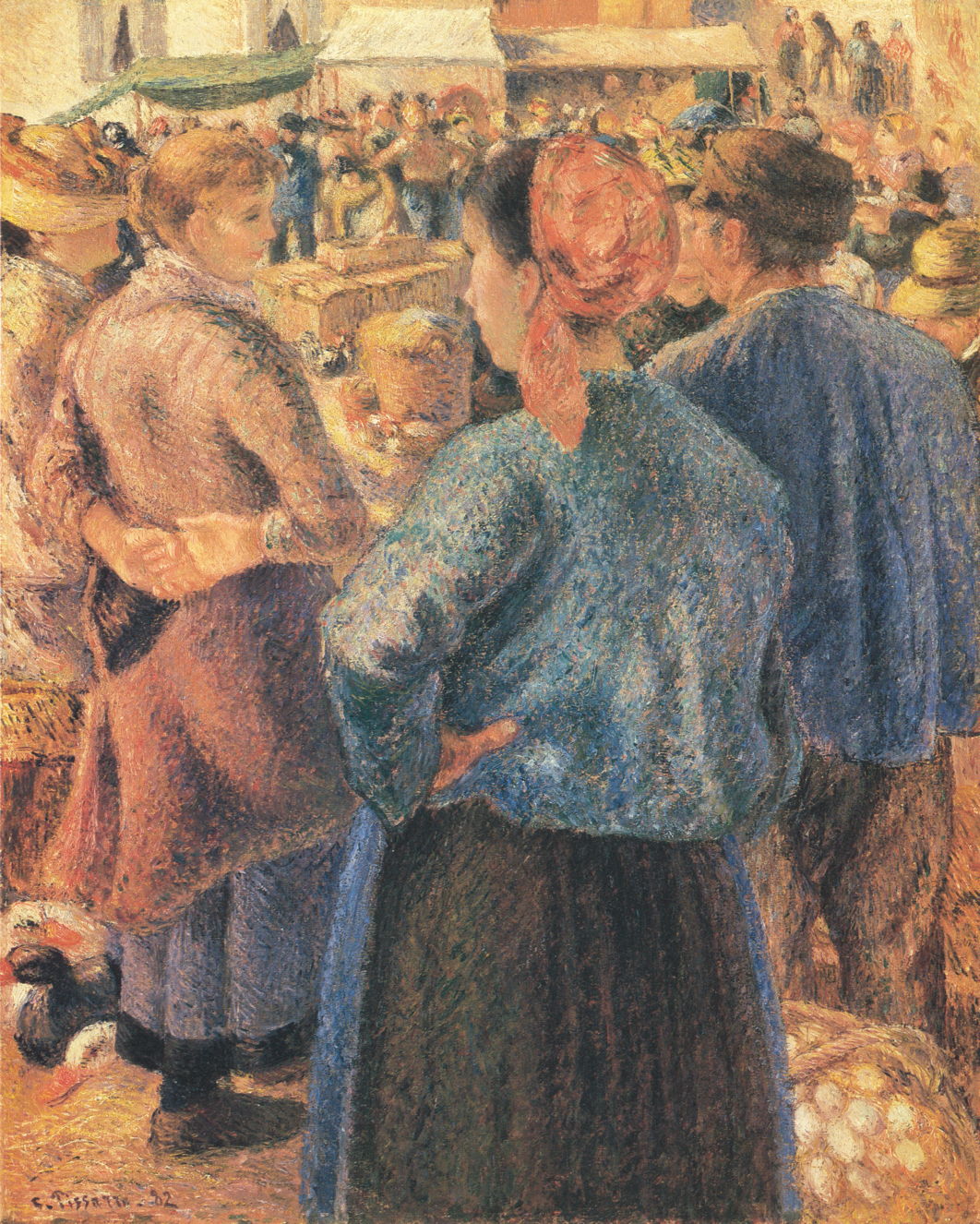
Camille Pissarro was a fine figurative artist when he wanted, and had a particular liking for markets and fairs, which may seem strange for a landscape painter. He painted this scene from The Poultry Market, Pontoise twice in 1882: once using (glue?) distemper, and here in oils, where his use of tiny marks is evolving, particularly in the fabrics.

For his portrait of his partner Aline Charigot in By the Seashore (1883), Pierre-Auguste Renoir most probably painted her in the studio, and took its background from the Normandy coast near Dieppe. This shows the growing divergence in his paintings during the 1880s, with landscapes becoming increasingly soft and high in chroma, while his figures remained realist and emphasised by his “dry” manner.
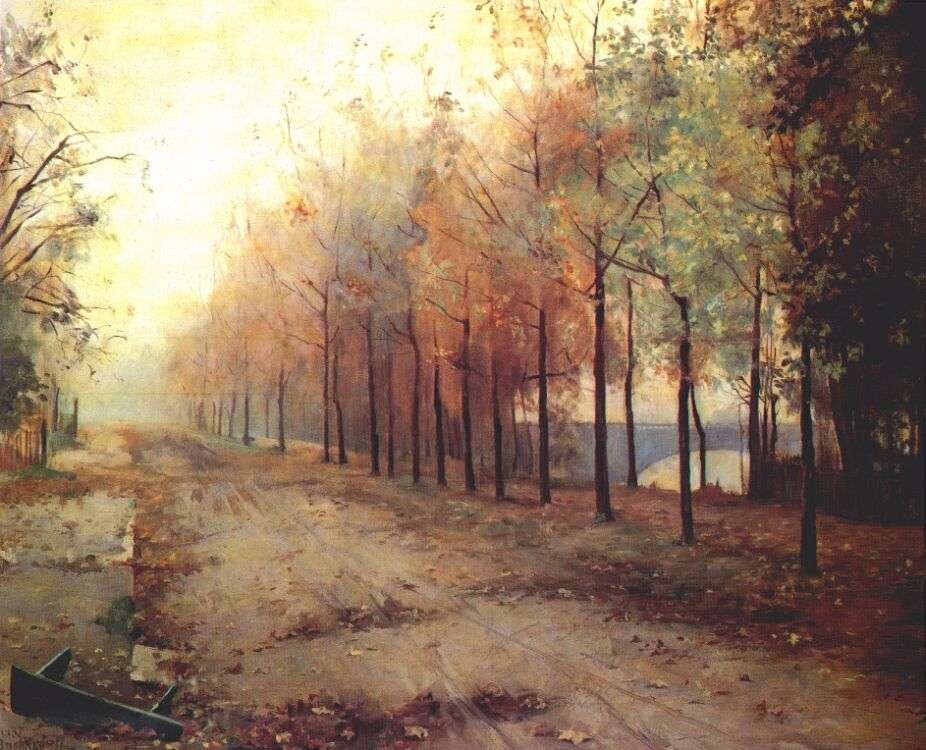
Bashkirtseff’s Autumn (1883) is a thoroughly Impressionist depiction of a row of trees on the bank of the River Seine in the centre of Paris, but is unusual in being devoid of people. The leaf litter, occasional rubbish, and fallen bench strengthen its feeling of desolation in the midst of the bustling city.

Gustave Caillebotte also painted in both styles, with several of his best-known works being Naturalist. The Plain at Gennevilliers, A Group of Poplars (1883) is more formally Impressionist, although it retains foreground detail and has a relatively high horizon.
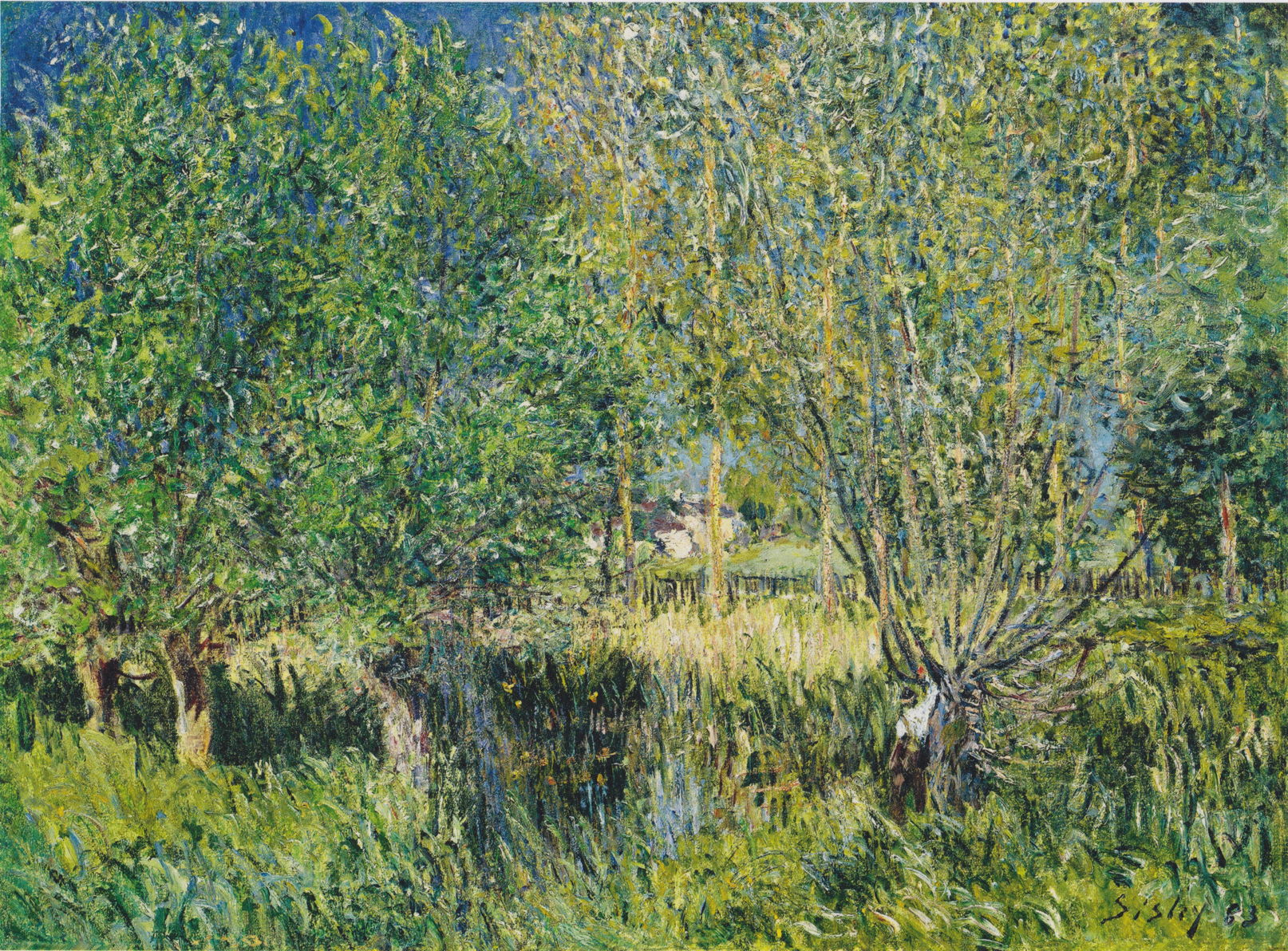
Alfred Sisley’s Willows on the Banks of the Orvanne (1883) is also more representative of Impressionism. An irregular row of pollarded willows, with well-developed heads, crosses the foreground, behind which there is the river Orvanne, reeds, and a tall stand of poplars. Behind this dense vegetation is a fence, field, and distant buildings, at the midpoint of the painting.
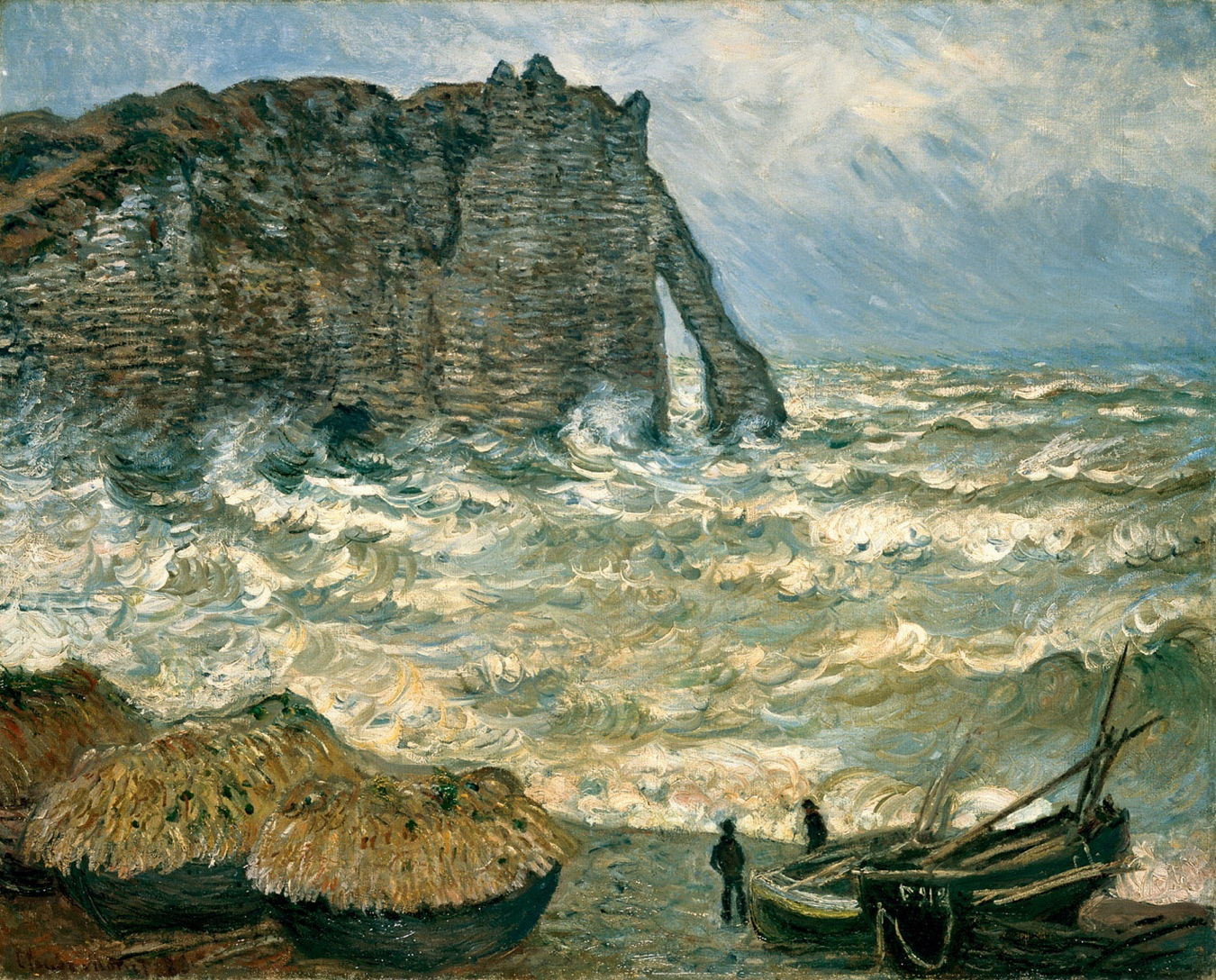
At the Impressionist end of the spectrum is Claude Monet’s Stormy Sea at Étretat (1883), painted from the beach directly in front of the the village, and a prototype for a small series.

For all his realist figures, Renoir’s Sunset at Douarnenez, from around 1883, is a classical Impressionist view looking into the setting sun.
I hope this small collection of paintings demonstrates there was a great deal more to French and European painting in 1883 than Impressionism. In this series I will explore the artists and paintings that accompanied Impressionism, but have now been largely forgotten. I hope you’ll join me.
 The Eclectic Light Company