
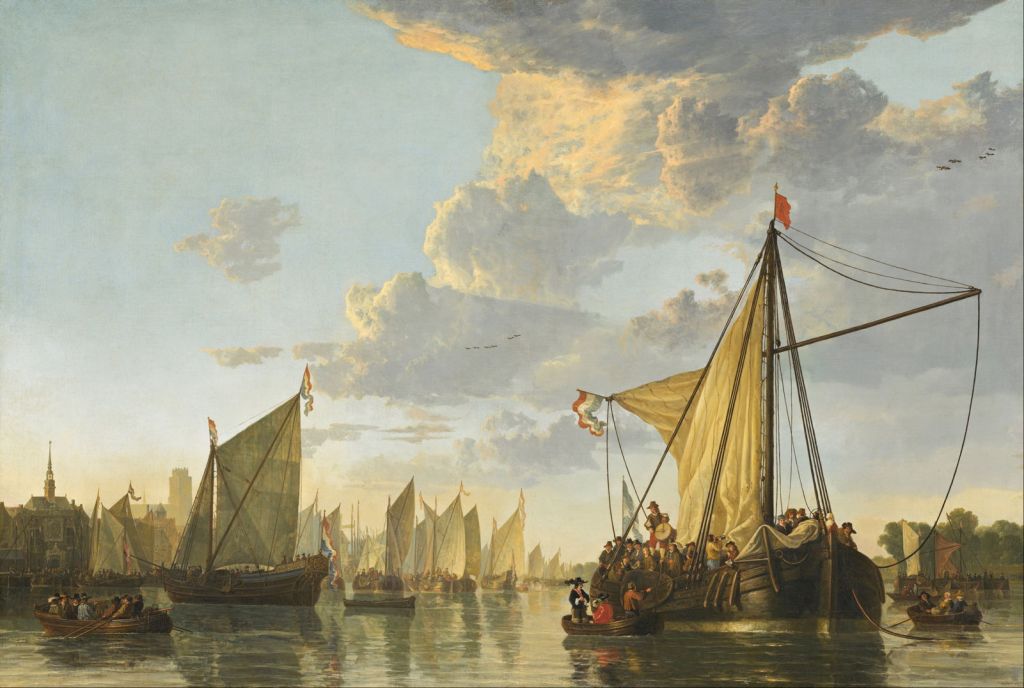
This series attempts to describe how European painting changed during the Dutch Golden Age, between about 1600-1672.

Provinces that united in the Dutch Republic are shown in red, orange and yellow in this map. Its centres of art included The Hague, its de facto capital, Utrecht, Leiden, Delft, Harlem, and Amsterdam. To the south were the lands composing the Spanish Netherlands, notably Flanders and Brabant, including the cities of Antwerp and Brussels.
History

Painted fifty years before the dawn of the Golden Age, Pieter Brueghel the Elder’s Winter Landscape with Skaters and Bird Trap (1565) is a precursor to winter scenes of the Dutch Republic.
Origins
Life in the Republic
Historical context 1565-1643
Historical context 1644-1674
Decline and legacy
How did it happen?
Genres

Group portraits
Ordinary people


Animal painting
Chiaroscuro in Utrecht
Stories
Landscapes
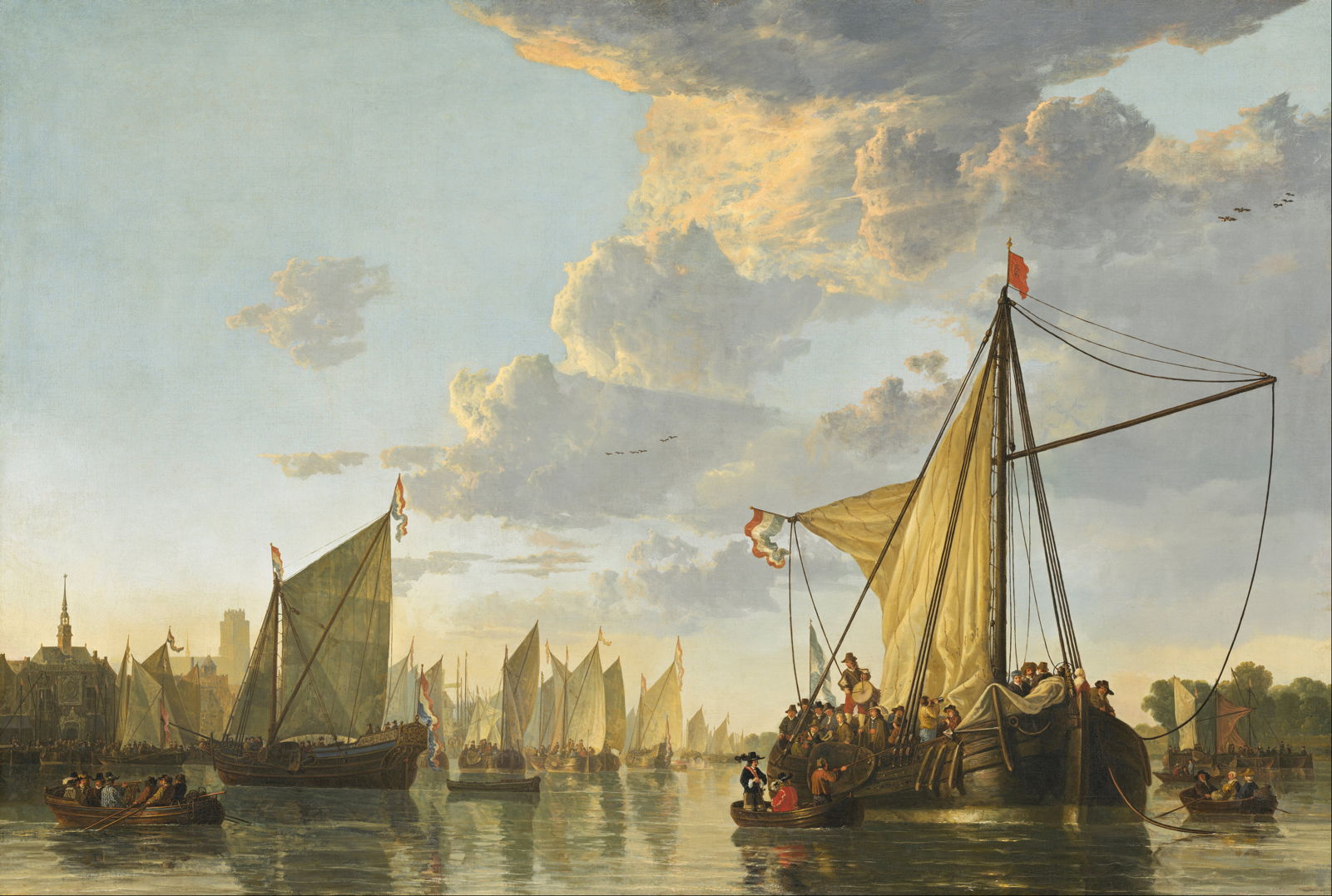

Individual artists

Everyday life of Gerard ter Borch
Aelbert Cuyp 1
Aelbert Cuyp 2
Jan Miense Molenaer

Rembrandt to 1640
Rembrandt after 1640
Jacob van Ruisdael’s trees

Johannes Vermeer 1
Johannes Vermeer 2
Unique imagery of Domenicus van Wijnen
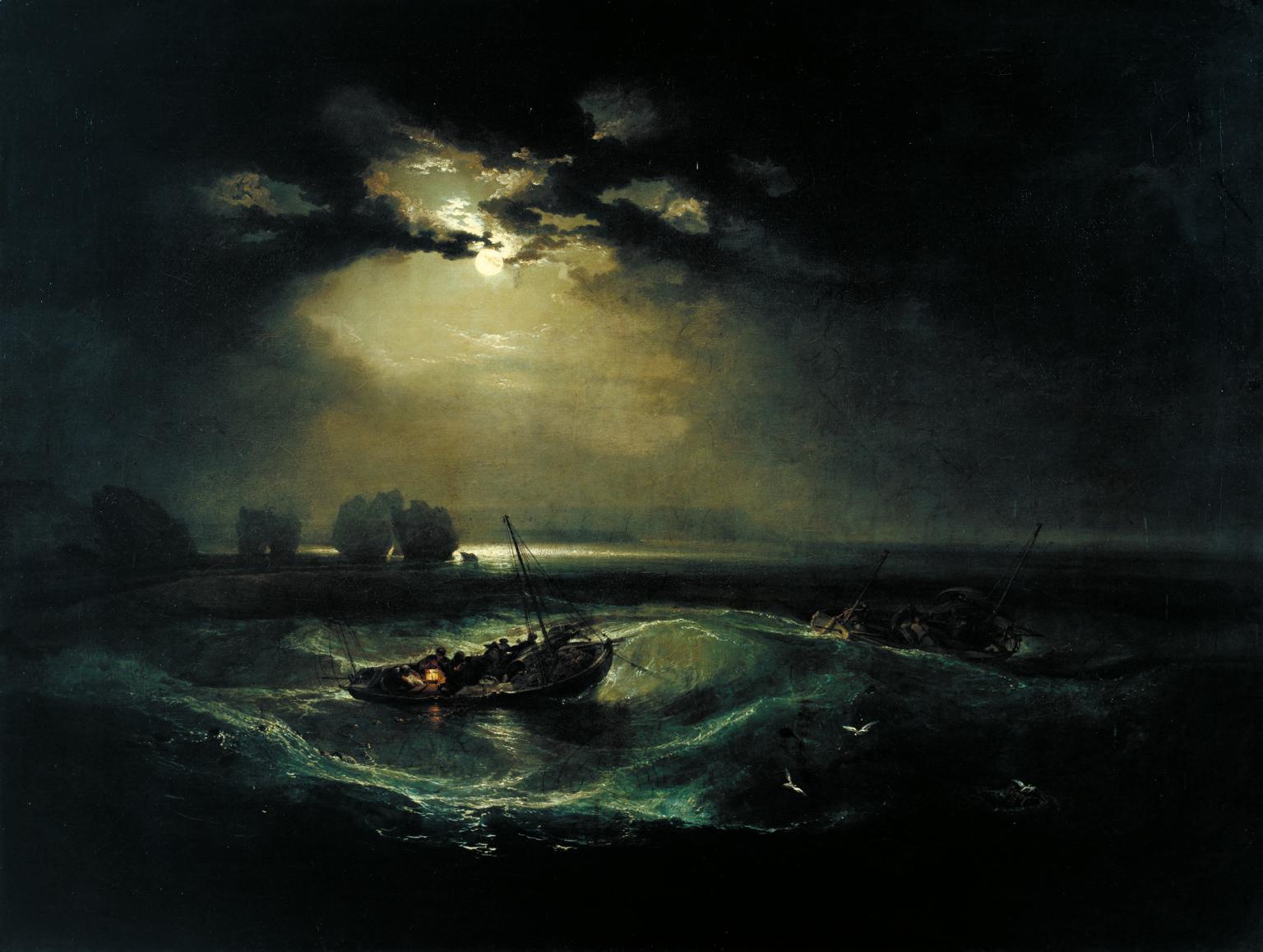
Painted over a century after the end of the Golden Age, JMW Turner’s Fishermen at Sea (1796) is a direct descendant of the maritimes and nocturnes developed by the artists of the Dutch Republic.
The innumerable paintings of the Golden Age transformed European painting from the art of the Renaissance to prepare it for the Age of Enlightenment and the major changes of the nineteenth century. Art broke free from domination by religious themes and patronage by the church and ruling elites, with the opening up of secular genres including landscape painting.
Related articles
A Painted Weekend in Amsterdam: 1645-1867
A Painted Weekend in Amsterdam: 1871-1923
Interiors by Design: The Dutch Golden Age
Blur in paintings: Vermeer
Landscape composition: Dutch Horizons
Still Life History: 2 Clara Peeters the pioneer
Still Life History: 3 The Dutch Golden Age
Next to Rembrandt: In Memoriam Adriaen van der Werff 1
Next to Rembrandt: In Memoriam Adriaen van der Werff 2
Landscapes for All Reasons: Paintings of Aelbert Cuyp 1
Landscapes for All Reasons: Paintings of Aelbert Cuyp 2
Landscapes for All Reasons: Paintings of Aelbert Cuyp 3
The Making of Vermeer’s Milkmaid
Commemorating 300 years since the death of Jan Weenix
Distant panoramas: The 400th anniversary of Philip de Koninck 1
Distant panoramas: The 400th anniversary of Philip de Koninck 2
The Golden Home: 400th anniversary of Gerard ter Borch, 1
The Golden Home: 400th anniversary of Gerard ter Borch, 2
Adriaen van de Velde
The 400th anniversary of the birth of Paulus Potter
 The Eclectic Light Company