
The first organised trading with Japan was established by the Dutch East India Company in 1609, at the start of its Golden Age, and that continued on a small scale from an artificial island in Nagasaki Harbour until the middle of the nineteenth century. Little of that trade involved paintings or other art, although that was sufficient to start small schools of western painting in Japan.
Japan’s isolation continued until a fleet of American ships, under the command of Commodore Matthew C Perry, arrived in Tokyo Bay in 1853. There followed a rapid opening up of trade and cultural exchange, accelerated when the Tokugawa dynasty was overthrown in the brief Boshin War. This marked the beginning of the Meiji period in 1868, with its dramatic reforms and accelerating Westernisation.
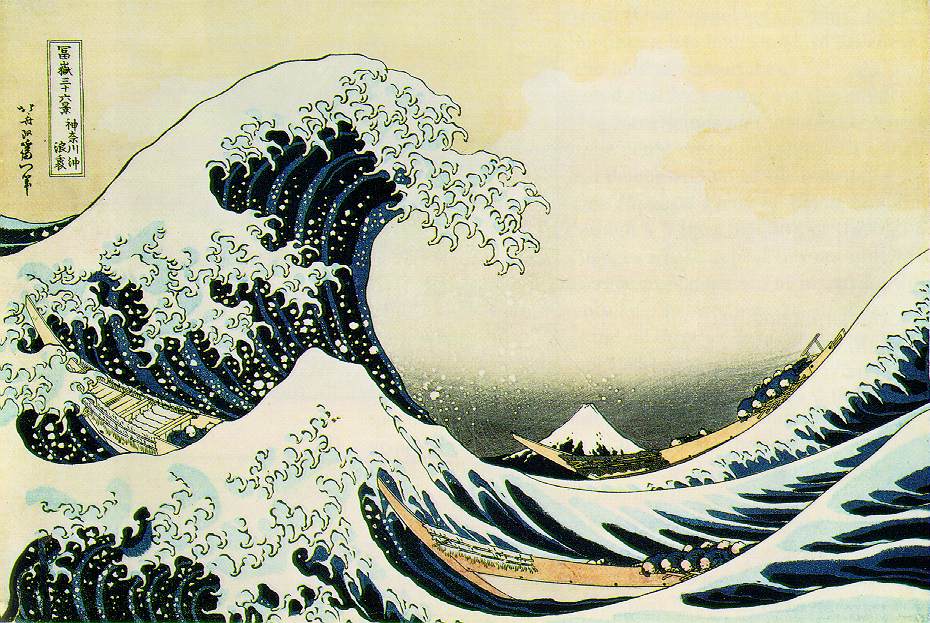
No one knows when Hokusai’s Great Wave first appeared in Europe. Although it’s sometimes claimed that this didn’t happen until the Meiji Restoration in 1868, there are records of the first ukiyo-e prints reaching the hands of artists in France more than a decade earlier.
Although popular in Japan, prints including uki-e, megane-e and the most famous ukiyo-e weren’t considered to be fine art at the time, and Japanese art historians see them as primarily artisanal in nature. Despite this, from their appearance in Europe in the nineteenth century to today, they have been accepted as fine art; indeed for many Westerners they are are the only Japanese visual art with which they are familiar, other than traditional painting.
They appear to have first arrived as protective wrapping for porcelain, and in about 1856 the French artist Félix Bracquemond, an accomplished print-maker, came across Hokusai’s prints. There are claims this happened at the workshop of his printer, or that he found a small volume of Hokusai prints used to pack Japanese porcelain. Japonisme then spread rapidly through artistic circles in Paris and other European cities. Among those who collected these prints were Bracquemond, Vincent van Gogh, Claude Monet, Edgar Degas, Gustav Klimt, Édouard Manet, and Paul Gauguin.
Bracquemond initially trained as a lithographer, but then went to work for Guichard, a former pupil of Ingres. A portrait of his was accepted for the Salon in 1852. After that youthful success, he concentrated on engraving and etching, rather than painting, and was part of the nineteenth century revival of print-making in France. He later went to work in the Sèvres porcelain factory, before working for the manufacturer of Limoges porcelain, in 1870. He was a long-standing friend of Manet and Whistler, as well as Millet, Corot, Rodin, Degas and the Impressionists.

Bracquemond’s Landscape is an unusual and exquisitely beautiful colour lithograph made later in his career. Although hardly Impressionist, its style is more closely related to the many designs that he made for paintings on porcelain.
This is a curious historical twist: European prints taken by the Dutch to Japan had inspired Japanese woodblock prints, which were a key influence on most of the Impressionists, who in turn became the inspiration for Japanese painters who went to Europe to train in Western techniques at the end of the nineteenth and early twentieth centuries.

One of the earliest painters to manifest Japonisme is the American James Abbott McNeill Whistler, as shown in his Princess from the Land of Porcelain, painted for his Peacock Room in 1863-65.

Others like Alfred Stevens followed. The Japanese Parisian from 1872 shows a woman dressed in fashionable Japonaiserie, holding a fan behind her back, and reflected in a large mirror.

The same year William Quiller-Orchardson completed Dolce Far Niente, incorporating in its painted screen a contemporary flavour of Japonisme. His woman, dressed in sober black, reclines on a thoroughly European chaise longue, her open book and fan beside her as she stares idly out of an unseen window.
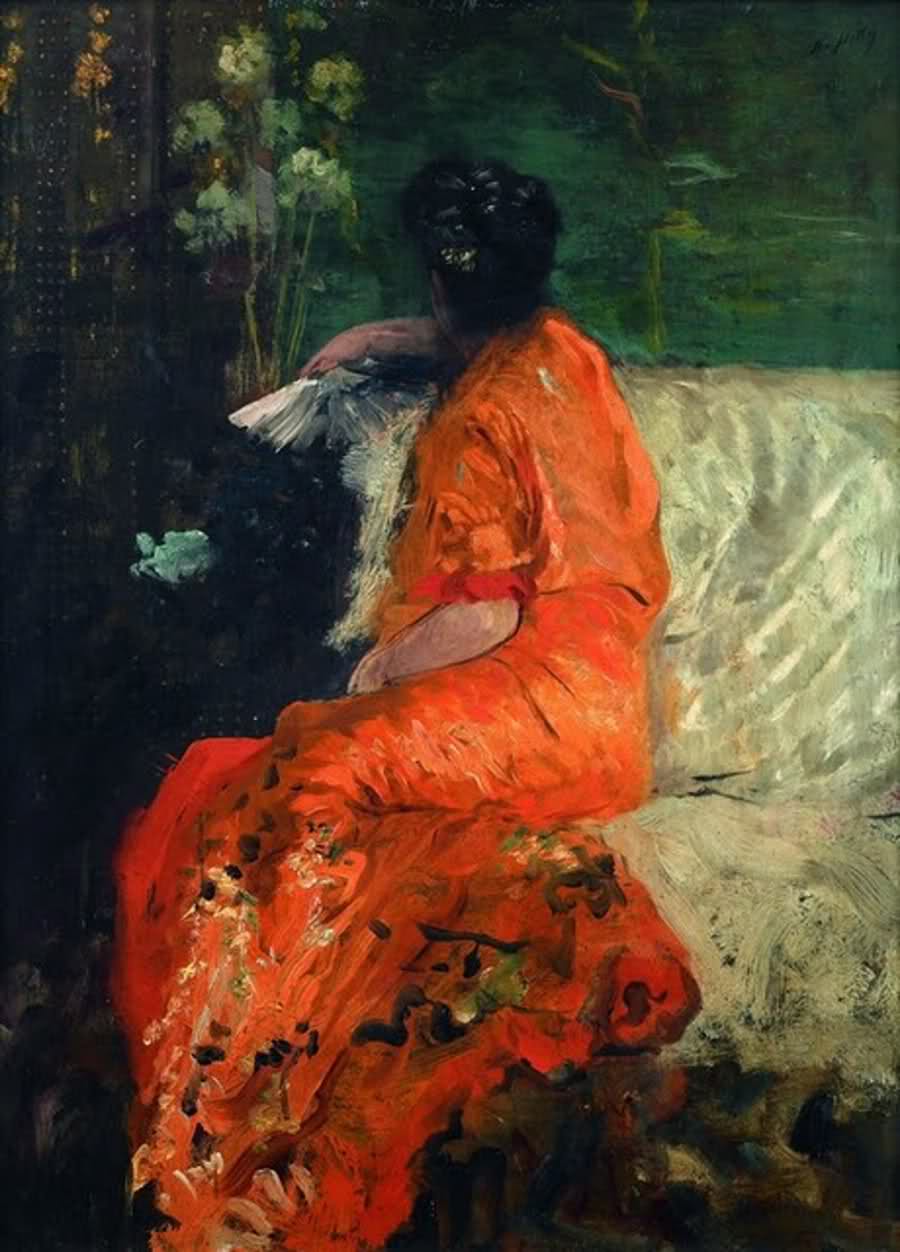
In 1878 the Italian Impressionist Giuseppe De Nittis campaigned successfully in London. Among his paintings from that series is The Orange Kimono.

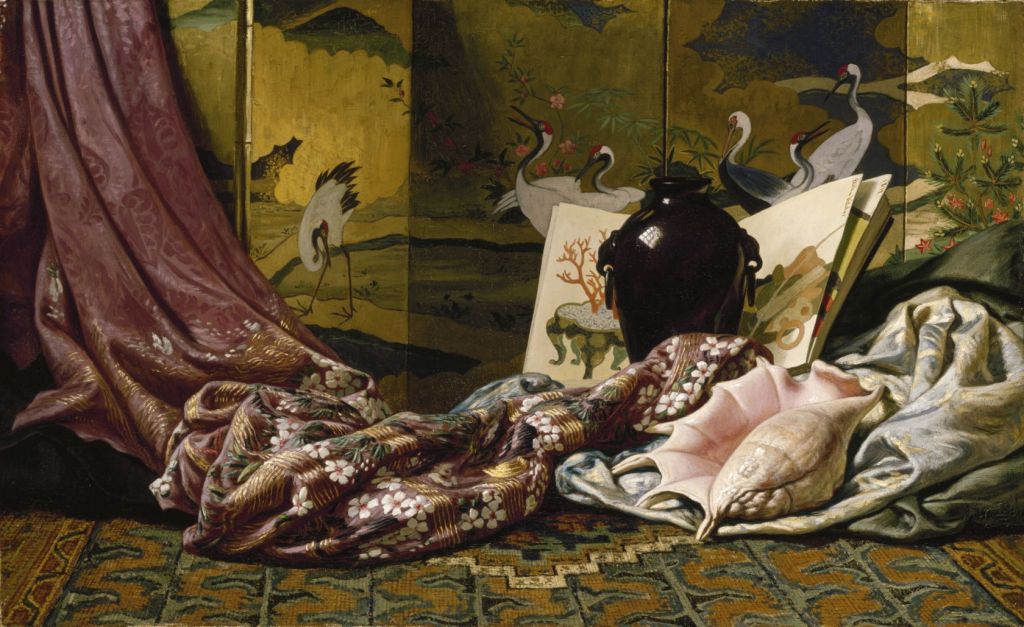
The American Elihu Vedder also developed a fascination for east Asian objets d’art, which he assembled in this Japanese Still Life in 1879. This unusual collection may have been assisted by the fact that his brother was a US Navy doctor who was stationed in Japan as it was being re-opened.

Pascal Dagnan-Bouveret’s Bouderie, meaning sulking, is a splendid and intimate portrait of the artist’s friend and colleague Gustave Courtois, painted in 1880. Courtois is seen at one end of a large sofa, smiling wryly and staring into the distance. He holds his palette and brushes in his left hand, and what may be a long mahlstick in the right. At the opposite end of the sofa, turned with her back towards Courtois, is a young woman dressed in fashionable black clothing, and on the left is a screen decorated with Japanese imagery.

The Swedish rising star Anders Zorn painted some Japoniste works, including this parasol portrait, Castles in the Air, from 1885.

Before he went to Arles, Vincent van Gogh had copied Utagawa Hiroshige’s woodblock print The Plum Orchard in Kameido. Shortly after his arrival there, in 1888, the fruit trees came into flower, and van Gogh painted a triptych intended for his brother Theo’s apartment, including The Pink Orchard above, and The Pink Peach Tree below.

Van Gogh’s approach to painting blossoming fruit trees was completely different from that of the Japanese prints he had collected. His trees are built anatomically, with trunk and branches drawn in outline, often using contrasting colour. Flowers are applied using impasto; sadly some of these have faded since, and some of the paint that now appears white or off-white was originally much pinker.
 The Eclectic Light Company