

The great majority of paintings are made on rectangular supports, but since ancient times some artists have opted for circular or elliptical shapes instead. These are known as tondo, from the Italian rotondo meaning “round”, with the plural of tondi, or tondos if you really must.

This tondo of a red-figure Attic cup, now in the Louvre, is typical of classical depictions of Triptolemus and Ceres, and dates from 470-460 BCE. The young deity is sat in Ceres’ special winged chariot, as she provides him with seed to be distributed to the lands around the world.
Fabricating a perfect tondo using wooden panels has remained relatively unusual, probably for practical reasons. The increasing use of fabric stretched on a wooden frame enabled them to become more popular, as they did during the Renaissance.
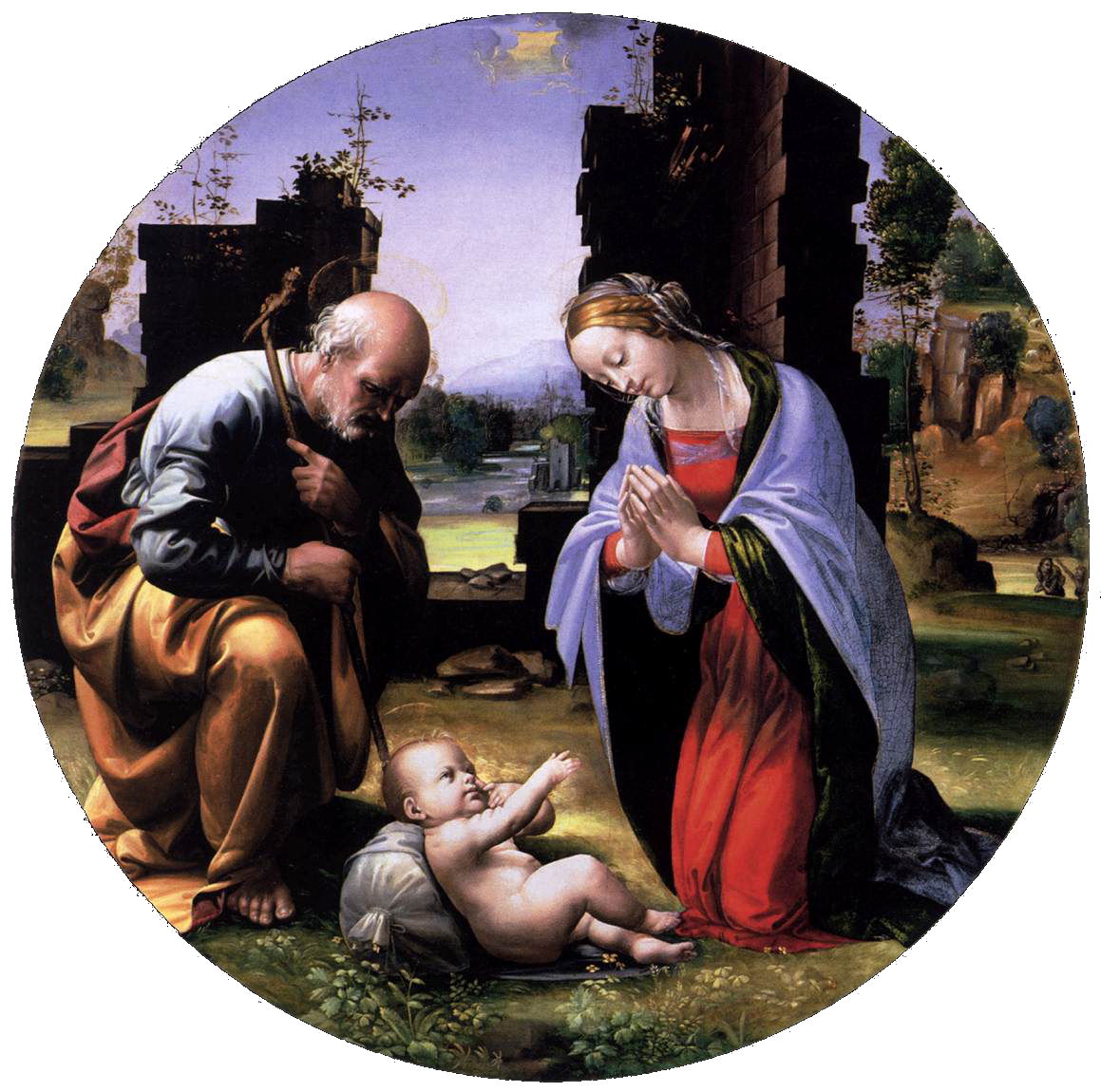
Far Bartolomeo’s tondo of the Adoration of the Child (c 1499) is a fine painting of an enormously popular Christian scene, with Jesus’ parents paying their respects to the baby.
The softer geometry of circles and ellipses makes tondi ideally suited to portraits of the Madonna and child, and for portraits of women more generally. Their use has proved particularly successful in the paintings of Raphael.

Raphael’s Alba Madonna was probably painted around 1510, and has spawned many replicas. It was commissioned by a bishop for the church of the Olivetans in Nocera dei Pagani, a town on the coastal plain of the south-west of Italy, in the province of Salerno. Its landscape background is also notable.

Of all Raphael’s tondo Madonnas, it’s his Madonna della Sedia (Madonna of the Chair) from 1513-14 which is my favourite. It shows a thoroughly real and natural mother with two infants, every surface texture rendered as in life, in a close-cropped composition matched to its shape.
Tondi have also proved ideal for self-portraits.

This small undated Self-portrait shows Sofonisba Anguissola, the first great female master.

Although his best-known paintings were all rectangular, Nicolas Poussin’s later tondo Time Defending Truth against the Attacks of Envy and Discord (1641) puts Father Time at its centre, with a firm grip around Truth’s waist, while Envy and Discord sit below them. On this occasion Time doesn’t have a hand free for an hour-glass. This appears to have been projected for placement in a round ceiling, another good reason for his choice of format.

Although Tiepolo’s Discovery of the True Cross and Saint Helena (c 1743) is painted on a flat tondo, it was intended for display from the ceiling of the Capuchin church in Castello, as demonstrated in its projection.

In about 1780, Angelica Kauffman painted this delightful tondo of Cymon and Iphigenia, a variation on a popular theme.

Girodet chose a large elliptical tondo for his ‘revenge’ portrait of Mlle Lange, who had refused his previous portrait of her. As a motif in painting, Danaë had come to be represented as a reclining, beautiful, nude woman, on whom a stream of golden coins was falling, and it was that stream Girodet wanted to exploit. It could have only one reading in this context: that Mlle Lange sold her body in return for money, and Girodet was happy to be even more explicit.
Tondi were also imitated on occasion. Ford Madox Brown’s first painting to establish his interest in more complex storytelling was The Last of England, which he started as his response to the emigration to Australia of the only Pre-Raphaelite sculptor, Thomas Woolner, in 1852.

Brown’s original oil version is one of his most subtle compositions. Central to its imitation of a circular tondo is a middle-class couple who are not enjoying the fact that their migrant ship is ‘all one class’. They both stare with grim determination at the prospect of sharing the next few weeks with the rowdy working class passengers behind them, eating the same increasingly stale vegetables which are now slung from cords around the ship’s rail in front of them.
This isn’t just a couple, though: look closely at their hands, and the woman’s left hand is clutching the tiny hand of her baby, who is safely swaddled inside her weatherproof hooded travelling cape. Her right hand, wearing a black leather glove, grasps that of her husband, whose left hand is tucked under his heavy coat. Splashes of brilliant colour are supplied by the wind blowing the woman’s ribbons.

Richard Dadd’s Contradiction: Oberon and Titania from 1854-8 develops his early faerie paintings into a new and unique style, and was painted for the hospital’s first resident Physician-Superintendent, William Charles Hood.
Dadd takes its theme from Shakespeare’s Midsummer Night’s Dream, and there’s hardly a square millimetre of canvas into which he hasn’t squeezed yet another curious detail. Like other great imaginative painters such as Bosch before, his dense details dart about in scale: there are tiny figures next to huge leaves and butterflies, and towards the top these distortions of scale generate an exaggerated feeling of perspective, which his choice of format may have enhanced.

Carlos Schwabe’s watercolour tondo portrait of Medusa from 1895 is one of the most startling paintings in the round.
All good art suppliers continue to do a steady trade in tondi.
 The Eclectic Light Company