

Boccaccio’s Decameron is set in Florence at the height of the Black Death or plague of 1348. A group of seven young women and three young men have fled the piles of corpses in the city and taken refuge in a mansion in the surrounding country. To pass the time while they wait for the epidemic to abate, they agree to tell one another stories, ten each day, for ten ‘working’ days over a fortnight.
This series retells six of those that are well-known in their paintings, with a bonus at the end.

Day 4, Story 1
Told by Fiammetta about those whose love ended unhappily.

Bernardino Mei’s Ghismunda from 1650-59 captures the resolute response of Ghismonda, as she stands squeezing her lover’s heart in her hand, tears still on her face.
Day 4, Story 5
Told by Filomena about those whose love ended unhappily.

John Everett Millais’ Isabella (Lorenzo and Isabella) from 1848-49 is based on Keats’ poetic retelling, and one of the earliest Pre-Raphaelite paintings.
Set at an imaginary family meal, it shows Lisabetta and her lover Lorenzo, with her three brothers. Lorenzo is sharing a blood orange with Lisabetta, white roses and passion flowers climbing from behind their heads. The dog, a surrogate for Lorenzo, is being petted by Lisabetta, but one of her brothers aims a kick at it. Other symbols are shown of the plot to kill Lorenzo: a brother staring at a glass of red wine, spilt salt on the table, and a hawk pecking at a white feather. The pot of basil is already on the balcony, awaiting Lorenzo’s head.
Day 5, Story 1
Told by Panfilo about the adventures of lovers who survived calamities or misfortunes and reached a state of happiness.

Lord Leighton’s Cymon and Iphigenia from 1884 shows Iphigenia stretched out languidly in her sleep, in the last warm light of the day; behind her the full moon is just starting to rise. Cymon stands in shadow on the right, idly scratching his left knee, gazing intently at Iphigenia. But there is much more to Boccaccio’s story than that.
Day 5, Story 8
Told by Filomena about the adventures of lovers who survived calamities or misfortunes and reached a state of happiness.

The third painting in Botticelli’s series of four shows a breakfast banquet at which the ghost of a dead woman is attacked by dogs, and is about to be caught and killed in front of Nastagio’s guests. Nastagio used this ghostly spectacle to persuade the woman he loved to stop spurning his advances.
Nastagio degli Onesti’s breakfast
Day 10, Story 5
Told by Emilia about those who have performed liberal or munificent deeds in the cause of love, or for other reasons.

Marie Spartali Stillman’s The Enchanted Garden of Messer Ansaldo from 1889 shows Madonna Dianora visiting the magical garden set up by Messer Ansaldo with its flowers and fruit, in the midst of snow during harsh January weather.
Day 10, Story 10
Told by Dioneo about those who have performed liberal or munificent deeds in the cause of love, or for other reasons.
This is a re-telling of the folk story of Griselda.
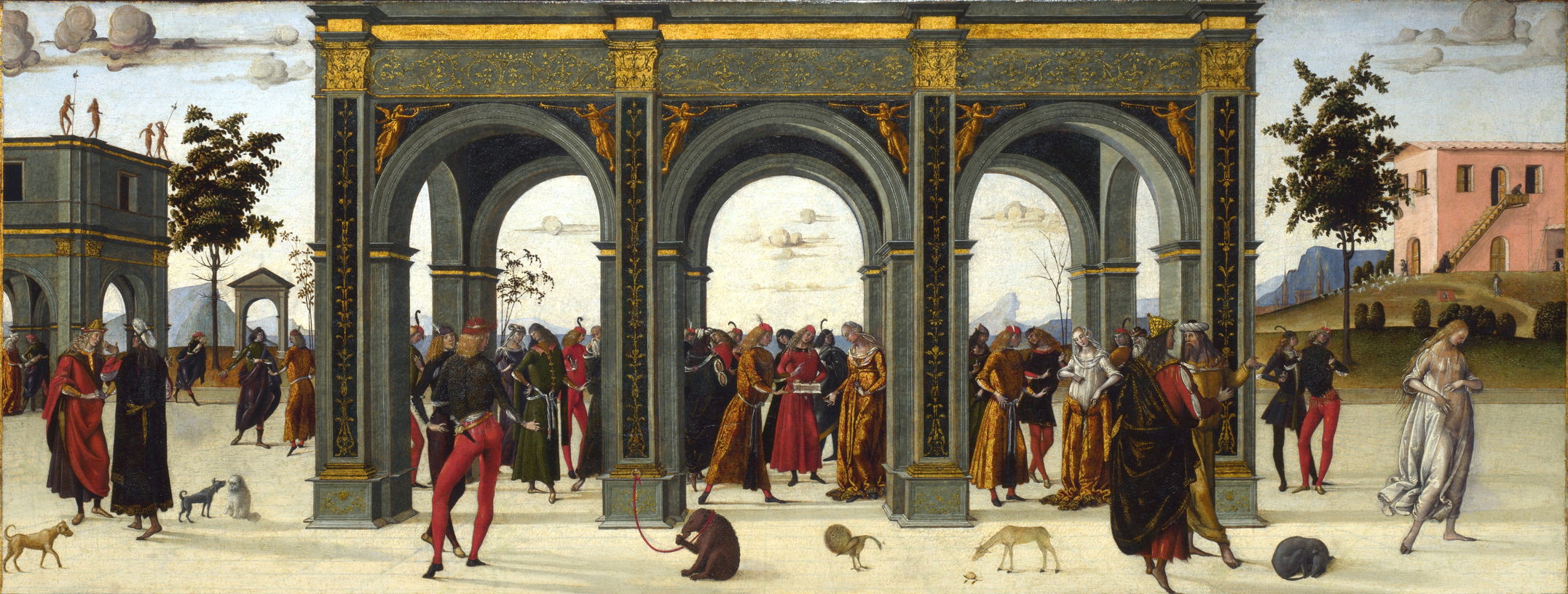
The second panel of a series of three is set in the grand surroundings of the house of Gualtieri, Griselda’s husband. At the left edge, Griselda’s infant is taken from her to be killed. In the centre, she is shown a forged Papal dispensation dissolving her marriage, then to the right she is removing her fine clothes prior to leaving Gualtieri’s house. At the far right she is barefoot, wearing just her shift, returning to her father’s house to work as a shepherdess.
101st Story, Day 4, Introduction
A bonus, the hundred and first story is buried in Filostrato’s introduction to the fourth day. This is the best-known of all the stories in the Decameron as it has made its way into the French language, through one of La Fontaine’s fables.

In about 1736, Nicolas Lancret painted this tale in oil on copper, as one of a pair, among a larger group of his paintings of La Fontaine’s fables.
 The Eclectic Light Company