
In the first of these two articles looking at bread in visual art, I considered it as a symbol of life, predominantly following the Christian tradition set by the Last Supper. Here I consider bread in its role as food, the staple of most Europeans.

Man with Two Loaves of Bread (1879) is one of Jean-François Raffaëlli’s social realist paintings. This man’s bowed head and furtive look make you wonder just how he had acquired those loaves.
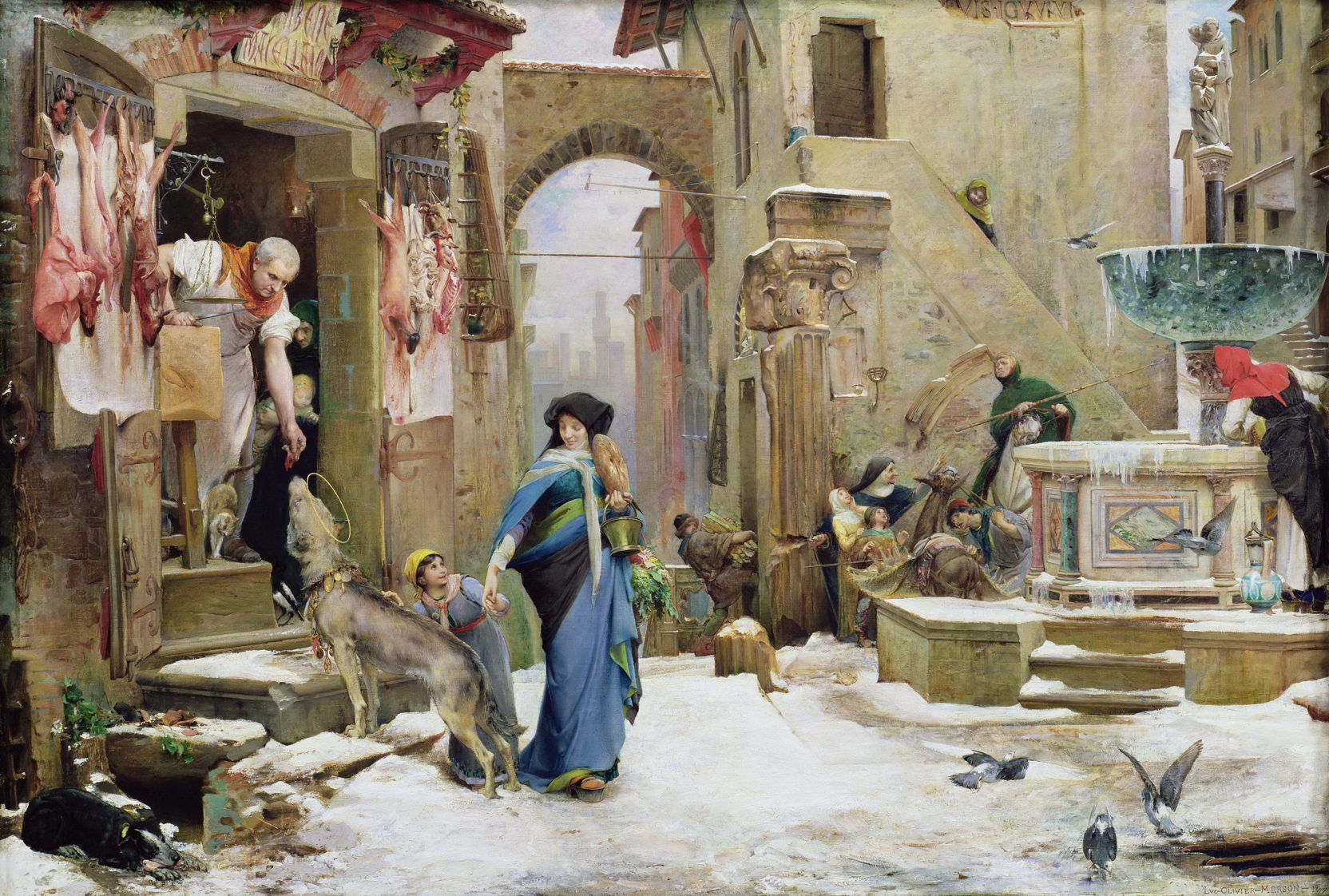
Luc-Olivier Merson’s wonderful painting of the Franciscan legend of The Wolf of Agubbio from 1877 is set in the town’s central piazza on a bitter winter’s day. The large wolf of the legend has a prominent halo and stands at the door of the butcher’s shop, from where the butcher is handing it a piece of meat. A young girl smiles open-mouthed as she strokes the wolf’s back. Her mother holds her other hand, as she walks back clutching a loaf of bread and other provisions (detail below).


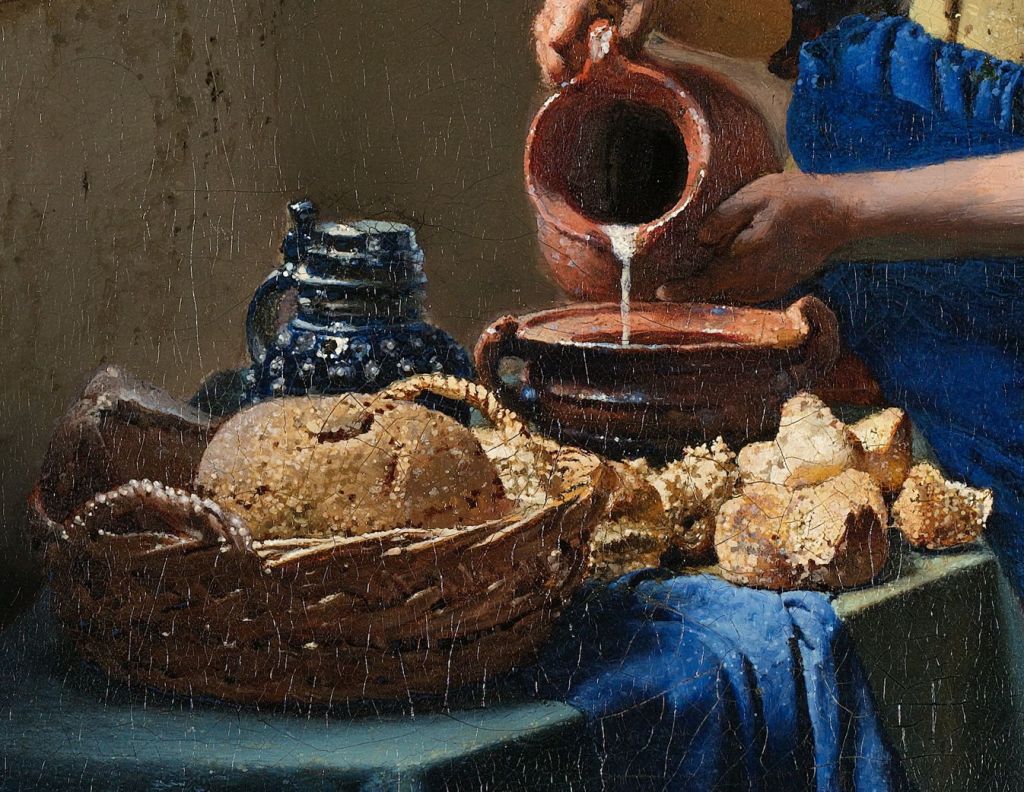
Vermeer’s Milkmaid, probably from about 1658-59, is less about milk than the bread on the tabletop. A wicker basket of bread is nearest the viewer, broken and smaller pieces of different types of bread behind and towards the woman, in the centre. These are shown in the detail below, where Vermeer’s controlled use of blurring is visible.

Perhaps because it was so commonplace in many households and bakers, there are relatively few paintings showing the making and baking of bread.
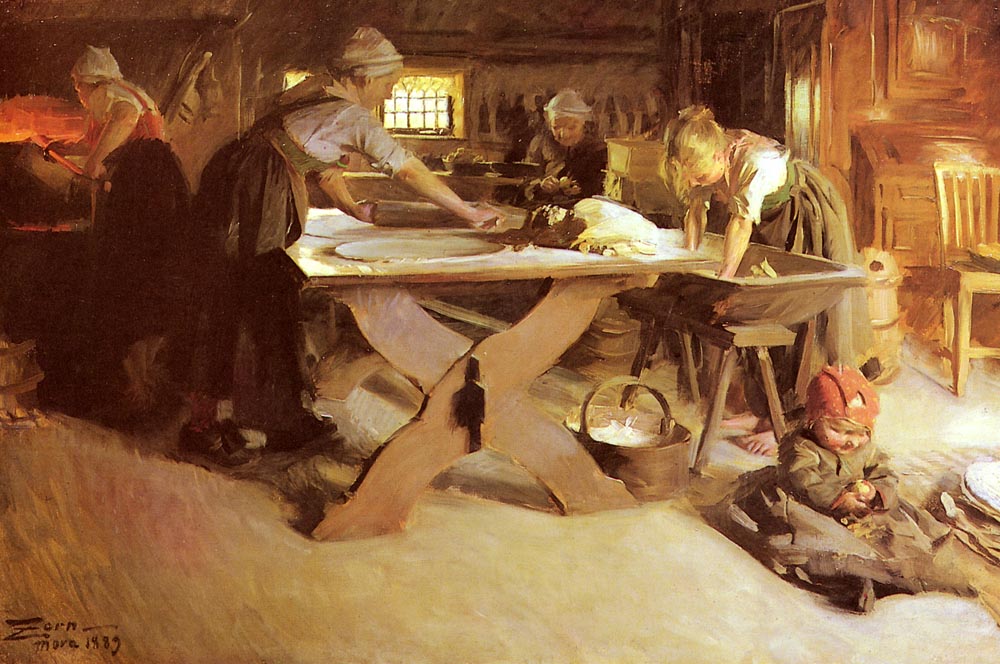
In Baking Bread, painted in Mora, the artist’s home town in Sweden in 1889, Anders Zorn captures each step in the process in documentary fashion, from kneading the dough, through rolling and preparing it, to its baking. There’s even an infant in the foreground who looks ready to be its consumer.

Helen Allingham’s undated Baking Bread shows a traditional farmhouse baking oven being used to bake the bread for an extended family, or possibly a small village shop. These ovens can still be found in many remaining period dwellings, but are now seldom used.

Christian Krohg’s early painting of Ane Gaihede as a Woman Cutting Bread (1879) marked the start of his social realism. Krohg documents her in almost ethnographic detachment. She is aligned in profile, against an almost bare wall, perfectly framed at three-quarter length.
Finally, bread is occasionally featured in still life paintings.

Anne Vallayer-Coster painted A Still Life of Mackerel, Glassware, a Loaf of Bread and Lemons on a Table with a White Cloth in 1787, when she was at her artistic zenith.
 The Eclectic Light Company