
Artists like Rembrandt and Vermeer are exceptional in any period in history. Among the thousands of artists in the Dutch Republic, there were a few dozen who never achieved such greatness, but whose paintings have endured the collapse of the market in the late seventeenth century. Among them is Aelbert Cuyp (1620–1691), who is also a bit of a mystery in that he appears to have stopped painting soon after 1660, although he lived for another thirty years.
Cuyp was born into an artistic family, who were also quite rich. He was taught to paint by his father, Jacob Gerritsz Cuyp, who was primarily a portrait painter, and lived in Dordrecht. Trained as a landscape painter, he often used views as a platform for genre scenes, animal and human portraits, and more, and seems to have been both happy and highly proficient at painting almost anything. During his early career, he was mostly under the influence of the prolific artist Jan van Goyen (1596-1656), but doesn’t appear to have been his pupil.

Cuyp is thought to have painted this Landscape with Cattle when he was only about nineteen, in 1639. It’s set against the background of the city of Dordrecht, situated on the Rhine-Meuse-Scheldt river delta. The herdsman and animals in the foreground are engaged in diversions from that landscape: the man is taunting a billy goat, while the cow at the far right is urinating copiously. Above them is a lucent sky with slightly unnatural clouds.

Cuyp was soon using his landscapes with more diverse themes. Orpheus with Animals in a Landscape from about 1640 is one of at least two different paintings he made of this story from mythology. Here he has included a wide range of both domestic and exotic animals and birds, including a distant elephant, an ostrich, herons and wildfowl.

Throughout his career, Cuyp seems to have made detailed sketches in front of the motif, to inform his studio paintings. This View of Arnhem from the South from about 1642-46 was made using grey wash, watercolour and black chalk.

His dramatic Thunderstorm over Dordrecht from about 1645 is amazingly effective and accurate, considering it was painted more than two centuries before anyone saw high-speed photographic images of lightning.

Many of Cuyp’s landscapes show more varied terrain than he could ever have seen in the Republic. Although the cliffs at the right of his Herdsmen with Cows (c 1645) may have been fairly local, the more substantial crags in the left distance are far from being Dutch. It’s not known whether he travelled to other countries, or perhaps relied on the paintings of artists who did.

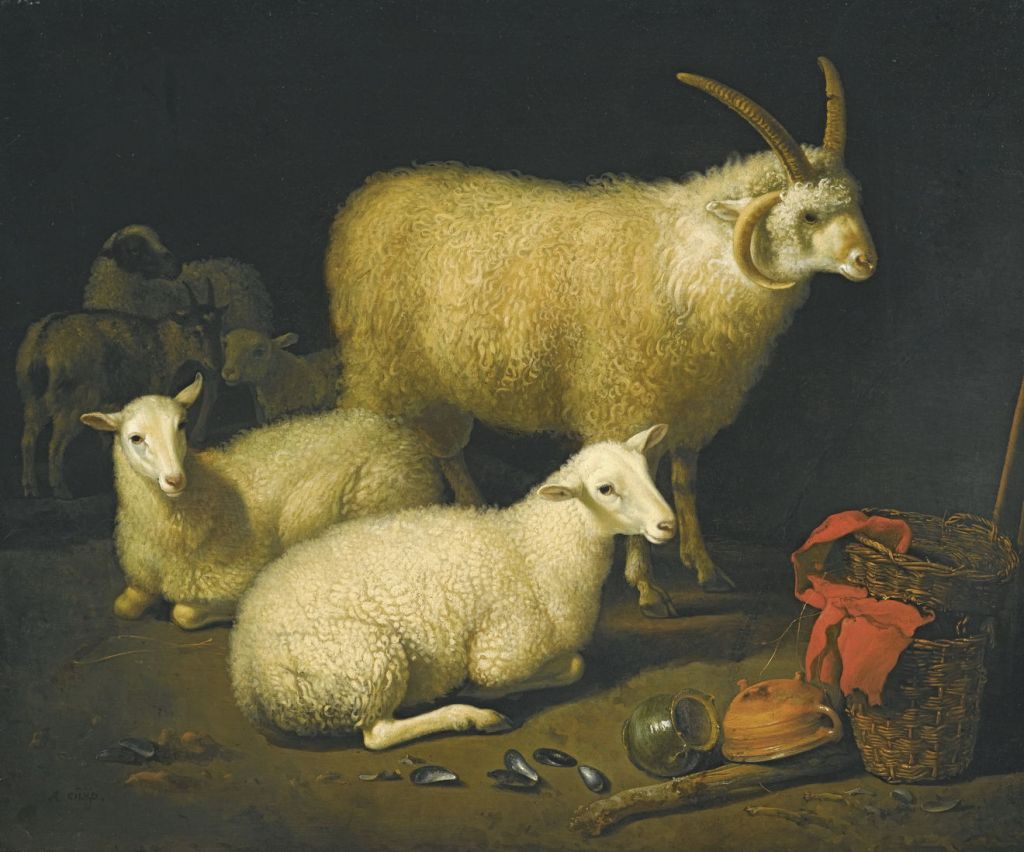
His paintings of domestic animals also took him indoors, for example in this fascinating painting of Sheep in a Stable from about 1645. The sheep are faithfully depicted, and surrounded by objects suggesting this was more of a still life. In the foreground are empty mussel shells, a couple of earthenware pots, and two wickerwork baskets with some scarlet cloth. He also renders the texture of the fleeces using painterly brushstrokes, particularly that of the standing ram.

View on the Rhine also from about 1645 appears to have been the result of a trip up river into steeper terrain inland. It’s wonderfully painterly, and might even be mistaken for one of Turner’s landscapes from nearly two centuries later.
In the mid-1640s, Cuyp is believed to have come under the influence of Jan Dirksz Both (c 1610-52), who had returned to Utrecht by 1646 following a formative period spent in Rome. When he was in Italy, Both transformed his painting thanks to the work of, and working with, Claude Lorrain. As a result, Cuyp changed the direction of light in his landscapes to elongate shadows and enrich his colour ranges. His father was still alive for much of this period, and it’s thought that in some paintings prior to about 1650, the son painted the landscape and father the figures.

Cuyp continued to make fine studies in front of the motif, such as this View of the Groote Kerk in Dordrecht from the River Maas from about 1647-48, made using a combination of black and brown chalk and watercolour washes. Like the previous study, it sadly wasn’t intended to be seen by the public.
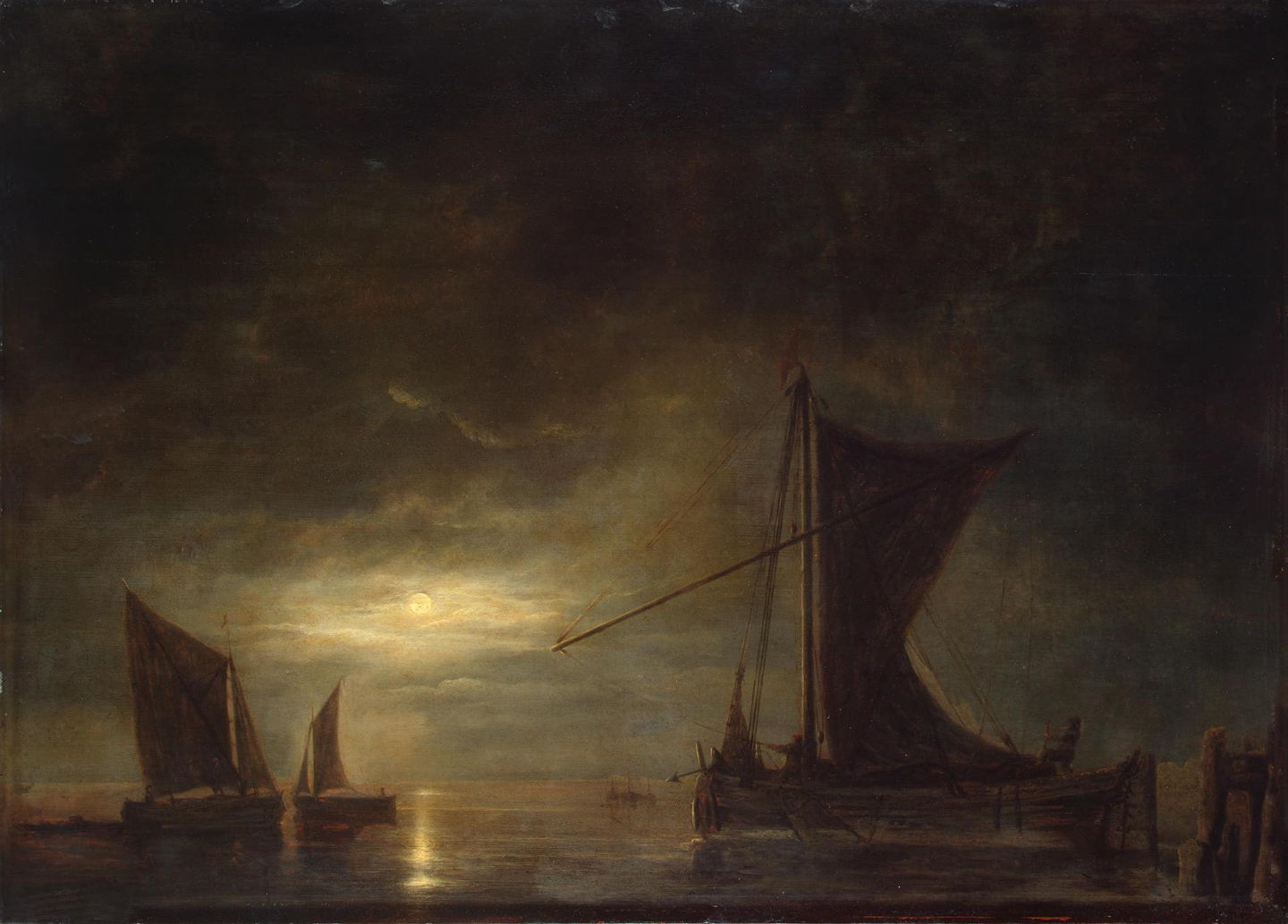
He also painted a few nocturnes, including this view of the Sea by Moonlight from about 1648, where he extends his exploration of the effects of light.
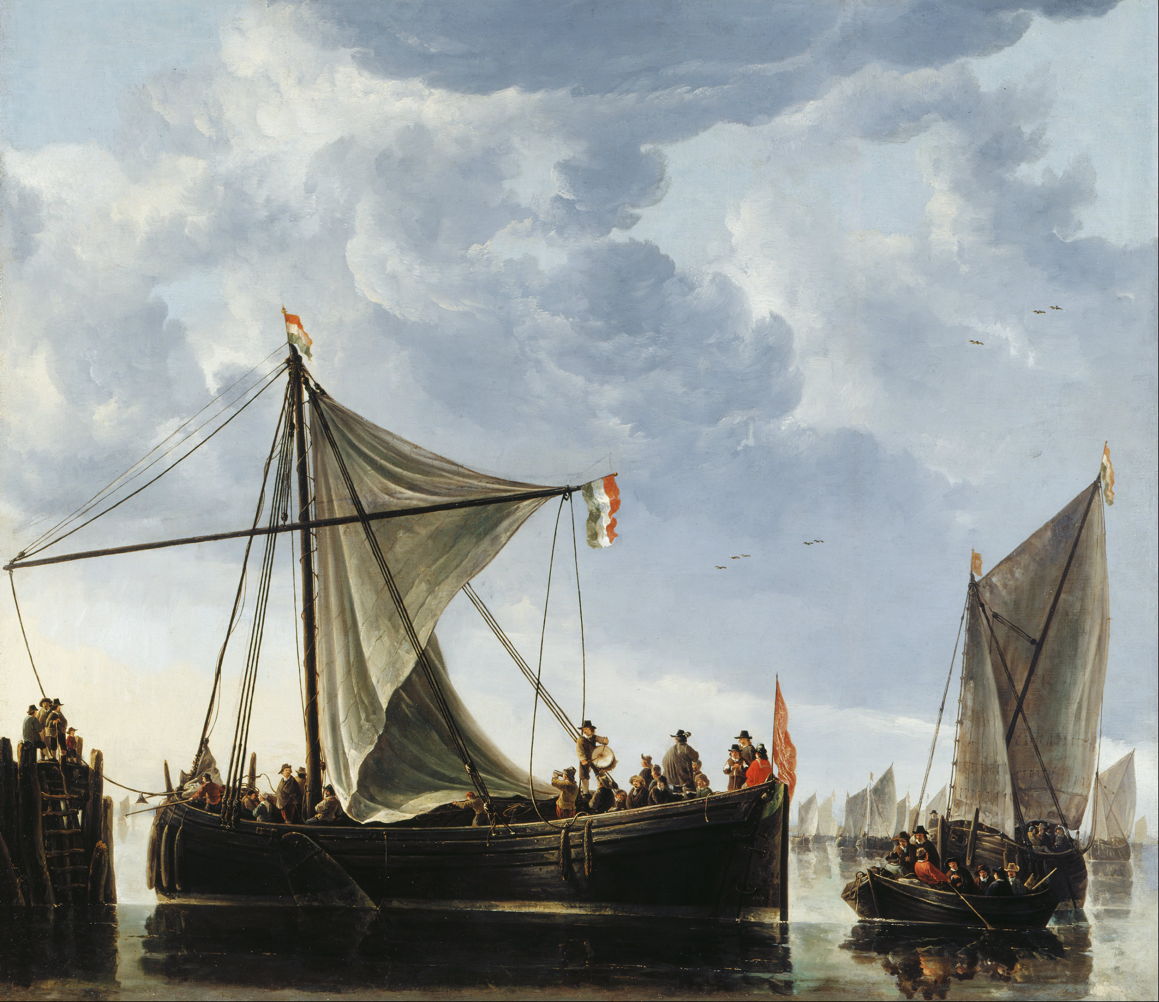
Although Cuyp never seems to have become a more dedicated marine specialist, his paintings of ships including The Passage Boat from about 1650, are landmarks at the height of his career. This ferry was most probably run between Dordrecht and Rotterdam, a distance of little more than twelve miles (20 km) by river. The figures in the boat are finely detailed, including a drummer towards the stern, and the clouds are also finely crafted.
Reference
 The Eclectic Light Company