
During his career in Delft, Johannes Vermeer had been respected as an artist, but soon after his death at the end of the Dutch Golden Age he slipped quietly into obscurity, alongside many hundreds of others. A few connoisseurs maintained an interest in his work, but it wasn’t until the middle of the nineteenth century that he was rediscovered. Since then his few remaining paintings have become among the most revered in the European canon.
Vermeer was born in the city of Delft in 1632, where he took over his father’s business as a dealer in paintings. He also trained as a painter, and at the end of 1653 was admitted to the city’s Guild of Saint Luke. The following year Delft was struck by a catastrophic explosion in a gunpowder store, destroying a large section of the city and its occupants.

Vermeer’s Christ in the House of Martha and Mary is his largest surviving painting, and probably one of his earliest, dating from about 1654-56. It’s unusual among them for its religious theme.

By about 1657-58, when he painted Officer and Laughing Girl, he had found form in the compositional approach for which he is most famous. Figures going about their everyday lives are seen in the daylight cast from windows on the left. The map depicted so meticulously has been identified as that made of Holland and West Friesland by Willem Blaeu and Balthasar Florisz van Berckenrode. Unfortunately, no other complete copy of that map has survived, but its second edition was published by Blaeu in 1621, and that’s believed to be on display here, as shown in the detail below.


Some of these paintings feature heavy curtains in the foreground, drawn back to reveal Vermeer’s subject behind. Among those is his Girl reading a Letter at an Open Window (c 1658), where its railed curtain gives an air of intimacy, suggesting the viewer is peeping past the curtain and gazing in at real and private life.

The Milkmaid, probably from about 1658-59, is perhaps Vermeer’s first true masterpiece, and introduces the optical effects for which he is now best-known.
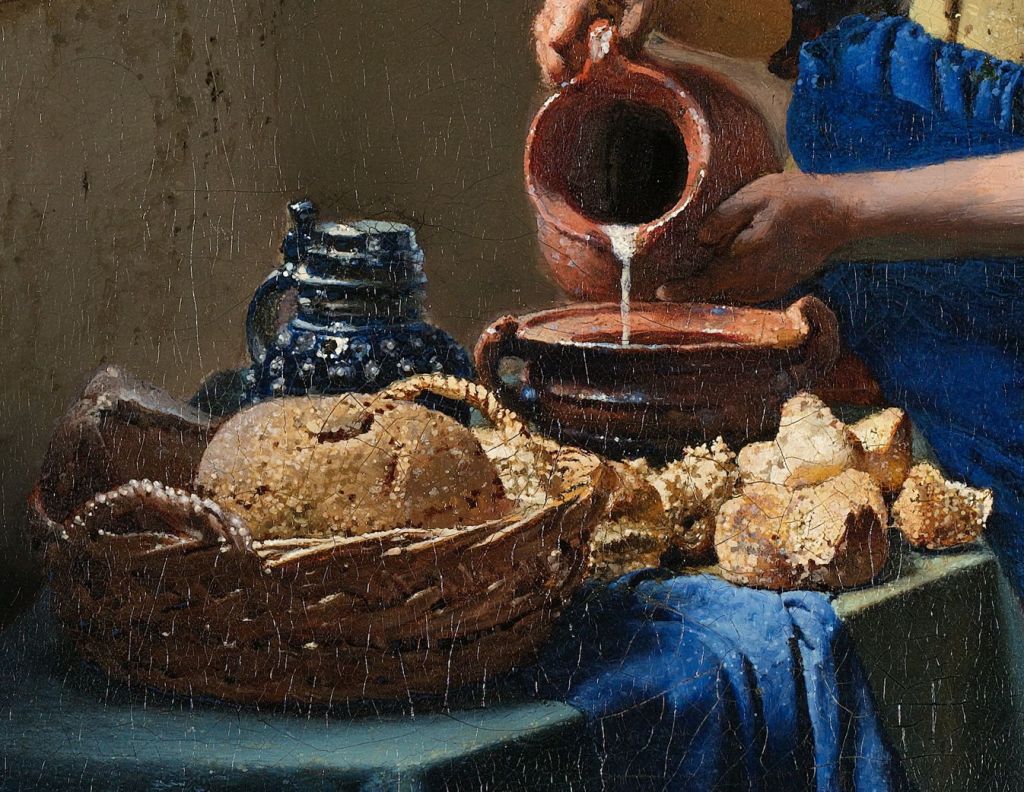
A milkmaid is pouring milk from a jug, beside a tabletop with bread. In the left foreground the bread and pots rest on a folded Dutch octagonal table, covered with a mid-blue cloth. A wicker basket of bread is nearest the viewer, broken and smaller pieces of different types of bread behind and towards the woman, in the centre. Behind the bread is a dark blue studded mug with pewter lid, and just in front of the woman (to the right of the mug) a brown earthenware ‘Dutch oven’ pot into which the milk is being poured. An ultramarine blue cloth (matching the woman’s apron) rests at the edge of the table.
The woman, seen in three-quarter view, wears working dress: a stiff, white linen cap, a yellow jacket laced at the front, a brilliant ultramarine blue apron, and a dull red skirt underneath. Her right hand holds the handle of a brown earthenware pitcher, which she supports from below with her left hand. Her work sleeves are pushed up to lay both her weathered forearms bare to the elbow. Her strong-featured face and eyes are cast down, watching the milk as it runs into the pot.
More remarkable still is the visible blurring.

Edges and detail are sharpest around her left shoulder and upper arm, and soften as you look away towards her hands and the pitcher. Highlights on that pitcher and the pot below it are also decidedly blurry, suggesting this is intended as a depth of field effect.

Bread and other objects on the table in front of the woman also show controlled use of blurring, most obviously in the highlights on the wicker basket.
At some time around 1660, Vermeer painted a couple of cityscapes that are his only surviving non-figurative paintings.

Above is his view of a street and its occupants in The Little Street, and below is his View of Delft waterfront. A third cityscape of a House Standing in Delft has been recorded but is now apparently lost.


His Woman Holding a Balance from around 1662-64 shows a young woman who is pregnant holding an empty balance in front of a collection of pearls and gold. Its focus is noticeably softer than his earlier paintings. The edges of the tabletop in the centre of the canvas and the woman’s left hand are the crispest, and those further from that are softer, as would be consistent with depth of field effects.

Similar effects are seen in Vermeer’s better-lit Young Woman with a Water Pitcher from the same period. Here the central focus is in the upper chest of the figure, where the edge between the split in her white mantle and the underlying deep ultramarine clothing is crispest, and the reflections on the pitcher and bowl are blurry, again consistent with depth of field. So too is the window, which could indicate motion.
Amazingly, this painting was bought by Henry Gurdon Marquand in 1887 for a mere $800, and became the first of Vermeer’s paintings to enter an American collection.
 The Eclectic Light Company