
Rembrandt is probably the most famous artist of the Dutch Golden Age. Although his career is by no means typical, it does illustrate some of the forces at work behind the explosive growth of art during this period, and is a good excuse to show a few of his paintings for context with other artists of the period.
He was born in the city of Leiden, then the second largest in the Dutch Republic after Amsterdam, with a population of 45,000 in 1622, and growing rapidly. Its major industry was the weaving of textiles, and through the seventeenth century it attracted many weavers to migrate from Flanders. Another flourishing local industry was printing and publishing, which was helped by the city’s university, founded in 1575, and its role as a centre of learning and scientific development.
Rembrandt was the ninth child in a prosperous family, his father being a miller. He was well educated, initially at a school in the centre of the city, then from the age of 14 at the university. He soon opted to be apprenticed as a painter, and joined the workshop of Jacob van Swanenburg in Leiden, who had trained in Italy. After three years, Rembrandt went on to work for shorter periods with Pieter Lastman, a history painter in Amsterdam, and others there.

Rembrandt’s early painting of The Operation, from his late teens in 1624-25, shows a barber-surgeon and his assistant performing surgery on the side of a man’s head.
In 1625, when he was only 19, he became a master in his own right, and opened his first studio in Leiden, shared with his former fellow-student Jan Lievens. Two years later he started taking on his own apprentices.

In 1626-27, Rembrandt painted this portrait of a Man in a Gorget and a Plumed Cap, demonstrating the strange effects that cast shadows can have on perception of the face. This also shows his early mastery of surface textures and reflected highlights.
Rembrandt’s break came in 1629, when he was discovered by a distinguished poet and composer Constantijn Huygens, who was secretary to the head of state, held influence in the Hague, and was the father of Christiaan Huygens, a leading mathematician and physicist. Huygens helped arrange commissions for Rembrandt, and introduced his work to Prince Frederik Hendrik, then head of state.
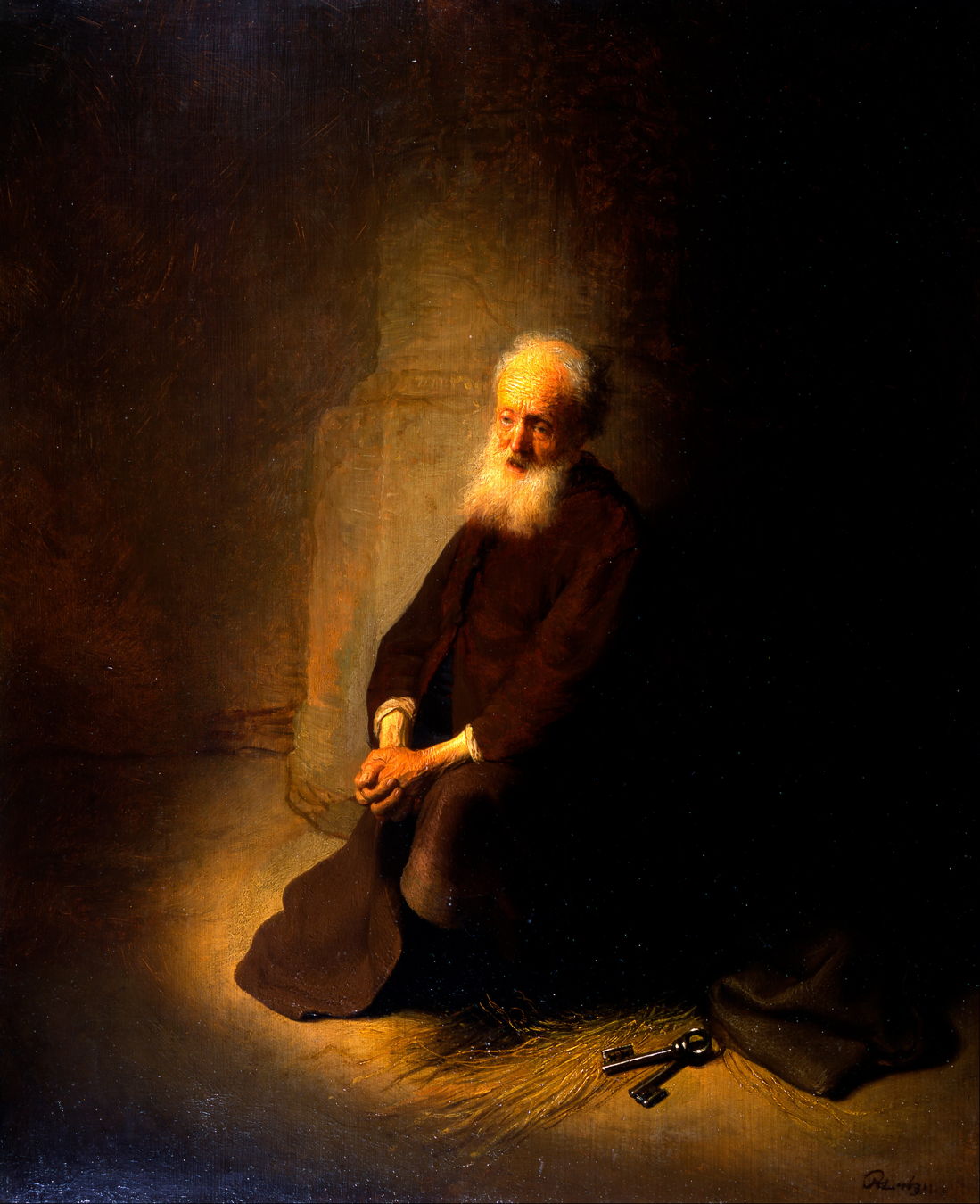
Although several of his best-known chiaroscuro paintings were made in his old age, Rembrandt had long used the technique when appropriate, here in Saint Peter in Prison (The Apostle Peter Kneeling) from 1631.

Rembrandt’s The Abduction of Proserpina (c 1631) is probably the first masterpiece to show this myth. Pluto is trying to drive his chariot away, with Proserpine inside it. She’s putting up fierce resistance, and trying to fend him off. Hanging on to the hem of Proserpine’s floral dress is a woman who should perhaps be her mother Ceres, but bears the crescent moon normally associated with Diana. Pluto’s chariot is being drawn by two black horses through an ethereal almost fluid carpet of flowers. The horses and chariot are about to disappear into a black cleft in the earth to make their descent to Hades.
In 1631, Rembrandt moved his studio to Amsterdam, the centre of trade and business for the Dutch Republic, and growing rapidly from a population of about 50,000 in 1600 to exceed 200,000 in the 1660s. He started getting commissions to paint portraits of those enjoying success in the city.

Rembrandt painted his Anatomy Lesson of Dr. Nicolaes Tulp in 1632, as an early commission soon after his arrival in Amsterdam. It’s a group portrait of distinguished members of the Surgeons’ Guild in their working environment, and a good example of his lucrative work. Portraits like this would typically be paid for by subscription of those included, often in proportion to their standing.

Rembrandt’s The Abduction of Europa (1632) isn’t well known today. It conforms to Ovid’s account in his Metamorphoses, but loses dramatic effect by placing the bolting bull in a dominant and very Dutch landscape, cluttered with Europa’s carriage, large trees, and a distant port.

His Philosopher in Meditation from 1632 shows the sinuous curves of a spiral staircase seemingly defying gravity as it rises to the storey above, and is one of his early interiors.

The young prophet Daniel (of lions’ den fame) was King Cyrus the Great’s confidant, according to the book of Daniel. When Cyrus asked Daniel why he didn’t worship the Persian god Bel (Baal), Daniel responded by saying that he worshipped a living god, not a mere idol. Cyrus then claimed that Bel too was a living god, and pointed to the offerings of food and wine that were placed before his statue, and were consumed each night. Daniel remarked cautiously that bronze statues do not eat, which for a moment threw Cyrus. But Daniel had exposed the deception of Bel’s priests.
In this painting of Daniel and Cyrus before the Idol Bel of 1633, Rembrandt has captured Cyrus, standing in the centre, pointing at the food and wine placed on the altar to Bel, whose huge idol is seen rather murkily at the upper right. Behind the modest figure of Daniel are some of the priests who maintained this deception.

Rembrandt painted this portrait of Bellona in 1633, when his career was flourishing. Given that she’s holding the Aegis normally associated with Minerva (Athena), I wonder whether there has been a misunderstanding here, but there’s no mention of the possibility that this might be Minerva instead.

His self-portrait from 1631-33 shows the artist in fancy dress with a large poodle, making it clear that he had truly arrived.
In 1634, Rembrandt became properly established in Amsterdam, when he was accepted as a member of Guild of Saint Luke, and married Saskia van Uylenburgh, daughter of a respected lawyer. The following year, the couple moved into a rented property with a view of the river. That December, she gave birth to their first child, a son, who lived for only two months.

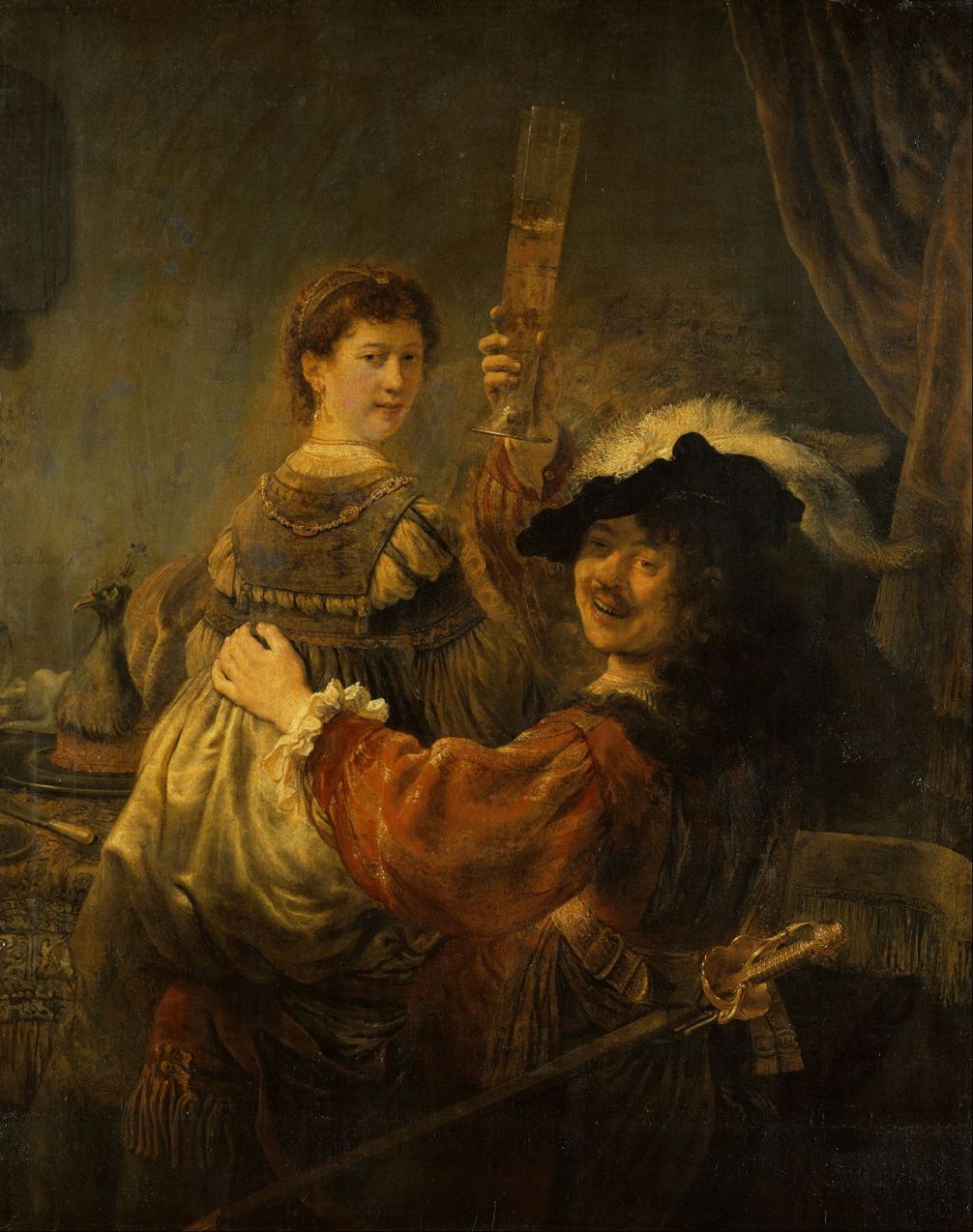
Rembrandt and Saskia in the Parable of the Prodigal Son from about 1635, when the artist was just short of being thirty years old, shows the young wife sitting on his lap as he raises a large fluted glass of beer at the viewer.
With his artistic and commercial success, Rembrandt’s income rose rapidly. Like many successful Dutch citizens of the time, much of that income was spent on gathering possessions. In his case, these included a remarkable collection of Old Masters, including several paintings by Giorgione, objets d’arts, and even suits of armour. Some of these appear as props in his paintings.

Rembrandt’s Blinding of Samson from 1636 is an explicit depiction of the destruction of his eyes, as Delilah makes off behind with his hair and a pair of shears.

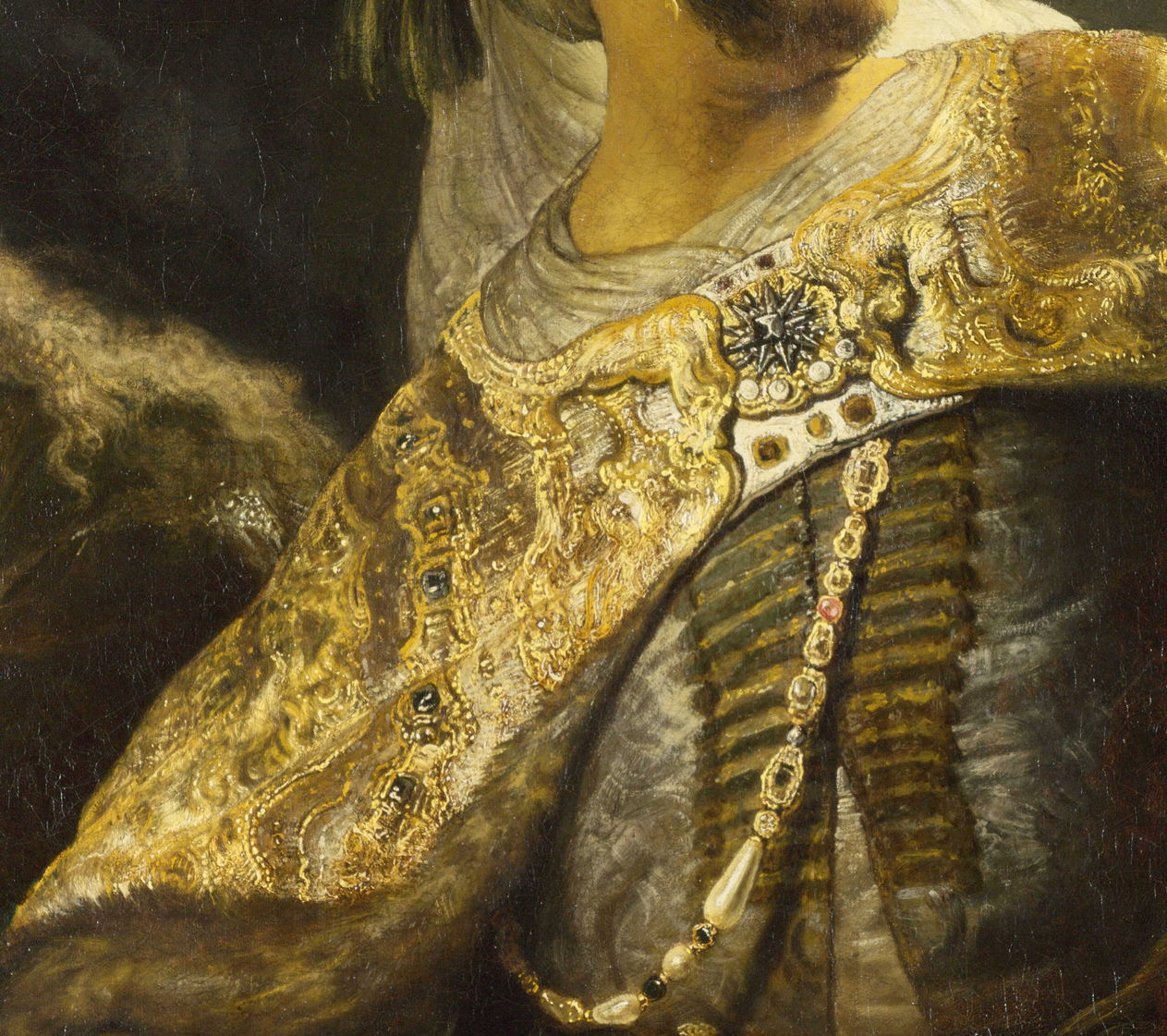
His outstanding painting of Belshazzar’s Feast was made in about 1635-38, when he was developing his distinctive techniques of depicting decorative metals, as shown in the detail below.
In the summer of 1638, Saskia gave birth to their second child, who died less than a month later.

The following year he followed fashion in painting this Still Life with Two Peacocks and a Girl (c 1639).
That Spring Rembrandt and his wife moved into their own house in one of the city’s more fashionable streets, among successful artists and dealers in art. To finance this purchase, the artist had to raise a substantial mortgage, which was to come back and haunt his later life, as I’ll describe in tomorrow’s conclusion.
 The Eclectic Light Company