

This article is a broad overview of the 74-part series covering paintings telling myths from Ovid’s Metamorphoses. Because of its length, there are four more detailed summaries describing each article. This explains broad themes and provides links to all those other articles.
In his Metamorphoses, Ovid relates many myths in which bodies are changed into new forms. These are set in the context of a Pythagorean world principle that everything in life and nature is subject to continuous change. Myths are arranged in chronological sequence, starting with the origin of the world from chaos, and ending in the reign of Emperor Augustus, who sent Ovid into exile.
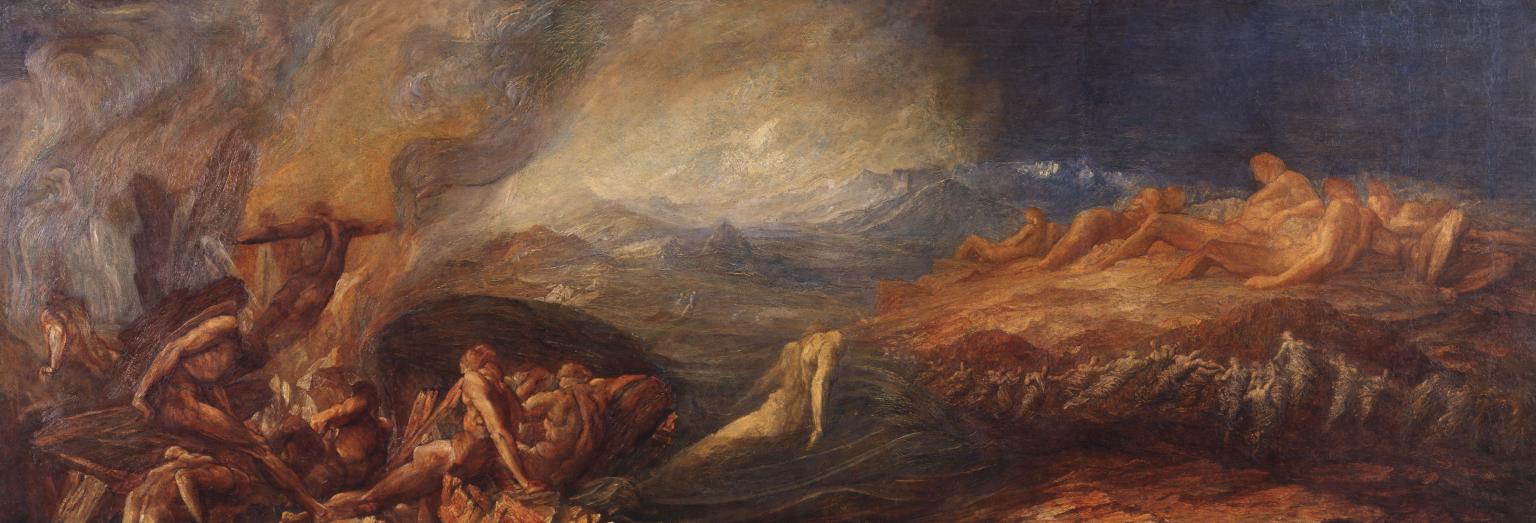
Major myths trace the early phases of humankind, with Jupiter’s flood as an attempt to destroy mortals, and its sole survivors Deucalion and Pyrrha. Those are followed by the first accounts of attempted rapes by the gods, of Daphne transformed into the laurel, and the convoluted story of Jupiter’s rape of Io. Next Phaëthon loses control of the sun chariot, and the world is nearly destroyed by fire. The origin of Aesculapius follows, and Jupiter’s abduction and rape of Europa. That starts the chronicle of Thebes, founded by Europa’s brother Cadmus, with its succession of tragedies leading to the fall of the house of Cadmus.
Summary and contents parts 1-18
1 Creation and Lycaon’s cannibalism
2 The flood and the Python
3 Daphne becomes the laurel
4 Io as a cow, the eyes of Argus, and Syrinx
5 Fall of Phaëthon
6 Callisto victimised
7 Gossip and the death of Coronis
8 Aglauros turned into stone
9 The abduction of Europa
10 Cadmus and the founding of Thebes
11 Actaeon changed into a stag
12 Death of Semele and Jupiter’s surrogate pregnancy
13 Echo and Narcissus
14 Death of Pentheus
15 Pyramus and Thisbe
16 Adultery and Unrequited love
17 Hermaphroditus
18 Ino and the fall of the house of Cadmus


This series starts with the myths of Perseus killing Medusa, rescuing and marrying Andromeda. The Muses tell the story of Pluto’s abduction of Proserpine, resulting in her spending the warmer half of the year with Ceres, and the colder months in Hades. Next are the fates of mortals who boasted they were better than deities: Arachne who said she was a better weaver than Minerva, and Niobe who claimed to be better than Latona. After those, Lycian peasants who prevent Latona from slaking her thirst are turned into frogs, and Marsyas is flayed alive for challenging Apollo to a music contest. This leads into the story of Jason and the Golden Fleece, and the dark side of Medea. Finally, Ovid describes the origin of the minotaur and the story of Theseus.
Summary and contents parts 19-36
19 Perseus rescues Andromeda
20 Perseus kills Medusa
21 The fate of Phineus, and the Muses on Helicon
22 Proserpine’s fate
23 Arethusa, Lyncus and the magpies
24 Arachne’s fate
25 The slaughter of Niobe’s children
26 Latona and the Lycian peasants
27 The music contest
28 Philomela’s revenge
29 Boreas and Orithyia
30 Jason, Medea and the Golden Fleece
31 Rejuvenating Aeson
32 Medea’s murder by proxy
33 The origins of Theseus
34 Minos and the Myrmidons
35 The tragedy of Cephalus and Procris
36 Theseus and the Minotaur


This opens on Crete with the death of Icarus, then tells of the Calydonian boar hunt. There is a second flood, this time sparing Philemon and Baucis for showing hospitality to the gods. After that are stories of Hercules, including the origin of the Horn of Plenty and the death of Nessus the centaur. The tragedy of Orpheus and Eurydice is followed by the death of Hyacinthus. After the happy ending of Pygmalion’s quest for a bride, Ovid tells myths about the birth and death of Adonis, the death of Orpheus, and the folly of King Midas.
Summary and contents parts 37-54
37 The fall of Icarus
38 The Calydonian Boar Hunt
39 The feast of Achelous
40 Hospitality to strangers and virtue rewarded
41 Shape-shifters and the Old Man of the Sea
42 Wrestling for the Horn of Plenty
43 The death of Hercules
44 The birth of Hercules
45 Dryope, Byblis and Iphis
46 Orpheus and Eurydice
47 The cypress tree, and the abduction of Ganymede
48 Killed by Apollo’s discus
49 Galatea transformed from a statue
50 The making of myrrh and birth of Adonis
51 The race between Hippomenes and Atalanta
52 Death of Adonis
53 The death of Orpheus
54 How Midas got his touch and his ears


The final sequence tells the mythical origin of Rome and summarises its history. This starts with the foundation of Troy, then the banquet of the gods, leading to the Judgement of Paris, and the birth of Achilles. Next is the sacrifice of Iphigenia to enable the Greek fleet to sail against Troy, the death of Achilles, and the fall of Troy. Aeneas flees the city and Ovid retells episodes from Virgil’s Aeneid, eventually taking him to defeat Turnus of Latium before undergoing apotheosis. Rome is founded by Romulus, and adopts the god Aesculapius to save itself from plague. The Metamorphoses ends with a brief account of the assassination of Julius Caesar, and praise for his successor Augustus.
Summary and contents parts 55-74
55 The Wedding of Peleus and Thetis
56 The hawk, kingfishers and a diver
57 The sacrifice of Iphigenia
58 A wedding ruined by centaurs
59 The death of Achilles
60 The sack of Troy
61 Sacrifice of Polyxena
62 Aeneas flees Troy
63 The tragedy of Galatea
64 Scylla meets Glaucus
65 The Cumaean Sibyl
66 The tale of Polyphemus
67 Circe and her swine
68 Apotheosis of Aeneas
69 Vertumnus and Pomona
70 Romulus and the founding of Rome
71 Pythagoras and Numa
72 Plague and Aesculapius
73 Julius Caesar
74 The Age of Augustus

Finally, two articles show a series of paintings of many stories from the Metamorphoses by Peter Paul Rubens, who probably painted more than any other artist.
 The Eclectic Light Company