

Ovid closed Book Twelve of his Metamorphoses with the death of the great Greek warrior Achilles at Troy. As was customary, his arms and armour were then to be passed on to a successor. As they had been made specially for him by the god Vulcan (Hephaestus), they were particularly sought-after. Two contenders emerged, Ajax the Great and Ulysses. Agamemnon therefore summoned his leading warriors to determine who was to be given these unique arms and armour.
Ovid uses the speeches of Ajax and Ulysses as a means of quickly summarising some of the action that had taken place in the war against Troy up to this moment.
Ajax puts his case first. He claims that, when Hector tried to set fire to the Greek fleet, it was he who stayed to fight the Trojans. He mentions that Ulysses was late joining the combat, as his rival had feigned madness, but he had been there from the start. When his colleague Philoctetes was dying, Ulysses had abandoned him to die alone. Ajax even had to save Ulysses on the battlefield, and finally he says that he needed a new shield as his current one was worn out with fighting, but Ulysses’ shield had barely been used.
Ajax concludes by proposing that the two should settle the matter in a fight, in which he feels Ulysses would stand no chance. This elicits applause from the surrounding crowd.
Ulysses doesn’t play to that gallery, but when he steps up, he delivers an eloquent argument to the leaders who are to make the decision. He says that he found Achilles hiding on the island of Scyros, and brought him to the war, so can claim Achilles’ successes as his. It was he who convinced Agamemnon to sacrifice Iphigenia in the first place, so enabling the thousand ships of the Greek fleet to sail on Troy. He had worked hard at diplomatic solutions during the first nine years of the war, when Ajax had done nothing. He had also convinced both Agamemnon and Ajax not to abandon the campaign.
Ulysses had killed a Trojan spy, Dolon, and unlike Ajax had been wounded in battle. He also denies Ajax’s claim to have saved the fleet from fire, arguing that had been Patroclus in disguise. Ulysses had later carried Achilles’ dead body from the battlefield, and will recover that of Philoctetes.
To emphasise that, at least in Ovid’s world of Metamorphoses, it is words that carry greater weight than deeds, Achilles’ armour is awarded to Ulysses.
Ajax’s response is sudden and shocking: he literally falls on his sword, and like Hyacinthus before, his blood is turned into the purple hyacinth flower, its leaves marked with the letters AI, both the start of Ajax’s name and a cry of grief.

This, created by the ‘Taleides Painter’ in about 520 BCE, shows the warriors being held apart as they vie for the arms and armour.

Leonaert Bramer’s small painting on copper of The Quarrel between Ajax and Odysseus was made between about 1625-30. The pair stand in their armour, next to tents pitched at the foot of Troy’s mighty walls. At their feet is the armour of Achilles, and all around them are Greek warriors, some in exotic dress to suggest more distant origins.
Just a year or two later, Ajax’s suicide appeared prominently in one of Nicolas Poussin’s greatest narrative paintings: The Empire of Flora.

Poussin painted this in early 1631 for someone named Valguarnera, who turned out to be a thief of uncut diamonds, whose prosecution in court enables its unusually precise dating. At that time it was simply known as Spring. It’s set in a garden, with trees in the left background, a flower-laden system of pergolas, a large water feature, and dancing putti. In this are a series of well-known characters, one of whom is Ajax, shown in the act of falling on his sword.

Poussin has already used the purple hyacinth for the death of Hyacinthus, so here places under Ajax a white carnation which will shortly turn blood red.
Ovid races through the final destruction of Troy and its nobility: the death of Priam, the herding together of the Trojan women to be taken as trophies, and the vicious murder of Astyanax, Hector’s young son, who is thrown from one of the city’s towers.
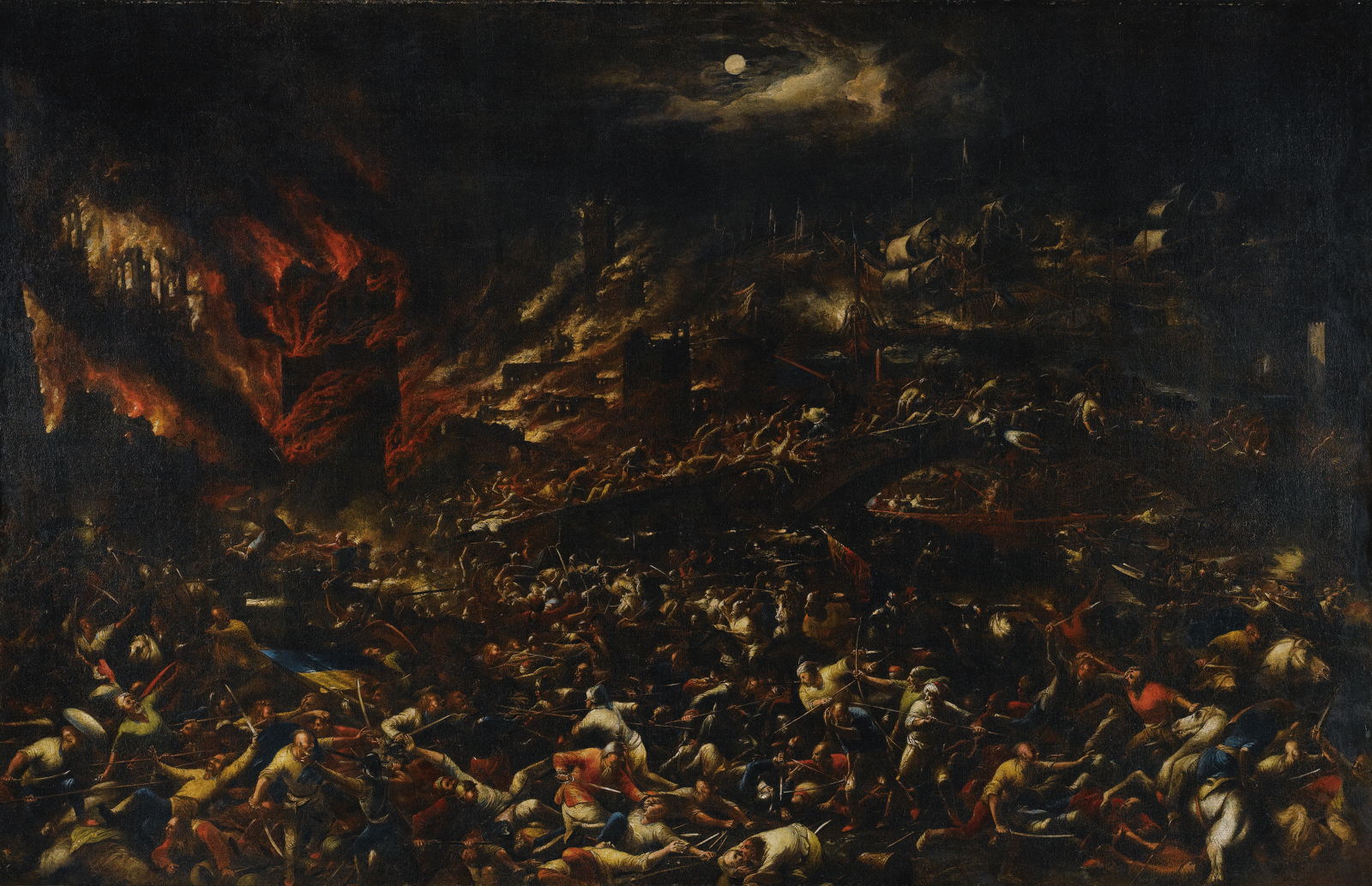
There are many paintings showing the sacking and destruction of Troy, of which my favourite, for its truly apocalyptic vision, is this, attributed to Gillis van Valckenborch.
The story of Astyanax is a relatively recent addition, and probably developed well after 700 BCE.

The clearest narrative painting showing this is Edouard-Théophile Blanchard’s winning entry for the Prix de Rome in 1868, The Death of Astyanax. It breaks convention in depicting Neoptolemus, Achilles’ vicious son, as a North African. Given that Achilles was the king of Thessaly, in central Greece, that seems a stretch of the imagination. Andromache pleads on her knees with the warrior to spare her son, her left hand vainly trying to prevent him from being slung from the wall. Two men cower in fear in the background. Two of Troy’s famous towers are shown, but there is no smoke or other evidence of a sacking in progress, neither is there any sign of King Priam.

Georges Rochegrosse enjoyed great success at the Salon in 1883 with Andromache, a huge and gruesome painting nearly nine metres (27 feet) high. She is at the centre, being restrained by four Greeks prior to her abduction by Neoptolemus. Her left arm points further up the steps, to a Greek warrior in black armour holding the infant Astyanax, as he takes him to the top, where another Greek is shown in silhouette, to murder him. There is death and desolation around the foot of the steps: a small pile of severed heads, a jumble of living and dead, and the debris of the sacking.

Jules Joseph Lefebvre won the Prix de Rome in 1861 with his Death of Priam; Georges Rochegrosse was later to become one of his students. A thoroughly conventional and Spartan Neoptolemus is just about to swing his sword at the prostrate figure of King Priam, who is lying on the floor by the altar to Zeus. Priam looks up at his killer, knowing that he has only seconds to live. Behind Neoptolemus is another body, presumably that of Priam’s son Polites. To the right, in the darkness behind, Queen Hecuba tries to comfort other Trojans. At the left, a young Trojan is trying to sneak away, back into the burning city, with smoke twisting its way into the dark sky.

