

Among the many wonderful paintings in the Musée d’Orsay, in Paris, is a large canvas showing a sprawling group of farmworkers being paid for their labour during the harvest. For many, this is the only work by Léon Augustin Lhermitte (1844–1925) which they will ever see. In a week it will be exactly one hundred years since his death, and this is the first of two articles to commemorate that in a brief account of his career, with a selection of his paintings.
Lhermitte was a precocious artist. His talents were recognised when he was still a child, and he was educated at a special school that went on to become the École Nationale Supérieure des Arts Décoratifs. After that, he studied at the prestigious École des Beaux-arts in Paris. He established his reputation at the Salon in 1864, although I’ve been unable to locate any suitable images of his paintings from the 1860s.
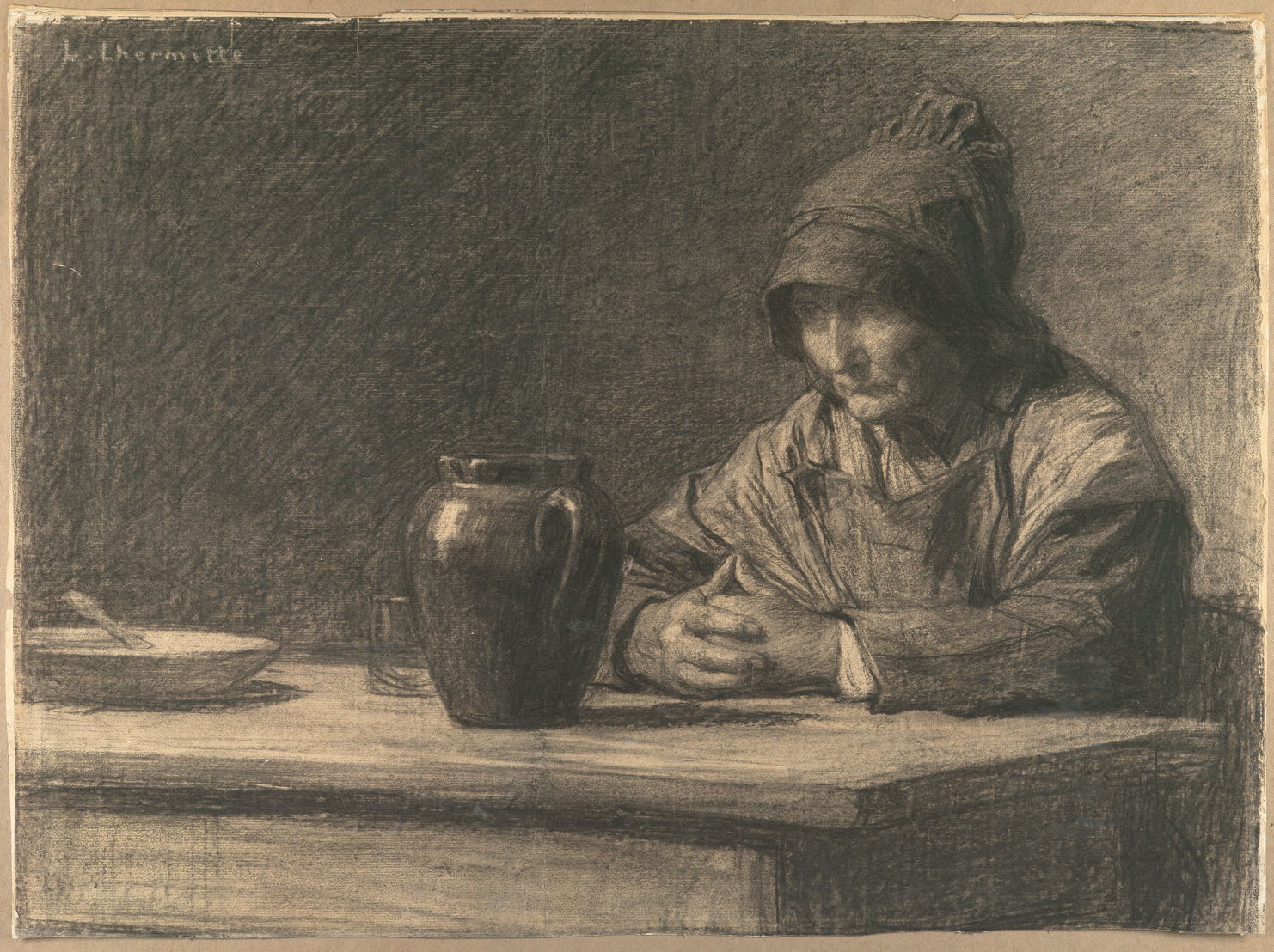
The persistent thread through much of Lhermitte’s work is the plight of the rural poor. In his charcoal drawing of The Cider Jug from 1874, an older woman stares at a jug of cider. Her bowl and glass are empty, and she has fallen back on drinking home-made cider to relieve her hunger and misery.

Lhermitte’s detailed realist style brought scenes such as this Apple Market, Landerneau, Brittany (c 1878) to life. With a cart on the move in the background, and sellers ready with their scales, it shows the small-scale bustle of a quiet country town.

Also painted in Brittany, Lhermitte’s sketchy Procession near Ploumanac’h (1879) shows a religious festival, with a small stream of locals making their way along a track on the open hillside towards the church. Behind its leader are women and children dressed in white, the priest in front of the Host under its canopy, then mothers carrying infants, and the elderly.

The Musée d’Orsay’s best-known painting by Lhermitte, The Harvesters’ Pay (1882), is an unusual take on the harvest. Although there are a couple of cut sheaves of wheat at the lower right, it looks at the economic and social aspects. Four of the harvesters, bearing their heavy-duty scythes, await payment by the farmer’s factor, who holds a bag of coins for the purpose. In the centre of the painting, one of the workers is counting out his pay in front of his wife, who is feeding a young infant at her breast. To their left, another worker just sits and stares blankly into the distance, dead-beat tired and wondering whether his pittance was worth all that effort. Life was hard.
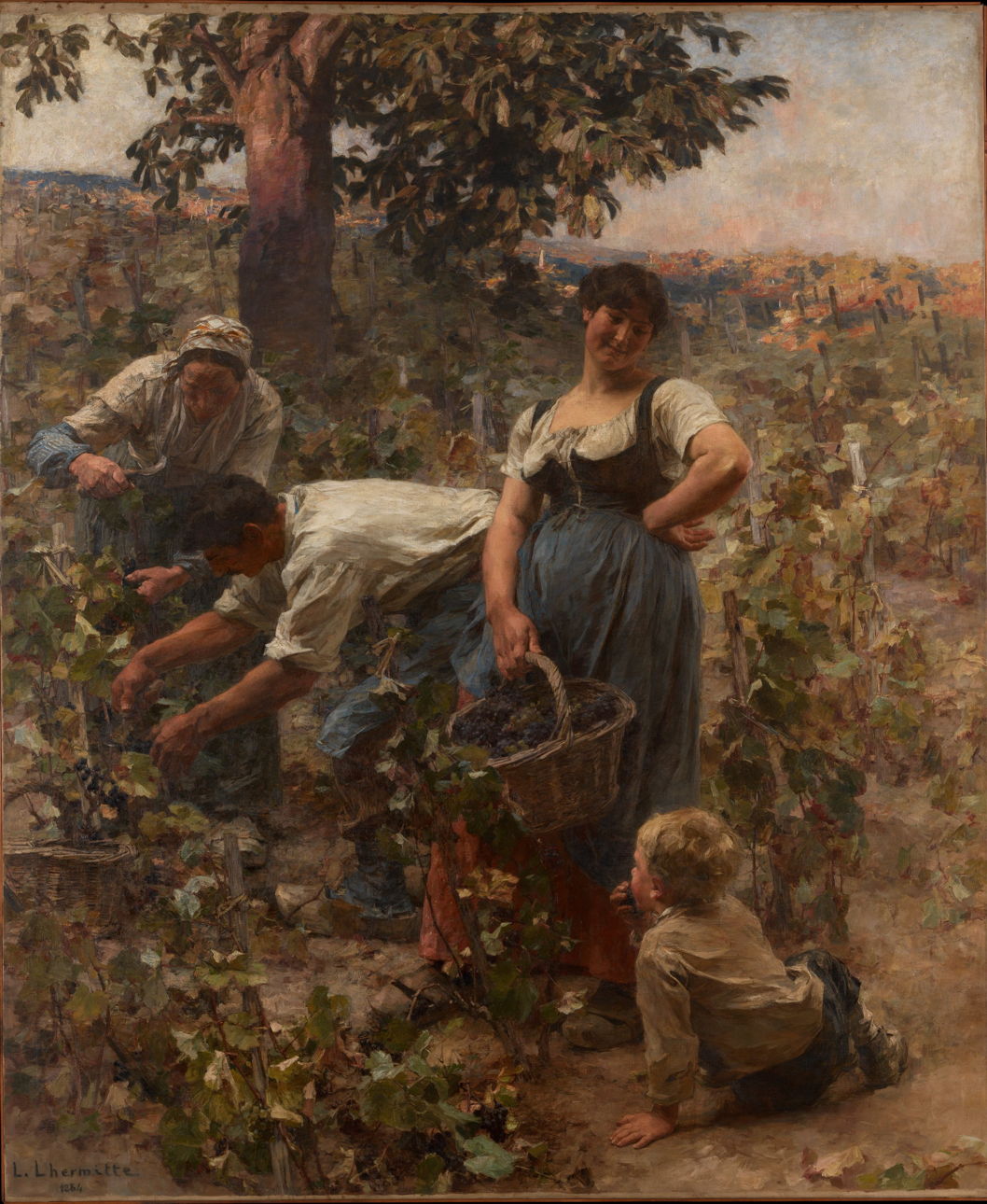
Lhermitte’s countryside wasn’t all bad, though. In The Grape Harvest (1884) there’s the uplifting smile of a mother as she watches her young boy eating the grapes. Behind and to the left, the work of the harvest goes on, and looks back-breaking. The painstakingly realist rendering of the vine leaves here gives this painting a unique visual texture.

The Haymakers (1887) continues a more relaxed rustic theme, perhaps picking up the traces following Jule Bastien-Lepage’s untimely death at the end of 1884. A team of haymakers are taking a short break providing the opportunity for a little girl to grab the other tools, as her parents enjoy some time together. Sharpening the blade of a heavy scythe used for mowing was performed by beating it with a hammer as shown here, while finer blades were normally brought to a keen edge using a whetstone.

As with Breton and Millet before him, Lhermitte’s most enduring expression of rural poverty was in showing those too poor to afford to pay for grain, and forced to salvage remains left in the fields after the harvest: the Gleaners, here his version of 1887.
Lhermitte was a close friend of Émile Zola, the Naturalist novelist, and was an enthusiastic supporter of his concept of ‘experimental’ art. Unlike Impressionism, which lacked any coherent theoretical basis, Naturalism was rooted in the Positivist philosophy of the day, expounded by the likes of Hippolyte Taine and Zola, and linked to more general changes occurring in science and technology.
One of the leading scientists and thinkers of the time was the French physiologist Claude Bernard (1813-1878), whose books were read avidly by Zola and many Naturalist artists. It may seem strange that non-scientists should read a book like Bernard’s Introduction to the Study of Experimental Medicine (1865), but in it Bernard expressed his views on far more than just physiology.

Following Bernard’s death, the Sorbonne (where he had taught) commissioned Lhermitte to paint his portrait in 1886. Sadly I’ve been unable to trace an image of the original, but Claude Bernard and His Pupils is a faithful copy of the original that Lhermitte exhibited at the Salon in 1889.
Bernard stressed the importance of not just observational science, but the experimental too, inspiring the Naturalists to pursue in the arts what they saw as the experimental approach. Zola observed people in life, filling notebooks with his observations of them. He set characters up in the scenario for a novel, and they behaved according to his observations, then he documented this imaginary experiment in his next novel.
Lhermitte’s painting shows Bernard in the midst of performing an experiment on a rabbit, his students discussing its results, and one writing the experimental observations in the laboratory daybook. This carefully-chosen composition is the single most explicit link between Bernard’s science and Naturalism in art.
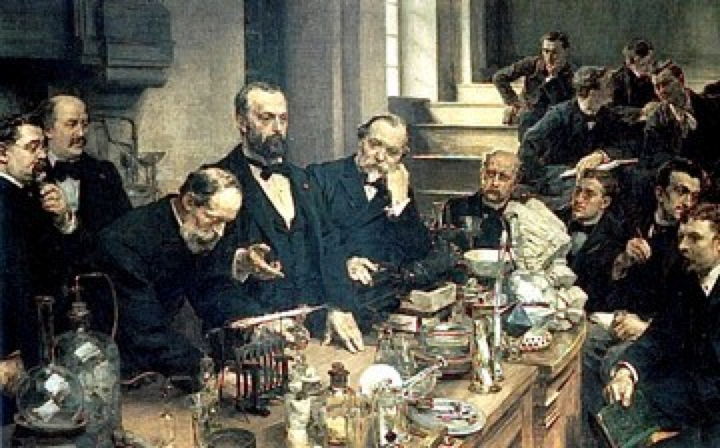
Lhermitte’s explanations for Naturalism go beyond that. His painting of The Chemist Henri-Étienne Sainte-Claire Deville, Lesson on Aluminium from the following year, also commissioned by the Sorbonne in Paris, links the movement with science and technology more generally.
Henri-Étienne Sainte-Claire Deville (1818-1881) was responsible for many significant discoveries in chemistry, the most important of which was a method for the industrial manufacture of aluminium. He is shown surrounded by objects made from this new material, which quickly came to transform manufacturing, and to invade every home.
 The Eclectic Light Company