
Compared to the number who have painted themselves in their studio, painting galleries have been an unusual theme for interiors. My examples start with a couple of fanciful images, but soon transfer to some of the more famous, as they went public during the late eighteenth and nineteenth centuries.

Giovanni Paolo Panini’s paintings of Ancient Rome (1757, above) and Gallery of Views of Modern Rome (1759, below) are almost certainly wholly imaginary, although some of their figures look to have been identifiable as leading collectors of the time. These may have been an ingenious device for the artist to show a dazzling array of his own views, of course.


A more accurate reflection of the excesses attained by some is in Johann Zoffany’s Tribuna of the Uffizi (1772-77). This shows a section of one room in the palace that had belonged to the Medici family in Florence. It had only recently (1765) been opened to the public when Zoffany painted this for Queen Charlotte, who never visited Italy let alone the Uffizi, although she was the wife of King George III. Several of the paintings included are familiar, including some by Raphael, and it might repay careful study to determine whether the collection is accurate.

As the middle classes were gaining better access to pictures in the nineteenth century, the hoarding of paintings by the upper classes was becoming extreme. Robert Huskisson’s painting of Lord Northwick’s Picture Gallery at Thirlestaine House (1846-47) not only shows one quite modest collection of the time, but reinforces how few people were able to enjoy the paintings secreted in the mansions of the rich.
John Rushout, the second Baron of Northwick (1770-1859), moved his collection from Northwick Park to Thirlestaine House when it grew too large for his own residence. When he died in 1859, he had no children, and this collection was sold off and dispersed around the world.

William Powell Frith’s last great human panorama shows A Private View at the Royal Academy, completed in 1883. Although he was a Fellow from 1853 until his retirement in 1890, his can’t have been an easy relationship with the British art establishment. This work gives some insight into the frictions within the Academy, as Oscar Wilde is seen at the right holding forth about art, to the dismay of Frith’s friends nearby. Frith had opposed the Pre-Raphaelite and Aesthetic movements, and, like Frederic, Lord Leighton (also shown in this painting), was a great traditionalist.

For Henri Gervex, depicting A Session of the Painting Jury of the Paris Salon was subtle revenge for their refusal of his most famous work Rolla in 1878. The painting the jury are voting on here is a ‘classical’ nude, thus acceptable, compared with Gervex’s of a naked prostitute, thus deemed immoral.
At the turn of the nineteenth to twentieth centuries, Louis Béroud emerged as the uncontested specialist in painting the interiors of galleries, specifically the Louvre in Paris. From then until the First World War, he seems to have painted little else.

At the Louvre (1899) is the earliest work of his that I can find showing the interior of the Louvre, although the pretty young lady posing beneath a painting of the deposition of Christ is merely sitting, holding her umbrella, and looking decorative. Nearer the nonchalant, even disinterested, guard is Correggio’s Venus and Cupid with a Satyr (also known as Jupiter and Antiope) from 1528, one of the gallery’s great treasures, and something of a favourite of Béroud.

If you have visited the Louvre, you will be familiar with the many copyists who work there. Some are students who are improving their skills by copying the Masters, but many are painters who sell those copies on. Béroud shows a copyist chatting to a man in The Rubens Room in the Louvre (1904).

He then seems to have become obsessed with painting copyists, and in An Artist in the Louvre with Correggio’s Jupiter and Antiope (1908) returns to the Correggio. Note the use of a sheet of scrap paper under the copyist’s easel, to ensure that no drips of paint ended up on the floor. All but one of Béroud’s copyists seem to be women, although today you’re almost as likely to come across a man. I suspect that reflects the more limited opportunities for women to train as painters at that time.

He started catching his models during their more social moments, as with the discussion taking place in his Copyists in the Louvre (1909). The large painting shown here is Watteau’s Embarkation for Cythera (1717); to the left is Greuze’s The Milkmaid (1780), and to the right his Broken Pitcher (1785).

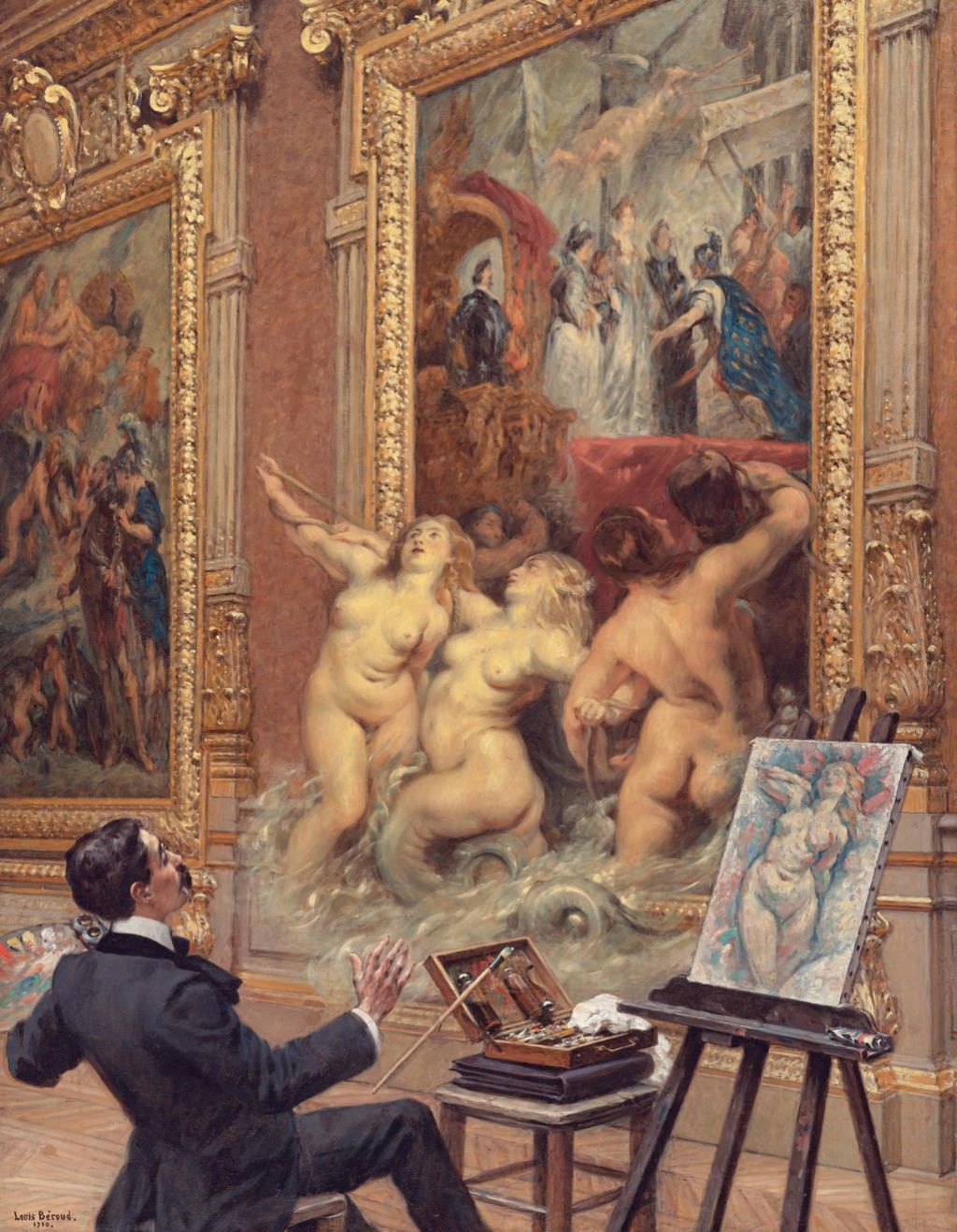
The Joys of the Flood (in the Medici Gallery) (1910) is probably the best of all Béroud’s gallery interiors. This time the copyist is the artist himself, the only man to appear in that role in these works. Rubens’ huge The Disembarkation of Marie de’ Medici at Marseilles (1621-25) bursts into life, as its water starts to flood the Louvre and its three nudes step out onto the floor.
Béroud had a close call with the police on 21 August 1911, when he had been painting a copy of Leonardo da Vinci’s Mona Lisa, and the original went missing. This was first noticed by Béroud, who reported the theft, and so became embroiled in the crime.

After his moment of fame, Béroud returned to painting his copyists. In his Painter Copying a Murillo in the Louvre from 1913, the only easel occupied is in front of Murillo’s The Young Beggar (c 1645).

Douglas Fox Pitt’s The Stafford Gallery from 1912 is an unusual watercolour with its elevated view recalling Spencer Gore’s Gauguins and Connoisseurs painted the previous year. While Gore’s painting (no image of which is in the public domain) shows a landmark exhibition of Post-Impressionist paintings in the same gallery, Fox Pitt shows an early exhibition of the Scottish Colourist J D Fergusson held from 9 March 1912. The painting shown most prominently is Fergusson’s La Dame aux Oranges (c 1908–09), whose location is now unknown. To the left is The Red Shawl (1908), and on the right is Le Manteau Chinois (1909).

Finally, this painting by Sir John Lavery (1856–1941) of The Opening of the Modern Foreign and Sargent Galleries at the Tate Gallery, 26 June 1926 (1929) was commissioned by the art dealer Sir Joseph Duveen to mark the opening of these new galleries by King George V. The King and Queen are seen on the dais, beneath a few of the Tate’s collection of paintings by JMW Turner. Duveen’s name is recorded in the inscription above the doorway.
 The Eclectic Light Company