
In December 1911, when he was 53 and at the peak of his career, Lovis Corinth suffered a major stroke. When he regained consciousness, he couldn’t even recognise his wife Charlotte, and his left arm and leg were paralysed. As he had painted his entire professional career with his left hand, it looked as if that career might have come to an abrupt and unexpected end.
(There is some uncertainty over which hand Corinth had painted with prior to this catastrophe, and which side was paralysed as a result. Although the consensus appears to be that he had painted with his left hand, and that was his paralysed side, some sources claim the opposite.)
Thankfully he made a rapid recovery over the following weeks. His left arm remained weak for some time, and he needed a stick when walking, but by February 1912 he had completed his first self-portrait since his stroke, and was painting actively again.
Corinth’s paintings changed visibly after his stroke. There is controversy among commentators as to how much of this change was the result of its effects, and how much his launch into Expressionist style was intentional on his part. Another question is whether any residual weakness or impaired hand-eye co-ordination might have brought other changes to his technique. Did he, for example, have to learn to paint using his right hand as compensation? Visual evidence can be gained from comparison of self-portraits shortly before and after his stroke.

One of his last completed prior to his stroke, Self-portrait as a Flag-Bearer (1911), shows a proud artist, posing in a suit of armour, a standard borne behind him. His pose is reminiscent of Rembrandt’s self-portrait of 1636, and reflects his perception of his role in the Secession, and the Secession’s importance in the history of art. His brushwork is rough and painterly throughout, even over his face, and the background is sketched in gesturally.

Self-portrait with a Panama Hat was painted in 1912, during his recovery, and differs little in its facture. His facial expression and bearing have changed totally, though, his eyes staring through his struggle, in concerned contemplation.
Once Corinth was fit enough after his stroke, he and Charlotte travelled for three months of convalescence on the French Riviera at Bordighera.

Balcony Scene in Bordighera (1912) shows Charlotte with a miniature parasol to shelter her from the dazzling sun, on the balcony of their accommodation there. His rough facture has extended more generally from his nudes and sketches, marking his move to Expressionism.
There are also some interesting traits in his brushwork that (at least partly) reflect his recovering condition. Verticals, indeed the whole painting, tend to lean to the left, in opposition to the diagonal strokes used to form the sky, which are more typical of someone painting with their right hand. His previously quite rigorous perspective projection has been largely lost, although he maintains an approximate vanishing point at the right of the base of Charlotte’s neck. He has employed aerial perspective, but the painting lacks the effect of depth seen in his earlier work.

Indoors, he painted an Italian Woman in a Yellow Chair (1912). There has been speculation as to whether this wasn’t a local Italian model, but Charlotte. The hat does seem to have been his wife’s, and appears in a sketch of her that he made at about the same time.

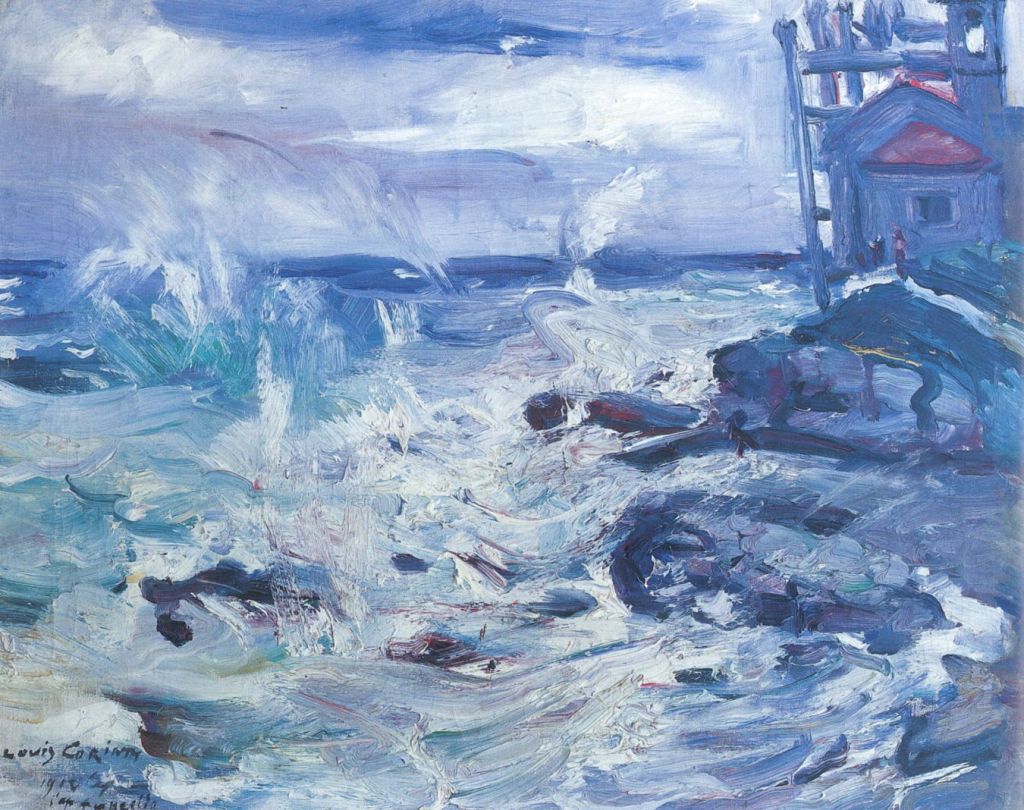
Storm off Cape Ampelio (1912) shows rough seas at the cape close to Bordighera. Its brushwork has great vigour, and captures the violent surges that occur when incident and reflected waves meet. Again its verticals are leaning to the left.

His first major painting following his stroke returned to the theme of Samson. This autobiographical portrait of The Blinded Samson (1912) expressed his feelings about his own battle against the sequelae of his stroke.
In the Samson story, it shows the once-mighty man reduced to a feeble prisoner, forced to grope his way around. No doubt Corinth didn’t intend referring to the conclusion of Samson’s story: with the aid of God, he pulled down the two central columns of the Philistines’ temple to Dagon, and brought the whole building down on top of its occupants.
Although rough in its facture, Corinth has now restored his verticals and clearly got the better of any residual mechanical problems in painting.

This wonderful Portrait of the Sculptor Nikolaus Friedrich (1912) at work wasn’t the first Corinth had painted, as he had made one previously in 1904, when the sculptor was young and muscular. Eight years later he’s seen in the midst of a broad and representative range of his work. Friedrich died two years later, when he was only 48.

At the Mirror (1912) is an ingenious painting using the woman’s reflection to make clear the struggle that Corinth, seen only in the reflection, had gone through to paint his images. Instead of providing the viewer with a faithful and detailed reflection, that image is even more loosely painted, rendering their faces barely recognisable.

View of the Jetties in Hamburg (1912) shows the continuing looseness of his facture. Its verticals are more consistent and vertical than in his paintings in Bordighera, and his brushstrokes are varied in orientation.
In the first year since his stroke, Corinth’s painting had come a long way. What he must have feared would be career-ending was not. The event may have accelerated his move to Expressionist style, but it doesn’t seem to have driven or determined it.
References
Lemoine S et al. (2008) Lovis Corinth, Musée d’Orsay & RMN. ISBN 978 2 711 85400 4. (In French.)
Czymmek G et al. (2010) German Impressionist Landscape Painting, Liebermann-Corinth-Slevogt, Arnoldsche. ISBN 978 3 89790 321 0.
 The Eclectic Light Company