
Some of the performing arts across Europe had their roots not with the affluent upper classes, but as entertainment for the masses. These included the Commedia dell’Arte, and the British music hall that was popular in London and other towns and cities between 1850-1918. These were low-brow theatres that staged variety acts including popular songs, comedy, and anything that might appeal to ordinary working men and women. They originated after about 1830, from entertainment provided in pubs and inns, and like them, music halls also served food and drink.

Although Walter Sickert’s painting of Tipperary dates from 1914, it’s a good example of the origin of the music hall. It shows the artist’s model ‘Chicken’ sat at a pub piano playing the contemporary hit, It’s a Long Way to Tipperary. That had swept to popularity with British troops in 1914 as they went off to fight in the trenches on the other side of the Channel.

Before Sickert had taken up painting in 1881, he had tried pursuing a career as an actor, resulting in his lasting interest in performing arts and the music hall in particular. His early painting of Gatti’s Hungerford Palace of Varieties. Second Turn of Katie Lawrence from about 1888 shows the dimly lit interior of a music hall, as a young woman sings to an audience that appears unreceptive. Hungerford is a market town around sixty miles to the west of London, and appears to be an unlikely location for this music hall, which is more probably in the west of London.

Another young woman sings from the gloom in Sickert’s The Music Hall, or more cryptically The P.S. Wings in the O.P. Mirror, from 1888–89.
Among more than five hundred music halls around Britain at the time, Sickert made the Bedford in Camden Town, London, his favourite. The first there, known as the Old Bedford, opened in 1861 and was destroyed by fire in 1898. Its successor was the New Bedford, which was larger and even featured electric lighting. Among others who frequented the New Bedford was the novelist Virginia Woolf, and its performers included Charlie Chaplin before it finally closed in 1959.

His view of The Pit at the Old Bedford from 1889 shows the limited accommodation for musicians between the audience and stage.

Sickert sketched Vesta Victoria at the Old Bedford in about 1890.
His enthusiasm for music halls inspired others in the Camden Town Group to paint them as well, most notably Spencer Gore.

Gore soon developed a fascination for the theatre and music hall, and in 1906 started regular visits to the Alhambra Theatre of Varieties in Leicester Square, well-known at the time for spectacular ballets and acrobats. Like Degas and others in Paris, he sketched performances, then turned those into studio paintings. This sketch of The Alhambra Theatre, “On the Sands” was made in 1910, using black chalk and graphite, and appears more compositional in purpose. The artist has squared it up ready to transfer to canvas.

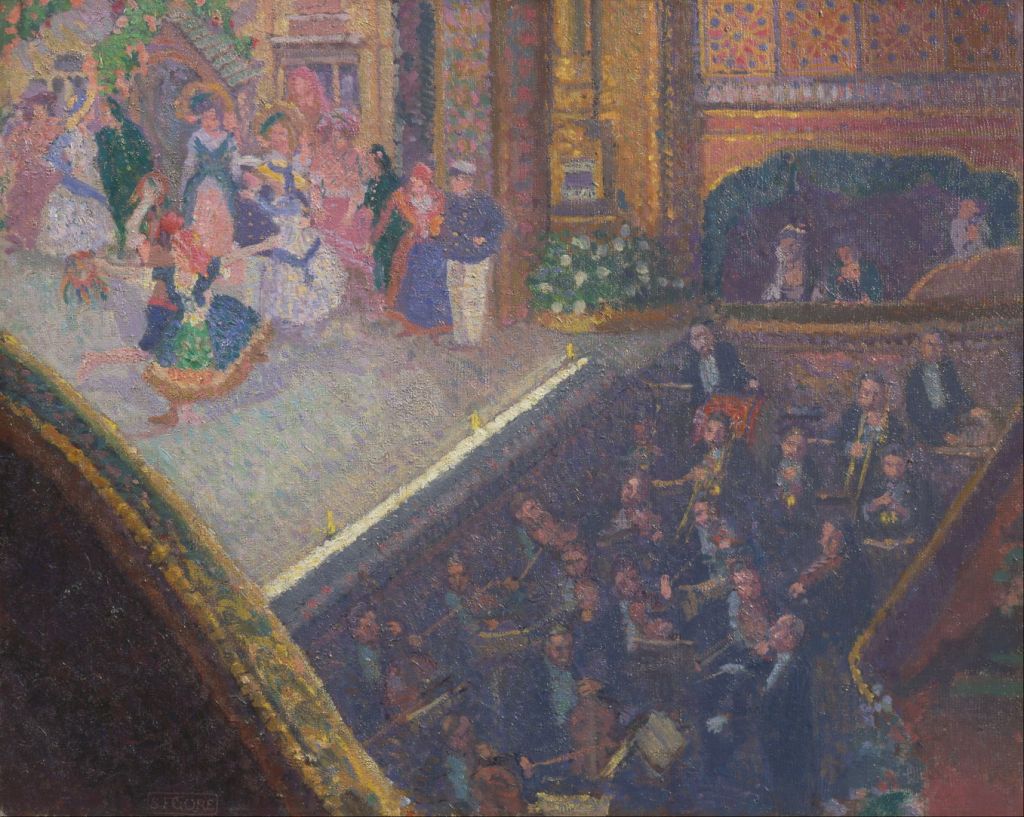
Ballet Scene from “On the Sands” (1910) is Gore’s finished painting. He has amended the foreground structure at the lower left, representing the front of the box or gallery he was seated in, but most of the other details appear faithful to his sketch. He has divided much of his canvas between the ballet on the stage at the upper left, and the musicians in the orchestra pit in the lower right.

Gore’s painting of the musical double act of Inez and Taki (1910) is another of his views from inside the Alhambra Theatre of Varieties. They’re playing antiquated lyre guitars, an odd choice of instrument.

Later in his career, Sickert returned to his enduring theme of music halls in The New Bedford, painted in about 1914-15, capturing the splendour of the interior at its height.
After the First World War, music halls were replaced as public tastes changed, and licensing laws prevented them from serving alcohol. The great majority were closed by the 1960s, when television was taking over as the most popular means of entertainment.
 The Eclectic Light Company