
This weekend I’m seeking therapy in paintings of Spring meadows and their abundant flowers. Having come from Botticelli’s Primavera to the painterly brushstrokes of Impressionism, I resume with a meadow growing a flower of great significance to the painter.

I’m not sure where Mykhaylo Berkos painted these Flax Blooms in 1893; they’re a particularly appropriate theme for an accomplished oil painter, as flax is the source of linseed oil, one of the major drying oils used as a binder in many oil paints, and its fibres can be used for ‘canvas’ too.

Camille Pissarro’s Big Walnut Tree in Spring, Éragny from the following year celebrates another source of binder in oil paint, the walnut, although it’s used far less frequently than linseed.
Not everyone was as painterly in 1894, though, as Georges Rochegrosse’s romp in a floral meadow demonstrates.
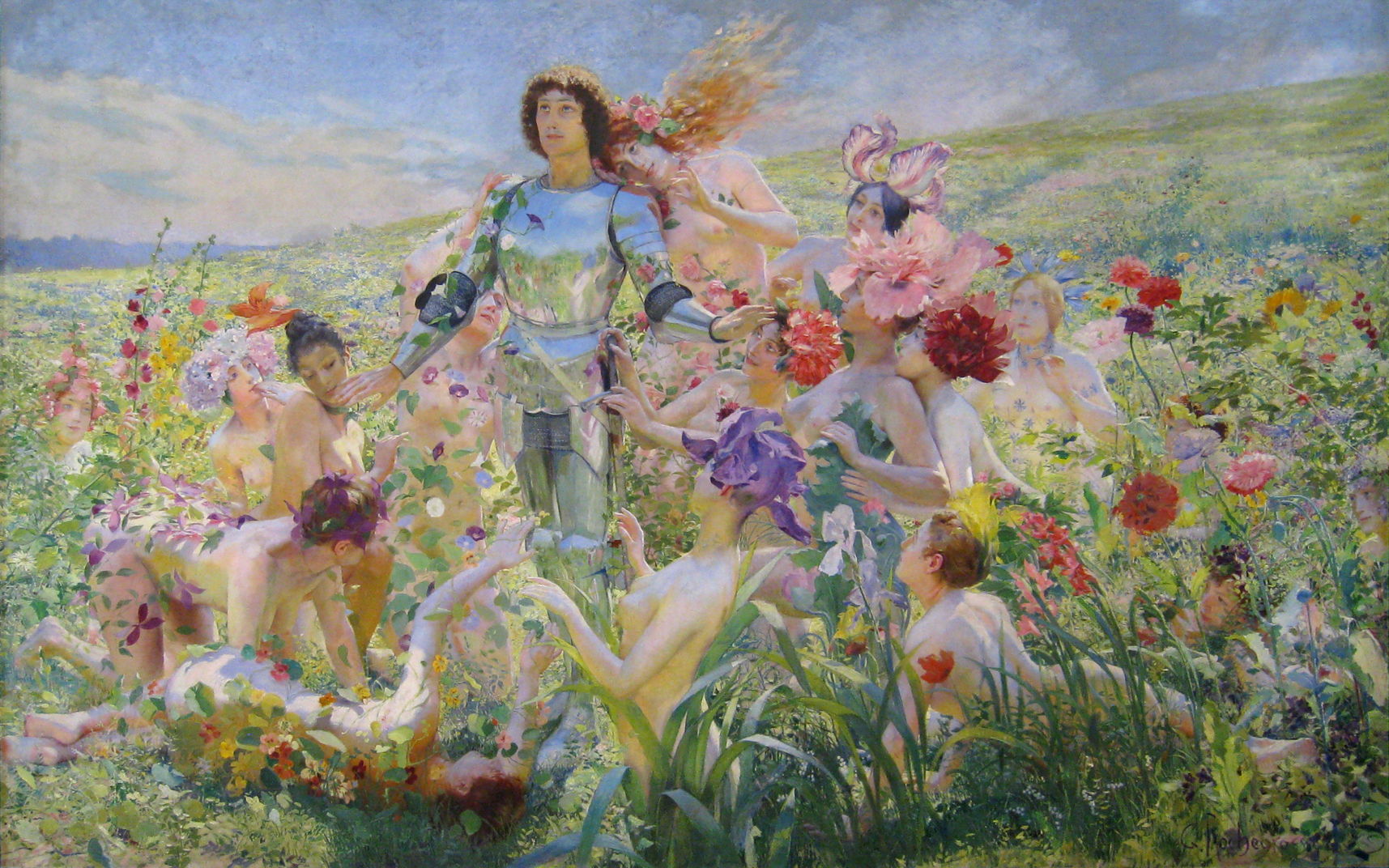
Le Chevalier aux Fleurs (The Knight of the Flowers) (1894) isn’t about frivolous chivalry and a bevy of Playboy bunnies, but a serious painting shown at the Salon in Paris in 1894 to critical acclaim. Its theme is, surprisingly, chastity and resistance to temptation, and it’s based on the popular opera Parsifal, which had been so successful at Bayreuth over the previous twelve years.
Wagner’s last opera (1882) was loosely based on a thirteenth-century German epic poem about the Arthurian legend of Parzival (Percival) and his quest for the Holy Grail. The moment chosen by Rochegrosse is the opening of Act 2, Scene 2. Parsifal, the knight and hero, is at Klingsor’s magic castle, where Klingsor summons his enchanted knights to fight Parsifal.
When Parsifal has overcome Klingsor’s knights and put them to flight, he strays into the Flowermaiden garden. Klingsor calls on the seductive sorceress Kundry to seek young Parsifal out and seduce him. Parsifal then finds himself in a beautiful garden, full of flowers, and surrounded by the beautiful and seductive Flowermaidens. They call him and entwine their bodies around him in their efforts to seduce him, but he resists their temptations and remains chaste.
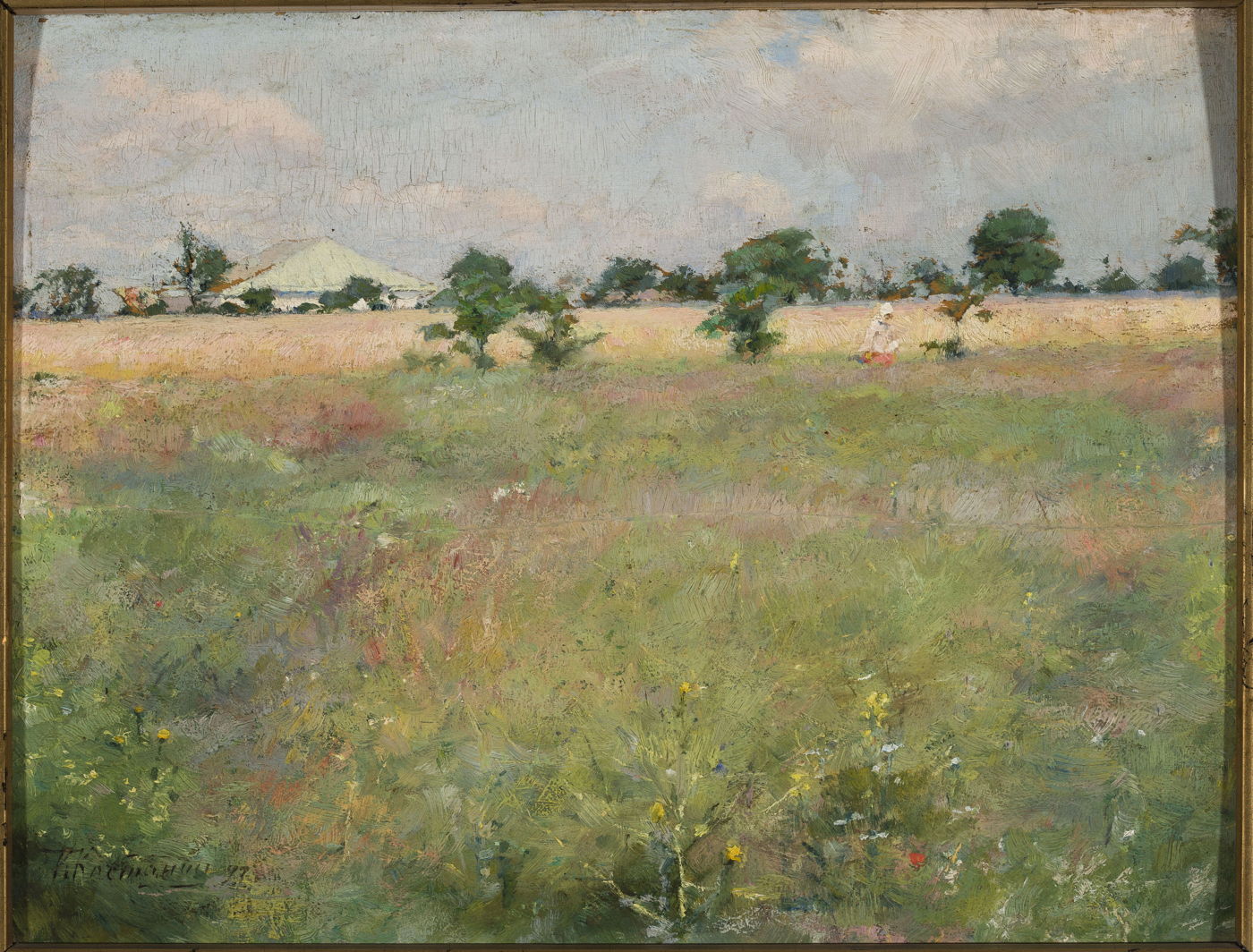
Kyriak Kostandi’s Landscape with a Meadow from 1897 shows a woman walking though a meadow rich with flowers, and a large farm in the background.
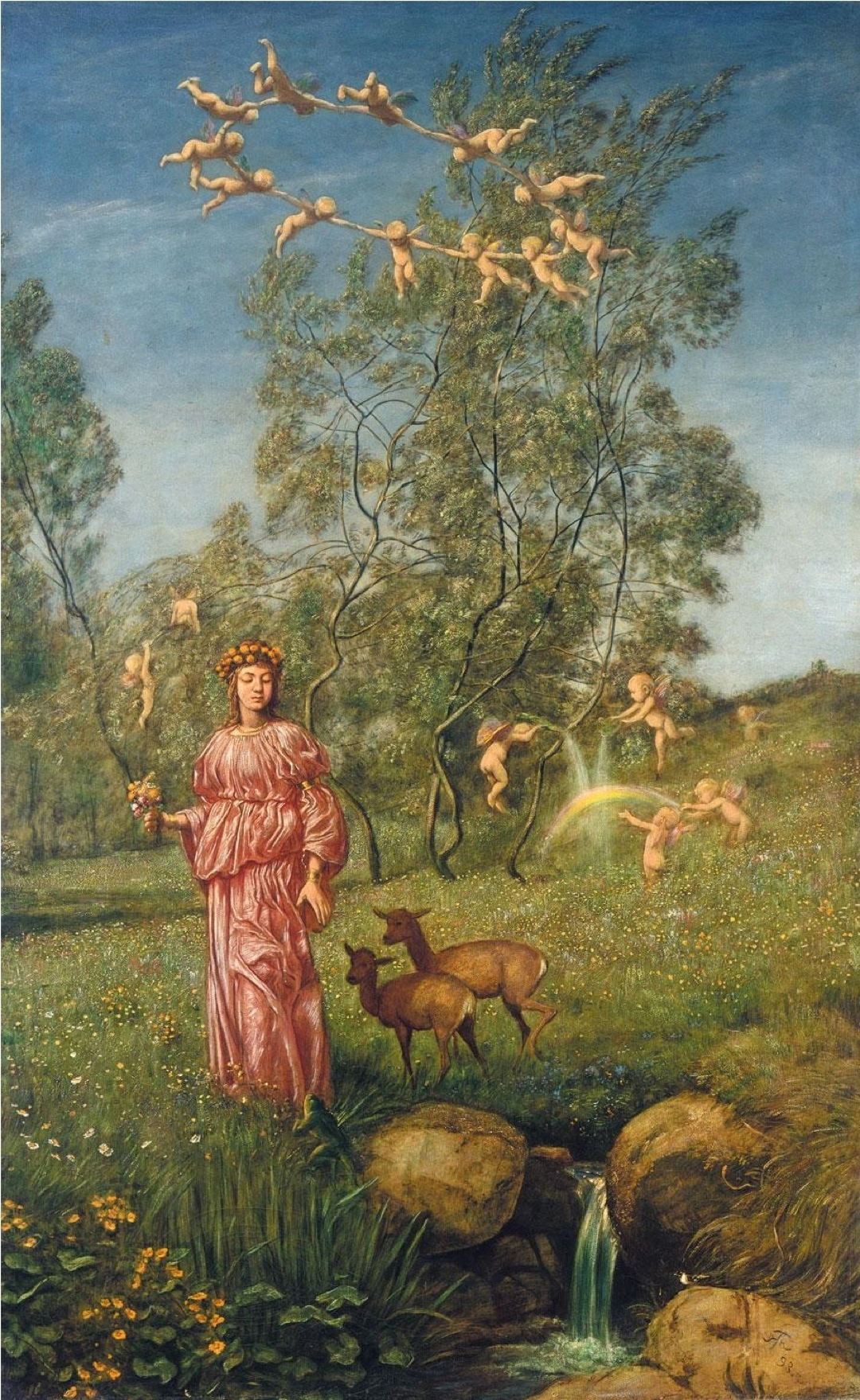
In Hans Thoma’s escapist Spring Fairytale, An Allegory (1898) a woman, who may have originated in Botticelli’s figure of Flora, is surrounded by meadow flowers, two small fawns, and sundry winged putti.

Helen Allingham’s Buckinghamshire house at Penstreet (c 1900) shows a house in the hamlet of Penn Street, which together with Knotty Green and Forty Green surround the village of Penn, near Amersham, in Buckinghamshire, England. This remains a relatively unspoilt part of the Chilterns to the north-west of London.
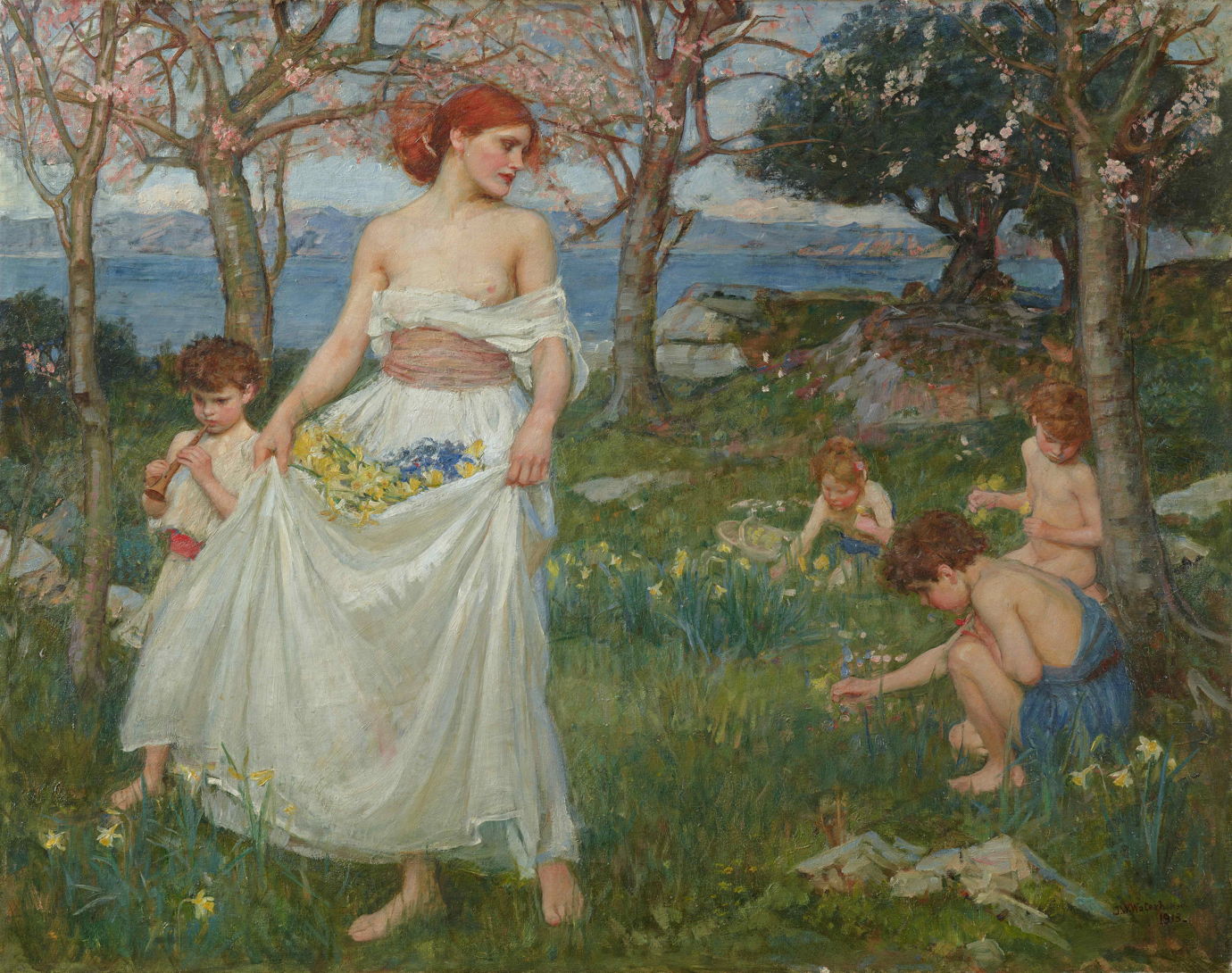
When John William Waterhouse revisited this theme just before the First World War, in his A Song of Springtime (1913), he depicted Flora with breasts bared, and a skirtful of daffodils or narcissi. Botticelli’s Graces have here been replaced by young children.

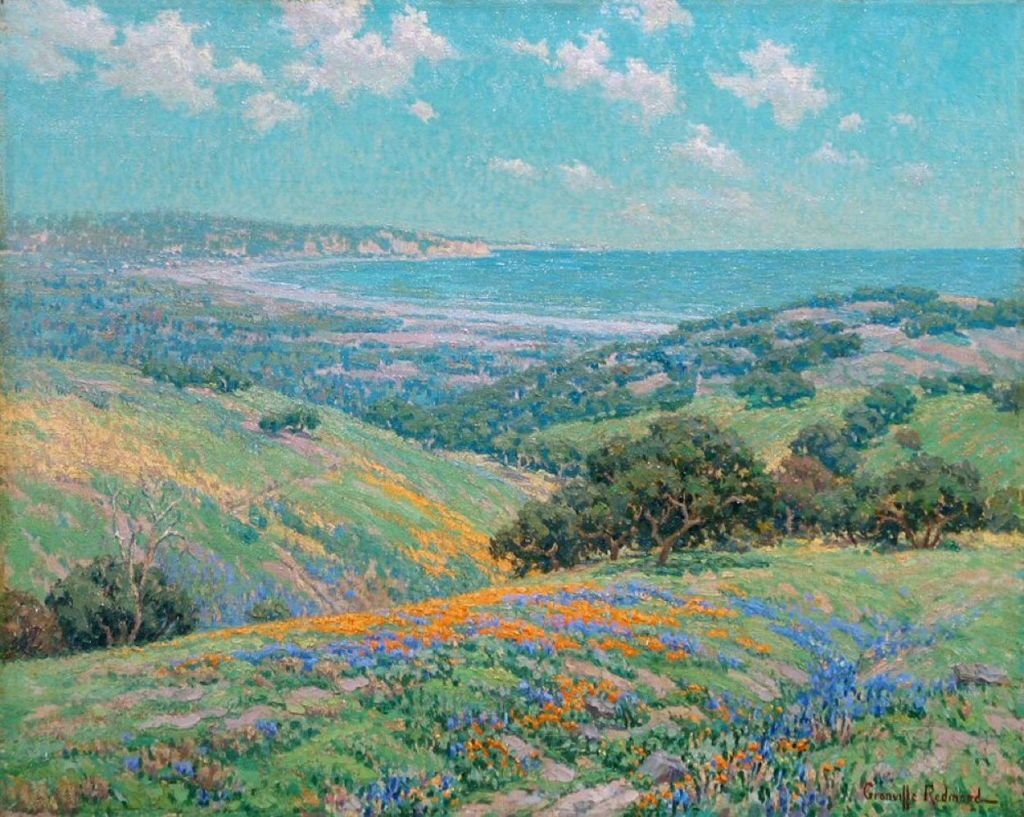
Granville Redmond’s Malibu Coast, Spring from about 1929 shows the twenty-one mile beach of this coastal resort thirty miles to the west of central Los Angeles, with golden poppies and purple lupines in full flower. At this time, Malibu was only just starting development, with its small Malibu Colony and a ceramic tile factory, surrounded by these multicoloured hills.
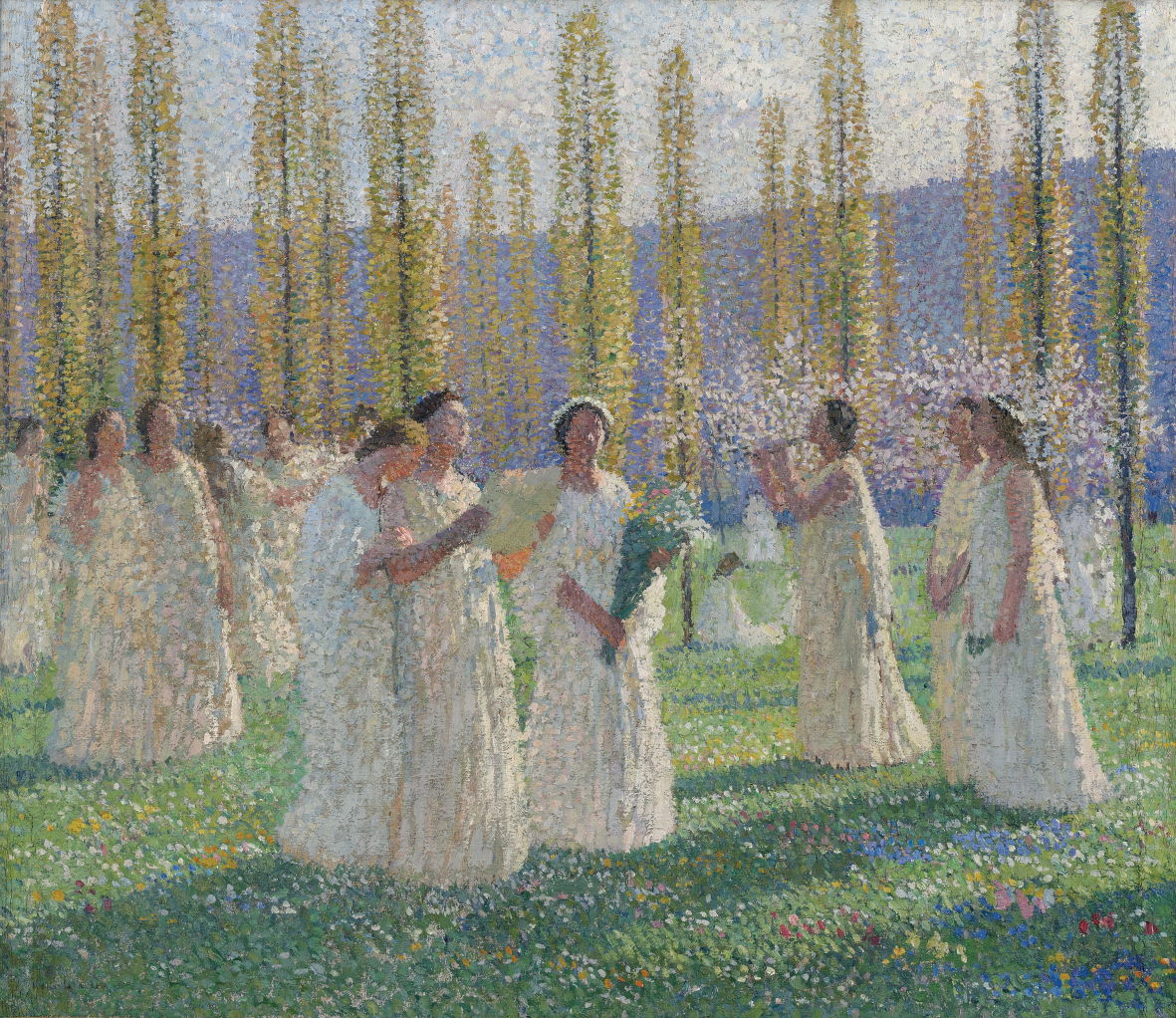
I end with one of the last Divisionist landscapes, completed on the eve of the Second World War in 1939, Henri-Jean Guillaume Martin’s Study for Les Champs Elysées. That year, the artist retired to Labastide-du-Vert, where he died in 1943, and made his way to the Elysian Fields.
 The Eclectic Light Company