

Soon after his success at the Exposition Universelle of 1855, Jean-Léon Gérôme left France to travel extensively in North Africa and the Middle East, and didn’t return until the following Spring. He then submitted five paintings from ‘the Orient’ and two others to the Salon in 1857.

One of the works resulting from his travels, Egyptian Recruits Crossing the Desert (1857) shows a group of new recruits struggling through desperate conditions in the heat of the desert, referring back, perhaps, to his Russian soldiers. From here on, a substantial proportion of Gérôme’s paintings are ‘Orientalist’; these are deeply mired in controversy, and have been ever since critics tackled them in the nineteenth century.
His success of the Salon in 1857 was The Duel After the Ball, the very antithesis of his earlier Age of Augustus, with its contemporary anecdotal narrative and slapstick humour. If the story is to be believed, on leaving a masked ball in Paris during the winter of 1856-7, an elected official and a former police commissioner fought a duel in a copse in the Bois de Boulogne. One was dressed as the character Pierrot, the other as Harlequin. Pierrot was wounded as a result, and the incident became notorious because of the personalities involved, and their comic costumes.

Pierrot leans, as white as his costume, collapsed against one of his team, his face suggesting shock if not imminent death from a wound bleeding onto his chest. His limp right arm still bears his sword, dragging on the ground. Two other friends are visibly distressed at his condition and trying to console him.
Harlequin, with his second, walks off into the distance at the right. His sword has been abandoned on the snowy ground, near four feathers that dropped from the American Indian headdress of his second. In the murky distance there’s a hackney cab, ready to take the combatants away, and a couple walking along the edge of the copse.
Gérôme uses the full range of conventional narrative techniques, with strong cues to the original story. He stages it theatrically, with the absurd grim humour of the participants’ costumes, referring to the comedy of Pierrot and Harlequin, making it intensely effective. This rapidly became one of the most widely reproduced paintings of its time, although Gérôme’s rival Thomas Couture was upset that his more academic version of the incident was ignored.
Gérôme was now an ideal candidate for a longer-term contract for reproductions of his paintings, and in 1859 made such an arrangement with Adolphe Goupil, whose galleries were to represent him and his work, most importantly promoting it in the growing US market. But at home he was coming under fire for succumbing to genre painting and anecdote, rather than keeping to the great traditions of history painting.

Gérôme’s response was to go back to three classical themes. Here, in Ave Caesar, Morituri Te Salutant (1859), it’s the spectacle of the Colosseum in Rome. Its story is simple, going no deeper than a translation of its title: Hail Caesar! We who are about to die salute you. A group of gladiators clustered in front of Caesar are just about to join the bodies of the last ones, who are still being dragged away by slaves.
Some consternation was raised in Gérôme’s depiction of the Vestal Virgins, carefully positioned between the gladiators and Caesar, watching and enjoying such a depraved spectacle. Despite its popular appeal, there’s more to Ave Caesar than its expansive view and the roar of the crowd. The viewer is, as in so many of Gérôme’s paintings, not only looking at the spectacle, but also at those looking at the spectacle, ultimately themselves. This painting was so successful that Goupil continued to sell reproductions of it, some as small as a calling card, for the next fifty years.

The second classical theme was the strange legend of King Candaules (1859), which has been painted by several artists over the centuries, and can usually be relied on to raise controversy.
According to legend, King Candaules of Lydia boasted of the beauty of his wife, Nyssia, to the chief of his personal guard, Gyges. To support his boast, the king showed his wife to Gyges by stealth, naked as she was preparing for bed. When she discovered Gyges’ voyeurism, Nyssia gave him the choice of being executed, or of murdering the king. Opting for the latter, Gyges stabbed the king to death when he was in bed, then married Nyssia and succeeded Candaules on the throne.
Gérôme was probably aware of William Etty’s painting of the story from 1830, but wouldn’t have been aware that Edgar Degas had started and abandoned his version in 1855. Each chose to show the moment that Nyssia removed the last item of her clothing, prior to the moment of peripeteia.
The king is in his bed, awaiting his wife, who has just removed the last of her clothing as she spots the dark and hooded figure of Gyges watching her from the open door. Gérôme’s love of detail in the decor saves this from the accusation that, like Etty’s, it was just another excuse for a full-length nude. However, neither Gérôme nor any of the previous artists who had depicted this story ever managed to provide clues as to its eventual outcome.
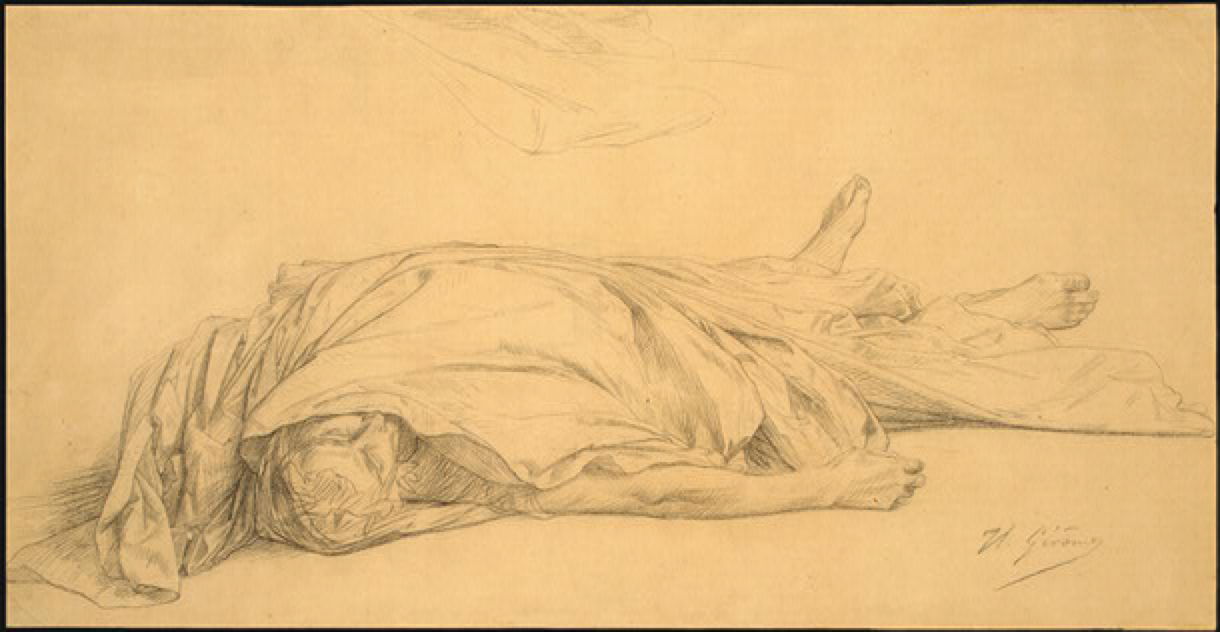
The third of Gérôme’s more traditional history paintings was the largest that he showed at the Salon of 1859, and the one which attracted the open praise of Charles Baudelaire. Unfortunately it’s one of Gérôme’s major works that has since vanished, its only traces being a monochrome photograph, and this graphite study of The Dead Caesar from about 1859.
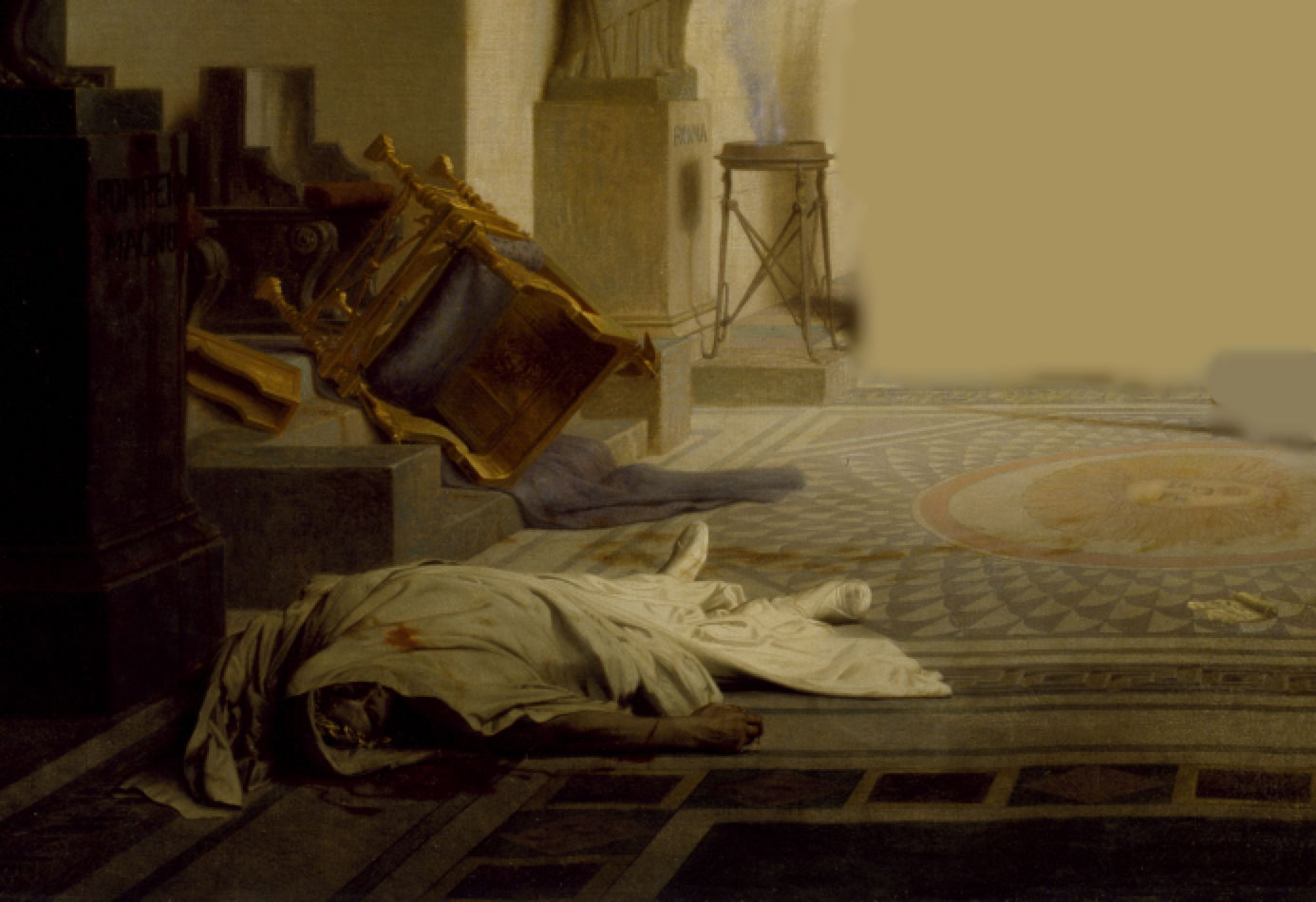
In the image above, I have tried to give an impression of how Gérôme’s huge Caesar of 1859 might have looked, by editing a detail from his surviving Death of Caesar, from the same year. There were, of course, details of the empty section of the curia in the upper right, and its projection was slightly different.
The surviving painting, The Death of Caesar (1859), is smaller in size and much wider in its view, including Caesar’s dead body, his departing murderers, even a senator sat far back at the right.

Both of Gérôme’s paintings of the dead Caesar are unusual because they show not the moments before his murder, nor the murder itself, but some moments afterwards. This defies conventional wisdom and Aristotle’s teaching of the importance of peripeteia.
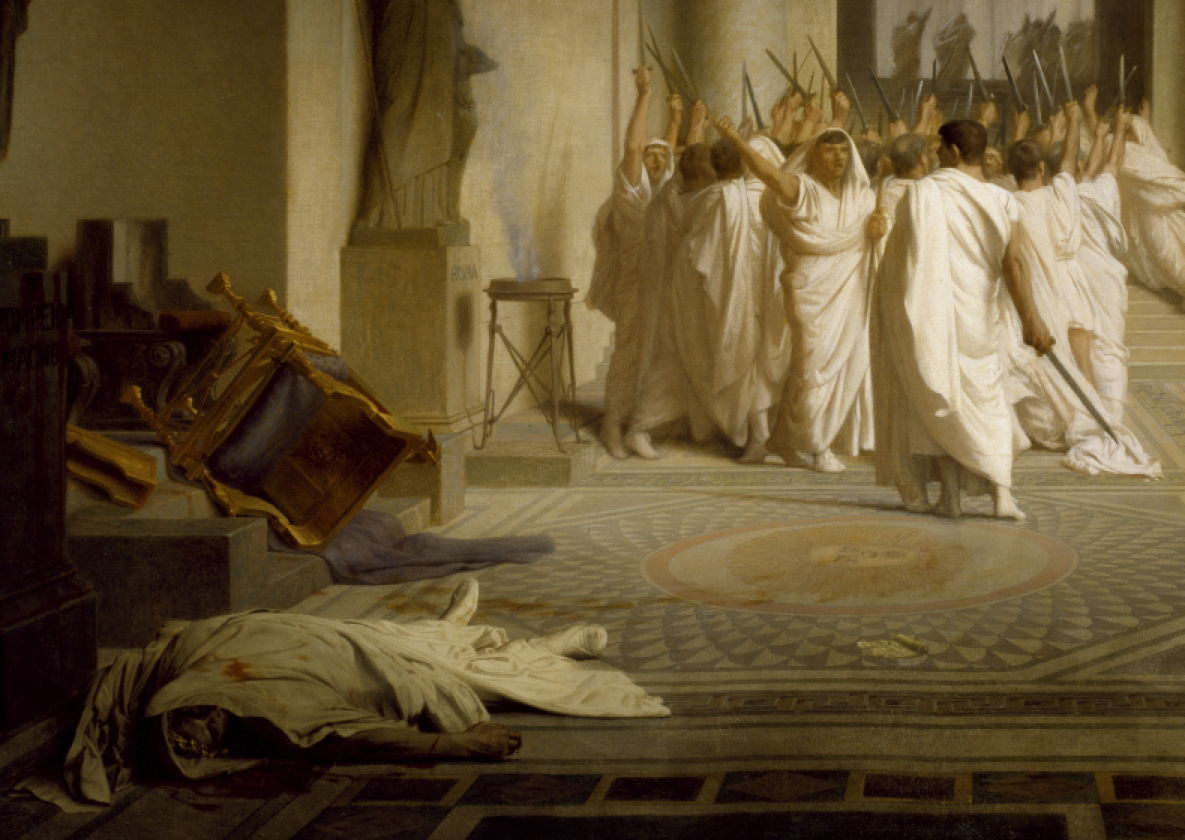
Gérôme gives the obvious clue of Caesar’s body, almost concealed in his toga, with a bloodstain prominent on the upper chest. The chair on which he had been sat is overturned amid the chaos and violence of the attack. As the conspirators depart, their backs to the viewer, they’re brandishing their blades in triumph above their heads.
Caesar’s bloody footprints lead down from the chair over towards the petition presented to him by Lucius Tillius Cimber immediately before he was killed. It rests by a floor mosaic depicting the head of Medusa, the Gorgon who was beheaded by Perseus.
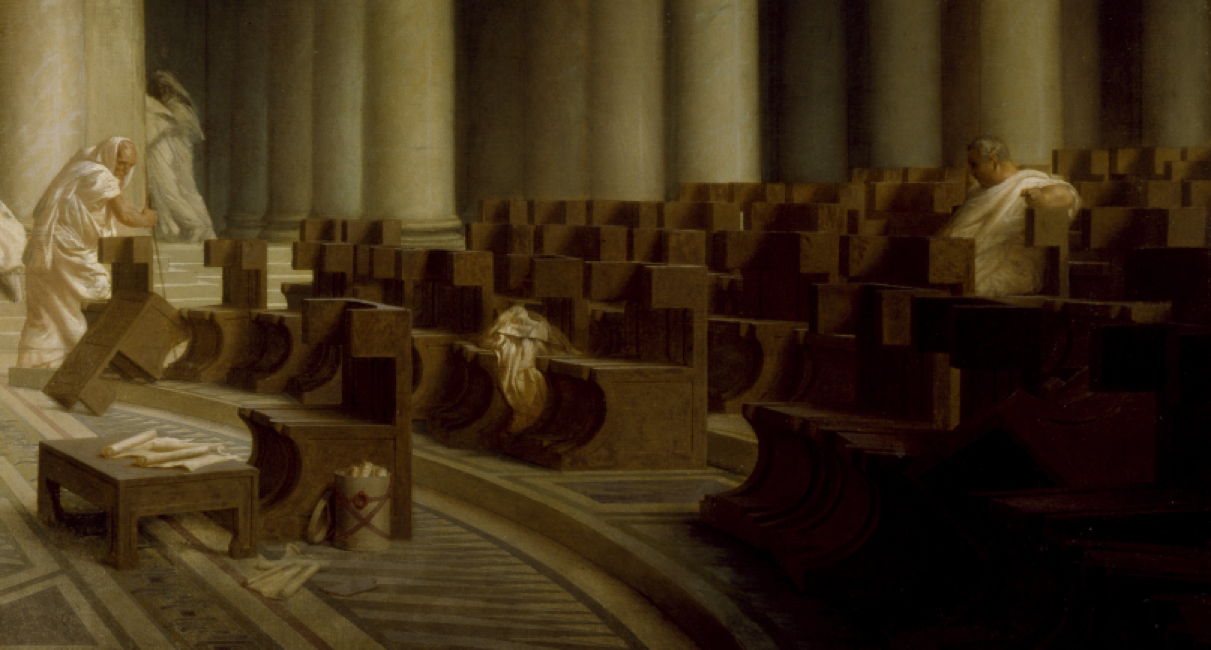
Far off at the right edge is a lone senator, still sitting in his place. Although it has been suggested that he was asleep, that isn’t supported by his posture. A white cloak has been abandoned in haste on a seat close to the front, scrolls are scattered, and some who were not part of the conspiracy are hurriedly making away in the distance.
Gérôme provides all the evidence to construct the story, much as might be done in a detective novel, a literary genre that started to become popular in Europe and North America in the first half of the nineteenth century, and became well-known with the publication of Edgar Allan Poe’s The Murders in the Rue Morgue in 1841.
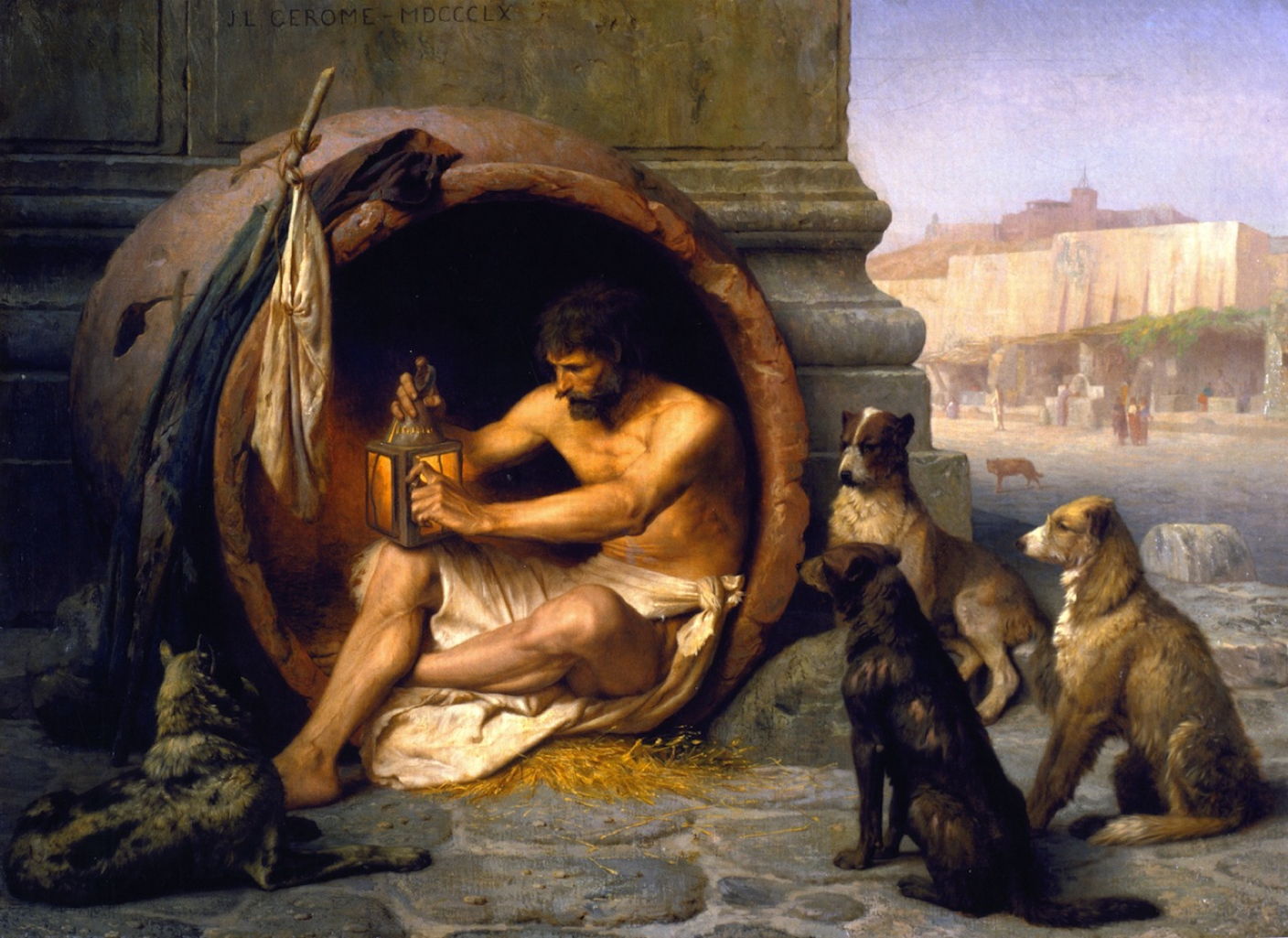
The following year, Gérôme painted this contrasting portrait of Diogenes (1860), the Cynic who is reputed to have lived in a large storage jar or possibly a barrel as he attacked the conventional view. Surrounding him are four dogs, a delightful visual pun, as the term cynic is derived from the Greek κυνικός (kynikos), meaning dog-like, the word that may be inscribed on the lantern that he’s trying to light.
As has been explained:
There are four reasons why the Cynics are so named. First because of the indifference of their way of life, for they make a cult of indifference and, like dogs, eat and make love in public, go barefoot, and sleep in tubs and at crossroads. The second reason is that the dog is a shameless animal, and they make a cult of shamelessness, not as being beneath modesty, but as superior to it. The third reason is that the dog is a good guard, and they guard the tenets of their philosophy. The fourth reason is that the dog is a discriminating animal which can distinguish between its friends and enemies. So do they recognize as friends those who are suited to philosophy, and receive them kindly, while those unfitted they drive away, like dogs, by barking at them. (Wikipedia.)
Diogenes wasn’t exhibited at the Salon, but was sold in 1861 by Goupil’s London gallery for four thousand francs. I can’t help but wonder whether Gérôme saw himself as a Cynic.
References
Ackerman GM (2000) Jean-Léon Gérôme, Monographie révisée, Catalogue Raisonné Mis à Jour, (in French) ACR Édition. ISBN 978 2 867 70137 5.
Scott Allan and Mary Morton, eds. (2010) Reconsidering Gérôme, Getty. ISBN 978 1 6060 6038 4.
Gülru Çakmak (2017) Jean-Léon Gérôme and the Crisis of History Painting in the 1850s, Liverpool UP. ISBN 978 1 78694 067 4.
de Cars L et al. (2010) The Spectacular Art of Jean-Léon Gérôme (1824-1904), Skira. ISBN 978 8 85 720702 5.
 The Eclectic Light Company