
JC Dahl, the leading Norwegian painter of his time, had settled in Dresden, Germany, in 1818, where he became a close friend and colleague of Caspar David Friedrich, and a professor at the city’s academy. Although he did return to his native Norway in 1826, 1834, and later, he spent most his career as a German Romantic artist, second only to Friedrich.

In 1829, Dahl painted this Winter Landscape at Vordingborg, showing barren trees and snowy fields near the town of Vordingborg, in the south of the Danish island of Sjælland (Zealand). There are the inevitable bare rocks suggesting an ancient burial, and plenty of sinister crows both in the air and on the ground, building a sense of grim foreboding.

Dahl’s Shipwreck on the Coast of Norway from 1831-32 may have been developed in conjunction with his pupil Peder Balke (1804–1887), who went on to spend much of his career painting similar scenes.

Danish Winter Landscape with Dolmen (1838) continues his theme of barren trees, crows and ancient stone tombs in the snow.
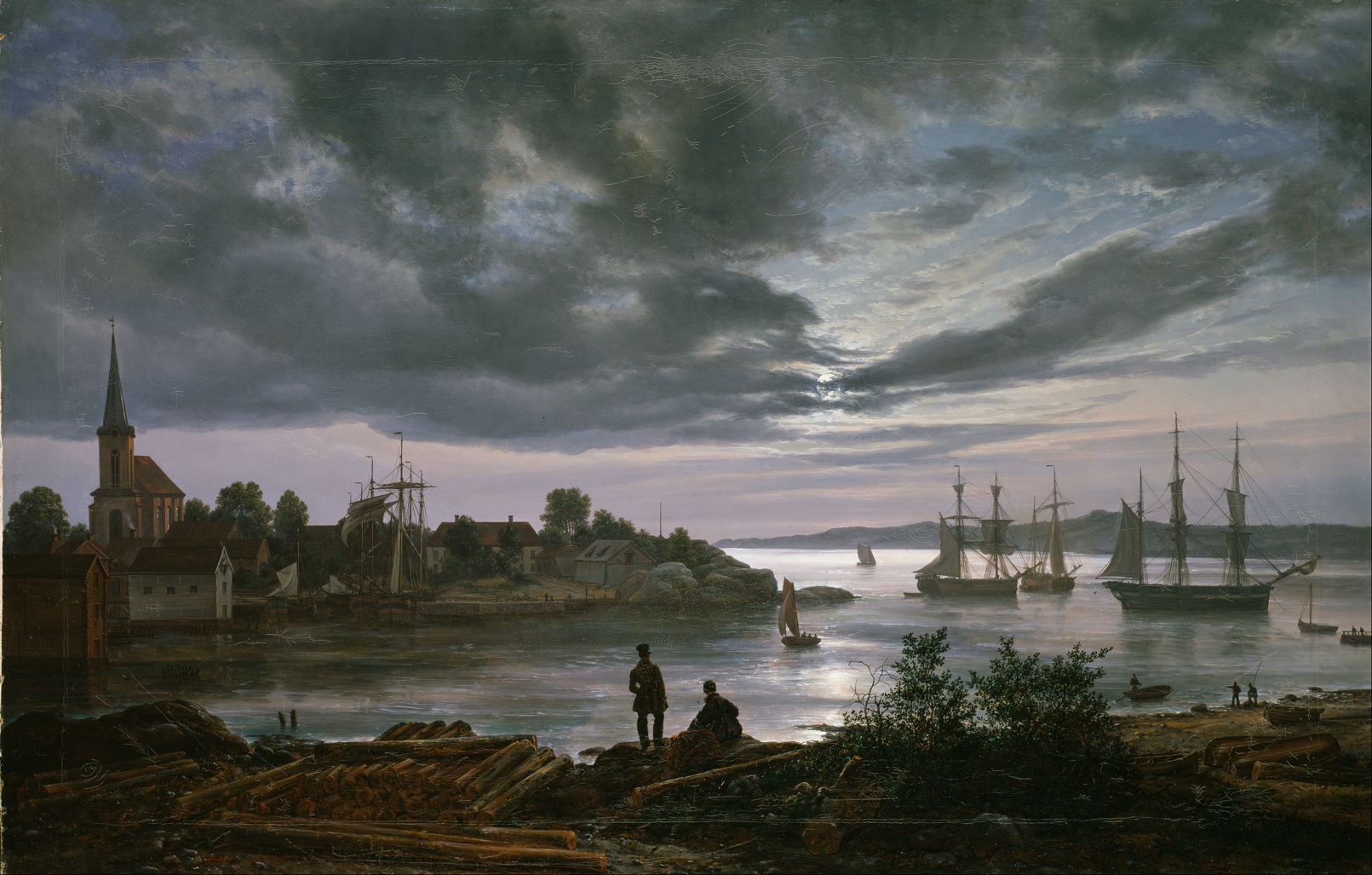
Dahl started a fashion for painting Scandinavian ports at night: this is his Larvik by Moonlight (1839), referring back to Claude-Joseph Vernet’s pioneering paintings of Mediterranean ports by night. This too was developed by Peder Balke.
In 1840, his longstanding friend and colleague Caspar David Friedrich died, leaving Dahl as the leading painter of the German Romantic movement.

Throughout his career, Dahl made copious oil sketches in front of the motif. This tiny plein air sketch of Dresden at Night was painted in 1845, and is an excellent example of the moon illusion at work, making the moon unnaturally large when it’s low in the sky and close to the skyline.

In Dahl’s Copenhagen Harbour by Moonlight (1846), he shows many ‘fully-rigged’ sailing ships in this major port at the south-western end of the Baltic Sea.

He was commissioned by an Oslo collector to paint the famous mediaeval stave church at Kaupanger, on the west coast of Norway, but had to employ a little deception to complete his Landscape in Kaupanger with a Stave Church in 1847. By this time, the church had been modified structurally and looked quite different. The artist therefore substituted the stave church at Vang, which was demolished shortly afterwards. Dahl stepped in and had it rebuilt in the Silesian Mountains for the Prussian King Friedrich Wilhelm IV.
By the time of Dahl’s last visit to Norway in 1850, he was in his early sixties and his health was in decline.

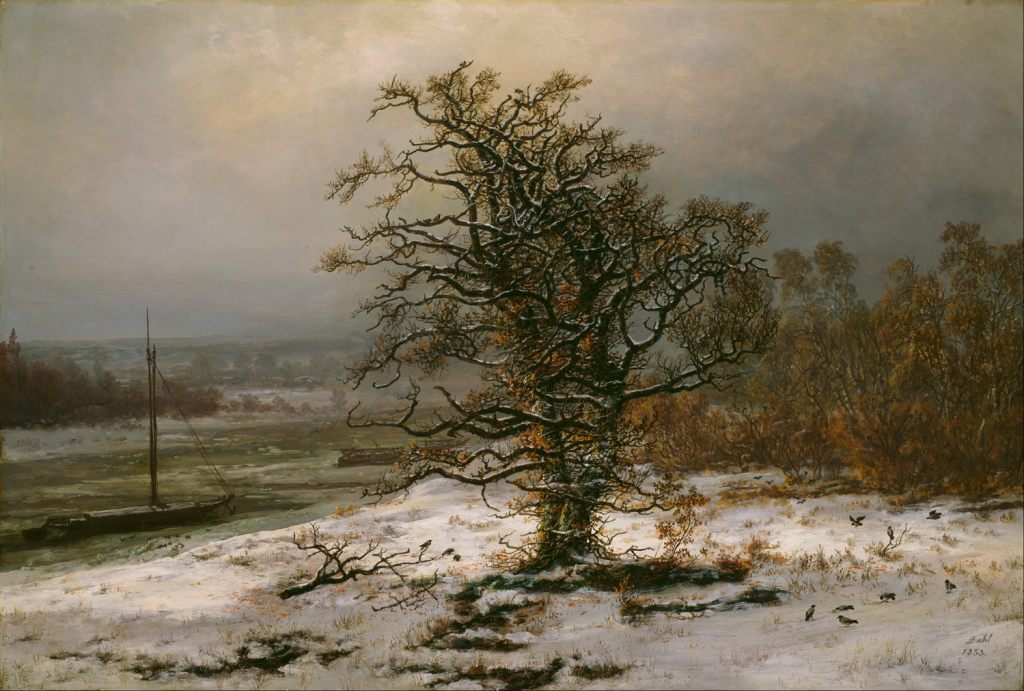
He continued painting, though, and revisited his barren tree theme in Oak Tree by the Elbe in Winter in 1853.

Painted in 1856, his Burning Windmill at Stege is an unusual brandje (a painting of fire) following a traditional sub-genre of the Dutch Golden Age. Although completed well before Impressionism, Dahl echoes the red of the flames in the field and trees to the left of the windmill, and even in his signature.
JC Dahl died in Dresden on 14 October 1857, at the age of sixty-nine. He remains known as the father of Norwegian landscape painting.

