
By 1830, reception of Caspar David Friedrich’s art was declining, as was Romanticism more generally. With the death of Goethe in 1832 and the ascendancy of the Düsseldorf School of painting, Friedrich became a figure in the margin of art, and increasingly isolated. Despite that, he painted some of his most enduring works in the years 1830-35, among them his most enigmatic and now-popular masterwork, The Stages of Life.

His Large Enclosure from about 1832 looks towards the setting sun hidden behind a band of cloud just above the horizon. This plain near Dresden is dissected by shallow pools of water, with a river (presumably the Elbe or a tributary) behind. On the river is a single boat, a simple sail lightly inflated by a gentle breeze from the right. Two figures are visible on board the vessel. Behind that, rows of trees with dense foliage are silhouetted against the receding plain and sky. Although its canvas isn’t even panoramic in aspect, this image appears to be viewed through a wide-angle lens, despite being made several years before the first photographs.
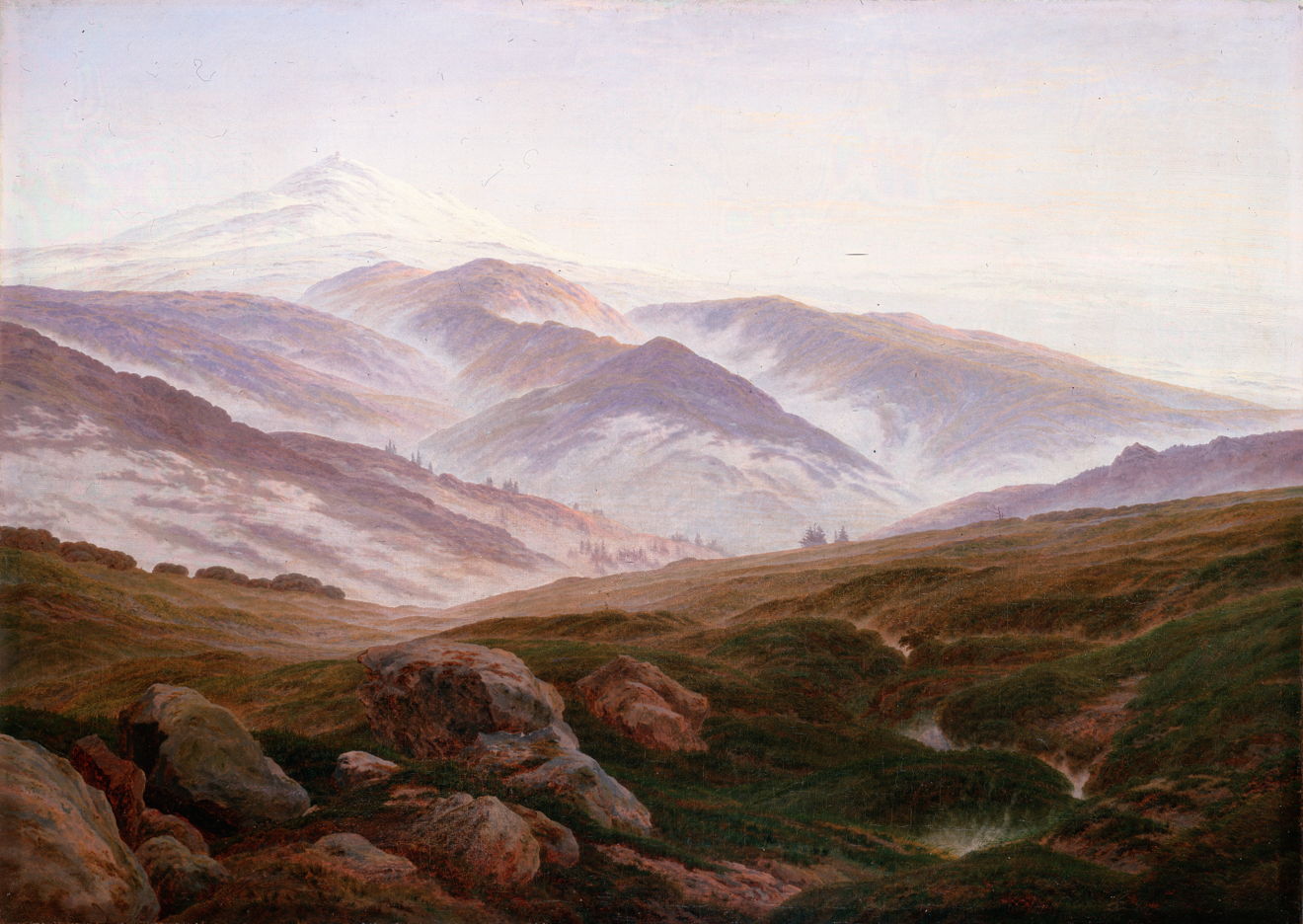
The Giant Mountains (Riesengebirge) (1830–5) are seen in full daylight, the deep V-shaped folds of foothills rising in the left distance to a snow-covered ridge. In the foreground are rough boulders, with green moorland, dissected by a hidden stream. In the middle distance are a few scattered trees, a thin mist clinging to the snow still lying in the hollows of the land. There is no man, nor living creature visible.
Although these mountains don’t rise much above 1500 metres (5,000 feet) and they aren’t steep, this area is rugged, barren, and empty even now. They also contain the source of the river Elbe, which flows down through Dresden.

Friedrich occasionally included owls in his paintings for their association with night, as in his Owl on a Bare Tree (1834), although his night is hardly a time for peace and pleasant dreams.
Later that year, Friedrich started work on what’s now considered to be his masterpiece.

It’s generally accepted that The Stages of Life (1834-5) is set at dusk. It shows five figures and assorted fishing equipment at the water’s edge, with five vessels sailing behind them.
Two of the figures are children, who raise a small Swedish flag between them, a reminder of Friedrich’s origins in Swedish Pomerania. To their right is a young woman, pointing and looking towards the children. To their left is a mature man, wearing a top hat, who is turned towards an elderly man, the closest to the viewer, his back towards us and a walking stick in his right hand. The younger man is gesticulating, his right hand towards the old man, his left pointing down towards the children. Of those five figures, all bar one are Rückenfiguren.
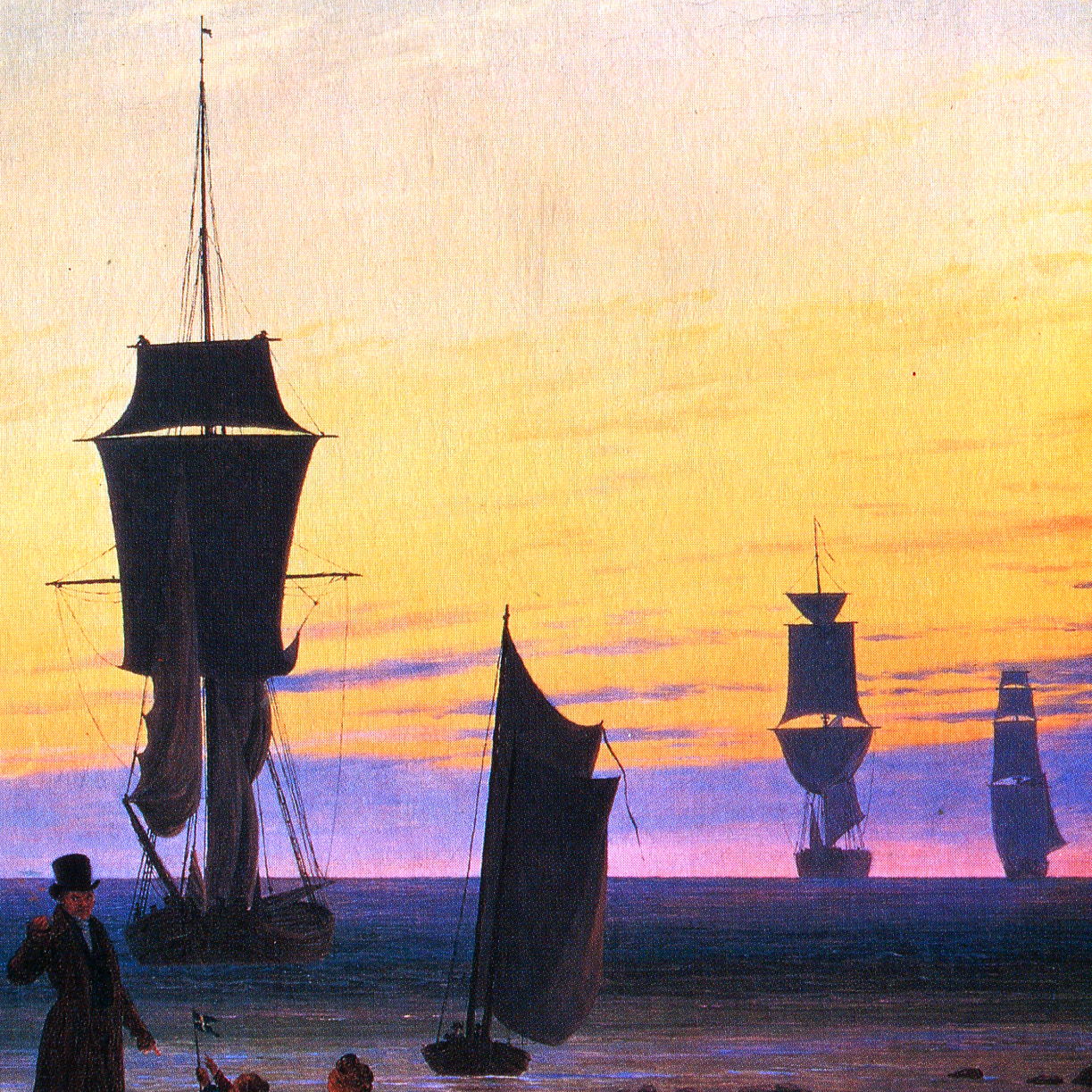
The vessels seem to mirror the figures. Closest in to the shore are two small fishing boats under full sail, heading towards the nearest of the three ships. Out in the deeper water behind them is a fully-rigged ship in the process of furling its sails. Further in the distance is a larger fully-rigged ship, also furling its sails, and on the horizon is the fifth, large ship, its sails still fully set.
This well-known painting has been interpreted as showing, in both figures and vessels, the ‘five stages of life’. Neither of the children is a baby, and their corresponding vessels are of similar size too. The children and two younger adults appear to form a family group, with its obvious visual reference to Sweden.
It has also been claimed that this painting is set on the beach at Utkiek, on the north-east German coast to the east of Friedrich’s native Greifswald. If that’s the case, then it cannot be depicting dusk accurately, as that part of the coastline faces east. If it is at that location, then it is either set at dawn, or Friedrich added the dusk effect contrary to its geography.
It’s also often stated that there are five ships. There are not: the two vessels closest to the viewer are small boats used for fishing, and for ferrying passengers and cargo between the shore and ships at anchor; they’re being navigated away from the shore towards the closest of the three ships. There are three ships, each of which is sailing towards the viewer and the coast.
The five figures on the shore don’t have a chest or other luggage with them. Although it’s possible that the small boats are already ferrying their luggage out to the nearest ship, it seems most unlikely that Friedrich intended the viewer to interpret the painting as showing the departure of the figures. Furthermore the two children and young woman aren’t dressed for a sea voyage, although the two men could be.
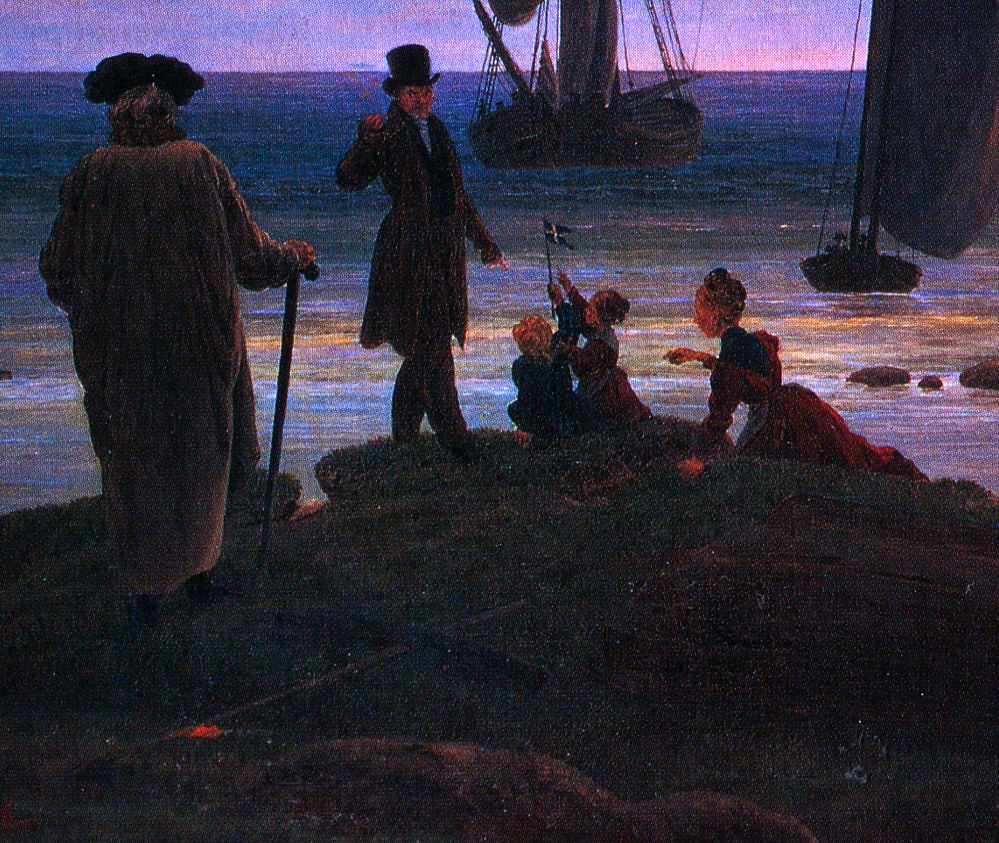
At the time of this painting, Friedrich himself was sixty years old, his wife was forty-one, their oldest child Emma was twenty-four, her younger sister Agnes was fifteen, and his son Gustav was ten. It’s therefore most probable – as is usually claimed – that the three younger people shown here are his three children, that the top-hatted man standing with them isn’t Friedrich himself but his nephew Johann, and that Friedrich could instead be the man in the tricorn hat. Friedrich’s wife is conspicuous in her absence.
Most worryingly, it seems that this painting was only dubbed The Stages of Life in the late nineteenth or early twentieth century, when there was a revival of interest in Friedrich’s paintings. Yet that posthumous title has coloured every interpretation of it since, inviting viewers to see the painting quite differently from the way that it is.

Mountain Peak with Drifting Clouds, also painted around 1835, may be another presentation of the Watzmann, seen in full daylight and from a slightly different angle. It shows wooded and grassy slopes in the foreground, the splintered trunk of a fallen tree crossing the front of the painting. Behind is a sloping mass of cloud, largely covering more rugged ground which rises to a double peak, set in line with foreground trees.
On 26 June 1835, Friedrich suffered a stroke. He returned to Teplitz in Bohemia for a ‘cure’, although he felt had no hope of ever recovering from the resulting paralysis. While most of his later paintings are small sepias, he managed to paint one last substantial oil painting.

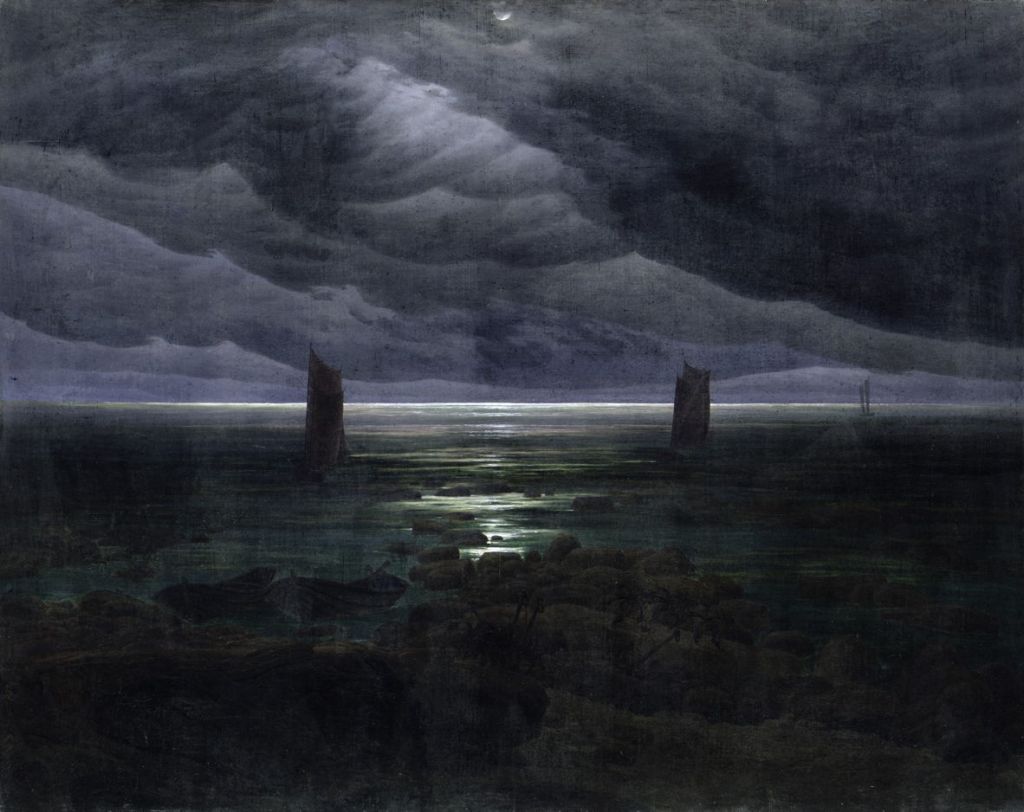
His Seashore by Moonlight (1835–6) is much darker and full of foreboding, perhaps of his own death. Three small fishing boats are shown at different distances from a rocky shore. Two small rowing boats are just visible in the gloom of the foreground, and there are black shadows of fishing gear. The horizon is lined by the bright reflection of the moon, the brightest tone in the whole painting, and moonlight glints on the central area of sea. The clouds are deep indigo, in smooth folds and curves threatening rain.
Caspar David Friedrich died in Dresden on 7 May 1840, leaving his family near-destitute. Three years later, after a long delay blamed on bureaucracy, his widow received a substantial gift of money from Emperor Nicholas I of Russia. His art, though, was forgotten until its rediscovery by the Norwegian art historian Andreas Aubert (1851–1913) at the turn of the century.
References
Wikipedia on Friedrich.
Wikipedia on The Stages of Life.
Hofmann W (2000) Caspar David Friedrich, Thames & Hudson. ISBN 978 0 500 09295 8.
Piotrovsky MB et al. (2008) Caspar David Friedrich & the German Romantic Landscape, Lund Humphries. ISBN 978 1 84822 017 1.
 The Eclectic Light Company