
By 1820, Caspar David Friedrich had established himself as one of the leading visual artists of the German Romantic movement. His paintings were known to Goethe, and one of his patrons was Grand Duke Nikolay Pavlovich, who was to become Emperor Nicholas I of Russia in 1825. He had married in 1818, and in 1820 the first of their three children was born. Despite this, he’s reported to have become increasingly solitary during the decade to 1830, and his paintings reflect his detachment.

His Ships at Anchor may have been painted as early as 1815, and is one of several similar motifs of sailing vessels in low light. This shows three larger ships at anchor just off the coast, apparently looking west into the setting full moon, although it’s a strange light whatever was intended.
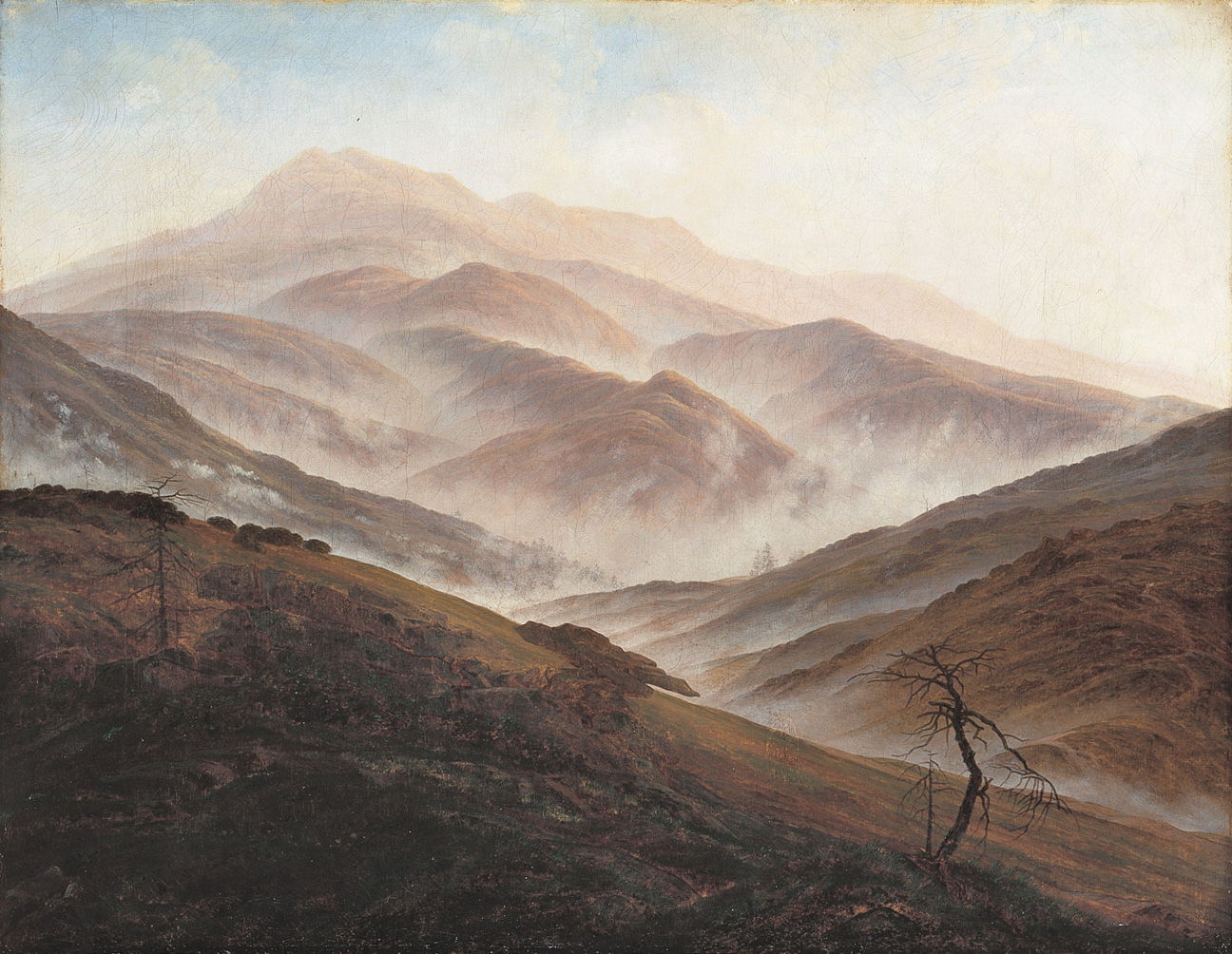
Friedrich was an enthusiastic user of newer pigments, and clearly kept up with the latest technical advances. The sky of his superb Riesengebirge Landscape with Rising Fog from 1819-20 is one of the earlier works known to use cobalt blue, which had only become available in oil paints in around 1806-08. Like so many of his paintings from this period, there’s no sign of life here, even its few trees are barren skeletons. These are the Giant Mountains on the border of the Czech Republic and Poland.
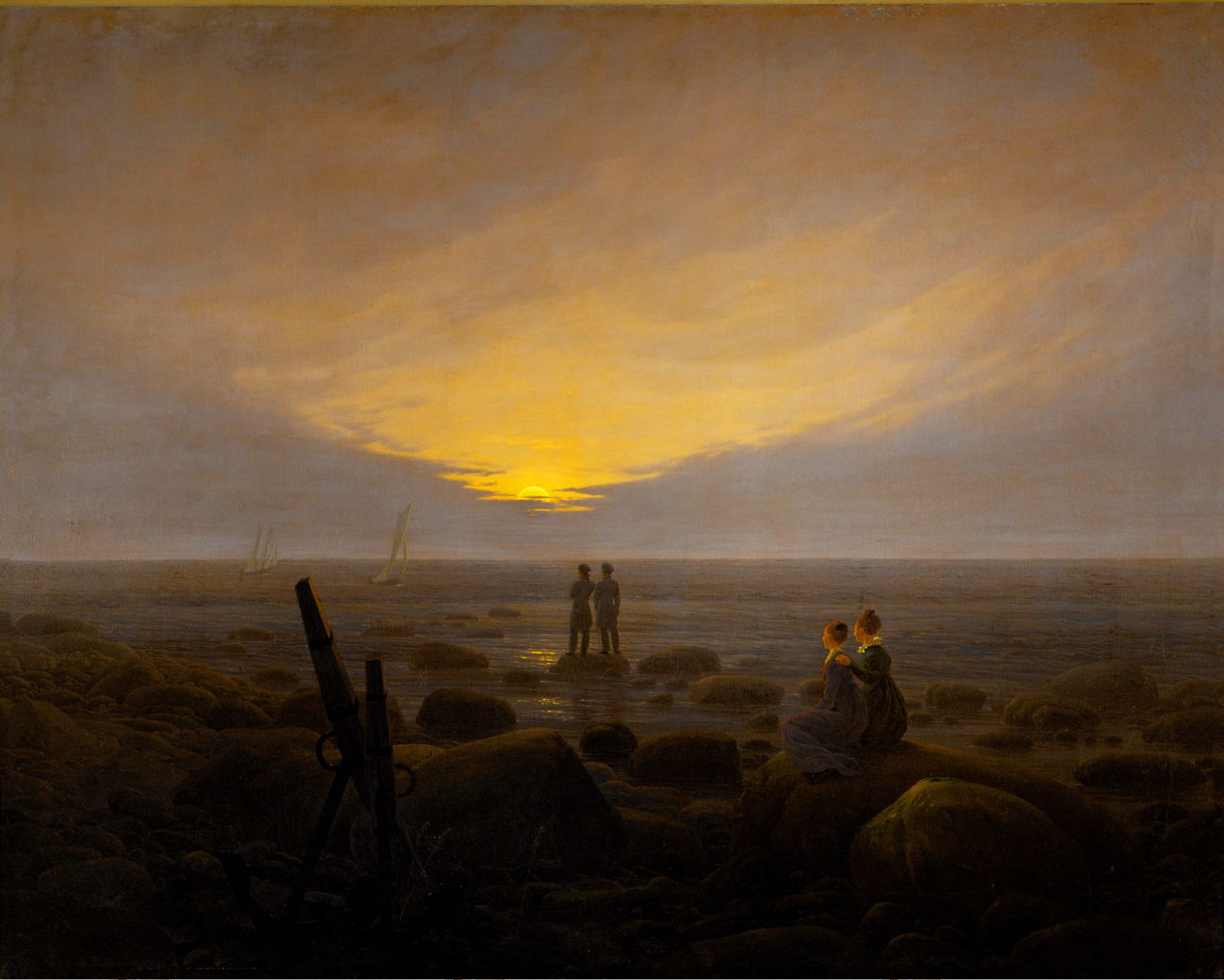
Where he does include figures, such as in his Moonrise over the Sea from about 1821, they are distant, enigmatic Rückenfiguren.

Moonrise by the Sea (1822) revisits this world of darkness and shadow, showing the view from a boulder-strewn beach, looking out to sea as the moon rises from behind a bank of cloud. The sea is calm, and glistens in the moonlight. Two fully-rigged sailing ships head straight towards the beach, the nearer furling its sails so as to lose way, the further still under full sail. On the top of the largest boulder, in the middle of the painting, are three more Rückenfiguren: two women sit close together, a man slightly to their right, all three gazing intently at the ships.

In this Tree of Crows from about 1822, the birds are only doing what they normally do around dusk, but Friedrich’s wonderfully wizened trees and the eerie light play tricks with us, giving them a thoroughly sinister look.

The North Sea in Moonlight from 1823-24 is devoid of all signs of life apart from the deserted fishing boat in its foreground.
In 1824, Friedrich was appointed professor at the Dresden Academy, although he was disappointed not to be made the director of its landscape class.

This view of The Watzmann, painted in 1824-5, is also deserted, with rock runs and barren land in the foreground, and patchy low grass. The middle distance contains rolling forest, behind which the land rises abruptly in a rock cliff, and a rock hill showing intensely folded strata. The Watzmann is the third highest peak in Germany, and is south of the village of Berchtesgaden in the Bavarian Alps.
By about 1826, Friedrich’s health was starting to trouble him, and that year he returned to Rügen in the Baltic to improve it. It was probably during that visit that he returned to his honeymoon oil painting in the watercolour I showed in the previous article, where he carefully removed the three figures that had populated his earlier painting.

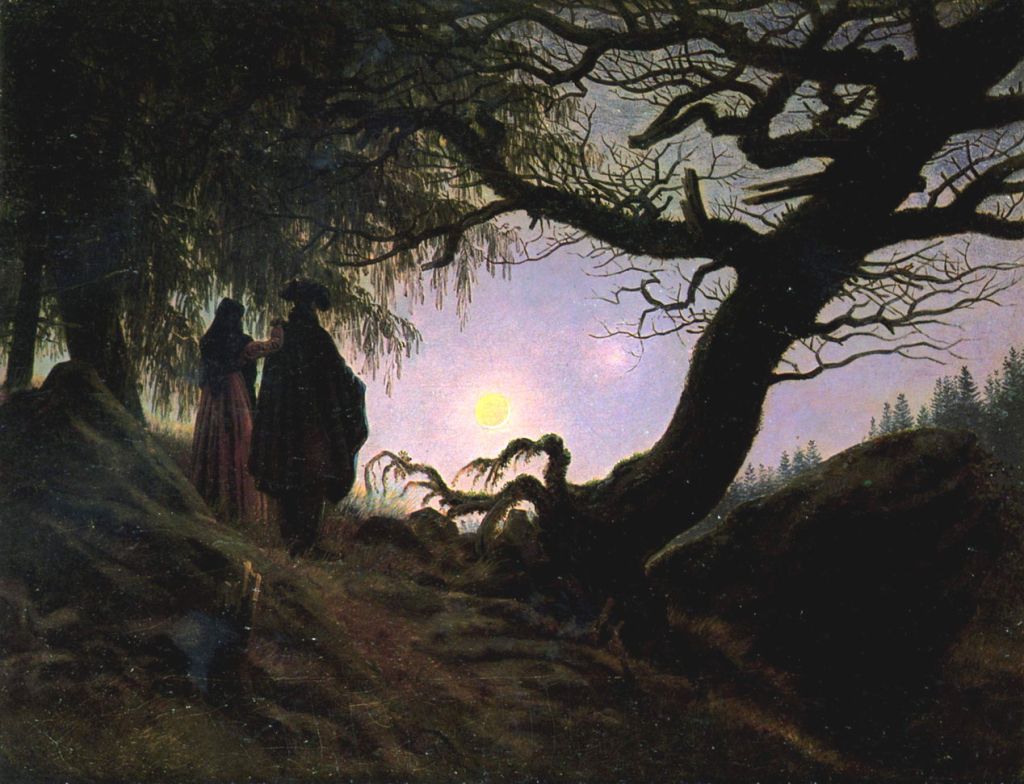
Friedrich returned to an earlier motif in his Man and Woman Contemplating the Moon from about 1827. A man and a woman, dressed in clothes from a century before, their right shoulders and backs towards the viewer, are looking at the moon. Both their heads are covered, the woman’s by a shawl, the man’s by one of Friedrich’s favourite tricorn hats. They’re at the edge of a clearing in a forest, an old and part-felled twisted tree to their right, filling much of the upper right of the painting. The tree is barren of leaves and appears dead, and all is lit by a sliver of new moon.
In 1830, Friedrich was visited by Crown Prince Frederick William of Prussia, who a decade later became King Frederick William IV of Prussia, and was noted for his taste for German Romantic art.
References
Wikipedia on Friedrich.
Hofmann W (2000) Caspar David Friedrich, Thames & Hudson. ISBN 978 0 500 09295 8.
Piotrovsky MB et al. (2008) Caspar David Friedrich & the German Romantic Landscape, Lund Humphries. ISBN 978 1 84822 017 1.
 The Eclectic Light Company