
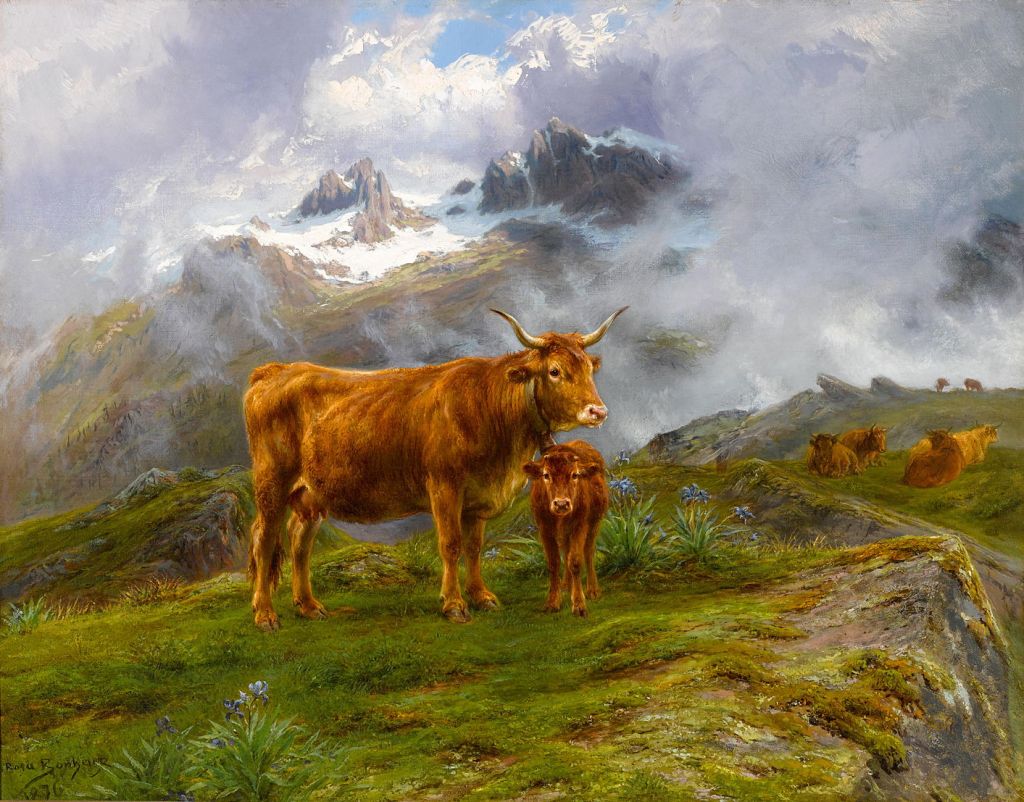
If you were to take most paintings of mountains at face value, you’d assume that animals and birds didn’t exist in mountainous areas. While it’s true that they may be less frequent, in some cases they’re species you’re unlikely to see anywhere else.
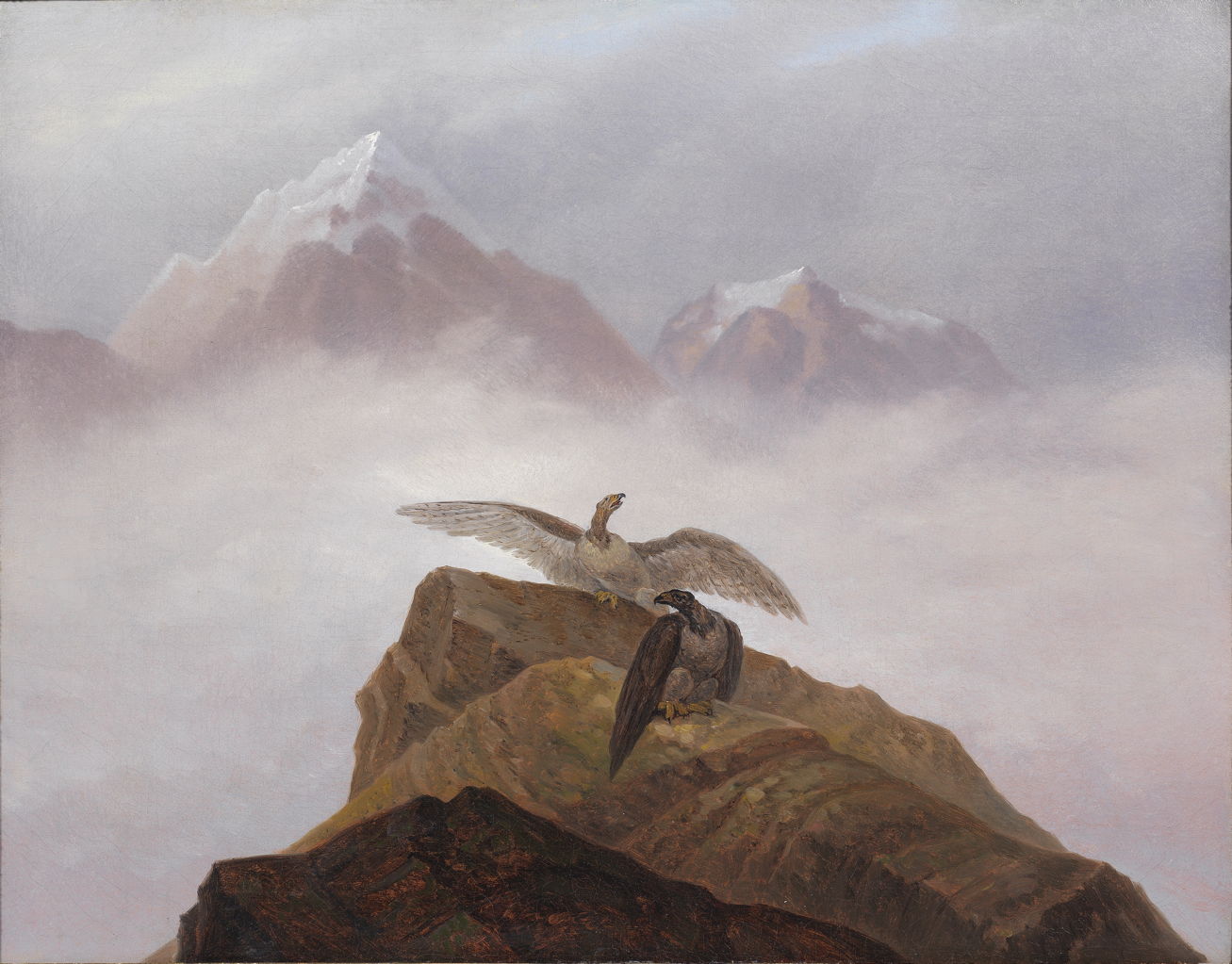
Eagles and other large birds of prey are most commonly found in remote and mountainous regions. In Fantasy of the Alps. Eagles Nesting on an Alpine Peak (1822), Carl Gustav Carus has developed his own version of the Gothic mountain and fog scene, in which the sole creatures are not human, but aquiline.

The bird flying in Albert Bierstadt’s A Storm in the Rocky Mountains, Mt. Rosalie, painted in 1866, isn’t as obvious. Its foreground shows a pastoral valley floor with a First Nation camp, in mottled light. Some people and their animals are seen making haste to return from the pastures to the shelter of the camp. A small rocky outcrop has trees straggling over it, which are silhouetted against the brilliant sunlight on the lake behind, in the middle distance. Behind the lake the land rises sharply, with rock crags also bright in the sunshine. In the background the land is blanketed by indigo and black stormclouds. Those clouds are piled high, obscuring much of Mount Rosalie (named by the artist after his wife), but its ice-clad peaks show proud, high up above the storm, with patches of blue sky above and beyond them. A single large bird, probably an eagle, is seen in silhouette, high above the lake.

John James Audubon’s oil painting of Black Cocks from 1828 most probably shows a European species, the black grouse (Lyrurus tetrix) that he may have come across during his time in the UK. The sketchy landscape background would certainly be consistent with this being set in the Scottish mountains. Audubon is of course most famous for his major book of prints of The Birds of America, published between 1827–1839.
The most numerous animals in most upland areas are domesticated, and in Europe and other parts of the world, that means sheep.

This painting of Highland Wanderers – Morning Glen Croe, Argyllshire, from 1906, was made by the British animalière William Watson, who specialised in landscapes featuring cattle and sheep. It shows a valley in the middle of the Arrochar ‘Alps’, an exceptionally rugged mountainous area of the Cowal Peninsula, to the north-west of Loch Lomond in Scotland.
After sheep come cattle, with their distinctive highland breeds.

Watson never reached the fame of the French animalière Rosa Bonheur, who painted her Highland Cattle in 1876, long after her visit to Scotland, although these look more typical of those in the Pyrenees than the Scottish Highlands.
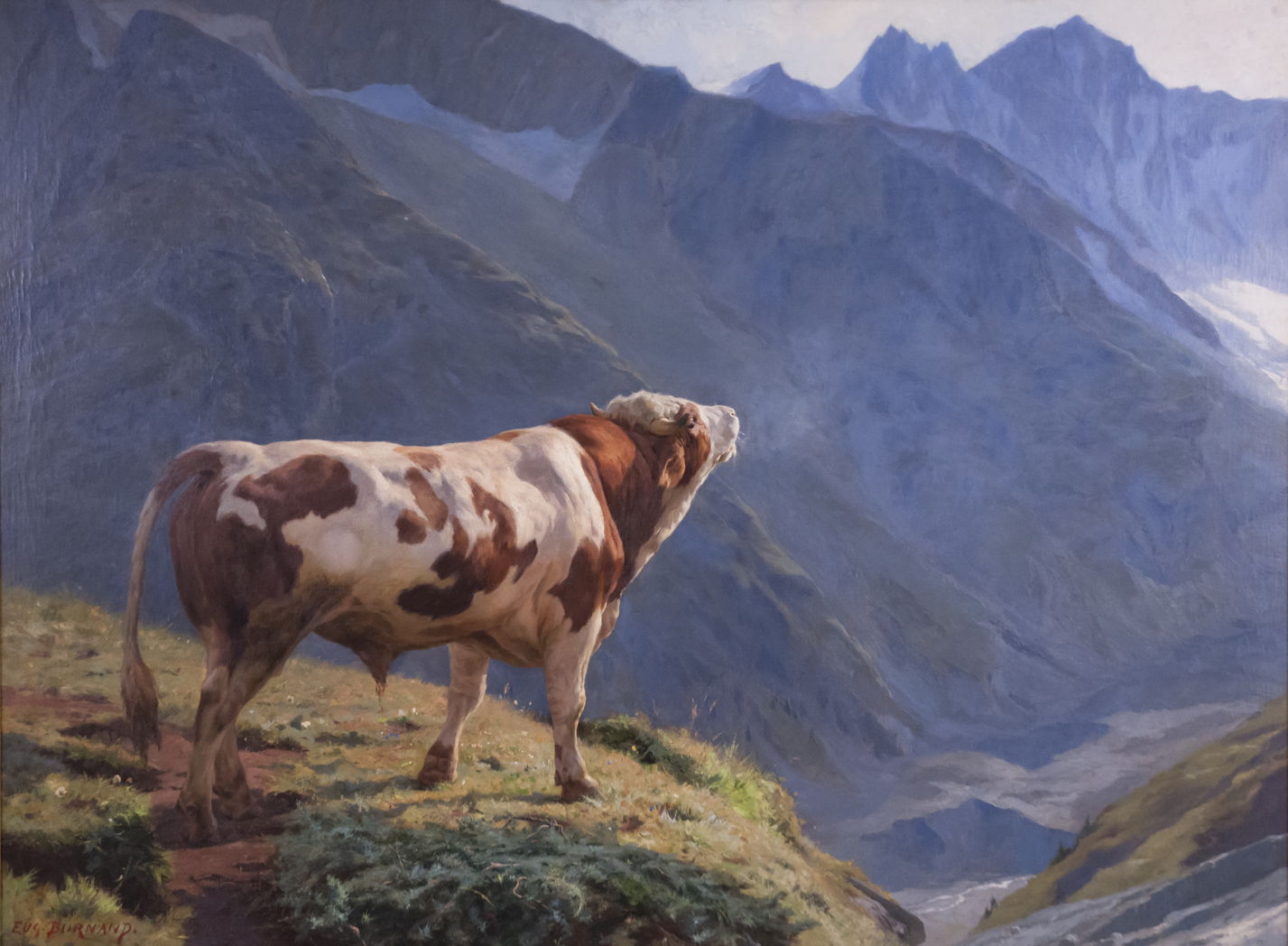
Eugène Burnand’s magnificent painting of Bull in the Alps from 1884 is both impressive and fascinating for his use of optical effects and extreme aerial perspective.
Deer can also be numerous, although far more wary of humans.

While Albert Bierstadt was travelling in Europe, he continued to paint in a series of rented studios. When in Rome during the winter of 1867-68, he painted Among the Sierra Nevada, California, based on his visit to the Sierra Nevada in 1863. There’s a small group of deer with a large stag at the edge of this lake, as well as a flock of birds.

Adrian Stokes and his artist wife Marianne, who was Austrian by birth, travelled widely in Europe. Autumn in the Mountains (1903) shows two deer approaching the young birch trees, probably in the European Alps.
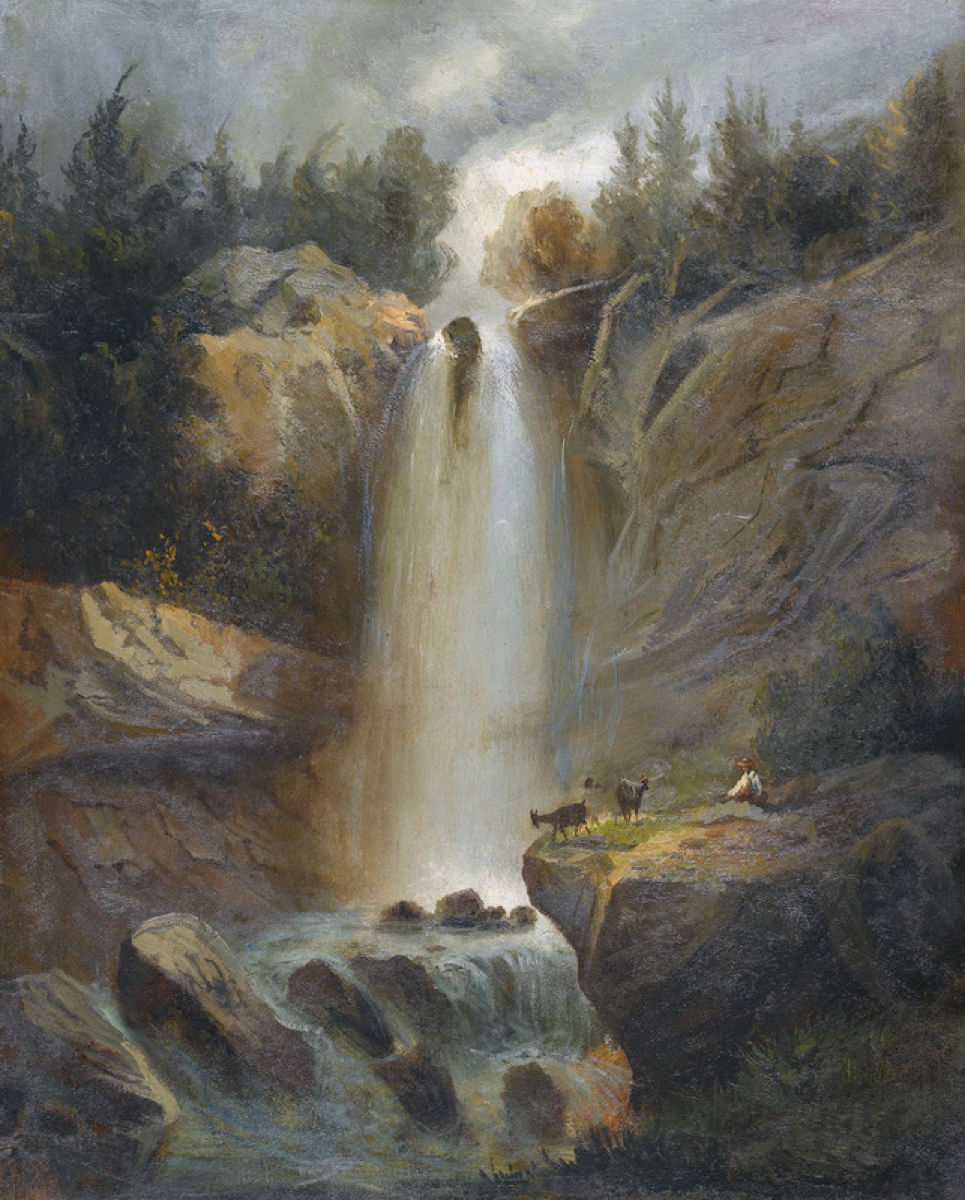
Among Ferdinand Hodler’s earliest surviving works are impressive views of two of the most famous Alpine waterfalls. Painted in about 1871, The Upper Reichenbach Falls shows the proverbial lonely goatherd with a couple of animals from his flock.
 The Eclectic Light Company