
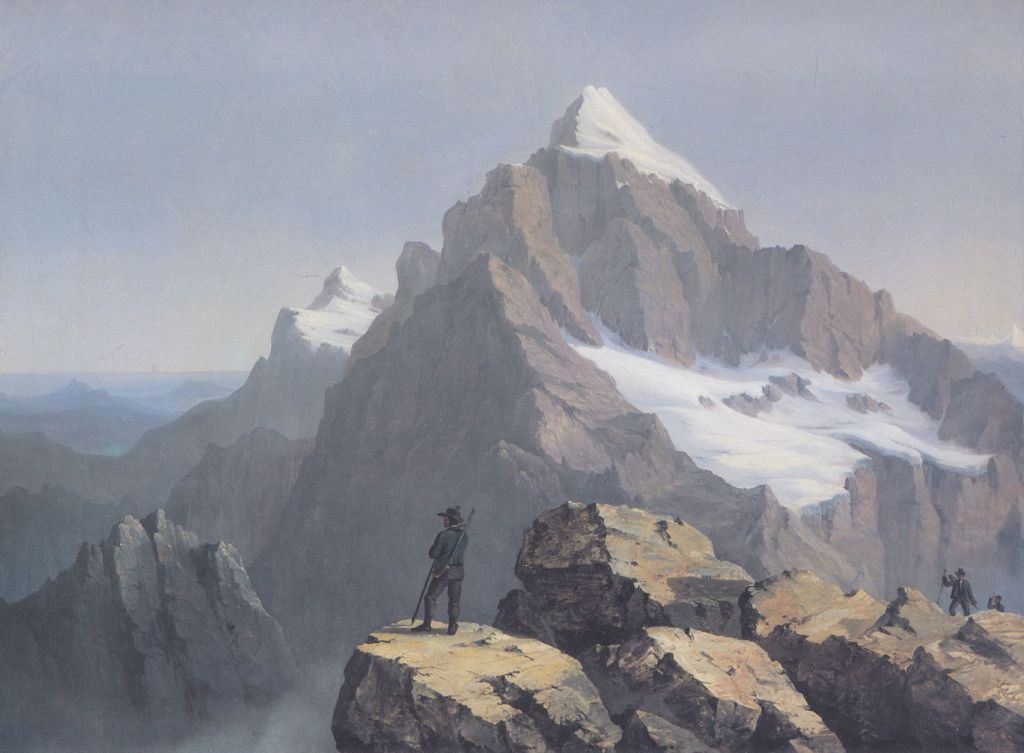
There are, of course, few paintings of people ascending mountains, and most have either been made from photographs, or imagined from the accounts of those who were there. Of those who went to the trouble of recording their climbs, the most extensive are those of the Canadian John Auldjo (1805-1886), who completed the fourteenth successful ascent of Mont Blanc in 1827.
It had become fashionable to travel to the Alps, don your finest tweed jacket, breeches and nailed boots, and go to walk up the most impressive mountain nearby. For some, this became an obligatory part of the Grand Tour, a rite of passage for the rich. Auldjo had been orphaned, so went to live in England, where he graduated from Trinity College in Cambridge University. He then departed on his Grand Tour, and decided to hire six local guides to help him climb Mont Blanc. He did this on 8-9 August 1827, making sketches during the ascent, and the party shared a bottle of champagne on the summit, in true Grand Tour style.
Mont Blanc is the highest mountain in Western Europe, its summit reaching 4,808 metres (nearly 16,000 feet). Its first ascent had been made by Jacques Balmat and Dr Michel Paccard from nearby Chamonix back in 1786, but it was still seen as one of the major mountaineering challenges in the Alps.
Rather than just move on to another formative experience on his travels, what Auldjo did next was different. He turned his sketches and notes into an illustrated account, which was published in 1828 and ran successfully through three editions. It was the first time the wider public had heard of Alpine mountaineering, and an important milestone in popularising the pursuit.
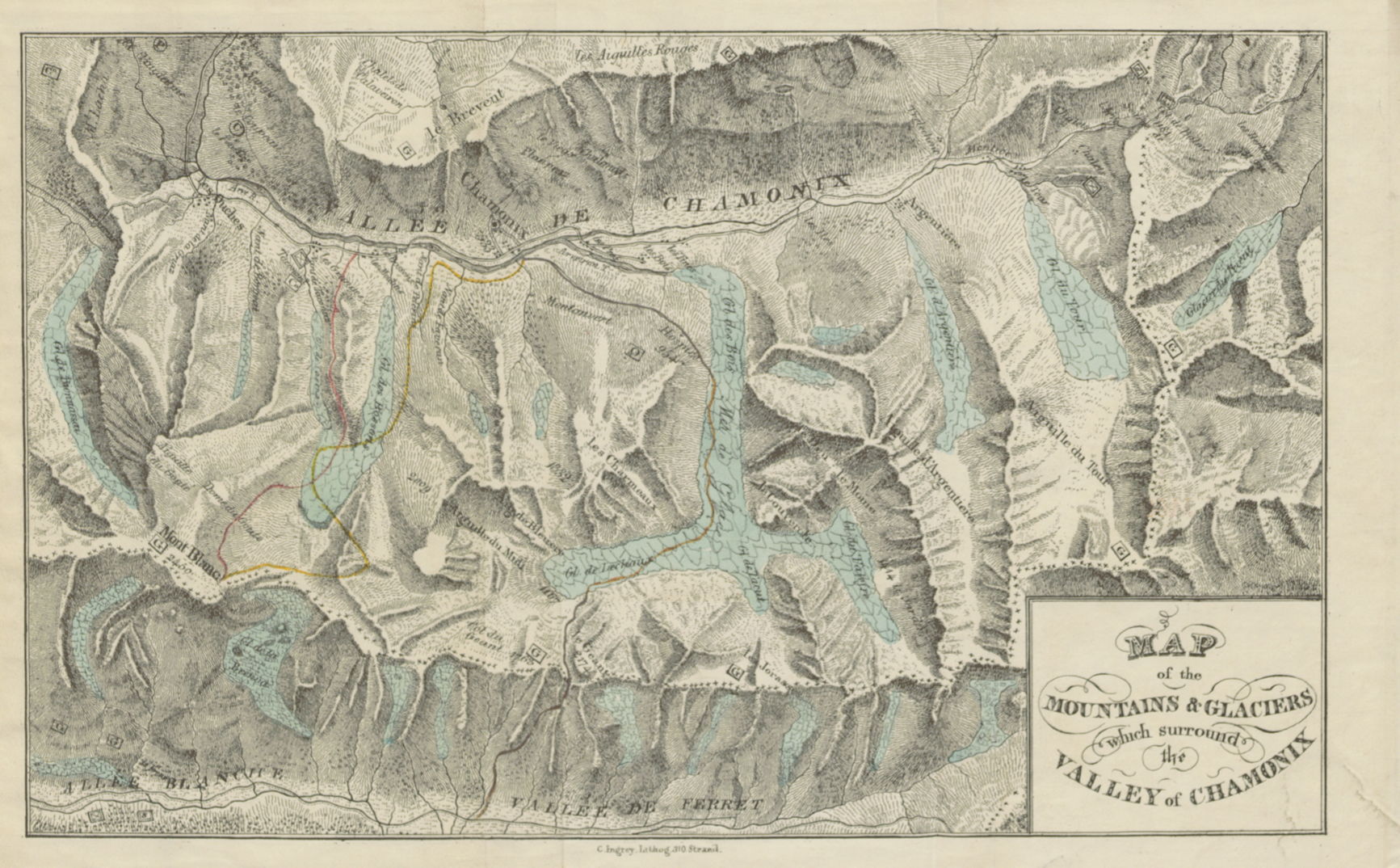
Auldjo approached his objective methodically, producing several detailed pencil and wash views which he carefully labelled. He also provided the drawing for this print of a Map of the mountains and glaciers which surround the valley of Chamonix (1830), which was published in his book, Narrative of an Ascent to the Summit of Mont Blanc, on the 8th and 9th August, 1827. Mont Blanc is at the lower left.
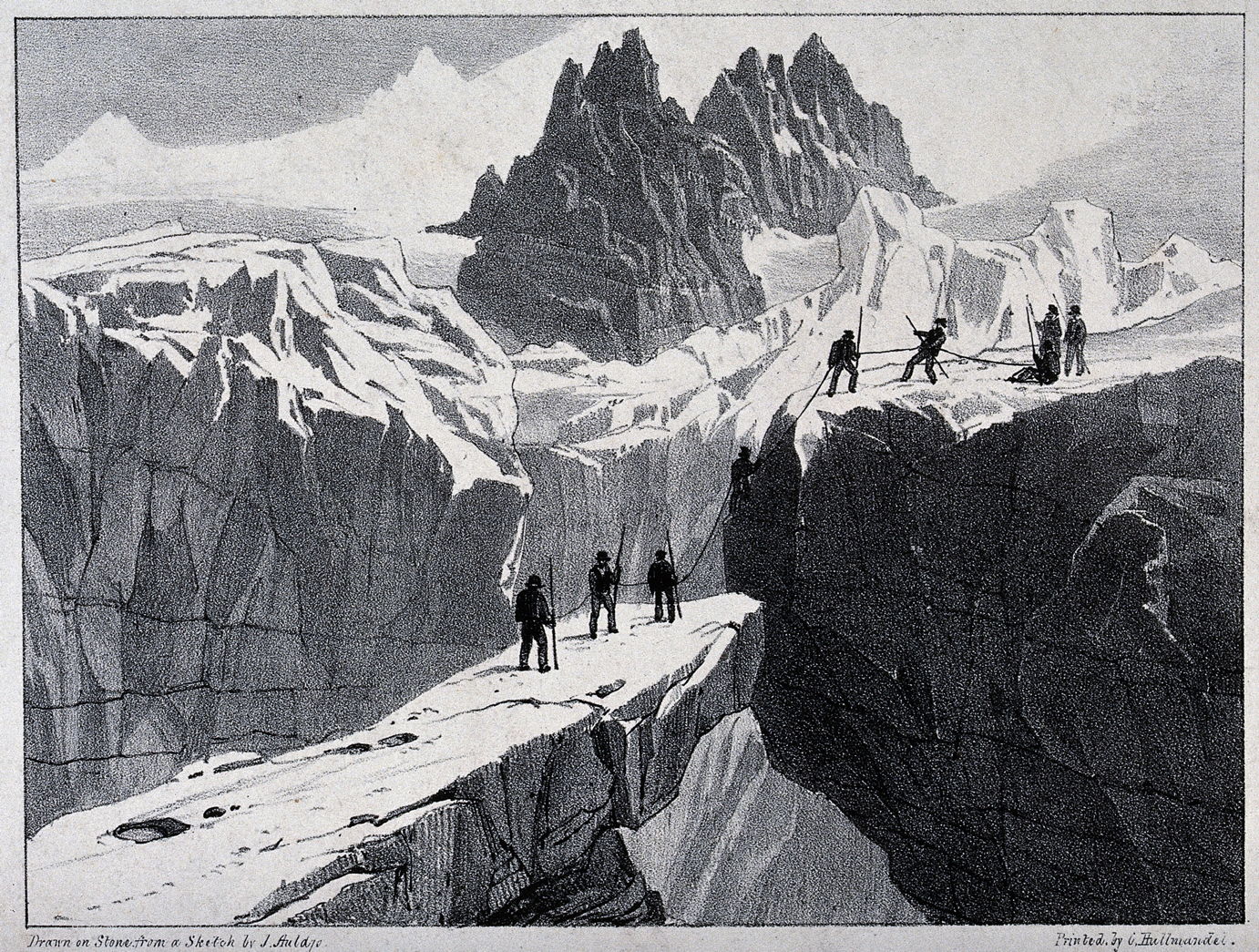
Surviving original paintings are now in the collection of the Alpine Club in London, and formed the basis for this lithograph of Mountaineers Scaling a Wall of Ice above a Precipice in 1828.

Auldjo’s guides weren’t allowed to let them go hungry, or particularly sober. The Party Breakfasting on a Bridge of Snow Between Two Cliffs (1828) shows them enjoying a hearty meal, and their provisions included twenty bottles of red wine, eighteen chickens and a large quantity of cheese.
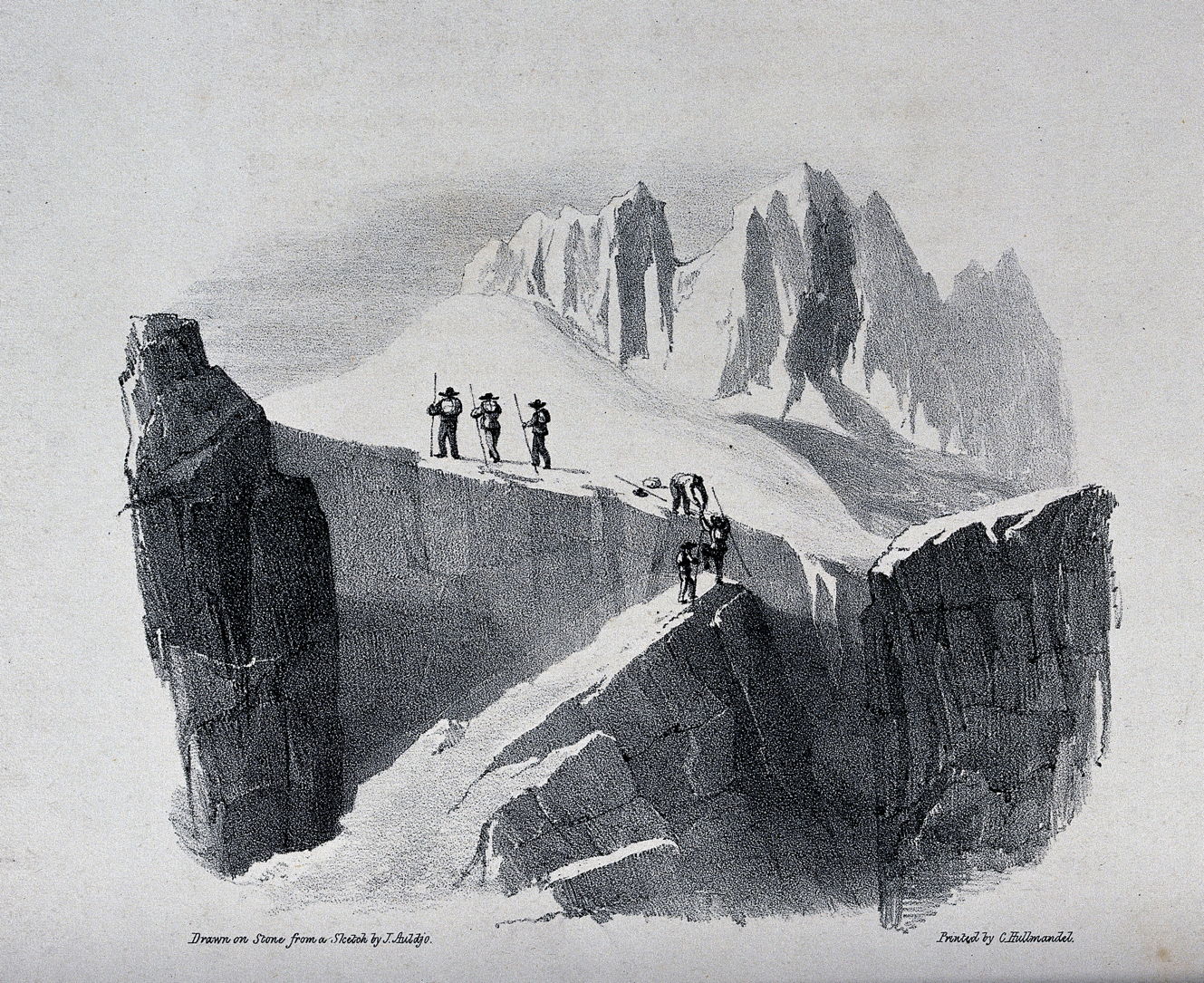
By modern standards, the ascent was hardly technically challenging, but when all that’s keeping your boots from slipping on ice are some double-headed screws in their soles, The Party Negotiating a Cliff (1828) is a lot scarier than it might appear.
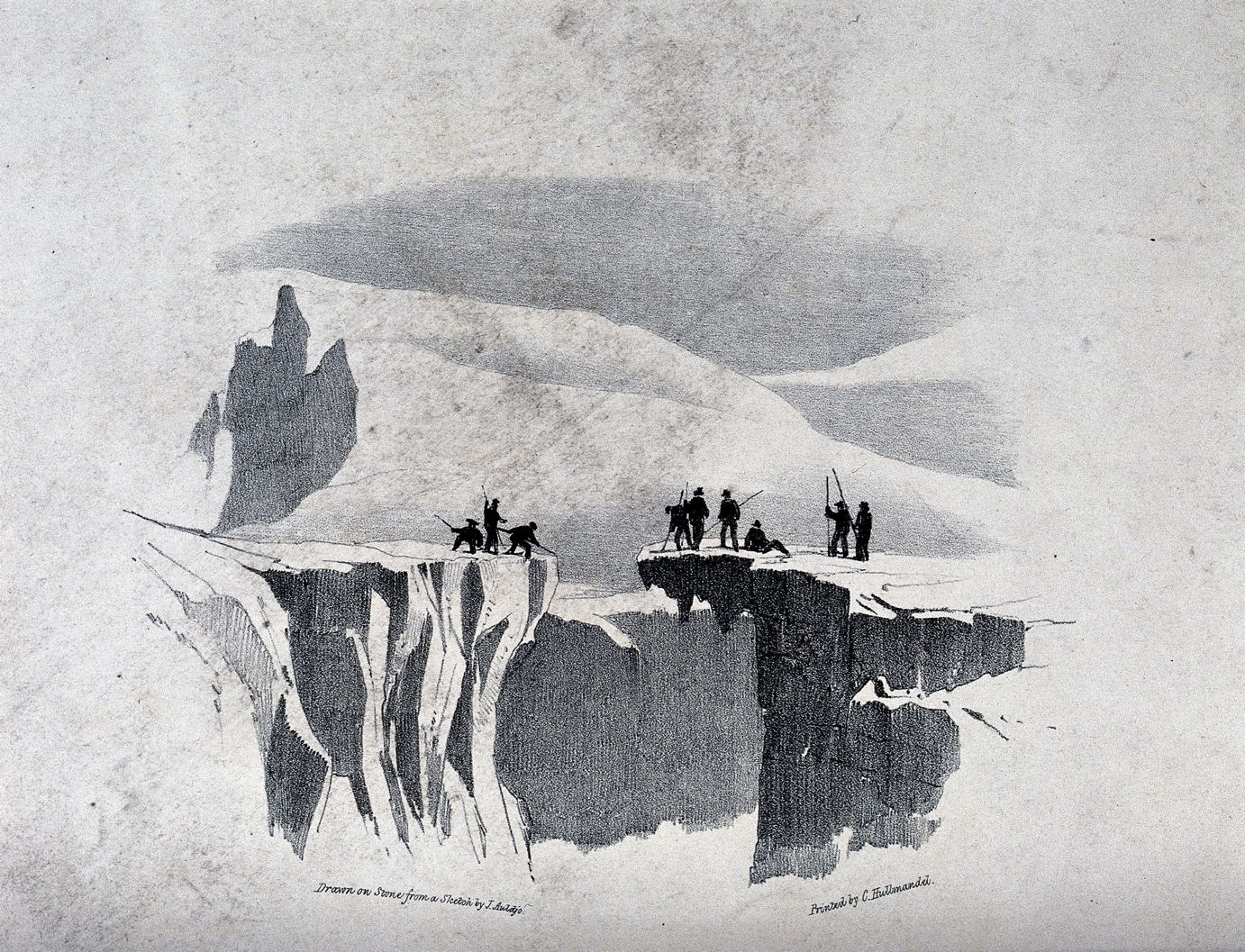
Lightweight modern aids to negotiate ice obstacles didn’t exist, so Traversing a Gap in a Glacier (1828) must have demanded plenty of pluck.
Auldjo apparently didn’t need to work for a living, and resided much of the time in Naples, where he socialised with the likes of Sir Walter Scott, Lord Byron, and Edward Bulwer-Lytton. He never lost his love for the mountains, though, and in 1831 painted views of Mount Vesuvius during one of its more active periods. Those led to another book, and fellowships of the Royal Society and the Royal Geographical Society. By 1870, he had moved to Geneva, where he died in 1886.
He wasn’t the only artist who recorded their early ascents of European mountains in paint. Sadly, few of these works are now accessible, but I show here two of the more striking examples.
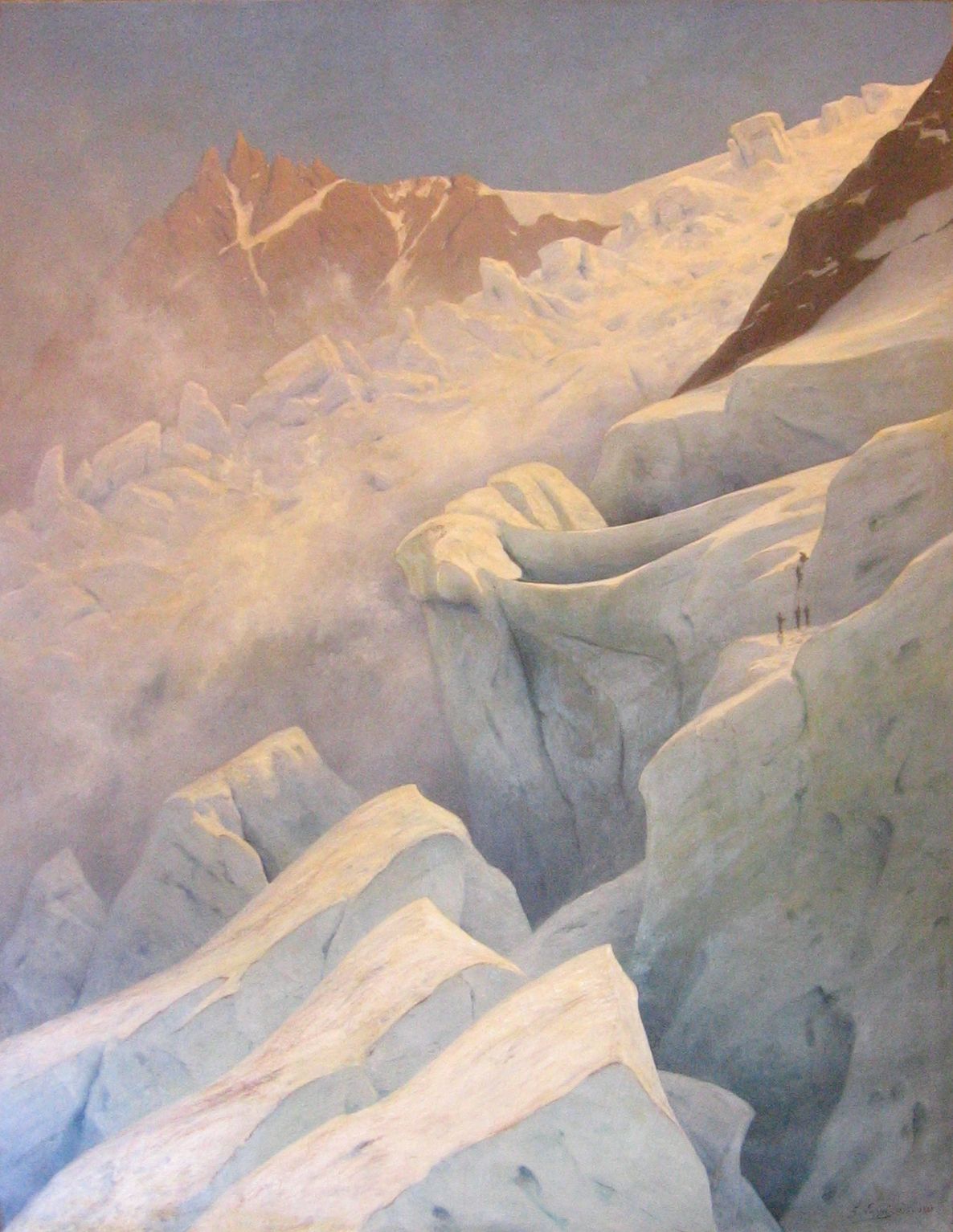
Gabriel Loppé’s Crevasses Below the Grands Mulets, Ascent of Mont Blanc was painted between 1875-83, and shows a view at an altitude of around 3,000 metres (10,000 feet), now the site of a refuge hut or bothy. Loppé was both a painter and mountaineer, and became the first foreign member of the prestigious Alpine Club in London. From the 1850s, he was an avid climber, and completed over forty ascents of Mont Blanc, often making oil sketches when climbing.
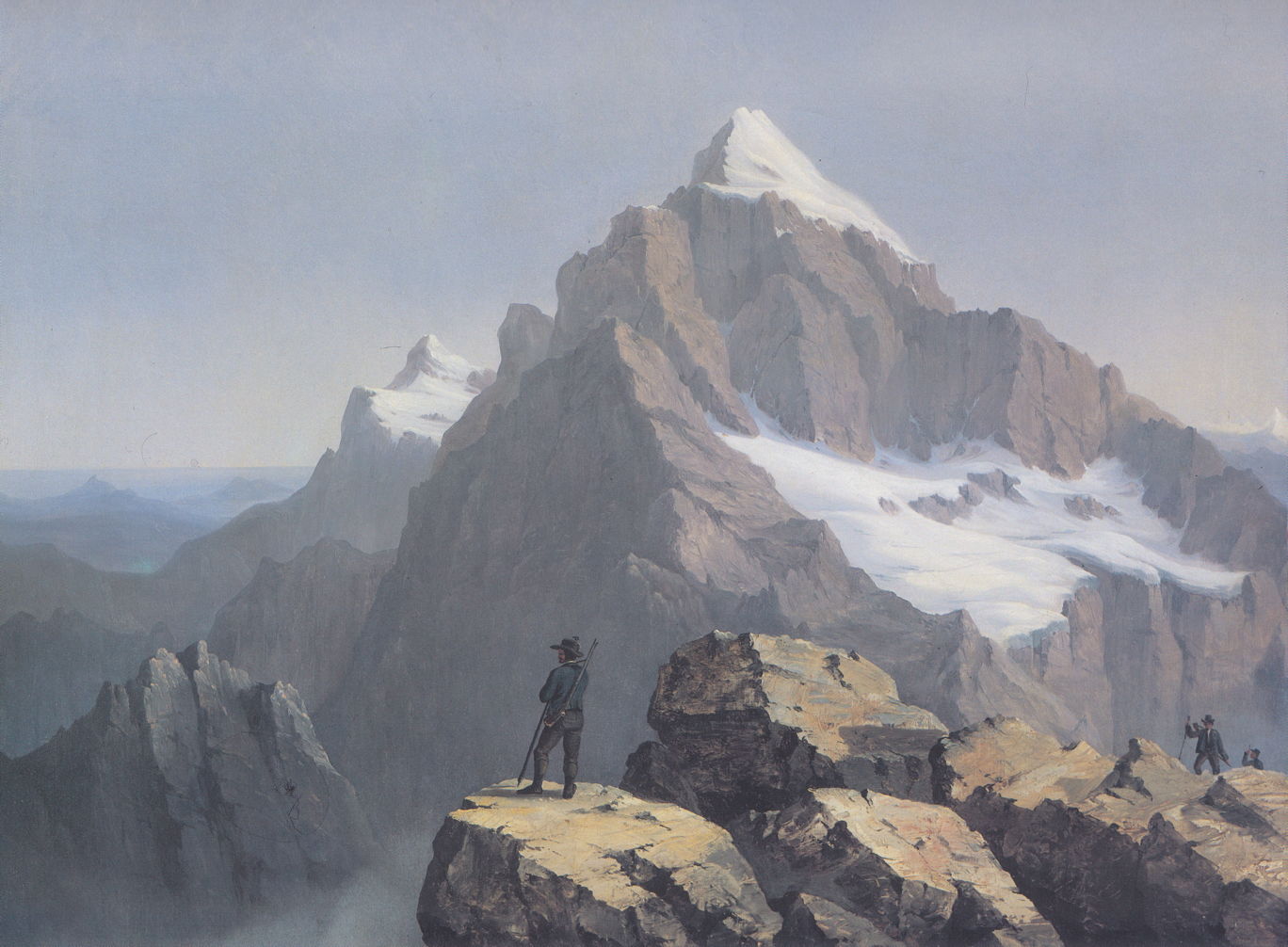
Marko Pernhart’s undated painting of Triglav III shows the lower summit of this mountain, which is the highest in Slovenia and the Julian Alps, at 2,864 metres (9,400 feet). Its first ascent was recorded in 1778, and it was another peak that became popular during the nineteenth century. Unlike Loppé, Pernhart wasn’t a mountaineer, but a successful Austrian landscape painter.
I finish with one of the few field sketches showing life in an expeditionary tent, although this comes from Edward Wilson, physician, zoologist and ornithologist to Captain Scott’s ill-fated Antarctic expedition of 1910-12, who died in one of these tents in 1912, alongside Scott.

This rough pencil sketch of Camping after Dark (1910) shows a cutaway of a ‘pyramid’ tent, its three occupants crammed in tightly together. From their tangle of legs and boots to the mittens and balaclava hats hanging to thaw and dry above them, it’s cramped but warm and sheltered.
 The Eclectic Light Company