
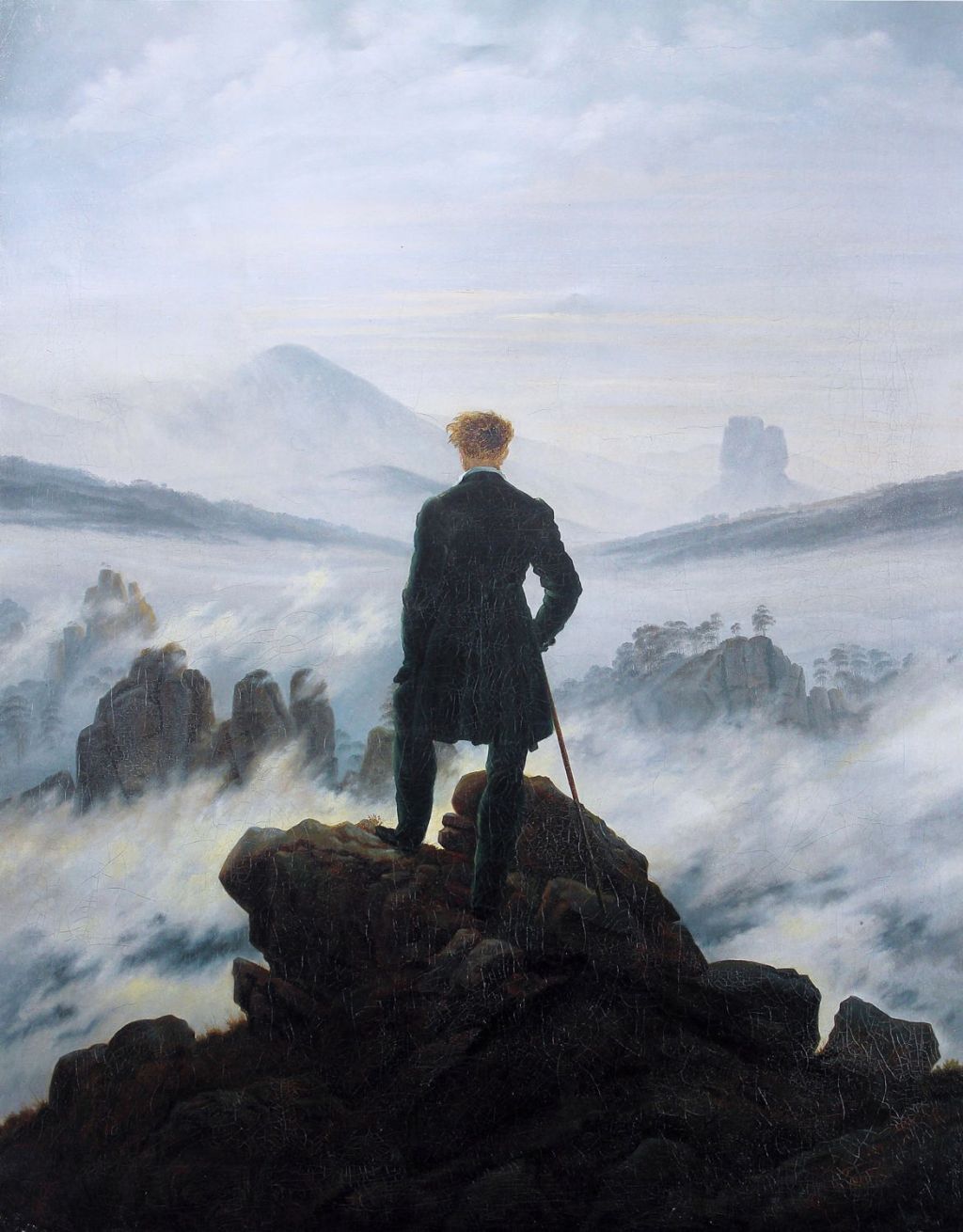
Most figures in images, both photos and paintings, like to look at least vaguely towards the viewer, unless there’s good reason that they should be looking at someone else. Occasionally, though, someone is pictured looking away, into the landscape, and showing the viewer their back – in German, Rückenfigur, ‘back-figure’.
Although this isn’t recent by any means, it came into vogue in the unusual landscape paintings of German Romantic artists of the early nineteenth century, in particular those of Caspar David Friedrich and his followers, and it even made its way into some well-known Impressionist works.

Friedrich’s famous Wanderer above the Sea of Mists (1818) uses extensive mist and cloud both to detach its scenery from ground level, and to maintain a pervasive air of mystery. A bareheaded, blond man stands astride a rocky outcrop in the foreground, a walking stick in his right hand, looking in the same direction as the viewer. He and we look out over a blanket of lower cloud, pierced by occasional rock pinnacles and peaks. In the distance, more gradual slopes suggest higher mountains to the sides, and vaguer forms of rounded peaks, and a massive rocky butte, fading into mist. Because we can’t see anything of his face, he remains anonymous and as mysterious as the view.

At some time after Friedrich’s marriage in 1818, he followed that with Chalk Cliffs on Rügen (after 1818). Here are dazzling white pinnacles of chalk, a calm sea with sailing vessels, shown in full daylight, the whole framed by trees in full leaf to enhance depth. But each of its three figures is looking away into the view. They might represent his bride (clad in red, symbolising love) and himself, both engaged in studying the clifftop from its edge, but there is a third person: a man wearing a tricorn hat (which becomes a recurrent theme in his work), arms folded, staring out to sea as if the couple were not there at all. It has been suggested that this third figure is Friedrich the artist.
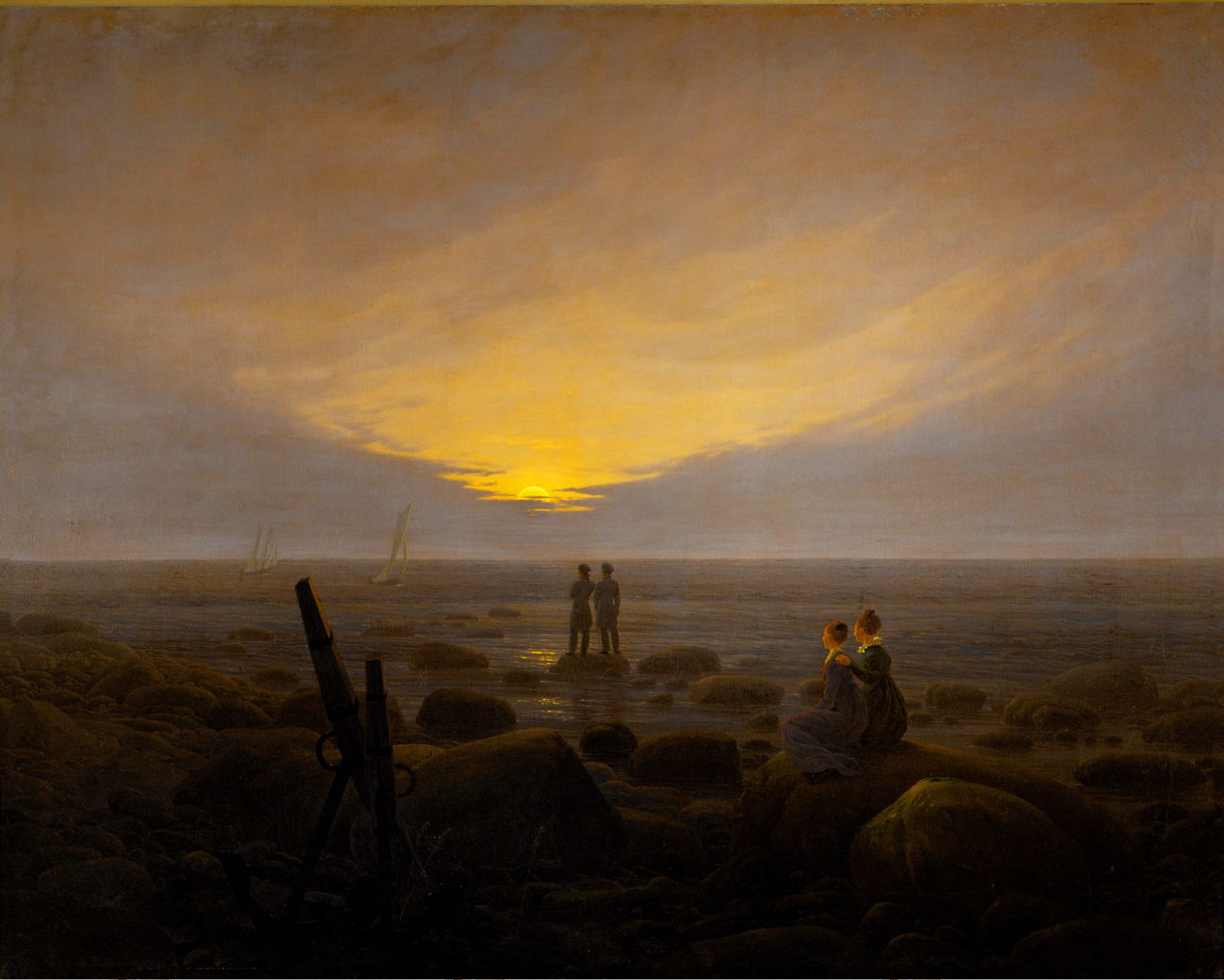
During the 1820s, Friedrich added enigmatic Rückenfiguren to his coastal nocturnes, as seen in his Moonrise over the Sea from about 1821.

Moonrise by the Sea (1822) revisits his world of darkness and shadow, showing the view from a boulder-strewn beach, looking out to sea as the moon rises from behind a bank of cloud. The sea is calm, and glistens in the moonlight. Two fully-rigged sailing ships head straight towards the beach, the nearer furling its sails so as to lose way, the further still under full sail. On the top of the largest boulder, in the middle of the painting, are three Rückenfiguren: two women sit close together, a man slightly to their right, all three gazing intently at the ships.

Friedrich returned to an earlier motif in his Man and Woman Contemplating the Moon from about 1827. A man and a woman, dressed in clothes from a century before, their right shoulders and backs towards the viewer, are looking at the moon. Both their heads are covered, the woman’s by a shawl, the man’s by another tricorn hat. They’re at the edge of a clearing in a forest, an old and part-felled twisted tree to their right, filling much of the upper right of the painting. The tree is barren of leaves and appears dead (in the earlier painting it still bore scattered leaves). The view is lit by a sliver of new moon, and stars are visible in the sky.
Friedrich is known to have had at least one pupil, Carl Gustav Carus, who was an eminent obstetrician and gynaecologist in Dresden, and studied oil painting under Friedrich from about 1814. Carus was quite a Renaissance man: his studies in botany and zoology influenced Darwin, his pioneering work in physiology and psychology helped develop the concept of the unconscious, and he was a friend and influence of Johann Wolfgang von Goethe. He was also an enthusiast for the Rückenfigur.

Carus’ Wanderer on the Mountaintop, Pilgrim’s Rest from 1818 is closely related to Friedrich’s Wanderer above the Sea of Mists from the same year.

In his Pilgrim in a Rocky Valley from about 1820, the man with a hat and walking stick is standing in front of a narrow gorge, which promises to make his passage very difficult.

View of Dresden at Sunset from about 1822 is one of Carus’ finest paintings, with the famous spires and towers of the city of Dresden seen against the rich, warm light of dusk. Sat admiring the sight are two Rückenfiguren, one wearing a distinctive top hat rather than Friedrich’s tricorn.

Woman on the Balcony (1824) replaces Carus’ faceless male pilgrim with a young woman dressed in black, facing away from the viewer. She is here on the terrace of a castellated mansion high above rolling wooded countryside, probably somewhere in central Germany.

Rudelsburg Castle, which Carus painted in 1825, is a Romantic/Gothic location on the River Saale, in Saxony, central Germany. In the nineteenth century, its ruins became a popular focal point for walkers, and grapevines were planted in its grounds. Carus’ Rückenfigur has made his way here too, this time in the company of his dog.
Tomorrow I’ll move on from Carus to some more recent variants, culminating in examples from Gustave Caillebotte.
 The Eclectic Light Company