
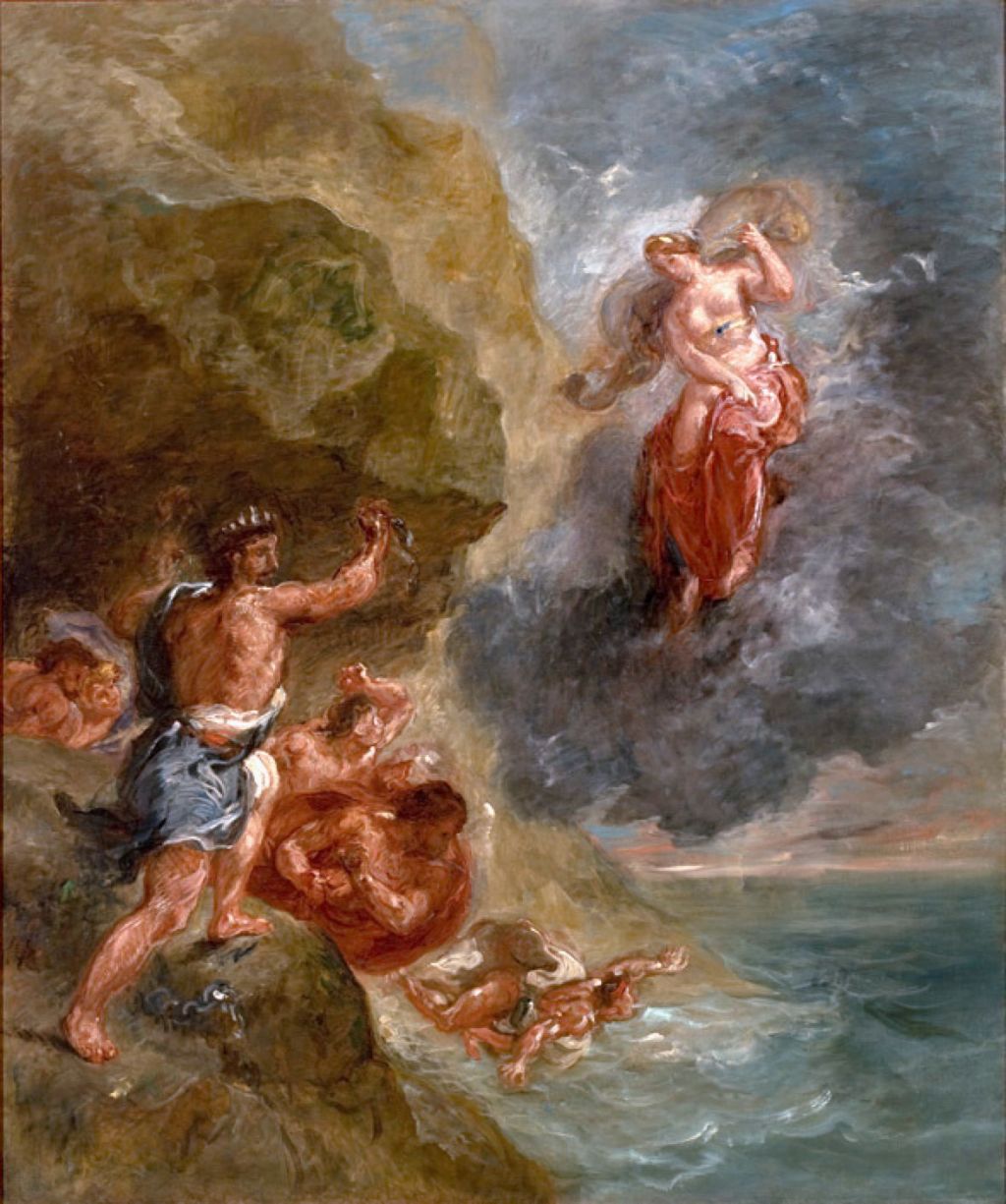
When Eugène Delacroix (1798–1863) had started work on his paintings in the Church of Saint-Sulpice, he was commissioned by the Alsacian industrialist and politician Frédéric Hartmann (1822-1880) to paint him a series depicting the four seasons in allegorical form. These were completed in 1863, shortly before the artist’s death on 13 August, and as a result are often referred to the Hartmann Seasons.
As with Nicolas Poussin’s famous allegorical four seasons, Delacroix decided to paint each as a narrative, although he drew on classical mythology rather than episodes from the Bible. Unlike Poussin’s, Delacroix’s series has now fallen out of favour and is barely mentioned in most accounts of his work. However, I think they merit better, and stand in the same league as those of Poussin.
The four paintings are:
- Spring, showing the death of Eurydice,
- Summer, showing Diana surprised by Actaeon,
- Autumn, showing Bacchus rescuing Ariadne from Naxos,
- Winter, showing Juno beseeching Aeolus to destroy the fleet of Odysseus.

Eurydice Bitten by a Serpent while Picking Flowers (Eurydice’s Death) shows the moment of tragedy following the marriage of Eurydice to Orpheus when she is bitten on the foot by a snake, and dies. This is told in multiplex narrative, with two copies of the couple. In the background Orpheus is clutching his lyre as he seeks his bride, who is gathering flowers on the right. In the foreground, she is collapsing and soon to die as Orpheus tries to steady her, and the dark snake makes its getaway on the right. The link with Spring appears to be flowers, thus Flora.

Summer brings Diana Surprised by Actaeon, in which Actaeon, on the right, has stumbled across the goddess bathing while he is out hunting. She bears her distinctive crescent moon on her forehead, and motions to him to stop. As a result of his unintentional glimpse of the goddess’s naked body, he’s turned into a stag and killed by his own hunting dogs, such as the two in the foreground. In Ovid’s account of this myth in his Metamorphoses, this takes place in the summer, when it’s sufficiently hot for both of them to seek to cool off. Actaeon is already starting to grow antlers on his head.

Delacroix’s choice for autumn draws on the common association between autumn/fall and wine, in Bacchus and Ariadne. After being abandoned on the island of Naxos by Theseus, who had promised to marry her, Ariadne is discovered by the young Bacchus. Here, Bacchus has just arrived and is helping the gloomy and despondent Ariadne to her feet. They shortly fall in love and marry.

For the final season of winter, he chose Juno Beseeches Aeolus to Destroy Ulysses’ Fleet, which has suffered a slight conflation between the stories of Odysseus/Ulysses and Aeneas. In the Aeneid, Juno offers Aeolus the nymph Deiopea as a wife if he will let loose his winds on the fleet of Aeneas. That he does, and the fleet is driven onto the coast of North Africa, in what was surely a winter storm.
Each of the paintings is rich in colour, loose in its form, and exceptionally sketchy in its brushwork. They could easily have been painted by an artist from the next generation, twenty-five years later. In the last years of his career and life, Delacroix was leading the way for the future of art.
References
Barthélémy Jobert (2018) Delacroix, new and expanded edn, Princeton UP. ISBN 978 0 691 18236 0.
Patrick Noon and Christopher Riopelle (2015) Delacroix and the Rise of Modern Art, National Gallery and Yale UP. ISBN 978 1 857 09575 3.
Lucy Norton (translator) (1995) The Journal of Eugène Delacroix, 3rd edn, Phaedon. ISBN 978 0 7148 3359 0.
Arlette Sérullaz (2004) Delacroix, Louvre Drawing Gallery, 5 Continents. ISBN 978 8 874 39105 9.
Beth S Wright (editor) (2001) The Cambridge Companion to Delacroix, Cambridge UP. ISBN 978 0 521 65077 1.
 The Eclectic Light Company