

By the early years of the twentieth century, Joaquín Sorolla (1863–1923) had established himself a formidable reputation as one of the great painters of Europe. In 1906 he had a solo exhibition of nearly 500 works at Georges Petit’s gallery in Paris, which was a critical and commercial triumph. He moved to the mountains of El Pardo outside Madrid for most of 1907 for the sake of his daughter’s health; later that year he painted a commissioned portrait of King Alfonso XIII.

This shows his daughter Maria Painting in El Pardo in 1907. She’s painting with a pochade box, and has a large parasol with a specialist mount so that it can provide her with shade.

After the Bath (1908) is one his many evocative paintings of light on the beach at Valencia.
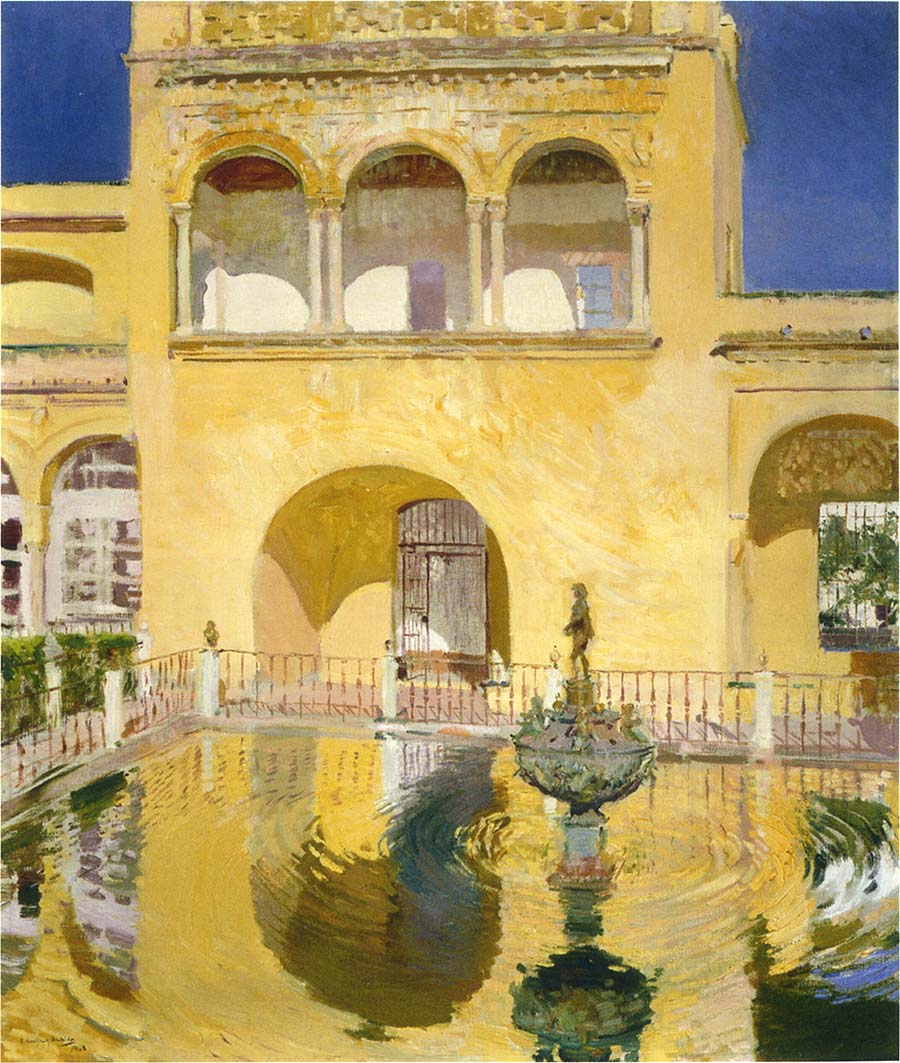
In 1908, Sorolla visited Seville to paint this cool pond in one of the courtyards of The Alcazar Seville.

His Beach of Valencia by Morning Light, again from 1908, shows mothers taking their children into the water on El Cabañal beach, Valencia, with his favourite fishing boats in the background.
In May of that year, Sorolla had a spectacular solo exhibition of 278 works in the Grafton Galleries in London, sponsored by his friend John Singer Sargent. Although not a commercial success, it was visited by Archer Milton Huntington, an American philanthropist who had founded the Hispanic Society of America in New York just six years earlier. Sorolla was made a member of the society, and exhibited there the following year. This led to several major commissions for portraits, including that of President Taft.

In 1909, he painted another of his signature works on the beach at Valencia, Strolling Along the Seashore.
Sorolla returned to the USA for a second visit in 1911, touring to the Art Institute of Chicago and the Saint Louis Art Museum with a solo exhibition of over 150 paintings. He was then commissioned to paint fourteen large murals for the library of the Hispanic Society of America building in Manhattan. Entitled Vision of Spain, this ambitious cycle depicts the provinces of Spain, and all but one were painted en plein air.
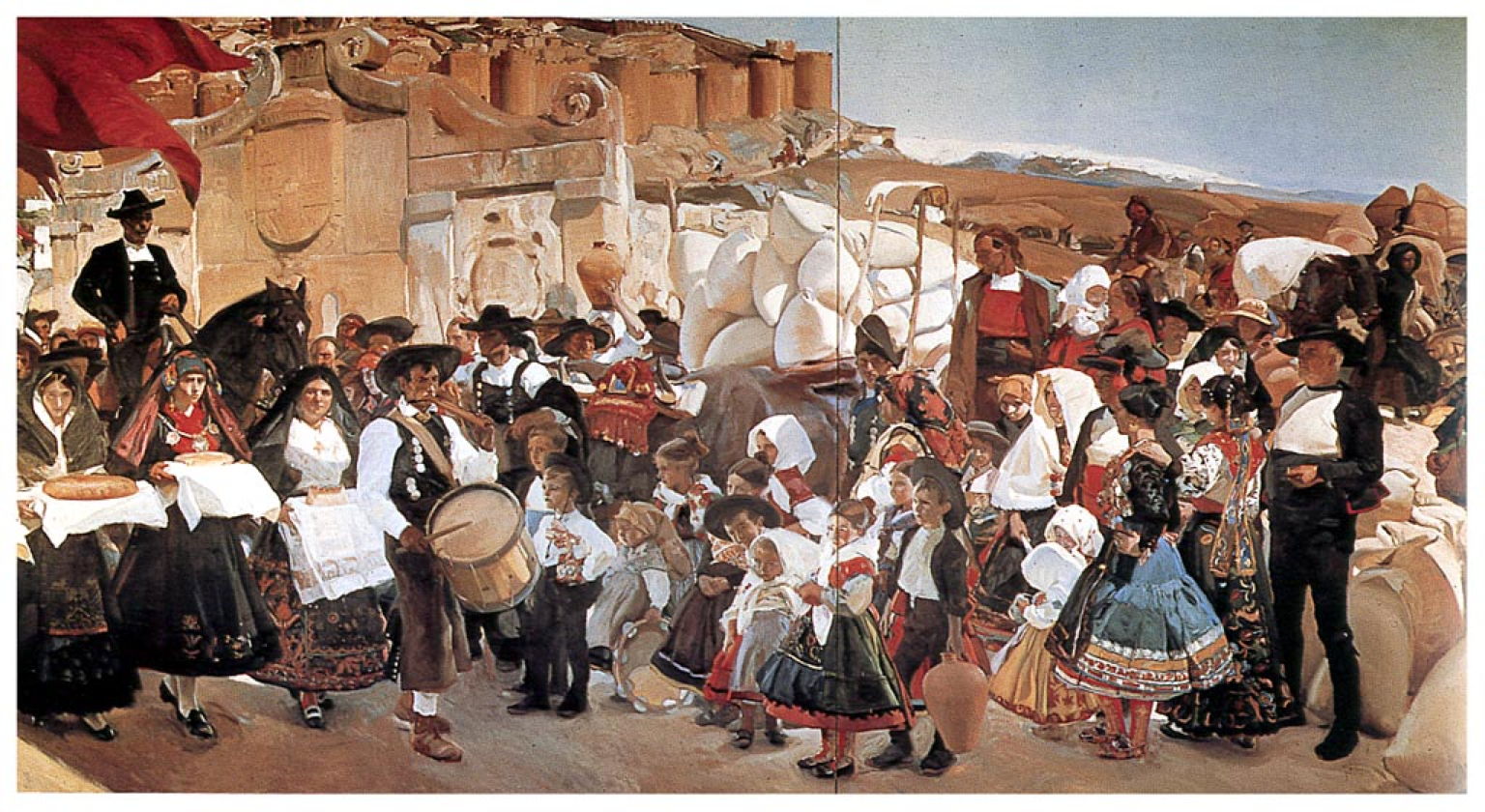
Castilla, The Bread Festival (1913) shows the pageantry of a local festival in the province of Castilla. The section here is just over half of the full width of this part, which is just under fourteen metres (45 feet) across.

Ayamonte, Tuna Fishing (1919) is a section from another painting in this series, showing the tuna market in the town of Ayamonte, Spain, which must have reminded Sorolla of his many Valencian summers.

He completed the final panel of the murals in 1919, by which time he was exhausted. He suffered a stroke while painting a portrait in his garden in 1920, which prevented him from painting again. His health slowly deteriorated, and he died on 10 August 1923.
Joaquín Sorolla was a virtuoso painter with a reputation for painting “voraciously” using brushes with exceptionally long handles to cover huge canvases at an astonishing speed. Much of his brushwork was painterly, but tightened up when his subject or the commission required. His paintings of the seaside are both distinctive and some of the greatest essays on light ever completed. Together with his contemporaries and friends John Singer Sargent and Anders Zorn he remains one of the grand masters of modern European art.
References
Véronique Gerard Powell (2019) Sorolla and ‘social painting’, in Sorolla, Spanish Master of Light, National Gallery and Yale UP, ISBN 978 1 85709 642 2.
Pons-Sorolla B (2012) Sorolla, the Masterworks, Skira. ISBN 978 0 8478 3933 9.
 The Eclectic Light Company