
With smoke already rising from the funeral pyre of his lover Queen Dido of Carthage, Aeneas and his fleet sailed north from the coast of Africa towards his destiny in Italy.
The fleet had further trouble trying to pursue its course to the north, so they landed on Sicily, where Aeneas held funeral games to honour the death of his father. While these were taking place Juno, through her divine messenger Iris, intervened and told the Trojan women to set fire to the fleet to halt their progress.
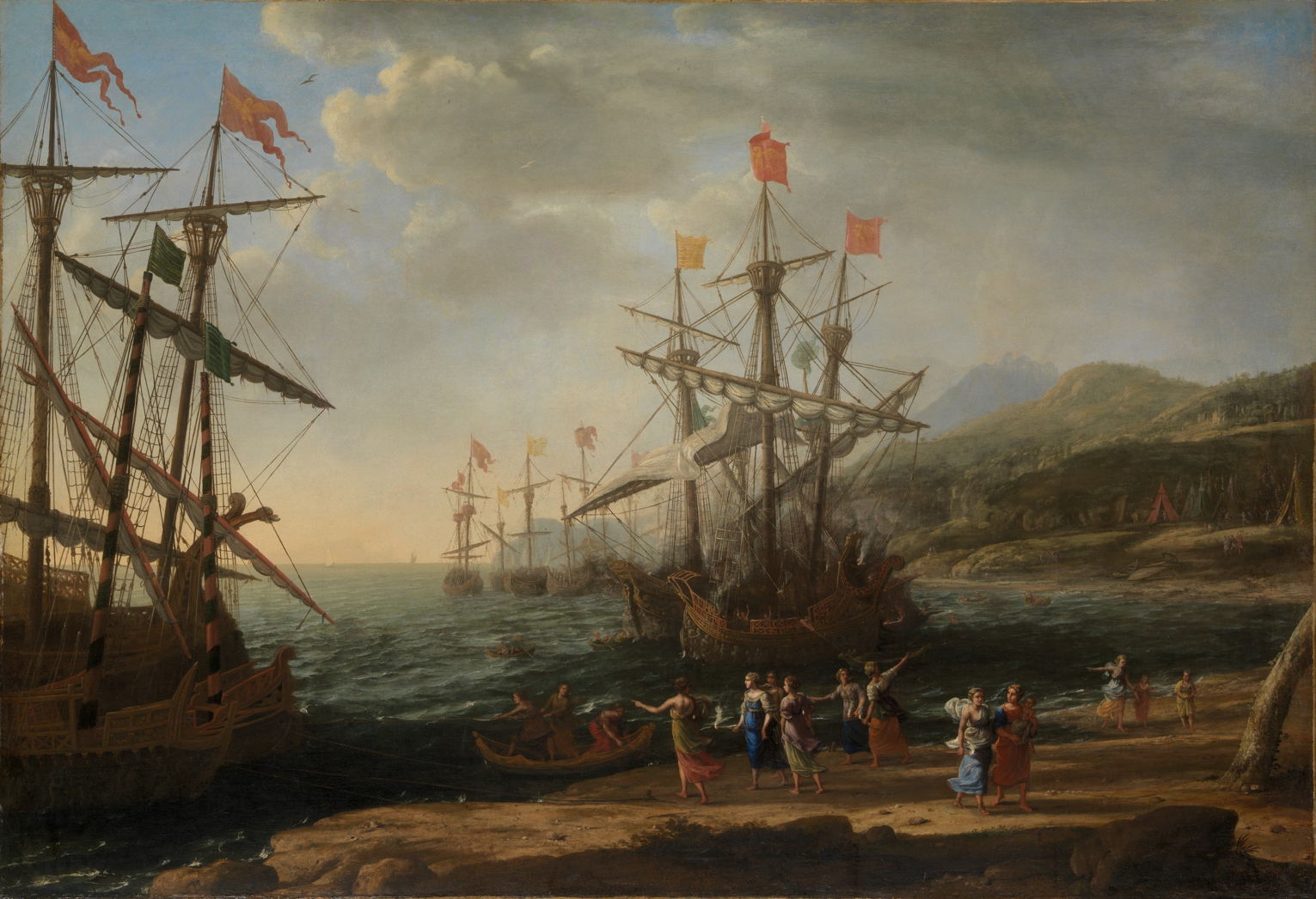
Claude Lorrain’s Trojan Women Set Fire to their Fleet (c 1643) shows the women preparing to do this. The building clouds warn of the storm sent by Jupiter in response to Aeneas’ prayers, which quenches the blaze, following which the women are transformed into mermaids at the behest of Cybele.
Aeneas then saw the ghost of his father Anchises telling him to go to the Underworld for a vision of his future and that of the city of Rome. His fleet finally reached the Italian mainland, where Aeneas made his way to Lake Avernus, a portal to the Underworld. There he met the Cumaean Sibyl, who reassured Aeneas that he would achieve his goals, and to that end she took him to Proserpine’s sacred glade. Finding a golden bough there, she told Aeneas to break that from the tree. Bearing that bough, the two of them travelled to the Underworld to make contact with the ghost of Anchises.

When Claude was painting his coastal view below, François Perrier was painting a conventional figurative account of Aeneas and the Cumaean Sibyl (c 1646). Aeneas, stood to the left of the incense burner, appears to be offering to burn incense in honour of the Sibyl, who stands at the right in front of her cave. Behind Aeneas is a queue of people, including a king, bearing gifts and waiting to consult with the Sibyl. At the top left corner is a temple, and in the clouds above it the god Apollo.

JMW Turner’s first version of this scene is thought to have been his first mythological painting from about 1798. This second version, Lake Avernus: Aeneas and the Cumaean Sybil, dates from 1814 or 1815, and is both an improvement on the original and in better condition.
True to the spirit of Claude’s landscape, this too is a mythological landscape showing the beautiful setting of Lake Avernus, near Pozzuoli, to the west of the city of Naples. In the distance is Baiae and the cliffs of Cape Miseno. The Sibyl, who doesn’t show her years, holds aloft a golden sprig rather than a bough, and Aeneas stands with his back to the viewer, as if he too is enjoying the view.

Turner’s last account is The Golden Bough, exhibited in 1834. The Sibyl stands on the left, radiant in white light, and holding aloft a more substantial golden branch than Turner showed previously. In her right hand is the golden sickle used to cut that branch. Down towards Lake Avernus are the Fates, dancing around another white glow. A couple of female companions of the Sibyl rest under the tree, but Aeneas is nowhere to be seen (he might be in the middle of the Fates, perhaps). In the right foreground is a snake as a symbol of the Underworld.
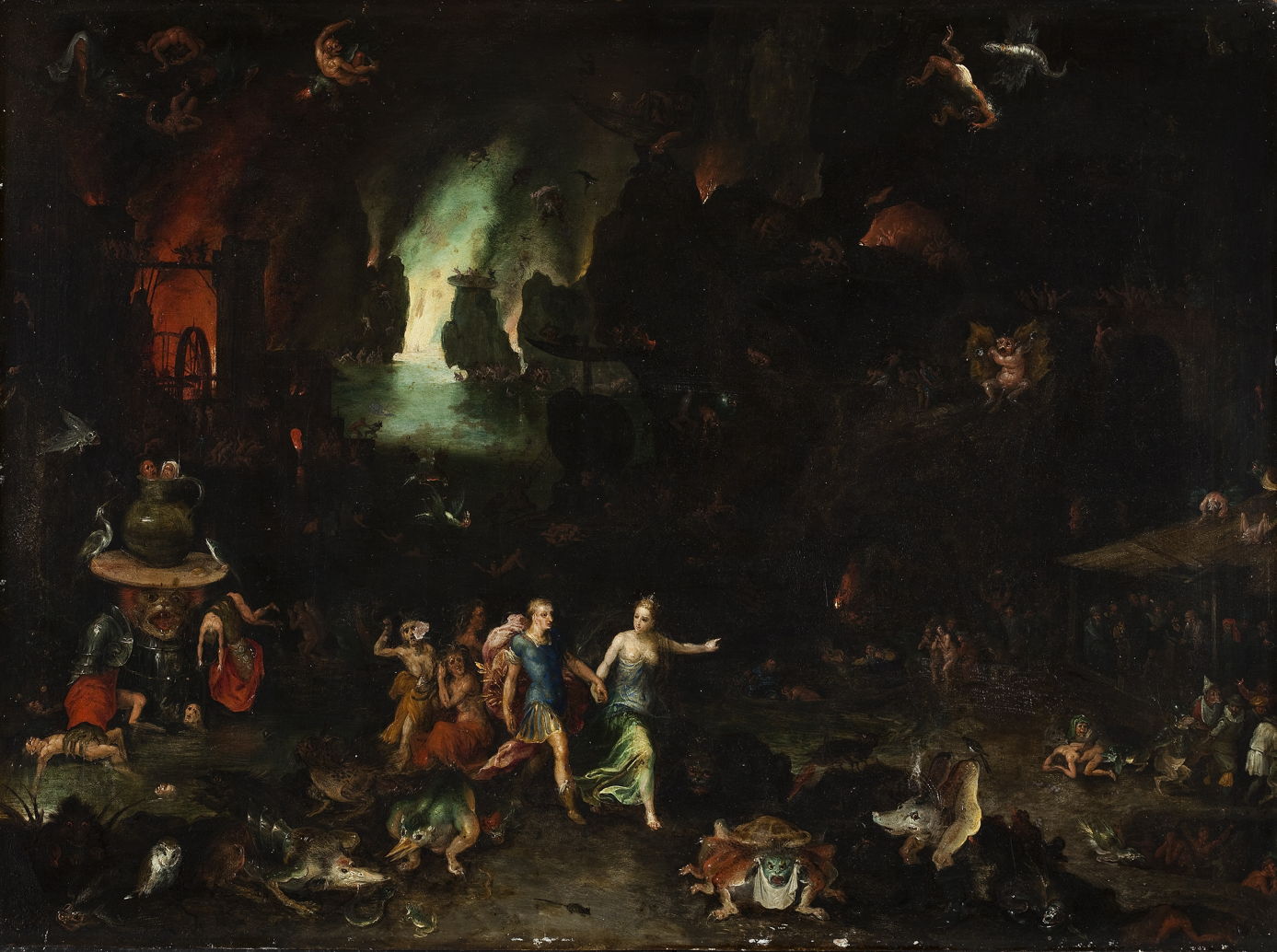
This magnificent painting, attributed to Jan Brueghel the Elder, shows Aeneas and the Cumaean Sibyl in the Underworld (1600-25) in an image worthy of Hieronymus Bosch himself. After meeting Dido, the Sibyl guides him through the Elysian Fields, where Anchises tells him of the future of Rome before he returns to the surface.
During their walk back, Aeneas thanked the Sibyl for her help and guidance, and offered to build a temple to her, assuming that she was a goddess. The Sibyl pointed out that she was no goddess, and explained how she had once been offered immortality if she were to let the god Apollo take her virginity.

Claude Lorrain’s wonderful Coast View with Apollo and the Cumaean Sibyl from about 1645-49 tells the story of the Sibyl’s younger days. Although their figures are small, Apollo on the left is holding his lyre in his left arm, trying to persuade the seated Sibyl, to the right. Around them are the ruins of classical buildings and a stand of tall trees, as the land drops away to an idealised view of the coast of Italy. In the small bay immediately below them are some ships, perhaps a reference to Aeneas’ future visit.

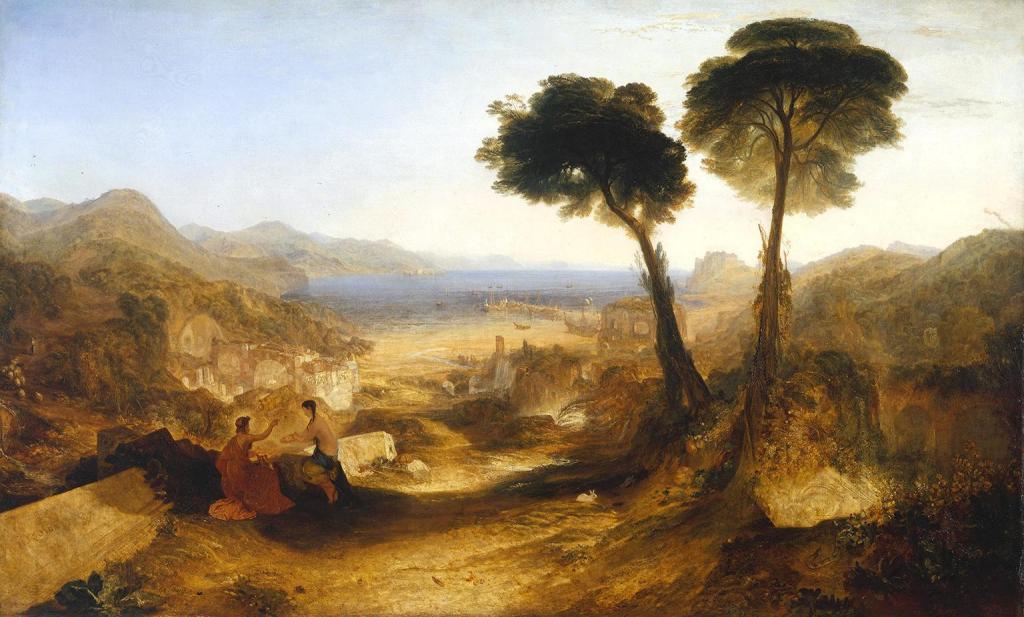
JMW Turner painted his version of this part of the story in The Bay of Baiae, with Apollo and the Sibyl in 1823. His view appears to have been loosely based on Claude’s, with common elements, but has been recast at Baiae, in the Bay of Naples. Apollo is again on the left, with his lyre, but the dark-haired Sibyl has adopted an odd kneeling position. She is holding some sand in the palm of her right hand, asking Apollo to grant her as many years of life as there are grains. Opposite the couple, on the other side of the path, under the trees, is a white rabbit.
Aeneas and his fleet put to sea again, heading north along the coast until they reached Latium.
 The Eclectic Light Company